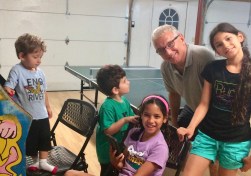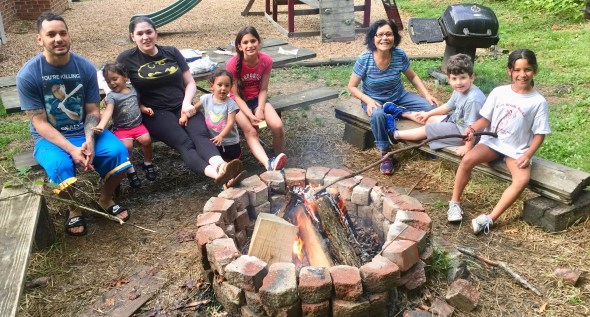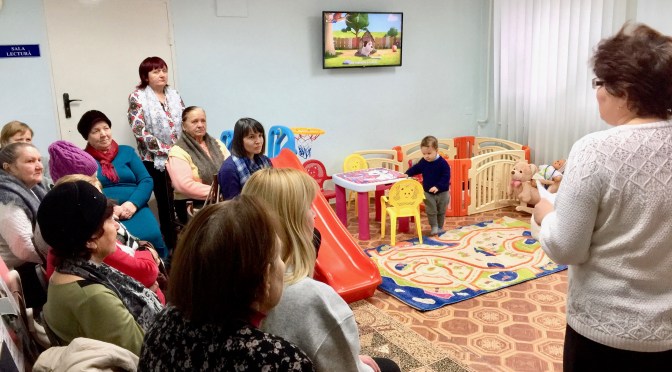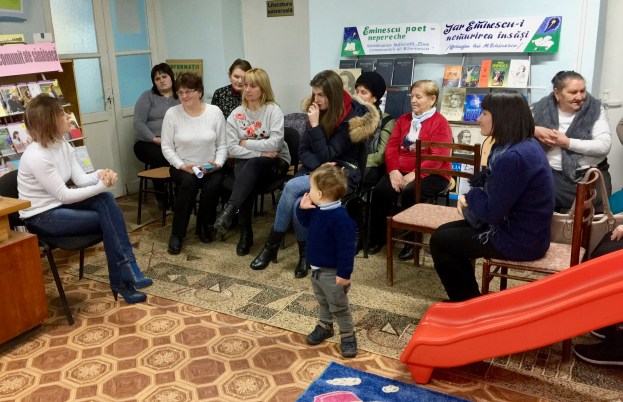
Ialoveni families came on Sunday afternoon to Bebeteca, the library’s new program that combines a colorful play area for kids with educational programming for adults. Television personality Rusalina Rusu led a lively conversation with local parents while their kids played, as shown below in the slide show. The library, BPO “Petre Ştefănucă, launched Bebeteca earlier this month with support from our Peace Corps grant. It will be announcing future Bebeteca events on its Facebook page. If you live in Ialoveni, especially if you’re a parent with a youngster, come join us!
Tag Archives: Peace Corps
‘Bebeteca’ for Families
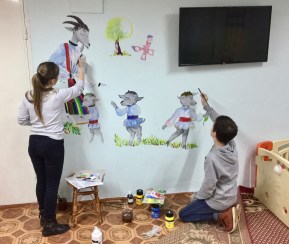
Ialoveni’s library has something new for local families: “Bebeteca,” a colorful children’s room where kids can play while adults enjoy educational discussions with guest speakers.

On Sunday, Jan. 28, Rusalina Russu will speak at 1 p.m. at Bebeteca about how she grew up in Ialoveni and became one of Moldova’s best-known television personalities, hosting a show about families. The program is free and the public is invited to attend. [ADDED: Here’s a short post about her talk along with several fun photos of the moms and kids.]
Last week, local doctor Diana Slivinschi, above, discussed children’s infectious diseases. Future speakers are scheduled to discuss topics ranging from dental care for children to planning trips with kids or how Ialoveni provides support to vulnerable families. At some programs, librarians will read stories aloud with the children. The library’s Facebook page will provide details.
Parents and grandparents can enjoy the discussions while their kids play with toys and books the library has bought along with children’s furniture and a wall-mounted TV.
Students from Ialoveni’s School of Art, upstairs from the library, are painting the room with an original mural featuring characters from national children’s stories.
“We are excited to offer this new programs for families in Ialoveni,” Valentina Plamadeala, director of BPO “Petre Ştefănucă” said.
“We want to offer mothers and families the chance to meet, have fun and learn something new. We also hope they will explore the library while they’re here and borrow some books or sign up for our free programs, from learning English to making simple animated movies.”
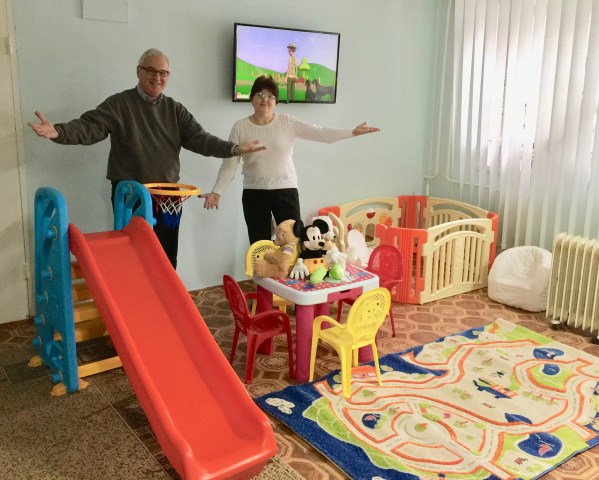
Plamadeala said story-telling programs at libraries are popular in many countries, including Romania, but a new idea in Moldova. She hopes the Ialoveni program may inspire other libraries in Moldova to launch similar efforts.

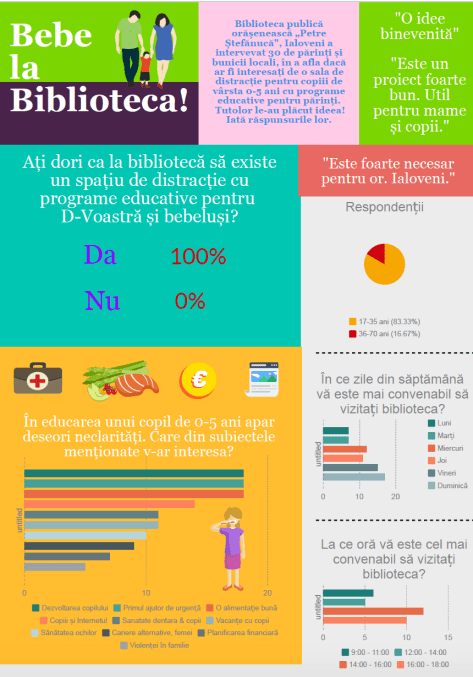
Responding to information gathered in a community survey, BPO “Petre Ştefănucă” created the new space with the support of a U.S. Peace Corps grant and a small project Plamadeala implemented through the “Together for the Community” program of the Association of Librarians in the Republic of Moldova and the National Library of Moldova in partnership with the Novateca National Program.
Librarian Lidia Rusu and Peace Corps Volunteer David Jarmul developed the project, purchased the materials and worked with the rest of the library staff to create the room and organize the programs.
(A Romanian version of this article was posted by the library, which used the infographic below to describe its survey results showing wide community support for the project idea .)
Dates of Departure
Champa and I now know when we will finish our Peace Corps service: on July 3.

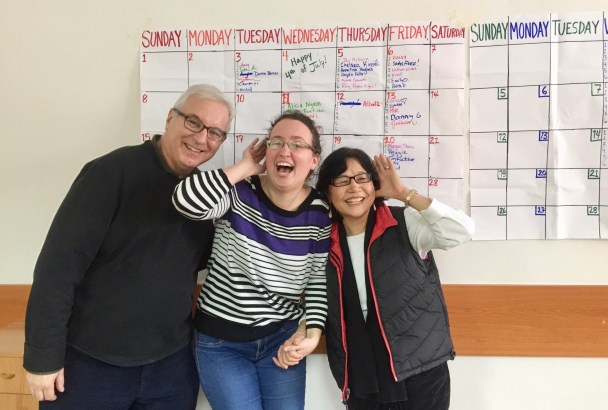
We and the other members of our Moldova 31 group gathered at a Close of Service (COS) Lottery on Saturday afternoon to take turns choosing dates this summer when we’ll each wrap up. Peace Corps staggers our departures to better manage all of the logistics.
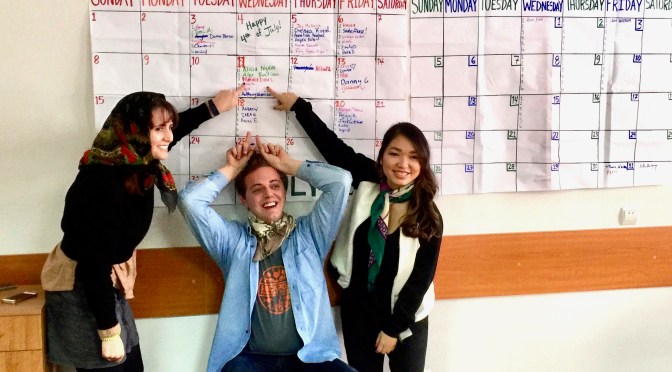
Everyone’s name was placed in a hat, with the three married couples each listed together. As people’s names were called, they selected one of the available departure slots on a large calendar.
Ours were among the first names called. We chose an early date because we plan to take a two-week trip with some friends and then head home to reoccupy our house in North Carolina, which will be vacated shortly before then by our tenants.
Many of our fellow M31 volunteers are also planning COS trips, a tradition among departing volunteers worldwide. Some members of our group need to return home quickly to begin jobs or graduate school. One just accepted a new Peace Corps assignment in Tonga.
When all of us first met at a hotel in Philadelphia in May 2016, one of our Peace Corps “stagers” said we were meeting our new “government-issued family.” During our time together in Moldova, we’ve become that and more.

We all had fun on Saturday posing for funny photos next to our departure dates, as we’re doing here with our friend Ingrid, and for a group photo together. Most of us then continued the party at the Smokehouse Restaurant launched by two former volunteers.

I found it all bittersweet. Now that Champa and I have an actual date, the approaching end of our Peace Corps service is no longer an abstraction. We know when we will reunite with our family and friends in America, and we cannot wait to see them, but we also know we’ll have to say goodbye to our host family and Moldovan friends, and to the other volunteers with whom we’ve shared this unforgettable journey.
The countdown has started. 163 days to go.

Visiting Gagauzia
If foreign tourists only visited New York City, they wouldn’t understand upstate New York, much less the rest of the country. Likewise if they visited my home town of Durham but skipped the rest of North Carolina.
The same is true here in Moldova, even though the whole country is only slightly larger than Maryland. This past weekend, Champa and I were reminded of this when we visited Comrat, a small city that is the capital of Moldova’s autonomous region of Gagauzia.
Comrat has notable red wines and a lovely church, but it’s best known in Moldova as the home of the Gagauz people, an Orthodox Christian ethnic minority that left Bulgaria years ago to escape persecution from the Ottoman Empire. Almost all Gagauz people speak Russian instead of Romanian and they have no interest in Moldova reuniting with Romania, which is a popular idea in our part of the country.
To the contrary, many have unhappy memories of Romanian rule.
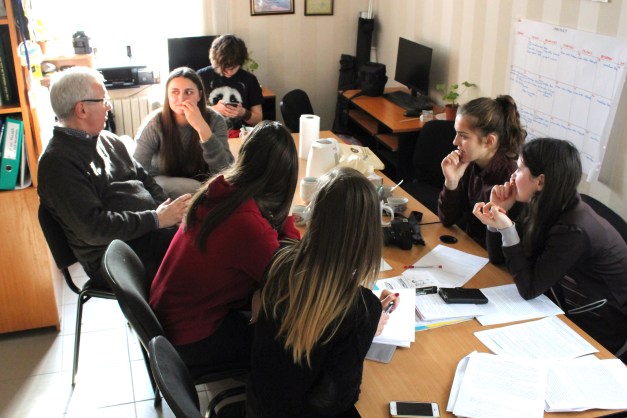
When I served previously as a Peace Corps Volunteer in Nepal, it took me nearly a year until my American eyes adjusted enough to notice the different facial features of people in various ethnic groups. Here in Moldova, where we are well into our second year, I was struck by how Gagauz faces showed similarities with the Balkans, in ways I don’t usually see in Ialoveni.

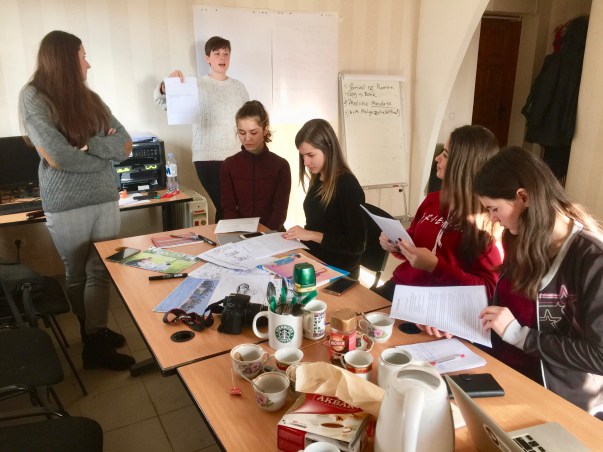
We traveled to Comrat by bus so I could help teach a journalism class led by Haley, a member of my Peace Corps group who is working with Miras Moldova, an NGO that advances Gagauz culture. At her request, I discussed my career as a journalist and communicator, and we then worked together with the students to review projects they have been developing on topics such as Gagauz cuisine and traditional medical practices.
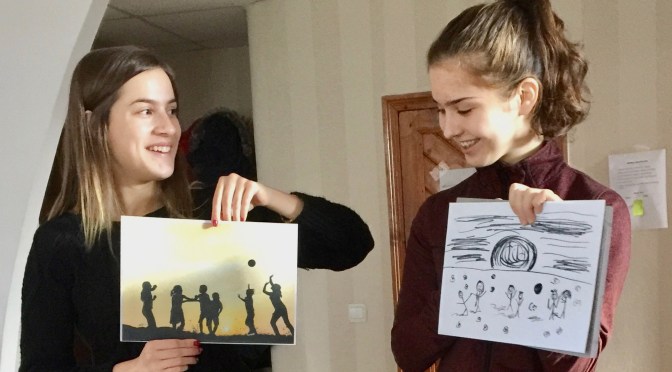
Haley and her partner Anna Celac also organized fun activities such as the one you see above, which challenged one student to draw a copy of a picture, guided only by verbal cues from her partner instead of seeing the original. The students also asked Champa to teach them some Nepali, as you can see in the video clip below (also on YouTube.)

Two other Peace Corps Volunteers in Comrat joined us, Haley and Anna for dinner at Haley’s house, where we spent the night. Haley cooked a fabulous meal and we loved meeting her host mother, a Gagauz journalist herself who remains active well into her 70s.
All in all, it was a short but fascinating reminder that even a small country can have big internal differences, in this case not “red states” vs. “blue states” but “bună ziua” vs. “Здравствуйте.”
Martin and Mihai
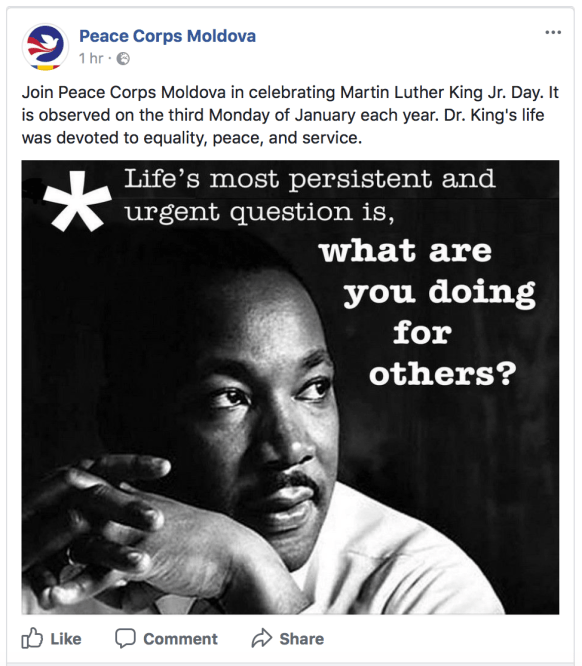
While Americans were commemorating Martin Luther King, Jr. on Monday, many Moldovans were celebrating the birthday of Mihai Eminescu.

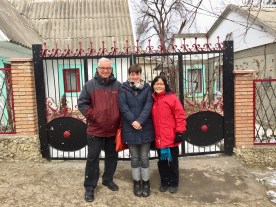
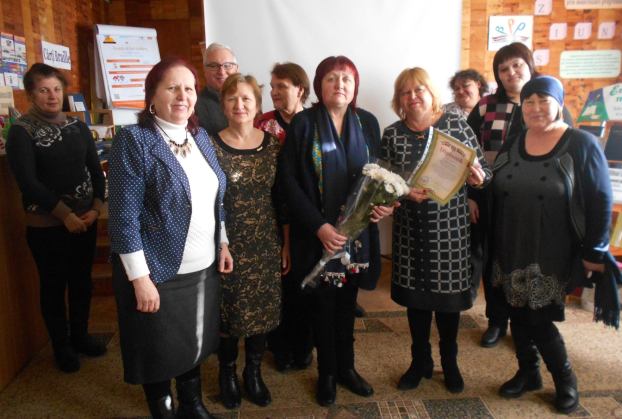
If you don’t know recognize his name, well, at least one of my work partners didn’t know who Dr. King is. She and others at the library, some of whom had heard of him, were more interested in the birthday of our colleague Raisa, who you see receiving flowers.

We celebrated Raisa with a big lunch and the singing of both “Happy Birthday to You” and La mulți ani trăiască.
It was my latest reminder that even though Dr. King is a hero of mine and many other Americans, our country is not the center of the universe, as much as we might like to think otherwise. To be sure, Dr. King is known and honored in many parts of the world, which is richly deserved, but people everywhere generally care most about their own lives and communities.
A few days ago, a friend back home wrote to ask whether Moldovan newspapers were coming up with their own phrases for “shithole.” I was sorry to disappoint him: Not a single Moldovan friend has mentioned the recent controversy to me. Keep in mind that I work with librarians and other friends who are well-educated. Undoubtedly some Moldovans have been following the controversy, but the ones I know don’t care about American politics unless it affects them personally, which it rarely does. At least they know where America is, which is more than most Americans know about Moldova.

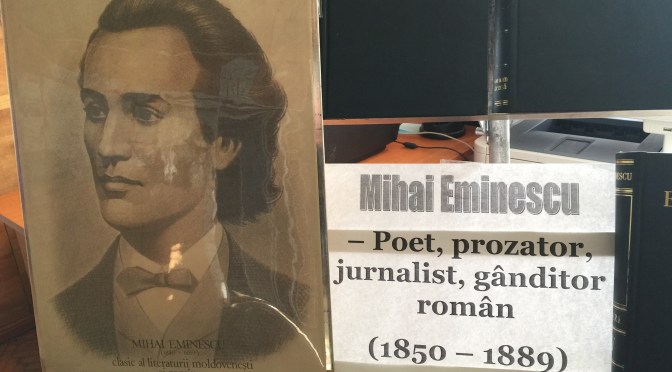
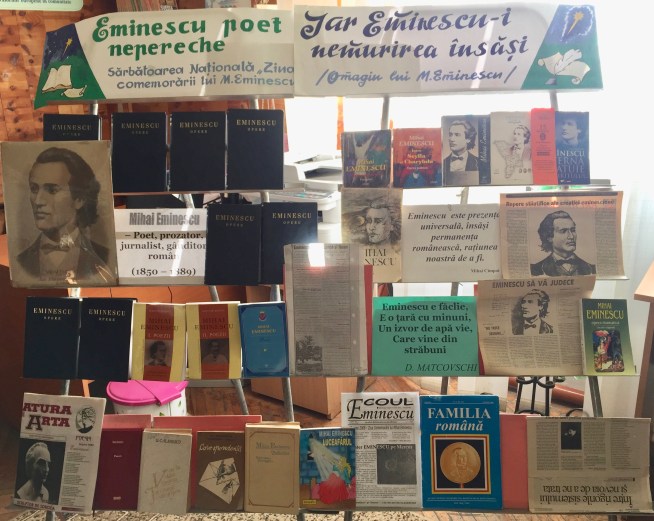
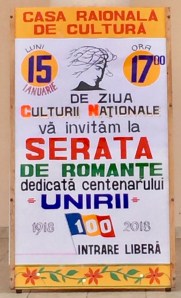
As you’ve probably guessed from the photos by now, Mihai Eminescu was a famous poet, perhaps the greatest ever to write in the Romanian language. He is beloved by many Moldovans not only for his beautiful work but also as a symbol of the cultural ties between Romania and Moldova, which was part of Romania until it was taken over by the Soviet Union. Ialoveni organized a big show in his honor on Monday evening, featured in the poster you see above.
So that’s the story of Martin and Mihai … unless, of course, you live elsewhere in the world. In that case, feel free to replace Mihai with someone from your country.
Less News is Good News
If you spent too much time obsessing about all of the big news stories in 2017 — the tax bill, the hurricanes, Charlottesville, #MeToo, North Korea and everything about President Trump, as well as about sports, entertainment and other fields — perhaps you’ve resolved to turn down the volume in 2018.
I am happy to tell you that change is possible! However, you may need to join the Peace Corps to break your habit.
As a volunteer serving in Eastern Europe, I have been living for more than a year and a half now without the nonstop chatter of American cable news stations. These channels aren’t widely available here in Moldova; much of the content comes from Russia or Romania, as well as locally. Champa and I don’t even have a television, much less English-language newspapers or magazines.
This has been a huge change for me. I used to run a university news office, paying close attention to what was happening not only on our campus but around the world. My office’s “rapid response” team tracked events and jumped quickly to highlight faculty experts who could discuss the latest political drama, natural diaster or social trend. I monitored the news throughout the day. It was both my job and a passion.
If I’d been home this past year, I probably would have been following every twist and turn in the Russia investigation, along with other stories. Instead, I’ve been focused more on what we’re doing at our post, such as with my robotics and entrepreneurship teams for local students, and with Champa’s costume project for her school’s drama program.
I still get my daily fix of American news, mainly via the online New York Times and Washington Post, both of which offered great overseas rates. Champa and I also watch monologues from the previous night’s comedy shows, such as Stephen Colbert. We often view these while eating dinner. I can’t believe I’ve become one of those people who gets news from late-night comedians, but I have, albeit with a seven-hour time difference.
This may still sound like plenty of news but it’s nothing compared to what I used to ingest. And guess what? Just like an obese person who went on a diet, I now feel lighter and healthier.
I’ll never quit the news altogether. I’m still a curious person who wants to know what’s going on. I still get outraged by some of what I see. But I’m thankful my time as a Peace Corps Volunteer has led me to step back a bit. I’m a lot happier never seeing people argue on a cable news program or CNN flog a story hour after hour.
When we return home next summer, I’m going to resist reverting to my old habits. I’ll try to stick with my new diet. If you come to visit us in North Carolina and see me staring at the news again for more than a few minutes, please snatch the remote control out of my hand.
My Favorite Books
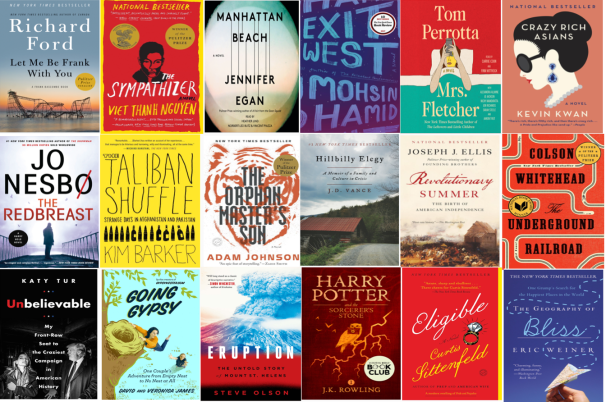
‘Tis the season for year-end lists of favorite books. Here’s mine from Moldova. I downloaded almost all of these books onto my Kindle for free through the online OverDrive system which, as I’ve written previously, is the best thing that ever happened to a Peace Corps Volunteer who likes to read.
I could fill my Top Ten list just with recent novels I read this year. My three favorites were Exit West, Mohsin Hamid’s brilliant depiction of two refugees from a war-torn Arab country; The Orphan Master’s Son by Adam Johnson, which captures the brutal insanity of North Korea; and The Underground Railroad, Colson Whitehead’s chilling exploration of slavery in antebellum America. All three novels haunted me for weeks.
I also loved Manhattan Beach, which Jennifer Egan sets on the waterfront of New York, showing us a different side of the city while telling a harrowing yet moving family saga. Richard Ford’s Let Me Be Frank With You and Richard Russo’s Everybody’s Fool are gentler but wonderfully written, with compelling protagonists struggling to make sense of their aging years. Viet Thanh Nguyen in The Sympathizer and Karan Mahajan in Association of Small Bombs both took me to communities I barely knew before. Tom Perrotta’s Mrs. Fletcher was funny and wise. Carl Hiaasen’s Razor Girl was even funnier. All ten of these novels were a pleasure.
I also loved three older novels: Disgrace by J.M. Coetzee, whose depiction of a man’s life upturned by accusations of sexual misconduct seemed especially timely now; Redeployment by Phil Klay, rightly hailed as one of the best novels about the Iraq war; and Smiley’s People by the great John LeCarre, who published an acclaimed autobiography this year.
I’ll give a partial thumbs-up to three other novels: Moonglow by Michael Chabon; The Sandcastle Girls by Chris Bohjalian; and Everything I Never Told You by Celeste Ng. Bohjalian’s book is about the Armenian genocide, and I read it shortly before we visited Armenia. Like the others, I thought it was good, not great. I was even less enthusiastic about Jenny Lawson’s Let’s Pretend This Never Happened, which was snarkily funny in places but somehow didn’t click for me.
I also read some great nonfiction this year. My favorite book was Hillbilly Elegy by J.D. Vance. I know it’s come in for criticism for its depiction of dysfunctional white families in Appalachia, but I found it insightful following our election last year. Arlie Russell Hochschild covered some of the same issues in Louisiana in Strangers in Their Own Land, which I enjoyed but found less compelling. Bruce Springsteen’s autobiography, Born to Run, was a treat from cover to cover. So was reporter Katy Tur’s recent Unbelievable, about covering the Trump campaign, although its uneven text reflected the haste with which it presumably was written. (Sorry, always an editor.)
I’m in a science book club back home, so I’ll give a shout-out to my favorite science book of the year: Steve Olson’s Eruption: The Untold Story of Mount St. Helens. It wove geology, politics, history and personal stories into a narrative I would have found engaging even if Steve weren’t a good friend.
I’m also a history fan. In Revolutionary Summer, Joseph Ellis offered a fresh look at how early military defeats under George Washington nearly ended the American Revolution in its early days. In The Wright Brothers, David McCullough showed how the two aviation pioneers were nothing less than admirable, illustrating what’s best in the American character at a time when I needed to be reminded.
I’ll also give a hat tip to two novels I read just for fun. In Crazy Rich Asians, Kevin Kwan poked fun at the super-rich families of Singapore and Hong Kong. I’m looking forward to seeing the movie version when it comes out next year. Another comedy of manners featuring people with too much money was Eligible, Curtis Sittenfield’s modern adaptation of Pride and Prejudice. Once again: well-done fluff that kept me turning the pages.
Detective and mystery novels are great page-turners, too, and I read several good ones this year, including books by John Grisham (The Litigators), David Baldacci (The Guilty), Paula Hawkins (Girl on a Train) and Jonathan Kellerman (The Murderer’s Daughter). My favorite was Jo Nesbo’s The Redbreast, which dealt with neo-Nazis emerging from the shadows, in this case in Norway, yet another case of novels unexpectedly touching on today’s news.
Then there were travel and adventure books. I’d missed The Old Patagonian Express by one of my favorite travel writers (and former Peace Corps Volunteer), Paul Theroux. It described his trip across Latin America. Eric Weiner’s entertaining The Geography of Bliss explored why some countries are happier than others, with Moldova featured at the opposite end of the happiness scale. In The Taliban Shuffle, Kim Barker described her adventures as a foreign war correspondent, a tale recently adapted by Tina Fey in the film Whiskey Tango Foxtrot. David and Veronica James in Going Gypsy and Kristin Newman in What I Was Doing While You Were Breeding described extended trips they made after leaving the workplace. All gave me new perspective on my own recent adventures.

Among the books I expected to like better but never finished were The Shadow Land by Elizabeth Kostova; The Handmaid’s Tale by Margaret Atwood; Still Here by Laura Vapnyar; Sweet Tooth by Ian McEwan and Homegoing by Yaa Gyasi. The biggest clunker for me was Marie Kondo’s The Life-Changing Magic of Tidying Up, which extolled the virtues of simplicity and decluttering while bloating a 10-page idea into an entire book.
Finally, and I’m embarrassed to admit this, 2017 was the year when I finally got around to reading some of the Harry Potter books. I blasted through both Sorcerer’s Stone and Chamber of Secrets and am looking forward to reading the others in the year ahead. That is, if I can find time after we get home and start binge-watching all of the movies we’ve missed.
Thanks to the Durham County Library and the Duke University Libraries, together with the OverDrive system, for providing these great books for free. Which others did I miss? I welcome your suggestions and will look forward to reading some of them in the year ahead. If you’re a reader, too, I hope you’ll try some of the books I’ve recommended here. Happy reading in 2018!
Getting Into Costume

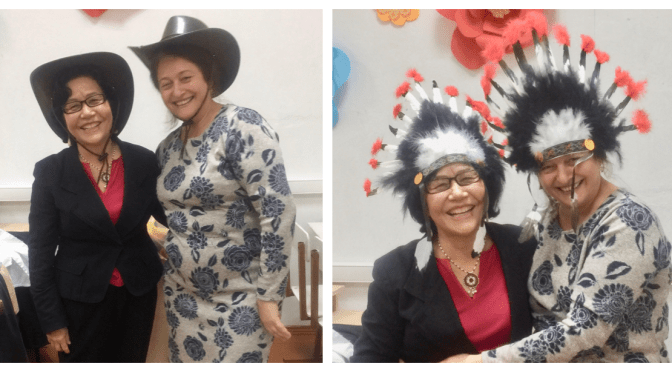
Cowboys, Indians, pirates and other characters have begun arriving at Champa’s school. Her grant project to create a costume and prop wardrobe for its drama program is progressing nicely, with many of the costumes now completed.
The school, LT “Andrei Vartic” in Ialoveni, Moldova, recently received its first batch of stage props, including some great hats. As you can see in these photos, Champa and I had fun trying them on with her project partner Ana Doschinescu, in the white and blue dress, and another teacher, Tamara Vîrlan.
Ana, Tamara and Champa can’t wait until the project is completed and students start using the props and costumes on stage. We’ll keep you posted.

Story Time at the Library
Readers, I seek your assistance — the first and only time Champa or I will make such a request while we are serving in Moldova as Peace Corps Volunteers.

The library where I work in Ialoveni has launched a project to create a “Story Time at the Library” program for toddlers along with educational programs for adults. They’ve already raised nearly $1,000 locally — a lot of money here — but need $2,303.94 more to create a kid-friendly room with small chairs, educational toys, art materials and the like.

I’ve worked with the library and Peace Corps to launch a fundraiser through the Let Girls Learn program championed by Michelle Obama.
As you can see in the infographic, the librarians did a survey showing overwhelming community support for the idea, which is similar to the story times held at many public libraries in the States. Their target audience is kids a bit younger than those you see in the photo above of a school group recently visiting the library.
The project is just the latest example of how Ialoveni’s library is trying to redefine itself for the modern world and become a vital community resource. During the past year alone it has expanded beyond books to create programs for video animation, advocacy, computer coding and robotics, together with new services for special-needs users.

You can learn more about the project and donate here. Your contribution is tax-deductible in the United States. You can donate in honor or memory of someone and, if you choose, share your contact information with me. You can also send words of encouragement to the project team. I will be administering the funds.
If you’ve enjoyed reading this blog, support what the Peace Corps is doing or just want to support a great cause for the holidays, I hope you will make a donation. On behalf of the mothers, children, families and librarians of Ialoveni: Mulțumesc (Thank you)!
What Tourists Expect
If you go to a restaurant in Moldova, don’t be surprised if the waiter doesn’t give you a big smile, offer menus to everyone at your table or serve all of the entrees together.

The waiter may also not be concerned about negative reviews on TripAdvisor or Yelp. Why? Because he may not know about these websites. Expedia? Lonely Planet? Maybe not those, either. Similarly, the woman working at a nearby hotel may not understand that you prefer to book a room online instead of calling her on the phone.
Moldova has so much to offer to foreign visitors: delicious food and wine, magnificent monasteries, beautiful countryside and travel options ranging from eco-tourism to adventure travel. Its hotels, restaurants and travel destinations are a bargain, and some offer warm and attentive service. Its people can be wonderfully gracious and generous, too. But it remains among the least-visited countries in Europe.
At a meeting several months ago, several of us serving as Peace Corps Volunteers here discussed whether we could do anything to help improve the situation.

We knew we had no money to address big problems like Moldova’s poor roads. However, as Americans who have made lots of travel decisions ourselves and are familiar with Moldova’s charms and challenges, we decided we could contribute in another way: We could help the owners of hotels, restaurants and tourist destinations understand what we and others expect in terms of customer service and how we use the Internet when deciding where to spend our travel dollars, whether in Moldova or someplace else.
Since that meeting, our group has been working with the Moldova Competitiveness Project of USAID and the leadership of ANTRIM, Moldova’s national inbound tourism association. After months of work and numerous drafts in both English and Romanian, we recently completed our project: an illustrated Romanian-language brochure for Moldovan businesses seeking to attract tourists from abroad. ANTRIM has posted the brochure online and will be sharing it with its members. USAID said it looks forward to supporting the project, too.

If you don’t speak Romanian, here’s the brochure’s message in a nutshell: Customer service is critically important, so smile at your customers and take good care of them. Build a strong online presence and try to attract favorable reviews.
I recently put the final touches on the brochure with Natalia Țurcanu, the head of ANTRIM, who you see above with me in their lovely new tourism center in the heart of Chișinău. Located on the city’s main street, the center offers brochures, maps, advice and even virtual-reality tours, as you can see in the photo. USAID and others provided support for the center, which was launched with the big press conference where you see Natalia speaking in the photo below.
She hopes our brochure may lead to workshops or other training programs to help Moldova’s tourist operators get better at using the Internet and providing consistently great customer service.
Our group is ready to assist if she wants her people to hear this directly from American travelers.
Our Peace Corps team included current volunteers Shannon Skelly and William Winter, and recently departed volunteers Chris Flowers, Lisa Gill, Stephen Gill, Jessica Randall and Denise Riegel. Natalia has been our invaluable partner at ANTRIM. Sergiu Botezatu, Natalia Curnic, Ana Efros and Diana Lazar provided assistance through USAID’s Moldova Competitiveness Project and Chemonics International Inc. At Peace Corps Moldova, Felicia Cenușă guided the final translation, Violeta Frimu-Patel was our program manager and Tracey Hébert-Seck provided support and encouragement as the country director.

If you know anyone in Moldova who might benefit from the brochure, I hope you will share it with them. Be sure to smile when you ask.