All posts by djarmul

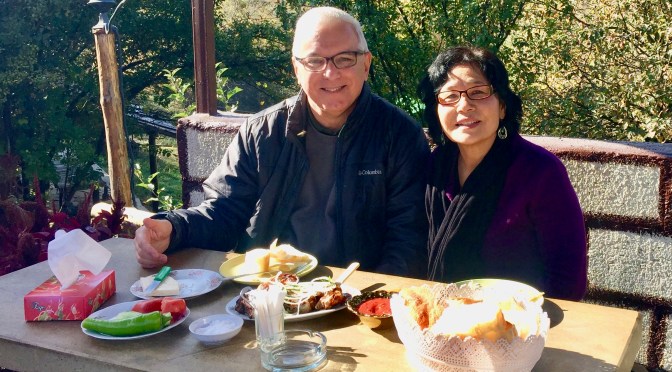
I am a Peace Corps volunteer in Moldova, in Eastern Europe, serving in the small city of Ialoveni with my wife, Champa. We are from Durham, N.C., where I was the head of news and communications for Duke University. You can follow our adventures on my blog, notexactlyretired.com.

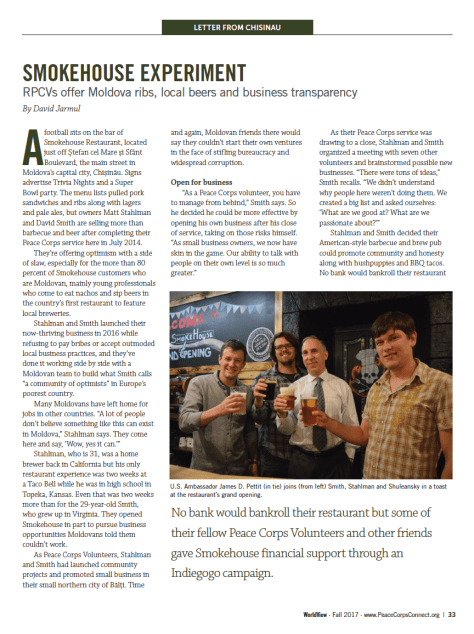
The Smokehouse Experiment

Smokehouse, a restaurant opened here in Moldova by two former Peace Corps Volunteers, shows how some PCVs contribute even more to a country after they finish their service.  It’s serving up optimism with a side of slaw

WorldView, the magazine of the National Peace Corps Association, just published this article I wrote about Smokehouse. You can read it below or link to this PDF version: WorldView – Smokehouse Experiment.

Screen Shot 2017-11-09 at 3.08.30 PMScreen Shot 2017-11-09 at 3.08.50 PM

The Surprise of Travel

The modest roadside cafe we saw outside the Armenian village of Sevkar lacked a sign in English, much less a website. It was hardly the place you’d expect two older Americans to stop for lunch. But we did, unexpectedly, while traveling last week and it turned out to be a highlight of our trip. It also provided a reminder about how we all need to look beyond our plans and checklists to embrace life’s surprises.

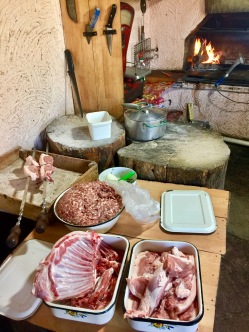
It was before noon and we were the only customers there. The owner led us into his kitchen, pointed to some bowls of meat and asked what we’d like him to barbecue over his charcoal fire. IMG_8603Then, as the meat sizzled, he sliced bread, tomatoes, onions and cheese onto a plate and took them outside to a wooden table, where he invited us to sit.

The barbecue was beyond delicious, as was everything else. Here along a small road in northern Armenia, we enjoyed one of the best meals of our lives.

This happened only because we asked our driver to find somewhere to stop early for lunch so we could spend our remaining Armenian money before crossing the border into Georgia.

This is one of the things I love most about traveling. No itinerary can anticipate many of the experiences that end up making a trip memorable.

Here’s another example: While in Armenia we also came across an area filled with small stone cairns, which reminded us of the mani stones people in Nepal pile along trekking paths. Beside them were hundreds of cloth and plastic ribbons wrapped around trees and bushes, which people placed for good wishes and luck. They, too, fascinated us, even though we’d actually come to see the adjacent Geghard monastery, partially carved out of a mountain.

IMG_8797

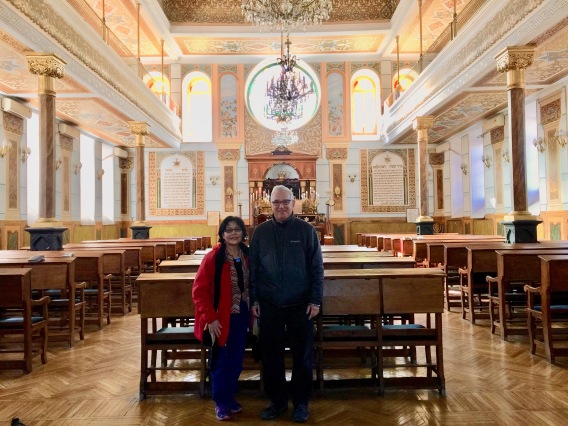
We were surprised at a Jewish synagogue, too. Its caretaker in Tbilisi, Georgia, gave Champa and me a private tour, even opening the ark to show us some of their Torah scrolls. He told us about Tbilisi’s small Jewish community and took the photo you see here.

IMG_8766

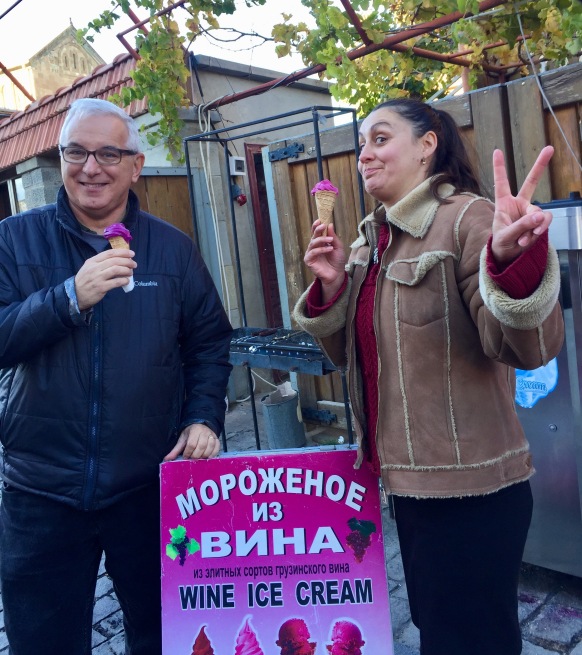
While near Tbilisi, we also discovered wine ice cream, from this woman at Mtskheta. We thought it was a gimmick but I bought a cone and it was wine ice cream, and pretty tasty, too.

IMG_8483

We also were surprised by people like this New Zealand woman, Lesley, who we met at an Armenian restaurant that provided a demonstration of traditional lavash baking. We discovered she lived previously in Turkmenistan, where she was friends with a young American woman who is now in our Peace Corps group in Moldova.

IMG_8532

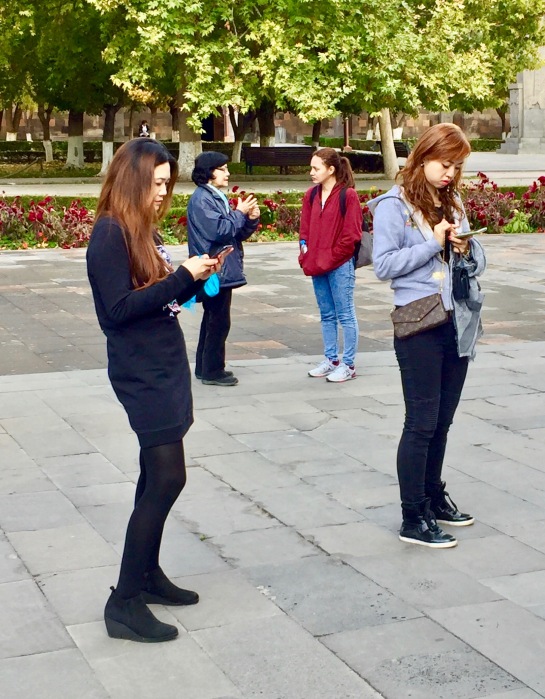
Then there was the woman with the red jacket you see talking with Champa. She is a physical therapist from the Philippines who works in Dubai. She and her husband came to Armenia for a brief vacation while renewing their visas. They were among several foreign nationals we met in Armenia who work in the Gulf. Who knew? The two Chinese women in the foreground, who took selfies and texted nonstop during our tour, are air hostesses for a Gulf airline.

It’s humbling for a planner like me to acknowledge that my detailed trip itineraries often fail to anticipate what Champa and I will remember most about a trip. As I wrote when I started this blog, one of my goals in being “not exacty retired” is to recognize the richness of life’s surprises and make the most of them, especially when traveling. “After being tied to calendars and project schedules for so many years,” I wrote then, “I wanted to embrace the unknown.”

Now, two and half years later, and especially after returning from a great trip, I feel that way even more. Spreadsheets are great but, in both the dictionary and on the road, serendipity will always come first.

Armenia and Georgia

IMG_8593

Moldova wasn’t the only country I barely knew before joining the Peace Corps. I also was unfamiliar with Armenia and Georgia, which Champa and I visited this past week during her school’s fall break.

Guess what: They’re beautiful, fascinating, filled with surprises and much easier to visit than you might expect, especially if you’re an American whose idea of “foreign travel” is limited to typical (and expensive) destinations such as Paris or London. Many of us who grew up during the Cold War tended to equate the Soviet Union with Russia, but it included so much more than that.

Screen Shot 2017-11-06 at 8.15.32 PM

As you can see on the map, Armenia and Georgia are located on the other side of the Black Sea from Moldova. All three countries are small former Soviet states that declared their independence in 1991. They share many traditions, from Orthodox Christianity to cheese pastries, but Armenia and Georgia each have their own distinct identity. Both are more prosperous than Moldova, especially in their capitals, Yerevan and Tbilisi. IMG_8386Their histories range from Armenia’s genocide to Georgia’s famous son, Joseph Stalin. They are Caucasian in the original sense of that word, with the Caucasus Mountains and striking landscapes.

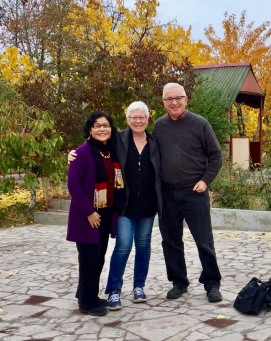
We flew from Moldova’s capital, Chișinău, via Kiev to Yerevan, where we spent our first full day visiting three friends serving in Peace Corps Amernia: Brent and Dee Beardsley and Karen Jean Hunt, all seen here with us. We then toured some of Armenia’s most famous sites, including the temples at Garni and Geghard, shown above, the cathedral and other treasures of Echmiadzin and the ruins at Zvartnots. We drove past countryside like you see below.

IMG_8413

Next we hired a car to drive us north across the Georgian border to Tbilisi, a trip of about six hours including stops at Lake Sevan, Dilijan and a nondescript roadside cafe that served some of the best barbecue we’ve ever eaten. We checked into an Airbnb, shown below, and immediately tried some of Georgia’s cuisine, including its khinkali dumplings that reminded us of Nepal’s momos. The next day we toured Tbilisi and the nearby sites of Jvari and Mtskheta, enjoying still more churches, a synagogue, outdoor markets and a cable car ride.

We loved Yerevan and Tbilisi. Both offer amazing sights, rich history, good hotels and restaurants, lively nightlife, friendly people and reasonable prices. We felt completely safe and had little trouble communicating; many people in both capitals speak at least some English.

During our tours, we met more tourists from Dubai and Abu Dhabi than the United States. That’s a shame. Americans are missing out on a great travel experience: two welcoming countries that are relatively easy to reach and require no visas. As I wrote previously about Transylvania in Romania, if you’re the kind of person who enjoys looking beyond the beaten path, consider visiting Armenia and Georgia — and Moldova! — before they are “discovered.”

I won’t tell anyone if you need to peek again at the map to be sure where they are.

Cultural Festival Video

60-second video captures the highlights of an annual cultural festival in Ialoveni where school groups sing, dance and act. Tick, tick, tick … Also available on YouTube.


Keeping Kids Safe Online

IMG_8215

Just like parents in America, Moldova’s moms and dads worry what their kids are seeing and doing on the internet.

On Sunday, some of them learned techniques for protecting their children’s privacy and for avoiding online threats such as predators and sexual content. They participated in a special SuperCoders event where they discussed E-safety while their kids got a fun introduction to computer coding.

At Biblioteca publică orăşenească „Petre Ştefănucă” in Ialoveni, where I work as a Peace Corps Volunteer, 19 kids took part in the program sponsored by Orange Moldova, the country’s largest telecommunications company. Orange Moldova teamed up with Novateca to organize similar sessions at 37 public libraries across Moldova over three weeks.

IMG_8186Ranging in age from 10 to 14, Ialoveni’s kids used a Romanian version of the colorful Scratch software developed at the MIT Media Lab to encourage young people to think creatively, reason systematically and work collaboratively. The software resembled some of the Hour of Code games I’ve used previously at the library.  As before, the kids loved it and began solving fun problems within minutes. Meanwhile, their parents were in an adjacent room discussing topics ranging from cyber bullying to the importance of changing passwords regularly.

In the brief video clip below, my library colleague Lidia Rusu asks the kids in Romanian whether they’re tired of programming. You can figure out their response without my translation.

[Video clip also viewable on YouTube.]

Robots Video

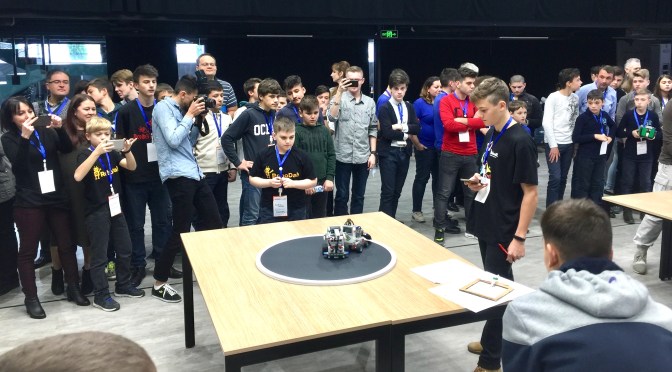
Students at Ialoveni’s library are learning to make, program and operate robots. See post with the full story.

Robots at the Library

If “robotics” sounds daunting to you, well, it did to me, too.

Then I agreed to help launch a robotics program at the library where I work as a Peace Corps Volunteer in Ialoveni. Now I can program a small robot to roam around the room, pick up objects, avoid collisions and roar like a dinosaur.

IMG_7825

More important, so can the students that my library colleagues and I have been teaching to do this and more with the Lego Mindstorms EV3 kits we received from Novateca, a nonprofit organization that promotes innovation among Moldova’s libraries.

We started with two weekly robotics classes. Word spread, more kids came, and we added a third class, and then a fourth, including one especially for girls. The kids keep coming, with their parents often lingering to watch.

IMG_7849

Students in the United States and around the world use the same kits, which combine familiar Lego components with a brick-shaped computer. You program the brick and then snap it together with the other pieces to create a vehicle that moves, a dog that barks or something else.

IMG_7674

The software is colorful and easy to learn. Here in Ialoveni, we now give new students a brief introduction and then set them loose on the first program, which tells a robot to drive forward, back and forward again. Within a few minutes, they’re clicking away. On Thursday, several new students needed less than 15 minutes to finish the first program. Then they started modifying it to make their robots rotate, pause, speed up or make funny sounds.

We’re hoping to form a Ialoveni library team to compete in Moldova’s upcoming Lego League competition, where the winner will move on to compete internationally.  (Here’s a YouTube video of last year’s event in Chișinău. My own video about Ialoveni’s program is posted above and also is on YouTube.)

Lego program

Lidia Rusu and Sergiu Blajinschi are my fantastic partners. They form groups for each lesson, work with every student, explain everything patiently and cheer as the robots perform. It’s no wonder the students are so enthusiastic.

The Lego EV3 core set costs $500 on Amazon back home. An expansion kit to build an elephant and other projects costs $154 more. That’s expensive, so it’s worth looking for a school program or club to join. If you have the money, though, and want to get a young person excited about engineering, you won’t be disappointed, so long as you both have some basic computer skills and comfort with technology. No one needs to know when you spend hours playing with it, too.

IMG_6977


Metro Shopping

If you shop at Costco, BJ’s or Sam’s Club, the two Metro stores in Moldova will seem familiar.

img_7208.jpg

I was astonished the first time Champa and I visited one of these local warehouse stores with our host family. The displays of Barbie dolls, blenders and Italian pastas seemed more appropriate to an American suburb than a country hosting Peace Corps volunteers. The brand names ranged from Coca Cola to Samsung, with ATM machines available to help customers buy even more merchandise.


The two stores in Chișinău are among more than 750 across Europe and Asia run by the German company Metro Cash & Carry. Together with France’s Carrefour and the British company Tesco, Metro has a big presence in this part of the world even if most Americans have never heard of it.

Screen Shot 2017-10-15 at 10.03.14 AMThe stores here resemble Costco, from their giant shelves and forklifts to their membership cards and crowded parking lots where customers unload giant boxes of laundry detergent or dog food. Here, too, customers seem to buy more than they need because they can’t resist an apparent bargain. Many pay with cash, although credit and debit cards are becoming more popular with the kinds of Moldovans who shop here. IMG_7207

They are among the more prosperous consumers in this country, where many people still shop mainly at village alimentaras that resemble larger convenience stores back home. Those shopping at Metro illustrate Moldova’s aspirations for a modern European economy.

One thing Metro doesn’t have are the giant muffins Costco sells. I’m partial to the ones with chocolate chips myself. I’m hoping Metro will have them if our host family ever brings us back for another visit.


Sharing Our Story

Earlier this year, Champa’s school received a wonderful gift of English-language books from Darien Book Aid, a nonprofit organization in Connecticut that sends free books to organizations in the United States and abroad. img_1420Champa requested the books, which ranged from easy readers to story anthologies. They’ve found a happy audience at her school ever since then.

More recently, the organization contacted us to ask whether they might profile us for a story in their newsletter about older Peace Corps Volunteers. Especially since they’d been so generous, we agreed. The article was just published.

Please consider donating to Darien Book Aid! Their latest newsletter is here, including the article about us, which follows below.

Screen Shot 2017-10-15 at 7.01.48 PM


Nobel Season

Back when I was a science writer in the Washington, D.C. area, I interacted with three of the scientists who received Nobel Prizes this past week, a fact that’s reminded me of the career I left behind and led me to reflect on what I’m doing now.

Screen Shot 2017-10-09 at 8.58.25 PM
Richard Thaler

I worked on an op-ed article with Richard Thaler, who won this year’s economics prize for his pioneering work showing how people make decisions less rationally than models may predict. I later included his article, “The Economics of Reality,” in an anthology I produced for the National Academy of Sciences, which you can download for free. I loved working with Thaler, who was brilliant and fun. (You may have seen his cameo with Selena Gomez in “The Big Short.”) He’s definitely having a better year than Bill Cosby, whose article began the anthology.

Screen Shot 2017-10-09 at 8.55.43 PM
Joachim Frank

Joachim Frank was among this year’s three chemistry winners. I visited with him in his lab when he was at the Wadsworth Center in Albany.  His innovations with cryo-electron microscopy helped transform how scientists visualize biological molecules. Both he and Michael Rosbash, who shared this year’s prize in physiology or medicine, were investigators of the Howard Hughes Medical Institute (HHMI), where I worked in the communications office.

Screen Shot 2017-10-09 at 8.56.58 PM
Michael Rosbash

Rosbash’s research helped change how we think about sleep and “circadian rhythms,” a subject he discussed eloquently in a televised lecture series on which I worked.

I used to pay close attention to “Nobel season” every October when I was at HHMI, whose researchers seemed to get the call from Stockholm every other year or so for the medicine or chemistry prize. I was sometimes awoken by reporters seeking to interview the winner. I remember being called one year by a reporter friend at NPR. “Who won?” I asked him, half-asleep. “Günter Blobel,” he responded, citing a scientist who showed how proteins move within cells. If I remember correctly, one of my colleagues, who took the lead on these requests, was able to connect them quickly.

Screen Shot 2017-10-09 at 8.59.24 PMI left Washington to run the news and communications office at Duke. A decade later, the university claimed its first Nobelist, ironically someone also affiliated with HHMI. In fact, I’d commissioned and edited a major profile of Bob Lefkowitz for HHMI’s magazine. He shared the 2012 chemistry prize for his discoveries about how biological signals pass into and through cells. After we were alerted early in the morning to his happy news, our Duke team pulled together a press conference and media package within a few hours. As usual, Bob was moving, funny and inspiring as he spoke with reporters.

Some of those reporters were star-struck, even more than when they met Coach K for the first time. They didn’t know what I had learned over the years, which is that Nobel Prize winners and other eminent scientists are pretty much like the rest of us, just really smart.

Screen Shot 2017-10-09 at 9.06.36 PM
Robert Lefkowitz

I was reminded at such moments of how lucky I was to work with people whose groundbreaking research was saving lives and transforming human knowledge.

This week, as I’ve been cheering for Rosbash, Frank and Thaler, I’ve also reflected on how memories like these evolve with our own lives. When I worked with each of them — briefly, to be sure — it was just an ordinary part of my job. Now I savor those moments.

In the same way, things that now appear routine to me as a second-year Peace Corps Volunteer in Moldova will probably seem different in the future. A decade or two from now, I may look back and think: “Wow, did Champa and I really do that when we were in our 60s?” Perhaps the same thing has happened to you, too: The ordinary becomes extraordinary without actually changing, a quantum motion of the heart. No one has won a Nobel Prize yet for explaining why this happens. Maybe next October.