I am a Peace Corps volunteer in Moldova, in Eastern Europe, serving in the small city of Ialoveni with my wife, Champa. We are from Durham, N.C., where I was the head of news and communications for Duke University. You can follow our adventures on my blog, notexactlyretired.com.
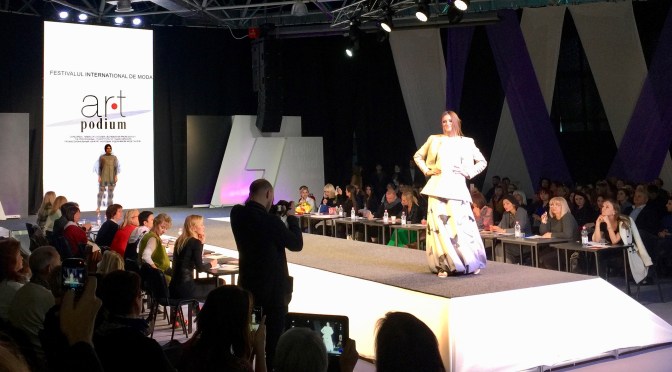
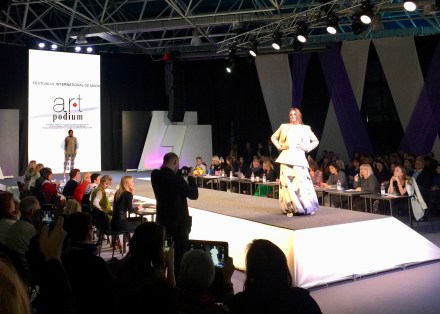
Models strutted, judges scribbled and photographers clicked away on Friday afternoon as Champa and I attended a Moldovan fashion show to cheer for an aspiring designer we know. Ludmila Cotelea-Condrea’s latest collection featured painted blouses and leather skirts, as shown here:
Her husband, Igor, with whom I work at the Consiliul Raional in Ialoveni, watched anxiously from the end of the runway as each model walked before the judges on either side. (That’s him in the photo.) Beside him was another friend, filming the event. Ludmila remained backstage until her collection, “Autumn Dream,” was finished, then appeared with one of the models to receive a bouquet of flowers and walk the runway to applause.
She was among a series of young designers showing their work at a 4-day Fashion Expo at MoldExpo, Chisinau’s convention center. Just beyond the runway were booths where local companies displayed their dresses, lingerie, handbags and other wares. There were also booths offering sewing machines, design software and other products for the industry, as well as models handing out advertisements.
According to one recent estimate, more than 25,000 people in Moldova are employed in the production of textiles, apparel, footwear and leather goods. Many of them are doing traditional work in villages, but more than 30 Moldovan companies now export to international markets. As I observed previously, small factories are springing up across the country, including one near Champa’s school. USAID and others have been supporting these efforts, as have several Peace Corps volunteers.
Champa and I never expected to attend our first fashion show when we signed up for the Peace Corps. It’s not exactly what we anticipated when we became “not exactly retired.” But we enjoyed ourselves thoroughly, admiring anew how local traditions intersect with modern aspirations here.
Ludmila was among the winners of the competition. If anyone reading this post has a connection to Anna Wintour, feel free to tell her that Ludmila speaks English and will be happy to take Anna’s call.
I awoke Monday morning to find my Facebook feed filled with adorable photos of children back home dressed up as monsters, princesses, cows and witches. My news feeds featured the latest polls about the presidential election.
Admiring the Facebook photo of my favorite Halloween cow (along with her twin sister).
When I talked with my Moldovan friends, though, few of them cared about Halloween or our election, just as they won’t care about Thanksgiving or the Super Bowl.
Most Moldovans are oblivious to the controversies involving Hillary Clinton’s e-mails or Donald Trump’s tax returns. If Sean Hannity and Megyn Kelly fight again on Fox News, well, who are they? What’s Fox News? Why should someone here care?
I’m humbled as an American to be reminded every day that most people around the world know or care little about many things we consider important. It’s one of the insights I treasure most as a Peace Corps volunteer. I’ve been given the gift of a new vantage point to view my country and its place in the world.
Did you know Moldova just had its own presidential election, which is now heading to a second round? Perhaps you actually paid attention to this because you know me. (Some of you even sent me stories about it.) But otherwise, would you have even glanced at this news, which people here are following closely?
What Champa and I are seeing here is like what we saw in Nepal when we spent time there a year ago. People live their own lives. They have their own country. They’re curious to talk with us about America, but then they go home and get ready for another day of work.
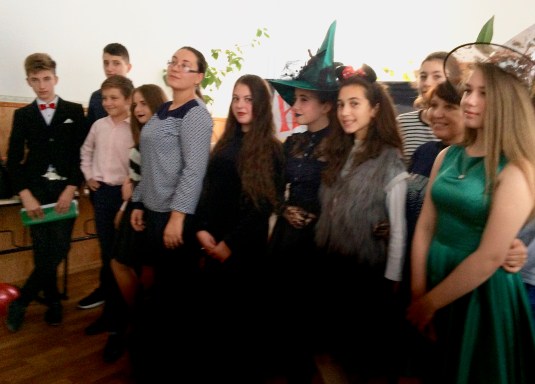
Champa’s partner teacher, Elena, in front wearing the black striped shirt, organized a fun Halloween play at their school.
This past Friday, Champa’s partner teacher organized a Halloween play at their school. It went great. Several other Peace Corps volunteers around Moldova also organized Halloween events, as did volunteers in other countries. Most of those events probably went well, too. Some of the kids who participated may remember Halloween for the rest of their lives. In small but immeasurable ways, our cultures grew closer together, all of which is wonderful.
Similarly, there’s no doubt millions of people around the world are paying close attention to the American election. They know it affects them, too. In general, they pay more attention to our country than we do to theirs. We are all more connected across nations than ever before.
Still, here in Moldova and around the world, most people will tuck their kids into bed tonight without thinking about Halloween, Donald Trump or all of the other things that loom so large in our American lives, sometimes even overwhelming us. They will sleep soundly just the same.
Personally, I have found it not only humbling but comforting to relearn this reality, which offers a different perspective on our own problems and obsessions. All of us, whether in the United States or someplace else live largely out of sight from one another. We share the world yet most of the world doesn’t care who will win the World Series tonight.
Ialoveni celebrated its 580th birthday with its annual “Zia de Hram” event. A highlight was the dedication of a new bust in front of the Consiliul Raional, where I work. The bust honors Ferdinand I, king of Romania 1914-1927, a period when Moldova was part of Romania. I produced this 5-minute video about the dedication ceremony.
Can a guy in his sixties who has never studied modern computer programming introduce a group of computer-savvy young people to software coding — and do it in a foreign language?
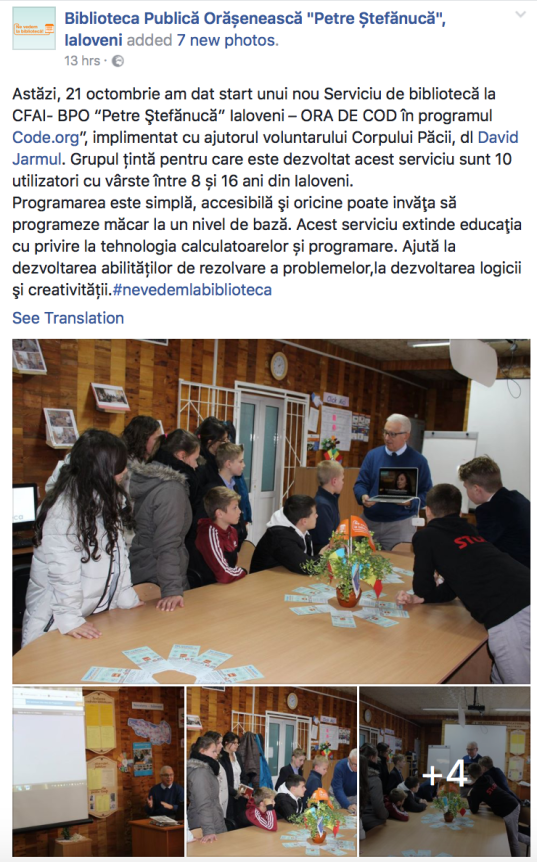
That’s what I did on Friday at our library in Ialoveni, Moldova. (A few hours later, they posted this story about it on Facebook; the live version offers an English translation):
I got the students started with Hour of Code, an international initiative through which millions of young people have begun learning about programming. My group watched a couple of inspirational videos and then began writing mock code for the popular computer game Minecraft. Within a few minutes, they were clicking away, instructing their characters to move in different directions, shear sheep and search for treasure.
Several of them finished the 14 tasks in less than an hour. All were engrossed, smiling when they completed a puzzle and giving me high fives as I walked around the room to help them out. Before we even finished, the librarian told me we should start a weekly Hour of Code club, which we’ve scheduled for 2:30 p.m. on Wednesdays.
Next week we’ll write code for a Star Wars game. Then we’ll do the “Frozen” module. After that, perhaps we’ll learn some JavaScript together.
Launched in 2013, Code.org is a nonprofit organization focused on making computer programming more accessible. Its videos feature Bill Gates, Mark Zuckerberg and other famous programmers, as well as President Obama, actors, sports stars and others, all emphasizing that coding isn’t as hard as you may think.
That’s a message more young people, especially girls, need to hear in our own country, Moldova and around the world. Coding is an increasingly essential skill. Especially in poorer countries, it can open the door to participating in the global economy. Here in Moldova, older girls can also take part in GirlsGoIT, a two-week program through which they learn about web applications, entrepreneurship and potential career paths. Around the world, Peace Corps is deeply involved in the Let Girls Learn program championed by First Lady Michelle Obama.
Back when I was running Duke’s news office, one of my colleagues wrote an article called Computer Science Looks Beyond Nerds, describing how the university redesigned its introductory course to attract more women, students of color, liberal arts majors and others who don’t fit the stereotype of programmers. Hour of Code is pursuing the same mission internationally. Its resources make it easy for people to serve as mentors regardless of their own level of coding experience.
Even if you’re “not exactly retired” or majored in American history like me, do yourself a favor and try some of the modules yourself. They’re fun. And if you know any students in Ialoveni — especially girls — looking for something interesting to do on Wednesday afternoons, send them my way. We still have a few spots open.
Student from schools across Ialoveni raion — where we live — performed on Friday afternoon at a cultural festival honoring Andrei Vartic, for whom Champa’s school is named. I produced this 3-minute video featuring some of the highlights from the first hour and a half of the event.
We often ride the #9 bus in Chisinau, which stops near the Peace Corps office. It costs 2 lei, or 10 cents.
A bus ride in New York City costs $2.75. In Philadelphia, it’s 2.25. Nationally, the average fare tops $2.
The minibuses, or rutieras, are usually full. Sometimes they are really full.
Here in Moldova, the bus fare in the capital city, Chisinau, is 10 cents. A minibus ride to Chisinau from our home town of Ialoveni is 20 cents. Champa and I can stuff our two backpacks with groceries for less than $20. It costs us two dollars for a bottle of local wine or, if we’re feeling thrifty, 75 cents to refill a bottle at the wine store.
It’s much cheaper to live here than in the United States, so long as we avoid products imported from outside the region. A pair of Nike running shoes costs about the same as back home. A pair of Levi’s costs more. So does an iPhone.
According to one popular website, consumer prices in Moldova are 62 percent lower than in the United States. Restaurant prices are 70 percent lower. The two of us are lucky to have some restaurants in our town — many volunteers don’t — and we have yet to spend ten dollars for the two of us, drinks and dessert included. Restaurants are somewhat pricier in Chisinau but still a bargain. Rents are also much lower; here in Ialoveni, as Champa and I discovered recently, apartments start at just over $100 per month.
The produce aisle at Victoria Market in Ialoveni
Best of all are the local fruits and vegetables, which are fresh, delicious and cheap. A few days ago I bought a bag of apples from a street vendor for 75 cents — enough to make a big pie. Pears are in season, too. A few weeks ago, we had peaches, cherries, raspberries and strawberries. The local vegetables now include cauliflowers, eggplants, onions, potatoes and our current favorite, beets. Champa has begun making beet salads with buckwheat, carrots, tomatoes and cucumbers, sprinkled with olive oil and balsamic vinegar.
Yes, you can buy those, too, although they’re imported and expensive by local standards. An imported jar of Barilla pasta sauce costs about $2, nearly twice the price of a larger jar of local tomato sauce. Some familiar brands — Snickers, Coca Cola, Colgate, Tide, Gilette — are produced regionally and sold everywhere. Peanut butter, on the other hand, is a delicacy. I bought my first and only jar a few weeks ago at an auction to raise money for an anti-trafficking campaign: $7 for a jar of Jif. Hey, it was for a good cause.
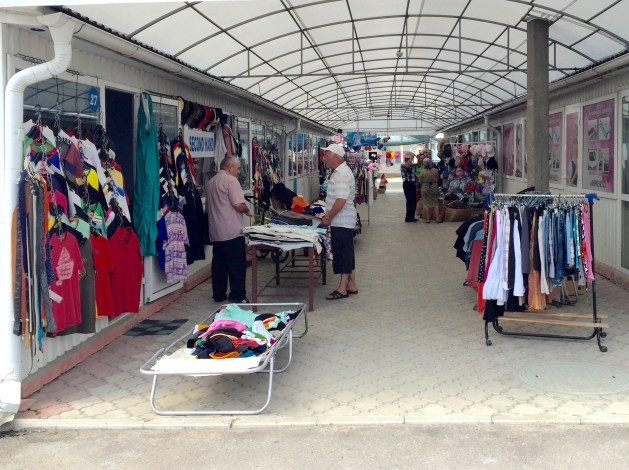
The piața, or traditional shopping plaza, in Ialoveni
Occasional splurges like this are within our budget as Peace Corps volunteers. Before we came to Moldova, Champa and I had never gone to the opera. A few weeks ago, we bought orchestra seats for a wonderful performance of La Traviata in Chisinau’s national theater. They cost us $10 each. Dinner at the outdoor restaurant next door was $13. Transportation home was a dollar. I’ve never been to the Met in New York but I’m guessing it costs slightly more.
Sounds great, right? Well, yes, by American standards. But not for Moldovans, whose average monthly after-tax disposable salary is $214.52, nearly 93 percent lower than ours, according to the same website. I can’t vouch for the accuracy of its data, which appear to be based on only 107 Moldovan respondents, but they’re in the same ballpark as statistics from the World Bank and other sources. When your monthly paycheck is so small, these “low” prices appear much larger.
As Peace Corps volunteers, our monthly income is much closer to the Moldovan side of the scale. We receive enough to pay for our rent, food, transportation and miscellaneous expenses, and Peace Corps sets aside some money for a one-time “readjustment allowance” that we’ll receive after our service.
Our paychecks are far less than we spent every month back home on basic living expenses, not to mention on college tuitions and other major outlays. Yet they’ve been enough for us to live comfortably, albeit not luxuriously. So far, they’ve been just enough.
You can buy laptops, smart phones and other electronics in Moldova, but don’t expect to find many bargains.
If we were still living in Durham, we’d have utility and cell phone bills, medical insurance premiums, car insurance, grocery bills and everything else. Here in Moldova, my only recurring monthly bills are for a New York Times online subscription and iCloud storage to back up our laptops. We hope to leave our retirement savings untouched and, if we’re lucky, for them to grow a bit while we’re gone, although they could move in the other direction, too. Whatever. This isn’t why we joined the Peace Corps and we don’t spend a lot of time thinking about it.
For now, I’m focused on the trip we’re planning to take from Ialoveni to Chisinau this weekend. As usual, we’ll ride the overcrowded local buses, for which we’ll need 60 cents each, roundtrip. I think we’ve got it covered.
If you’re “not exactly retired” like us, you may remember searching for apartments years ago by scouring bulletin boards and tearing off phone numbers from promising listings.
That was long before Craigslist and other sites moved the process online — at least in the United States.
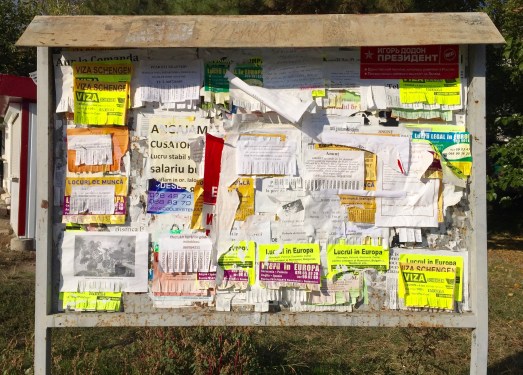
Here in Moldova, though, people are still using bulletin boards, often located near bus stops. Those looking to sell or rent their property post advertisements in Romanian or Russian, Moldova’s two main languages. Most of the signs are printed simply in black and white, with no photos or graphics. Some are scrawled by hand. Within a few days or after a storm, they start drooping.
Moldova does have sites resembling Craigslist, most notably 999.com, which also sells a wide range of products. It is especially popular with younger people, offering online streaming and mobile apps for both IOS and Android phones. The site’s listings for houses and apartments can be sorted by location, price and other factors, in Romanian and Russian. Just as in the United States, ads pop up in the margins to extol candidates in the upcoming presidential election.
Still, many Moldovans continue to rely on bulletin boards and old-fashioned word-of-mouth, asking friends to tell them if they’ve hear of something new coming on the market. I haven’t seen any companies that handle rentals, at least where we live, much less the local listings you sometimes see printed back home.
Champa and I have learned about all of this over the past few days as we’ve begun searching for an apartment ourselves. We’ve loved staying with our host family in Ialoveni, where we’ve been renting the second floor of their house. This past Saturday, we hosted our first dinner party, with several other Peace Corps volunteers who came from neighboring towns. Unfortunately, the family needs to reclaim the second floor, so we’re now actively looking for a new home.
The Peace Corps staff and our current host family have stepped up to assist us and, thanks to their help, it’s looking like we may resolve the situation soon. That’s good news — well, except for the bulletin boards. I was just starting to get the hang of using them again.
With the U.S. election just a month away, you may now consider yourself an expert on political slogans. Well, other countries have elections and slogans, too, so let’s see how smart you really are.
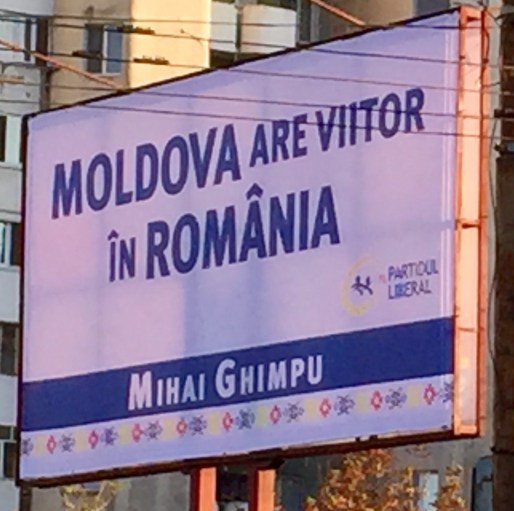
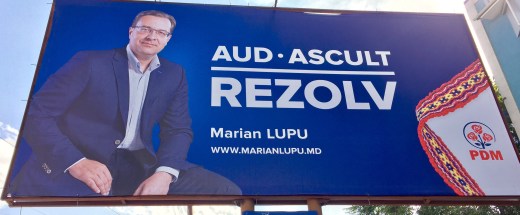
Moldova has a presidential election on October 30. I avoid local politics since I am a Peace Corps volunteer here, but I’ve been interested to watch the campaign. I’ve created a fun quiz so you can participate, too. Try to match the following English translations of some Moldovan campaign slogans with the billboards on which they appeared. The answers are at the bottom.
Ready? Here are the slogans from six billboards I’ve seen along my bus route:
1. Moldova has a future. The solution is coming soon.
2. I can get more for Moldova
3. Together we are stronger
4. I hear. I listen. I solve.
5. Change for Moldova
6. Moldova has a future in Romania
Here are the billboards:
A)
B)
C)
D)
E)
F)
Answers: 1-E, 2-C , 3-F , 4-D, 5-A, 6-B
Did you get them all right (without using Google Translate)? Nice job — you’ve made America great for slogans again … or perhaps we’re all just stronger with slogans together.
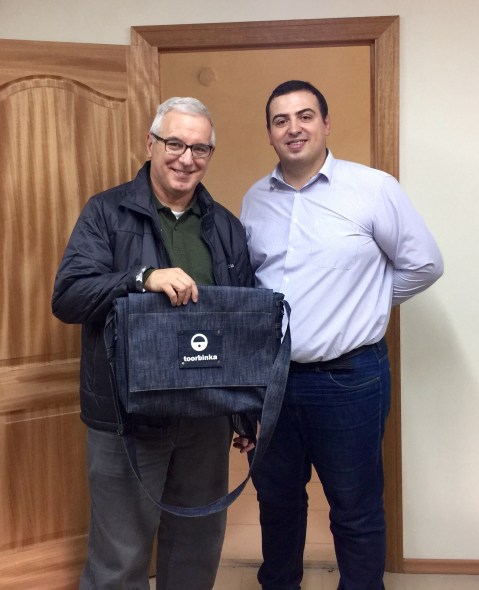
I bought it from the guy standing next to me in the photo, at his small factory. The bag has a padded compartment, zippered pockets and a carrying strap. I bought it for 350 Moldovan lei — less than $18.
Dumitru Guzun and his partner opened the factory last year above a market in the town of Criuleni. My Peace Corps group stopped by for a look on Monday afternoon.
The company’s main business is denim jeans, sold under the brand name DAOS. Several of my fellow volunteers bought a pair, for the sales price of about $13 each. I wanted a pair, too, but they were out of my size.
As Dumitru showed us around, his eight employees barely looked up from their sewing machines and other duties. They were racing to fill an order. The company is doing well but, as Moldova’s first jeans brand, it faces intense global competition. It recently turned to a new Moldovan crowd-funding site to try to raise capital for new equipment and products. Dumitru also hopes to open a retail shop in Moldova’s capital, Chisinau, 27 miles away.
I hope he succeeds. As I’ve written previously, it’s tough to be an entrepreneur in Moldova, but people like Dumitru and his team are giving it a shot. They’re creating new jobs and showing it’s possible for companies to succeed here.
If people ask about my new bag when I return from two weeks of language training to my job on Monday, they’ll probably be surprised when I tell them it was manufactured not in China, not in America, but in Moldova. And when Dumitru and his team open a shop in Chisinau, I plan to be among their first customers. I still want those jeans.
If you have kids in school, imagine what it would be like if the fathers of many of their classmates left town to seek work in another country. How would those kids feel?
Now imagine that some of their mothers left, too. Finally, suppose your own kids were among those going home every night to be raised by a grandmother, seeing you only online or during your occasional visits home.
If you have trouble imagining this, then come to Moldova. You’ll see it everywhere.
One woman we know is raising two energetic kids while her husband works abroad. In another family, the daughter and her husband are working abroad part-time, with two school-age girls at home. When Champa and I were sitting outside at a cafe, a guy sat beside us, said he was on a break from his job in England and asked whether we could help him get a green card to America. Lots of people want green cards. A work colleague told me he applied but didn’t get one. Someone I know through Peace Corps told me he wants one, too. One reason many adults are keen to learn English is to help them find employment abroad.
Moldova’s nominal gross domestic product per capita, as reported most recently by the International Monetary Fund, is just over US$1800. Good-paying jobs are scarce. People who want to start their own businesses face red tape and little capital. Banks are mistrusted. So are politicians. Many people are tired and discouraged.
So they go to Russia to drive trucks. They serve meals in Italy, build homes in Ukraine and raise other people’s children while their own grow up with grandparents or neighbors. According to the International Organization for Migration, one-quarter of Moldova’s working-age population now works abroad, a situation described here, here and here.
Many of these workers send money home and return for visits laden with televisions, laptops and toys. Their earnings pay for some of the loveliest homes in Moldovan villages.
None of this is unique to Moldova. Our own country is filled with immigrants looking for a better life, with children sometimes left behind. We’ve all been watching Syrian families flee from horrific conditions. Back when we were in North Carolina, Champa and I assisted a Rwandan family. In Nepal last fall, we met several families whose sons worked in the Persian Gulf. Indeed, all four of my own grandparents emigrated to America.
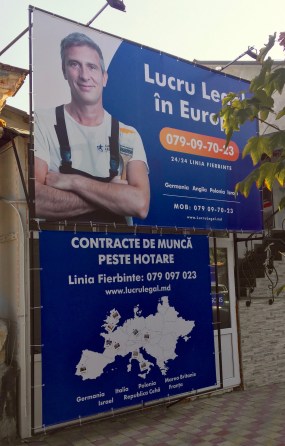
I’ve illustrated this blog post with some of the signs you see across Moldova. They’re from employment companies promoting legal jobs abroad. Every piece of paper torn from the bottom of a poster represents another person who may be leaving Moldova.
What does it mean for a country to lose, at least temporarily, so many of its citizens in the prime of their lives? What does it mean for this generation of children?
As a father and grandfather, I feel great empathy for Moldovans who make this choice. They are in a very difficult situation. They need to feed their families and they want to provide them with a few simple pleasures, like a nicer home or a modern bathroom. They love their children every bit as much as we do, and they do everything they can to help them. Those who return, moreover, may bring not only money and goods but also also a new perspective on what is possible for themselves and their country, something we saw in Nepal.
Spending time with these families has changed my own perspective on our immigration debate back home. Moldova doesn’t figure much in that debate, yet I’ve found it instructive nonetheless to watch here as a father calls home to ask his kids about their day. I’ve seen the kids run to the computer when they hear the Skype ringtone. I’ve heard the mother tell me later how much she misses him.
Her voice is but a whisper beside the angry rhetoric we hear on the campaign trail, yet it’s hers that speaks to my heart. Imagine that.
***
Addendum, September 23: Lauren Jaeger, a Peace Corps volunteer in Moldova who has been active in anti-trafficking efforts, responded on Facebook to this post with an important reminder about the potential dangers represented by the posters you see above. With her permission, I am reprinting her comment here as well. (Thanks Lauren!) Here it is: “I loved your piece, David, but just cringe when I see these posters. Because of the desire/necessity to find work abroad, support loved ones, and keep up with the ever-increasing living costs and stagnant incomes in Moldova, many people are tricked into unfair labor practices. While many great organizations are working to educate people on ways to verify work offers abroad, I still see many posters like this; no company name, no website, no real information, and many promising to cover document costs, transportation, or even living expenses. It puts Moldovans, and many others across the globe, in a very sensitive, dangerous situation that is the perfect breeding ground for fraud.”



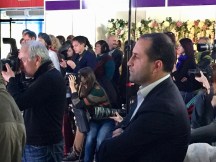 (That’s him in the photo.) Beside him was another friend, filming the event. Ludmila remained backstage until her collection, “Autumn Dream,” was finished, then appeared with one of the models to receive a bouquet of flowers and walk the runway to applause.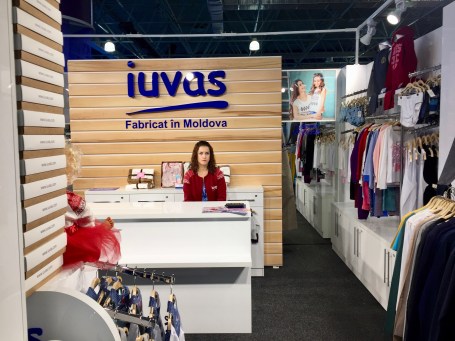






 That’s a message more young people, especially girls, need to hear in our own country, Moldova and around the world. Coding is an increasingly essential skill. Especially in poorer countries, it can open the door to participating in the global economy. Here in Moldova, older girls can also take part in


 I’ve never been to the Met in New York but I’m guessing it costs slightly more.


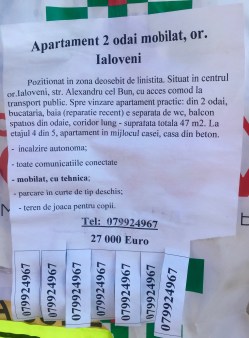 Here in Moldova, though, people are still using bulletin boards, often located near bus stops. Those looking to sell or rent their property post advertisements in Romanian or Russian, Moldova’s two main languages. Most of the signs are printed simply in black and white, with no photos or graphics. Some are scrawled by hand. Within a few days or after a storm, they start drooping.
 Champa and I have learned about all of this over the past few days as we’ve begun searching for an apartment ourselves. We’ve loved staying with our host family in Ialoveni, where we’ve been renting the second floor of their house. This past Saturday, we hosted our first dinner party, with several other Peace Corps volunteers who came from neighboring towns. Unfortunately, the family needs to reclaim the second floor, so we’re now actively looking for a new home.





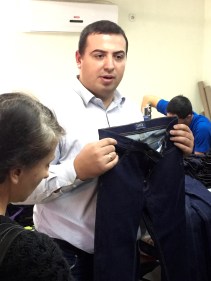 Dumitru Guzun and his partner opened the factory last year above a market in the town of Criuleni. My Peace Corps group stopped by for a look on Monday afternoon.
 As Dumitru showed us around, his eight employees barely looked up from their sewing machines and other duties. They were racing to fill an order. The company is doing well but, as Moldova’s first jeans brand, it faces intense global competition. It recently turned to a new Moldovan


 One woman we know is raising two energetic kids while her husband works abroad. In another family, the daughter and her husband are working abroad part-time, with two school-age girls at home. When Champa and I were sitting outside at a cafe, a guy sat beside us, said he was on a break from his job in England and asked whether we could help him get a green card to America. Lots of people want green cards. A work colleague told me he applied but didn’t get one. Someone I know through Peace Corps told me he wants one, too. One reason many adults are keen to learn English is to help them find employment abroad.
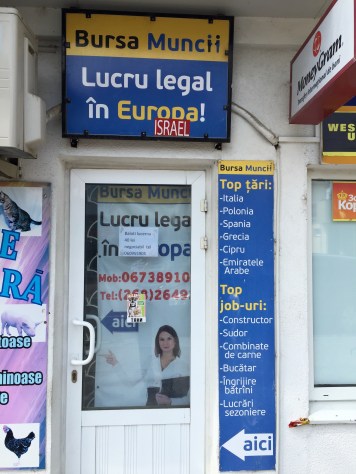 I’ve illustrated this blog post with some of the signs you see across Moldova. They’re from employment companies promoting legal jobs abroad. Every piece of paper torn from the bottom of a poster represents another person who may be leaving Moldova.
 "Not Exactly Retired"