All posts by djarmul

I am a Peace Corps volunteer in Moldova, in Eastern Europe, serving in the small city of Ialoveni with my wife, Champa. We are from Durham, N.C., where I was the head of news and communications for Duke University. You can follow our adventures on my blog, notexactlyretired.com.

The Sky in the Synagogue

IMG_2385

My paternal grandmother Sarah grew up in Odessa, Ukraine, not far from where I now serve as a Peace Corps volunteer in Moldova. Her family — my ancestors — fled to America to survive the violent anti-semitism depicted in “Fiddler on the Roof.”

At that time, more than 50,000 Jews lived in Moldova’s capital, Chișinău, comprising 46 percent of the city’s population according to an 1897 census. In 1903, 49 of them were killed in anti-semitic riots. A survivor said: “Dead bodies were everywhere, many of them horribly mutilated, and in most cases with the clothes torn off. There were ears, fingers, noses lying on the pavements. Babies were tossed in the air to be caught on the points of spears and swords. Young girls were horribly mistreated before death came to end their torture. I saw these things with my own eyes.”

It’s hard to imagine anything more chilling than that, but things got worse for Moldova’s Jews. A few decades later they were nearly wiped out by Nazi death squads who rounded them up and executed them in every corner of the country, sometimes with local help. Shortly before Champa and I joined the Peace Corps, “60 Minutes” broadcast a chilling story about a French Catholic priest investigating The Hidden Holocaust in the former Soviet States. (A clip is at the end of this story and on YouTube .)

Screen Shot 2017-03-14 at 3.50.24 PM“We traveled with Father Desbois to the former Soviet Republic of Moldova, where in one day he took us to four unmarked mass graves,” reporter Lara Logan said in the story. “In this field, he told us, 60 Jews beneath this farm, 100 above this city, under this hill, a thousand.”

In a small village near Telenești, an 85-year-old man tells them what he witnessed as a boy: “The Jews were facing the ditch, so they were shooting them in the back of their heads or their backs to fall into the ditch. They were shooting them as if they were dogs.”

Moldova’s Jews were murdered in their homes, in ravines, on death marches, in camps — everywhere. By the time the Soviet Army returned in August 1944, the Nazis had killed as many as 300,000 Jews across Moldova and neighboring areas of Bucovina, Bessarabia and Transnistria. Few survived.

After we were accepted as Peace Corps volunteers, one of our sons saw the “60 Minutes” story and told us he was worried about our own safety in Moldova, even though I am not an observant Jew and Champa grew up with local religions in Nepal.

In fact, we have both been welcomed warmly with few exceptions. We’ve now been here more than nine months and enjoy living here. I have yet to knowingly encounter anti-semitism, even though it still exists in Moldova and extremist groups can be found in much of Europe. What I have seen are some promising, if modest, signs of a Jewish revival.

IMG_1230
Jewish young people participated at a volunteer fair at Malldova in October.

Roughly 25,000 Jews live in Moldova these days, mainly in Chișinău but also in places such as Bălţi, Bender, Soroky, Rybnitsa, Orhei and Tiraspol. Their numbers grew under Soviet rule until the 1970s and 1980s, when anti-semitism led many of them to emigrate, mainly to Israel and North America.

Many of Moldova’s Jews now are elderly and living on small fixed incomes. In October, Champa and I spent an afternoon with Alex Weisler and others from the American Jewish Joint Distribution Committee, which is doing wonderful work here to support the Jewish community with basic services and religious, educational, legal and cultural programs.

IMG_8483

Earlier, shortly after arriving in Chișinău, my friend Tom and I visited the local Chabad, where they were happy to welcome us after I joined them in the prayer they were reciting, although I declined their attempt to wrap me in tefillin. Tom and I also passed the nearby synagogue shown at the beginning of this post, with the sky showing through its smashed windows. A few blocks away, on Jerusalem St.,  was the red granite monument you see here, honoring victims of the Chișinău ghetto.

On Sunday, Champa and I saw this display of a Torah, menorah and other Jewish symbols in the religion exhibit at Chișinău’s history museum. IMG_3276 Just outside of town is Europe’s largest Jewish cemetery, now overgrown beside an abandoned synagogue. A new website, JewishMemory: History of the Jews in Moldova, provides an excellent introduction for anyone who wants to learn more, as does this site.

In other words, Moldova’s Jewish legacy is here if you look for it. The Israeli Embassy maintains a good list of current organizations and activities. If any of my Moldovan friends or Peace Corps colleagues are curious, this article tells where to find graveyards, memorials and other Holocaust sites in Bălți, Cahul, Comrat, Briceni, Florești, Hincești, Calarași, Leova, Soroca, Ungheni and other locations.

I hope to visit Odessa before we leave, to honor my grandmother and the rest of my family who endured so much before finding a better life in America. I think their spirit is still here, like those of so many others, whispering to us from the sky-filled synagogues, bullet-pocked walls and broken cemetery stones.

Bardar Water Project

Moldova’s wells are omnipresent, picturesque and often unsafe, with water that may contain parasites or chemicals. I photographed these two when I lived in the village of Bardar during my Peace Corps training.

IMG_3237

Soon their water quality won’t matter so much. On Friday, I attended the kickoff conference for a project that will connect Bardar to a modern water system, providing safe running water for many of its 6,000 residents.

The Slovak Republic, primarily through SlovakAid, is donating financial and technical support for the project, which is scheduled to run through May 2018.

IMG_3198
Ambassador Robert Kirnág, center, and other Slovakian officials spoke at the meeting.

“Fresh drinking water is a fundamental right of people,” Robert Kirnág, the Slovak ambassador to Moldova, said at the meeting in Ialoveni’s business center. “Water will remain a problem in Moldova for many years to come. We’ve identified water, sanitation and waste management as a priority.”

“Water is life; it is critical for people everywhere,” agreed Michal Mlynár, director general for international organizations and development cooperation in Slovakia’s foreign ministry. The Bardar project will “make a difference in the lives of ordinary people in the region.”

IMG_3183The Consiliul Raional of Ialoveni district, of which Bardar is a part, is carrying out the project collaboratively with Moldova’s Regional Development Agency Center (ADR Centru) and the Regional Development Agency Senec-Pezinok in Bratislava, Slovakia’s capital.

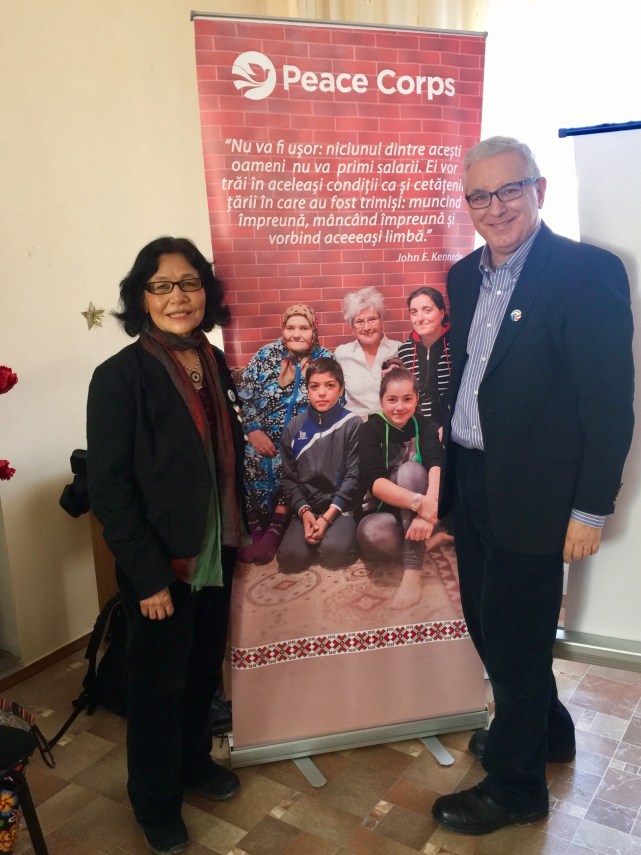
ADR Centru shares the fourth floor of the Consiliul Raional building in downtown Ialoveni. I work there myself and know people at both organizations. It’s great to see them collaborating to benefit the village where I had my training. At Friday’s meeting, I sat with my friend Mihail Tonu, Bardar’s vice mayor.

The project seeks not only to provide clean water for Bardar but also to raise awareness among public authorities and the public about the importance of water system management and quality drinking water.

Anatolie Dimitriu, president of the Consiliul Raional, called Friday “a very special day,” noting how the project will benefit Bardar and accelerate the process of providing clean drinking water throughout the district. The project is the first phase of a broader plan to distribute clean water more widely.

Eduard Ungureanu, from Moldova’s national ministry of regional development and construction, called the collaboration “historic,” one that ADR Centru Director Viorel Jardan predicted “won’t be the last” for Ialoveni district or Moldova.

IMG_3192
Moldovan officials thanked the Slovak Republic for its assistance and expressed enthusiasm for the new water project.

Two development specialists from Slovakia, Katarína Manczalová and Eva Balažovičová, also spoke at the meeting, emphasizing the importance not only of the tangible benefits but also of the trust and relationships being established. Following the kickoff ceremony and a traditional Moldovan lunch, they and others remained for technical discussions with their Moldovan counterparts.

Many buildings in Bardar already have running water through individual or neighborhood systems, supplemented by the wells, but the water from the new system will be safer and more reliable. In a very tangible way, it will improve people’s lives.

Bardar will still have its wells, of course, many of them adorned with crosses and religious iconography. Their beauty will remain a rich part of this region’s landscape and cultural heritage even as their threat to the public health subsides.

Subscribe to this blog — it’s free!

Your Questions Answered

What do I miss the most from my U.S. life?

That was one of the questions I received recently after inviting readers to ask me anything. It came from Lisa, a science-writer friend from Bethesda, Md. It was a great question, to which my answer has only two words: My family.

IMG_2964
We’re thoroughly enjoying our Peace Corps experience but we miss our family.

My answer to Lisa’s follow-up question — was I surprised to miss them the most? — is even briefer: No. We expected to miss them every day, and we have.

Sorry, Lisa, I’m usually chattier than that.

I loved the questions you all sent. My friend Barry, who served with me in Peace Corps Nepal, asked whether we’ve met other Nepalis in Moldova. We haven’t, but we did meet a translator who helped a Nepalese family that came here for their daughter’s wedding with a Moldovan guy. She said the couple lives abroad and left Moldova after the wedding. Too bad.

Another returned Peace Corps volunteer asked what impact Peace Corps is having on “the anti-American view of many (especially older) Moldovans?” I’m not sure how to answer that because I don’t think “many” Moldovans are anti-American. Most of the Moldovans I’ve met seem to like Americans, although Champa and I do live in an especially pro-Western part of the country.

IMG_1679

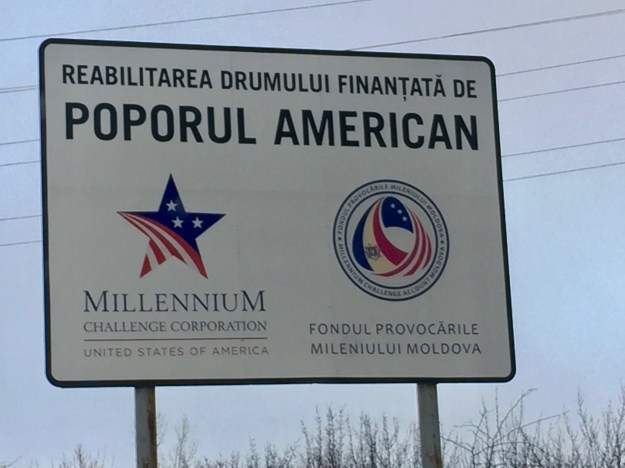
In any case, Peace Corps volunteers definitely enhance the relationship between our two countries as they provide service, live modestly, learn the language and embrace the local culture.You also see signs of American assistance everywhere, from the USAID decals on recycling bins to this sign noting how the United States helped repair a road  in the northern part of the country.

Another RPCV, Ron, who served in Venezuala, asked how younger volunteers are feeling about their job and career prospects, and also about Peace Corps’ future with the new presidential administration. I’ve become friends with many of the volunteers here who are in their 20s and 30s. Those finishing this summer have diverse plans, with many applying to graduate schools or looking for jobs. Their levels of anxiety or anticipation vary, as you’d expect, which is also true among older volunteers. As for the future of Peace Corps with the Trump administration, well, nobody knows yet. We’re all watching and wondering ourselves.

An incoming volunteer, Julie, asked whether I’d read the book Moldovan Autumn by local author Ion Druță. I haven’t, but it’s now on my list. In turn, let me recommend Bessarabian Nights, by Stela Brinzeanu, for anyone interested in Moldova. It’s a recent novel that focuses on trafficking and other social problems. You’ll learn a lot from it.

IMG_7277Julie also asked whether I’ve sent any postcards to people back home. I shared lots of postcards from Durham with two Moldovan groups, as I described recently, and I mailed home local holiday cards to our two sons, but we haven’t yet mailed home any Moldovan postcards. Now that you mention it, Julie, I haven’t seen many for sale here.

Finally, my friend Bob, who stepped down from his job in the White House science office shortly before President Obama completed his term, sent our favorite question of all. He and his wife Karen, shown here,  asked when would be a good time to visit us in Moldova. That’s a question we like to hear, and we’re already discussing the answer.

I’m closing the blog mailbag for now but, trust me, if you write back with a question half as good as Bob’s, I will respond immediately.

Durham in Moldova

img_2950

Duke Chapel, the Durham Bulls Athletic Park and the American Tobacco Campus are among the destinations I’ll be featuring today.

Wait, you’re thinking, isn’t this blog about our experiences as “not exactly retired” Peace Corps volunteers in Eastern Europe?

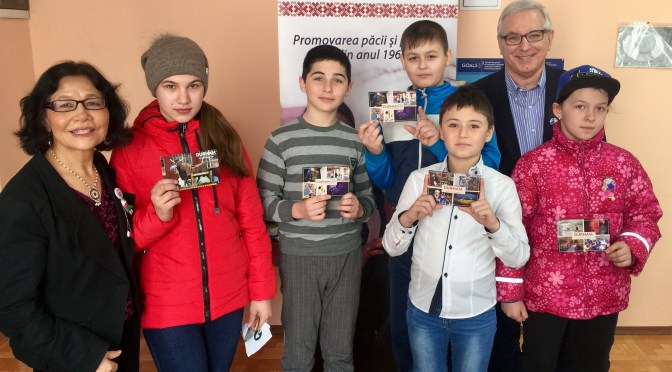
Yes, exactly. On Thursday, we handed out souvenir postcards of Durham, N.C., as prizes for students competing in geography quizzes we held during two presentations we gave in the town of Criuleni. Watching them react to the Durham bull and other landmarks from back home was an experience we won’t forget.

img_2926
Who wants to answer the geography question and win a postcard from Durham, N.C.?

My friends at the Durham Convention & Visitors Bureau gave me the cards before Champa and I left to join the Peace Corps last spring. Thanks anew to Shelly Green (@DCVBPrez) and her colleagues for helping us show off our home town with people we’ve met in Moldova. (Durham! Fresh Daily with great restaurants, arts and entertainment!)

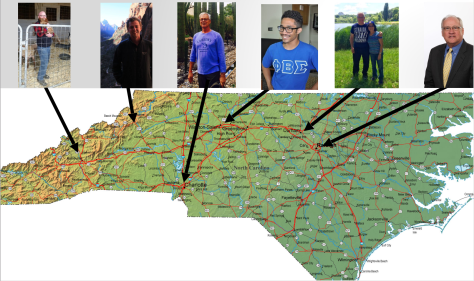
As I’ve written before, North Carolina has a special relationship with Moldova. Just in my group, we have volunteers from Asheville, Boone, Charlotte, Winston-Salem, Raleigh and, of course, Durham.

Champa and I went to Criuleni to help commemorate Peace Corps Week, the annual celebration of  President Kennedy’s founding of the Peace Corps on March 1, 1961. We joined other volunteers and country director Tracey Hébert-Seck in speaking at a week-long series of events organized by volunteers Chris Flowers and Rebecca Lehman. Further to the south, in Causeni, volunteer Anne Reed and her colleagues are planning a big event on Saturday to celebrate Peace Corps Week and International Women’s Month.

img_2938In our two presentations, Champa and I highlighted Peace Corps activities around the world. Our quizzes challenged the students to match photographs of Peace Corps volunteers with the countries where they served. In the middle photo of the three-photo strip above, for example, the boy is guessing which Peace Corps photos came from Albania, China or Swaziland. We also showed a video of our 2015 trip to Nepal and this video featuring people from 156 countries joining together to sing “All You Need Is Love.”

I don’t know whether Moldovan tourists will now start arriving in droves in the Bull City. But if they do, I’m sure they’ll enjoy themselves, whether they watch a show at DPAC, an exhibition at the Nasher Museum of Art, the Hayti Heritage Center, the weekly farmers’ market or a local beer at Fullsteam. After all, I have the postcards to prove it.

screen-shot-2017-03-03-at-8-50-27-am

Making Music

For a hard rock trio, you need a guitar, a bass and drums. For a string quartet: two violins, a viola and a cello. But for traditional music here in Moldova, get an accordion, a cobza, a nai and a tobă, as well as some people with great voices. You know what an accordion is. A cobza is a Moldovan lute, with eight strings. A nai is a pan flute, similar to those played in Bolivia. A tobă is a traditional drum.

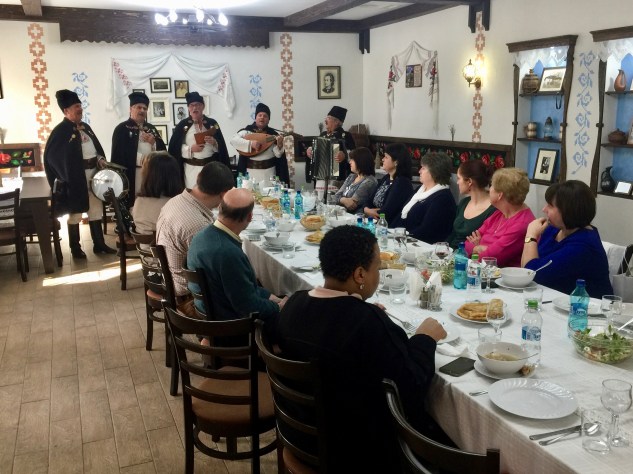
The musicians you see here play these instruments. They come from Constești, the village where Champa lived during her pre-service training. The lead singer, shown in the larger photo, is Tudor Grigoriţă, a colleague and friend of mine at the Consiliul Raional in Ialoveni. He organizes cultural activities for the entire county, or raion, of which Costești is a part. I usually see him wearing a suit, so it’s fun to watch him perform. That’s him in the video interacting with the nai, or flute, player, who is the music teacher in Costești.

Costești is near Ialoveni, where Champa and I live now. On Saturday, we traveled there to visit Champa’s host family and to meet Mary Pendleton, the first American ambassador to Moldova, from 1992-1995, after Moldova gained its independence from the former Soviet Union.

img_2848

We expected an informal gathering where Amb. Pendleton, now retired, would share some memories. Since she was a Peace Corps volunteer herself in Tunisia earlier in her career, she also wanted to meet some current volunteers. The mayor of Costești, Natalia Petrea, surprised us with a much grander event — a delicious meal at a beautiful local resort, with entertainment provided by this reknown local musical group. That’s the mayor, or primara, in the purple dress, next to the former ambassador, in pink.

Moldova, which shares many of its musical traditions with Romania, has other instruments, too, such as the bucium (a long alphorn), the kaval (an end-blown flute) and the cimbalom (a kind of dulcimer). But as you can see and hear for yourself, the ones shown here are quite enough to produce beautiful music together.

Ask a Question

img_1749What have you wondered about what Champa and I are doing in the Peace Corps? What questions do you have about Moldova, our service, our fellow volunteers, etc., or about what it’s been like for us to walk away from our American lives to do something so different? Ask us — either with a comment here or in a private message (djarmul@gmail.com). We’ll try to answer your questions in an upcoming post!

Hearing Voices

I gave a talk here recently about black holes and “singularities within the framework of general relativity.”

No, not because I used to work as a science writer. I was just reading aloud a passage about Stephen Hawking, the famous British physicist, that appears in Moldova’s national textbook for eighth-grade English classes.

img_2585

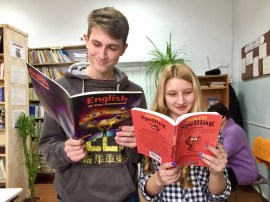
A fellow Peace Corps volunteer, Michelle McNeary, recorded me, as she’s recorded more than 20 other volunteers and, by long distance, her father reciting all 99 passages in this nation’s textbooks for grades five through nine. That’s Michelle in the top photo. She’s compiled the readings on a website called English for Moldova. It’s a great new resource for local students trying to improve their listening comprehension and pronunciation skills.

“The site features a huge variety of American voices and pronunciation,” says Michelle, an English education volunteer from California.

screen-shot-2017-02-22-at-9-07-58-am

Peace Corps volunteers have been teaching English ever since they came to Moldova in 1993. Michelle and other English teachers, including Champa, work daily alongside local teachers. Many of the volunteers in the three other Peace Corps programs here — health education, small business and community development — teach English informally through clubs and community classes. I teach two groups myself, as well as a weekly computer club for teenagers.

Two previous volunteers, Tim Schneider and Sarah Ewell, worked with the Ministry of Education to rewrite the country’s English textbooks a few years ago. They also tried to produce accompanying audio recordings but weren’t able to finish that part of the project.

screen-shot-2017-02-22-at-9-09-42-am

Michelle stepped into the gap initially to help a Moldovan partner teacher who’d been foregoing listening exercises with her students because she had no way for them to hear the sentences spoken correctly. Michelle developed a friendlier website structure and added features such as audio downloading. As a result, teachers and students can now go to the site or use their own device, click and listen easily while they read along.

“Part of our role here as English educators is to create resources that teachers and students can use,” Michelle says. “This project shows how much we want to provide assistance in whatever way we can.” The project has been a “highlight” of her service, she says, “and not one person hesitated when I asked them to read for it.”

Michelle, who graduated from the University of California, Riverside, will complete her Peace Corps tour this summer and return to her graduate studies at the Middlebury Institute of International Studies in Monterrey. I’m pretty sure she won’t be studying cosmology or quantum gravity there. I’ve already covered that for her.

The Big Box of Books

img_1420

These kids have a good reason to look so happy. On Monday afternoon, they were among the first students at Champa’s school to enjoy a big box of English-language books that just arrived.

img_2785The two older students in the second photo enjoyed the books, too. The box included everything from illustrated children’s books to short story collections.
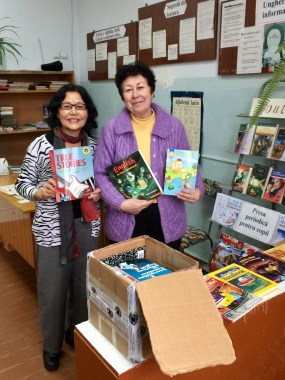
img_2781The school got them all for free. Champa requested them from Darien Book Aid, a nonprofit organization in Connecticut that’s been sending free books to developing communities since 1949. Its volunteers currently ship 20-30 boxes each week, or nearly 20 tons annually, to 190 countries and across the United States.
Maureen Shanley, a former Peace Corps volunteer in Colombia, picked out and packed the books for Champa’s box, along with a personal note. Maureen is also active in Connecticut Returned Peace Corps Volunteers. She and others work with the Darien Book Aid’s Peggy Minnis to send shipments to Peace Corps volunteers worldwide. img_1077They also send free books elsewhere in the developing world, and to libraries, prisons, hospitals and Native American and Appalachian groups in the United States.

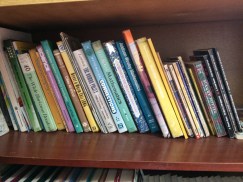
Until now, Liceul Teoretic Andrei Vartic in Ialoveni has had only a single small shelf of English books, few of them appealing, as you can see in the photo. Many of the students study English, so it’s no wonder the school librarian, Doamna Zinaida, was excited as she helped Champa open the box and pull out the treasures inside.

I’m so impressed by this organization. They’re doing something simple and meaningful, year after year, to improve people’s lives and make friends for our country.

img_2782.jpg

Darien Book Aid depends on donations to help cover their shipping costs so, if you’re moved by the photos you see here, I encourage you to support them. That’s what we plan to do after we return home.

Super Moldovans


Has someone ever inspired you? Inspirational people exist not only in America but here in Moldova, too. A few weeks ago, Peace Corps launched a social media campaign on Facebook to honor some of them as Super Moldovans.

Celia Joyce, a Peace Corps volunteer from Ohio, selected Ruslan Bistrița, a science teacher from her school with whom she’s posing in the top-left photo. Celia said all of the students and teachers “admire his dedication, kindness and willingness to help. I feel the same way and am lucky to work with him.”

screen-shot-2017-02-10-at-8-52-03-amIn the middle photo on top is Donna Barnes, formerly a professor at Howard University, who called her school director, Eudochia Babalici, a Super Moldovan for working “so long, with so little. She is a true inspiration to me.”

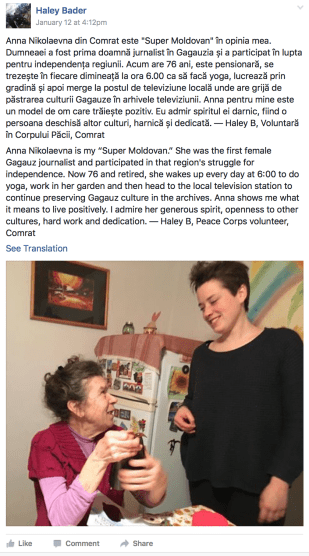
Champa is posing with our host family grandmother, or “bunica.” She wrote: “Nadejda Ciornea is my ‘Super Moldovan.’ She inspires me with her hard work and cheerful spirit. She is 86 years old and travels on public transportation every day to Chișinău, where she sells goods in the outdoor market, even during the winter. It is amazing how much energy she has. ‘Bunica’ is a caring person who makes me feel like a member of her own family. I am so lucky to know her.”

As you can see in the example from Haley Bader, volunteers are posting these salutes in both Romanian and English, with Peace Corps staff providing some translation help. Then the volunteers share the posts within their communities. Facebook is popular in Moldova, so local people see the nice things being said about their neighbors.


The response has been gratifying. Donna wrote: “When I showed the Super Moldovan page to my director with a picture of the two of us, her face lit up as though I had given her a pot of gold. I swear I made her day. She began sharing it with friends and family. She recently lost her husband and this is the first time in weeks I have seen her grin from ear to ear.”

Chris Flowers, in the maroon shirt above, got a similar reaction from his Super Moldovan, Ana Mirza, one of the leaders of Diamond Challenge in Moldova. Chris said Ana’s “face absolutely lit up. We often tell each other how much we appreciate the work we both do on the project but this gesture seemed very important to her and I’m very happy to have acknowledged her publicly.”

In the middle photo above is Peace Corps volunteer Alex Bostian, with his host mom, Valentina Efticov. On the right is Katrina Broughman with Nadejda Stoica, an English teacher and community leader.screen-shot-2017-02-05-at-4-47-00-pm

One of the first posters was Michelle McNeary from California. She’s honoring Rodica Novak, in the striped shirt, a senior in her high school whose “enthusiasm never ceases to amaze me.”

The Super Moldovans project began after our Peace Corps country director, Tracey Hébert-Seck, challenged Liuba Chitaev and me to think of a way to attract moreimg_2593 attention not only for volunteers but also for the great work being done by some of our Moldovan partners. Liuba manages communications for Peace Corps Moldova and, at Tracey’s request, I recently began working with her and others on communications projects, drawing on my own background in the field.
That’s Liuba at her desk in the photo. She helped to initiate the Super Moldovans campaign and has been doing a great job of managing it. She’s also planning some other new ways for Peace Corps Moldova to reach out to  various audiences.

It’s been a lot of fun to work with Liuba, who is full of energy and good ideas. She’s Moldovan, of course. Come to think of it, she’s pretty super, too.

Carolina du Nord

screen-shot-2017-02-08-at-7-45-32-am

Duke and UNC will compete again on Thursday evening in college basketball’s greatest rivalry, so it’s a good day to share my answer to anyone in Moldova who asks where Champa and I live in the United States: “Carolina du Nord” (Cair-o-LEE-na du nord).

screen-shot-2017-02-08-at-7-51-52-amFive other members of my Peace Corps group also call North Carolina home. As you can see in the top photo, we hail from Asheville, Boone, Charlotte, Winston-Salem, Durham and Raleigh. From the left, we’re Tim Crowley, Alex Bostian, Tom Harvey, Reggie Gravely, myself, Champa and Jim Fletcher. The six of us are now working as volunteers across Moldova.
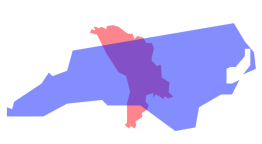
screen-shot-2017-02-08-at-7-46-26-am

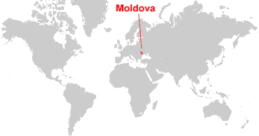
To give you a sense of scale, North Carolina (one of 50 U.S. states) is four times larger than Moldova, with roughly three times as many people.

North Carolina is famous for its barbecue; Moldova is known for its wine; North Carolina had Andy Griffith. Moldova has Andy’s Pizza. North Carolina produced the basketball star Stephen Curry;  Moldova’s national hero is Stephan cel Mare. On and on it goes.

It’s no wonder Moldovans and Tarheels have formed close ties. For more than 20 years, the N.C. Army National Guard has been helping to modernize Moldova’s military and police, screen-shot-2017-02-08-at-10-10-13-amproviding training in anti-terrorism, cyber defense, emergency medicine and other areas. In 1999, North Carolina established an official partnership with Moldova, which now includes the efforts of numerous private firms, civic organizations and nonprofit agencies. Secretary of State Elaine Marshall, who oversees the partnership, has visited Moldova at least 10 times.
North Carolinians have built playgrounds and a medical clinic, trained medical personnel and provided computers in Moldova. They’ve hosted more than 250 Moldovan farmers and hundreds of students at Southeastern Community College. UNC-Chapel Hill offers online education assistance. NC State pairs grade-school classrooms with Moldovan counterparts.

A personal story: When I contacted the NC State agricultural extension service  to see if they had any information that might help wine growers in my district, they responded by telling me about one of their professors who had just returned from Moldova to provide workshops on the subject.

img_8991
North Carolina members of our Peace Corps Moldova group gathered at our swearing-in ceremony last summer. From left, Tom Harvey (Charlotte), Alex Bostian (Boone), Tim Crowley (Asheville), Reggie Gravely (Winston-Salem), Champa Jarmul (Durham), Jim Fletcher (Raleigh) and David Jarmul (Durham)

North Carolina’s most visible presence in Moldova is its Peace Corps volunteers, who are teaching in schools, working with local governments and libraries and promoting small business efforts. screen-shot-2017-02-08-at-7-57-52-amOur ranks also include Mark Gilchrist, left, a volunteer in the group ahead of us. An article by Mark, who previously worked for the News Reporter in Columbus County, describes the collaboration in greater detail. Mark also produces an excellent blog and newsletter.

Another fellow volunteer and blogger, Rebecca Lehman, recently hosted a program that featured the many ties between North Carolina and Moldova. She produced the chart at the top of this post. Curiously, Rebecca herself came to Moldova from Cincinnati. She’s a remarkably nice person for someone who hails from a state with the audacity to call itself the birthplace of aviation just because the Wright Brothers came from Dayton.

The true home of aviation, of course, is Kitty Hawk, North Carolina, where the Wright Brothers first rose into the sky. Here in Moldova, regardless of which team we’re cheering for tonight, and despite all of the political turmoil of the past couple of years, we’re proud to call it our home, too.

#NCSecState

#NCNationalGuard