Tag Archives: Portugal

Danger on the Road

I was deeply saddened by the funicular tram accident in Lisbon on Wednesday, which claimed 15 lives, including foreign tourists.

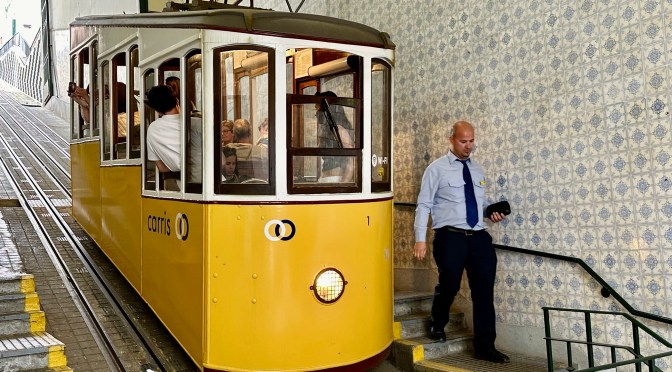
I could have been one of them, since we rode this tram when we visited Portugal last year. I remember spotting it from the Bairro Alto neighborhood where we were staying, right after we passed the street demonstration shown below. We rode the tram later and I snapped the photo atop this post.

The crash illustrates why some people fear traveling, especially to foreign countries: Something terrible might happen to them. They feel safer staying close to home.

I know from personal experience that bad things do indeed happen around the world.

In Sri Lanka, where we traveled earlier this year, the 2004 tsunami rose to the height of this Buddha’s head, killing tens of thousands of people. As in Portugal, we were lucky to not be there when this happened.

In 2015, we visited Nepal shortly after an earthquake killed nearly 9,000 people and caused extensive damage, as with this rubble pile near where we stayed. The earthquake could have struck while we were there.

We’ve also visited countries where we saw frequent reminders of recent wars and bloody violence. This exhibit is at the War Remnants Museum in Ho Chi Minh City in Vietnam, which we visited two years ago.

In neighboring Cambodia, we visited the Tuol Sleng Genocide Museum in Phnom Penh, with its chilling displays of the Khmer Rouge’s brutal reign.

Last year we saw this small memorial in the Plaza de Mayo of Buenos Aires. It honors the mothers who bravely protested the “disappearance” of their children during Argentina’s military dictatorship.
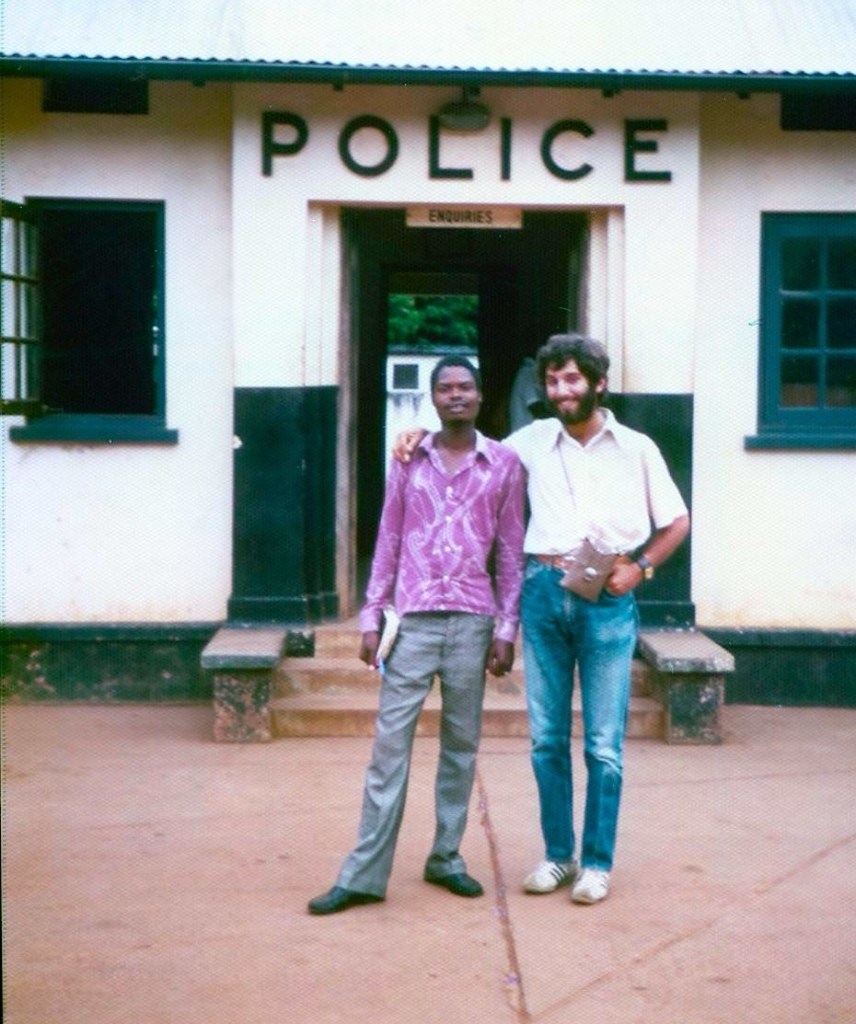
So I’ve seen plenty of examples of things going badly around the world, and I haven’t always been able to avoid them. Back in 1976, I made the mistake of visiting Uganda when it was ruled by the dictator Idi Amin. This photo shows me with a guy we met on the train while traveling there from Kenya. My friend, Mitch, and I were detained at this police station in Gulu and suspected of being spies. We were lucky to leave Uganda unharmed.

But bad things happen in our country, too. This photo shows Champa checking out the menu at a restaurant in Maui where we celebrated a special wedding anniversary in 2019. A few years later, much of Lahaina was destroyed by a wildfire, including this restaurant and the Airbnb where we stayed. They’re all gone, and it could have happened while we were there.

Some people we meet during our travels are scared to come to the United States because of all of our shootings and other violence, not to mention feeling unwelcome as foreigners. When I look at some recent notable shootings — Minneapolis, Las Vegas, Orlando and many more — I say to myself: Been there. Been there. Been there. In other words, just as with the tram in Lisbon, I was in the wrong place but at the right time. So here I still am.

Now here’s another shot from our Portugal trip, taken in the Douro Valley, the renowned wine region. As you can see, we thoroughly enjoyed our visit there. It was a wonderful day, one we would never have experienced if we’d stayed home, where we could have died in some random accident anyway. And it was just one day in one trip in one country of the many we’ve been fortunate to visit.

I’m writing this in Dubrovnik, Croatia, a place I’d long hoped to see for myself. It’s even more stunning than I expected. Tomorrow we’re heading to Bosnia and Herzegovina, where we’ll confront the horrors of the 1990s conflict, including in Sarajevo, but also meet interesting people, try new foods and learn about a country that cannot be defined only by its worst moments.

My heart goes out to all of the victims of the Lisbon tragedy, and their families, both Portuguese and foreign. Having traveled where their loved ones died, I feel a connection to their loss. But I will not let breathless news reports, recency bias or anecdotal evidence distort my assessment of actual danger, which I still consider very low if I’m careful.

That’s true back home and it’s true on the road. My conclusion is to keep traveling, enthusiastically, mindful of potential dangers but realistic about how dangerous they really are.

Most Popular Posts

Predicting the outcome of a game or an election is child’s play compared to the uncertainty I face as a blog author. I’ve been writing this blog for a decade and still can’t predict which posts will attract the most readers. 

According to my site statistics, for example, my most successful post of the past 12 months was Stones of Remembrance, about a COVID memorial in Buenos Aires. Back in May 2024, I described the memorial, shown below, and asked why our own country has done so little to honor the million-plus Americans who died during the pandemic.

I never expected that post to build an audience over time and end up first in Google’s rankings for searches on “Argentina Covid Memorial.”

As part of this blog’s 10-year anniversary, I’m pausing my regular content to pop open the blog’s hood and share some insights about it. I’m guessing this may be especially interesting to those of you who are fellow writers, social media users or data geeks. As you’ll see, though, my guess may well be wrong.

So back to the statistics.

My second-most popular piece of the year, Amazing But False, was about tour guides in Portugal, including the one above, who kept telling me a startling story about their country’s divorce rate. I knew the story was nonsense and was amused by their obstinancy in clinging to it. On a whim, I dashed off a quick post, which now ranks higher on Google than similar stories from the BBC and elsewhere.

Third was Momos Down Under, about the delicious Nepalese dumplings we ate in Australia and New Zealand, including at the shop in Christchurch shown above. The post is Google’s top hit for “momos in Australia.” For “momos in New Zealand,” it ranks second, behind a Tripadvisor guide on the topic.

I enjoyed writing all three posts but, honestly, they meant less to me than some others, like my recent story and video about the school we helped build in Nepal. All three were just interesting things I observed while traveling.

I don’t check my traffic statistics often and haven’t discussed them here since 2017, when I reached 200 posts. I write for fun, not as a business, and have resisted inquiries about monetizing this site.

My most popular story back in 2017 remains atop my all-time list. This one isn’t a surprise. Peace Corps After 50, which I wrote while serving in Moldova, was promoted on a PBS website, above, and elsewhere. It’s been attracting views ever since, presumably from older Americans thinking about applying. Over time, it’s slipped in the Google rankings, but that’s unsurprising since Google’s algorithm favors fresher content.

Ah, the Google search engine algorithm. It’s their mysterious, ever-changing formula for ranking pages. Advertisers, political consultants and others obsess about it. I wish I still had my crack Duke University social media team available to advise me why my stories about a foreign memorial and divorce rate have done so well. Maybe it’s because they were both on niche topics where my article could stand out more than one about Middle East autocracies or even Magical Kathmandu.

Or maybe there’s another reason. If you have any insights, please share them with a comment. Don’t wait, though. Before we all know it, artificial intelligence is likely to transform the entire search engine business, which extends beyond Google.

Another measure of user interest is file downloads from a site. At the top of my site’s download list are the lyrics to Orașul Meu, the song and music video I produced with Moldovan singer Laura Bodorin. That song is still being performed in Ialoveni, the city where we created it.

Speaking of users, most of mine live in the United States, followed by Moldova, Germany, the United Kingdom and Canada. Rounding out the top ten are Nepal, Romania, Australia, India and China. Readers in more than 150 countries have visited the site at least once.

I produce the site using the TwentyFourteen theme on WordPress.

I might now close by expressing my deep appreciation to the web designers, editors and others who work with me on the site. However, the entire operation is just me, with 384 posts so far and more to come.

Looking ahead, I hope to keep entertaining you with whatever travels, topics and musings come next, even as I acknowledge my inability to predict which posts you’ll find interesting. 

That unpredictability extends to this post. I have no idea how many people will read it. Maybe nobody. Maybe a lot. Who knows? Now that you’ve reached the end, though, I know that at least one person finished it, so maybe my odds just got a little better.

Top photo: Tram near our Airbnb in Lisbon. Photo by Karen Simon.


Subscribe to Not Exactly Retired. It’s free!

Amazing but False

Whether it’s voting results, vaccines or space lasers, many Americans cling to dramatic stories long after they’re shown to be nonsense.

As I saw during our recent trip to Portugal, Americans are not alone. People everywhere prefer a good story to a factual one.

Two of our guides there told us the same amazing, but false, story. When I questioned them about it, one guide avoided the conversation and the other told me I was ruining his narration. They undoubtedly found me annoying even though I was right.

The story involved Portugal’s high rate of divorce. Daniel, our guide in the university town of Coimbra, shown above, said 94 percent of married couples got divorced during the Covid pandemic. Wait a minute, I thought to myself, 23 or 24 of every 25 married couples got divorced? That couldn’t possibly be true, no matter how stressed out people were from Covid.

“Are you sure that’s right?” I asked Daniel quietly.

“Oh, yes,” he responded confidently. “I saw it on television. Portugal has a really high divorce rate. It’s a big problem for us.”

I’m sure it is, but 94 percent? My BS Detector, which I cultivated during my career as a science writer, began blaring in my head.

I lagged behind the group, pulled out my phone and checked the facts. Portugal’s 94% “divorce rate” was an actual statistic but not what Daniel and our subsequent guide in the Douro Valley wine region said it meant, namely that 94 percent of couples got divorced.

Instead, it was a comparison of the total number of divorces to the total number of marriages in a given year. During the pandemic, divorces rose while marriages declined, so the ratio climbed to 94 percent. The odds that a specific couple would divorce, however, remained much lower.

Sure enough, after the pandemic ended, Portugal’s divorce-marriage ratio decreased dramatically to normal levels.

As we continued walking, I whispered to Daniel that I had uncovered the discrepancy and could explain it to him after the tour ended. He gave me a tight smile and, as soon as everyone dispersed, he left.

Our Douro Valley guide, Carlos, couldn’t escape since we were in a car together. After he told the same story, he had no choice but to listen to my brief explanation of what “94 percent” actually measured. Carlos laughed that he still preferred his version even though it wasn’t true.

I knew I was coming across as a know-it-all American retiree.  But having spent much of my career assessing scientific claims before agreeing to write about them, I’ve developed a sixth sense about statistics being misused. I’ve written or edited countless articles about research findings and consider accuracy more essential than popularity, even when my wife reminds me we’re on vacation.

This all happened two weeks ago but I’ve kept wondering about it, even though it’s hard to imagine anything that affects my own life less than Portugal’s divorce rate.

Am I just being a mansplaining jerk? Or did this episode highlight something deeper about human behavior that informs the situation we face here in America? As I’ve tuned in again to our angry political controversies and “fake news” accusations, with politicians peddling scary anecdotes that misrepresent larger realities, much of it sounds to me like the Portugal divorce story — catchy, unnerving but wrong.

I’m not sure what to think. For now I’m assessing my own uncertainty level at 94 percent. I’m also keeping my BS Detector turned on. 

Portugal Chill

Chill, with hills.

That was our trip to Portugal: beautiful sights, good food, friendly people, relatively inexpensive and easy to like — if you don’t mind walking up and down hills.

Champa and I traveled there with our friends Karen and Bob after touring Morocco, where our packed itinerary took us from urban bazaars to a tent camp in the Sahara Desert. We figured we could relax once we got to Portugal.

That’s what we did, although “relax” is relative when it comes to Bob and me, the travel planners, who both tend to load activities into itineraries. In Portugal, we would stay in three cities — Lisbon, Coimbra and Porto. We vowed to slow down by orienting ourselves in each one with a free walking tour and then wandering on our own. 

As I’ve written previously, I love these tours since the guides are highly motivated to do a great job. In Portugal, we booked five tours altogether, including three in Lisbon. Four of them were with Sandeman’s, which I’d used in Brussels, Amsterdam, Edinburgh and Dublin. Once again, they were excellent and we tipped our guides accordingly.

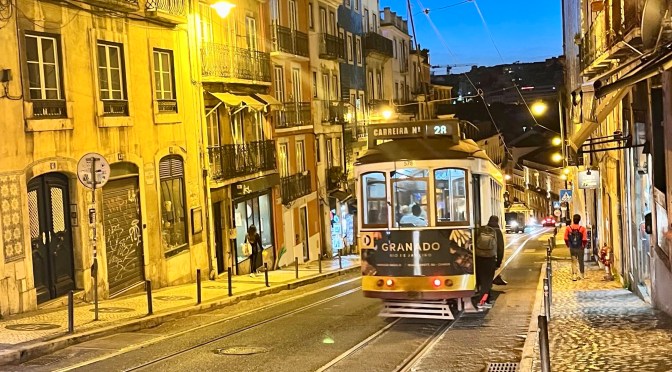
We started in Lisbon, staying in an Airbnb in the artsy Bairro Alto neighborhood. The famous Tram 28, which winds through the city, rumbled below our window. Our apartment owner was a professional designer, and his place was filled with paintings, sculptures and art books. It was like living inside Architectural Digest, although we lacked some functional things like a latch to the bathroom and places to put our suitcases. Still, we enjoyed it, including the neighborhood fish restaurant downstairs.

Our Uber driver from the airport was from Nepal. So was our waiter at the breakfast restaurant the next morning. There was a Nepalese restaurant up the street. They were all surprised when I started talking Nepali, much less seeing me with Champa.

We timed our Lisbon visit to coincide with the 50th anniversary of Portugal’s Carnation Revolution, when a military coup toppled the fascist dictatorship of António Salazar. People filled the streets holding red carnations. They cheered as aging former coup members waved from old military vehicles. Given what’s been happening in our own country, the four of us felt like cheering, too, as we watched people reaffirm their commitment to democracy.

Back in the 15th and 16th centuries, the Portuguese were at the forefront of European exploration. They were the first to reach India by sea, settled what became Brazil and established trading posts in Asia and Africa. Despite its small size, Portugal became one of the world’s most powerful countries, as we saw celebrated at the tomb of Vasco da Gama and at Lisbon’s “Monument of the Discoveries.” It’s a fascinating but complicated legacy.

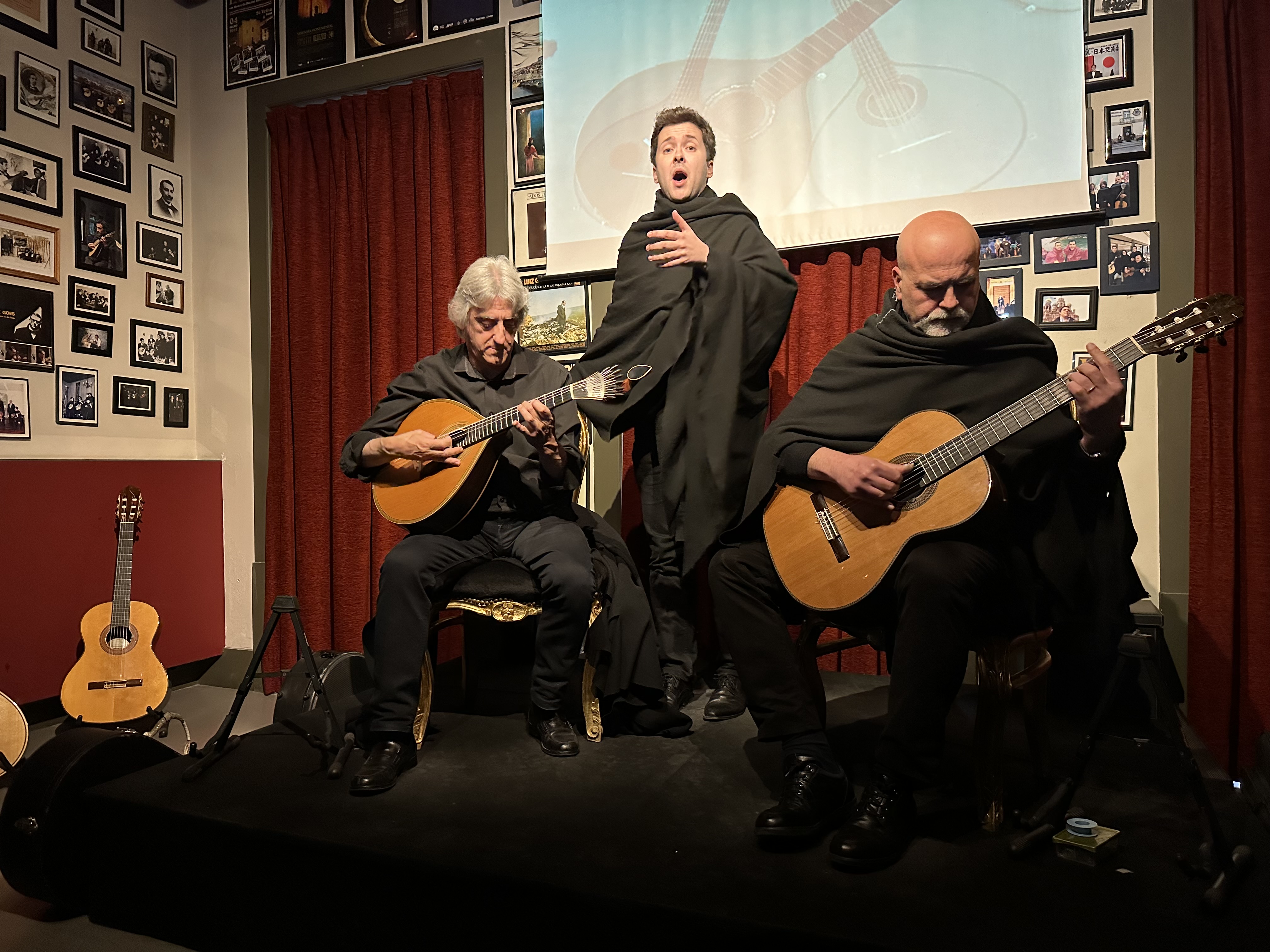
Our second stop was Coimbra, known for its great universities, which we visited as students prepared for graduation in black robes that reminded me of both Harry Potter and the many graduations I attended at Duke. We also went to a concert of fado music, the melancholic genre featuring mournful songs and guitars.

Then we continued north to the Douro Valley, with its stunning scenery and wineries, and Porto, the country’s second largest city. Since there were four of us, we hired cars and drivers instead of riding the trains. It cost only a bit more and proved much more convenient. We were picked up and dropped off everywhere and could stop along the way at the castles of Óbidos, the Batalha Monastery and the “Little Venice” town of Aveiro, among other places.

Oh, yes, the hills. I wrote recently that my experience in Nepal has made me smug about “mountains” around the world. Portugal’s highest mountain, Mount Pico, is a mere 7,713 feet, just over a quarter of Mount Everest’s height. But “hills” are a different story. Portugal has them everywhere, reminding me of San Francisco. They were a great way to walk off some of the pastries we ate, from Portugal’s famous pastel de nata tarts to regional delicacies such as Aveiro’s ovos moles.

Looking back, I guess we were busier than “chill, with hills.” Let’s just say that Portugal left us feeling elevated.