Tag Archives: Peace Corps

Travel Fair

If you haven’t planned your summer vacation yet, how about a trip to Macedonia, Ukraine or Bulgaria?

IMG_3612Not for you? Well, then maybe someplace here in Moldova: to see crafts in Nisporeni, a beautiful mansion in Hîncești or the castle in Soroca?

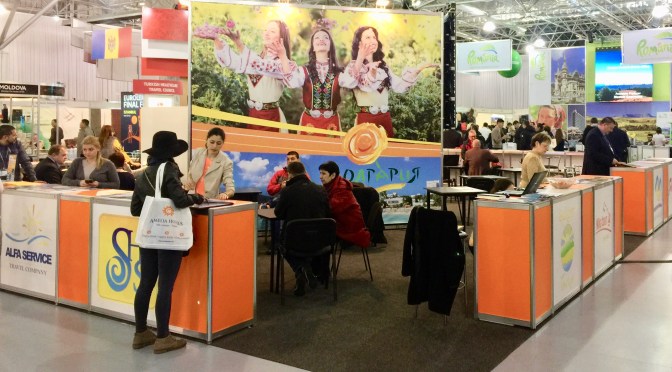
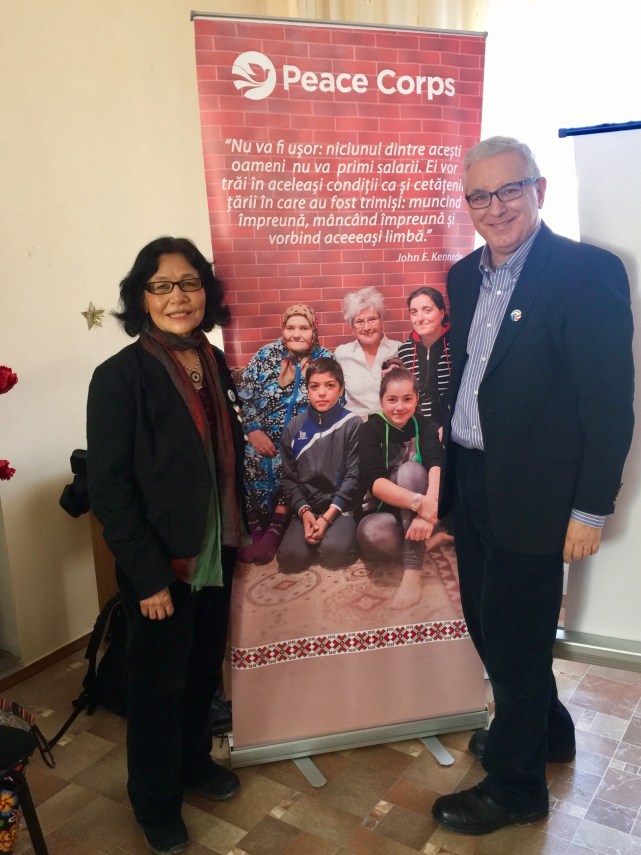
All of these destinations had booths at a travel fair Champa and I attended on Saturday at the MoldExpo convention center in Chișinău. There was also information about destinations more familiar to American travelers, such as Greece, Israel and Hungary. But most were places you’ve probably never heard of, much less considered visiting.

IMG_3673In other words, it was our kind of travel fair. We went there to gather information for a trip we hope to take at the end of 2017 to Bulgaria, Macedonia and Albania. But we were also curious to see what the travel industry looks like in this part of the world. I’ve also been working with several other Peace Corps volunteers on a project to highlight the importance of friendly customer service and online marketing for Moldovan travel destinations.
IMG_3610

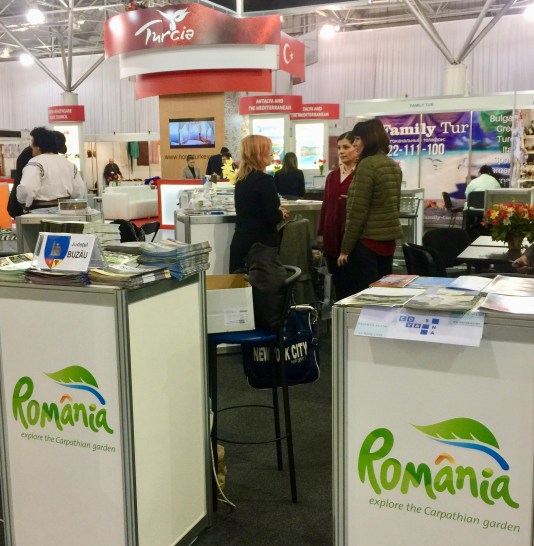
Bulgaria, Romania and Turkey had some of the biggest exhibits at this weekend’s fair. All are popular among Moldovans who have the means and interest to travel. Moldovan national travel organizations and companies had exhibits, too, as did some of its 37 raions, or districts. There was a small booth for Georgia, where an enthusiastic guy told us about that country’s hiking, food scene and night life in Tbilisi. We also picked up brochures for everything from holidays in Montenegro to the painted monasteries of Bucovina, Romania.

My favorite booth was for the Slovak Republic, where I recognized the man in a casual shirt and blue jeans who was laying out brochures and pouring free beer. It was Robert Kirnág, the Slovak ambassador to Moldova, who I met last month at a ceremony to launch a water project.

IMG_3631

I said hello and he thanked me for the the article I wrote about the  project, which his embassy posted on its website. We chatted and posed for the photo you see here of him with Champa, me and our friend Denise, a Peace Corps volunteer from California who is working with me on our tourism project. He also told us more about Slovakia, which we now plan to visit if only because we like its ambassador so much.

Champa’s favorite moment was learning to paint an egg in the traditional style of Romania, which we’re visiting in one week. In my next post, I’ll show you what she created.

Buying Groceries

Shopping in Moldova can include Heinz ketchup, Lay’s potato chips, Tide detergent, Nescafe and a Coke. Add a bag of Skittles, too, if you want.

When Champa and I shop for groceries in Ialoveni, however, we usually buy products made in Moldova or in nearby countries such as Ukraine, Russia or Romania.

We cook our own food, a mixture of Nepalese, American and Moldovan dishes. There’s no doubt we eat better than some other Peace Corps volunteers around the world, especially since we live in a small city, but we always stay within our official food budget. Our daily diet is more modest than some of these photos suggest.

The local bread comes in many forms and is cheap and delicious. Cheeses are great, too. As you see, they come in many varieties. Salami is a local favorite. We love the fresh chicken and pork, which is much tastier than our supermarkets sell back in Durham. (Yes, that’s a pig’s head in the photo.)

Moldova is famous for wine and, as I’ve noted previously, its grocery shelves are stocked with local merlots, cabernet sauvignon, chardonnay and more, as well as cognacs, brandies and sparkling wines. The Ialoveni Winery is just up the street from us.

Our neighborhood markets also offer cakes from local bakeries, noodles from local pasta makers, candies from local confectioners and, of course, local fruits and vegetables that will soon be abundant and delicious. No surprise, we eat a lot of rice. We also can enjoy cheeses from Holland, persimmons from Israel and beer from Germany. One block from our house is the Sandra ice cream factory, with flags from both France and Moldova.

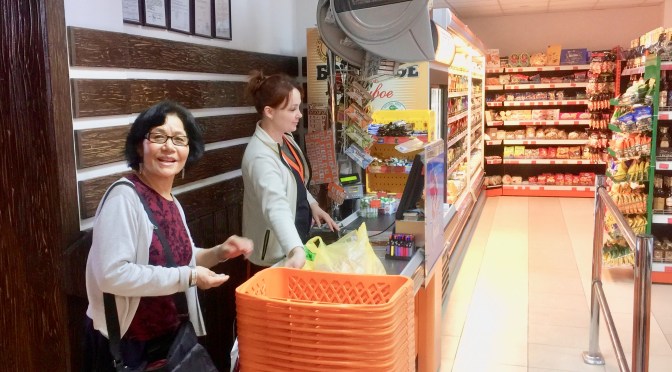
Champa and I have become regular customers at all of Ialoveni’s grocery stores, including two Victoria Markets and a UniMarket. We also shop at the Casa Cărnii store shown above, where I shot many of the photos in this post, and at some of the kiosk shops we pass on the main street as we walk home. Local farmers and vendors sell goods along the sidewalk, too.

IMG_3593

Just up the street is an apartment complex with a corner market where we often buy groceries. If you look carefully at the photo, to the left of the door, you’ll see it also offers an ATM machine for our bank. The “Farmacie” to the right of the door is actually a separate shop. Downstairs, by the yellow brick, is another shop, selling meat. The windows to the right are yet another shop, selling soaps and toiletries.

In other words, shopping in Ialoveni is a mixture of small grocery stores, neighborhood shops resembling bodegas and smaller shops specializing in certain kinds of products. At the other end of the spectrum is Moldova’s “super store,” Metro, which resembles Costco. We’ll visit there in a future post. Right now, I’m hungry.

***

Have you responded yet to my reader survey? I would love to hear from you. Since we’re probably too far apart to talk in person, this is my best way to know what you and other readers want. Please click herethe survey takes just a moment. Thank you!

Web Designers

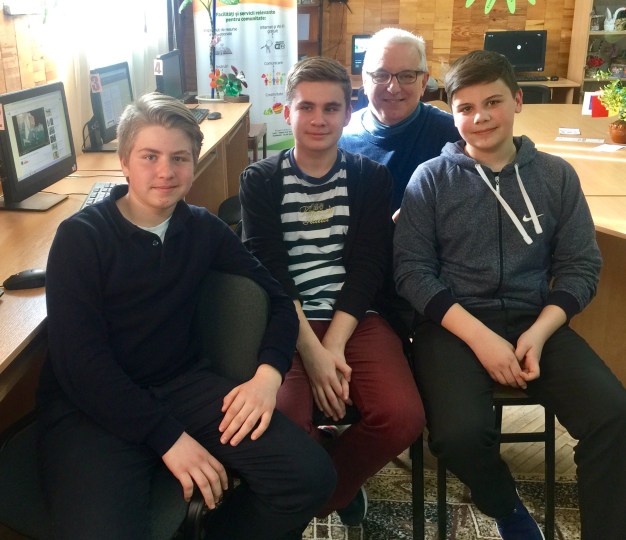
This is Mihai, with the first website he ever designed. It’s about our city, Ialoveni.

Victor has his first website, too, about Moldova’s famous wines.

This boy, also named Mihai, made his first website about his family.

IMG_3368

All three boys are in my weekly computer class at the Ialoveni library. During the past several months, they’ve learned some JavaScript, Excel and other programs. Two weeks ago we turned our attention to website design. Since I am most familiar with WordPress, which is also available in Romanian, that’s what I told them to use to build their first sites.

In fact, I created this post — the one you’re reading now — while they were watching, to show them how to do it. I snapped their photos with my iPhone, uploaded them to my blog on WordPress and inserted them here.

Perhaps you were surprised by Victor’s site about Moldovan wine, given how young he is. When I pointed this out to him, he produced the following screen. Enjoy:

IMG_3370

Poems, Dances and Songs

Ialoveni students performed poems, dances and songs to welcome Claudia Partole, a popular Moldovan author of children’s stories and other books. She spoke at the local library. Don’t miss Champa receiving her certificate. (The video is also on YouTube at https://youtu.be/_eRms9fmshU.)

Our Favorite Food


This slideshow requires JavaScript.

What’s our favorite food here in Moldova? That’s easy: Placinte (plah-chin-teh), the soft, savory, mouth-watering pastries stuffed with cabbage, potatoes, apples, cherries or other delights.

We especially enjoy placinte made with brinza, the traditional cheese usually produced from sheep’s milk, similar to crumbled Greek feta cheese.

I’m writing “placinte” in the plural form because it’s nearly impossible to eat only one placinta.

Some Moldovans make round placinte, like thick pancakes. Others swirl them into into spirals or pat them into triangles. On Sunday, Champa learned how to roll them into a shape like breadsticks.

She had two great teachers: Natalia, an adult niece of our host family, and Bunica, our 86-year-old host grandmother who is such a beloved part of our lives here.

The recipe was simple: Combine the brinza cheese with some eggs, dill and salt. Roll out pastry dough on a towel in the shape of a rectangle, Place the cheese mixture along one end of the rectangle. Gently lift the towel under the cheese side of the rectangle and roll the dough in the opposite direction, forming a long tube. Place the tubes on a greased pan, seam sides down, and bake at medium heat for about 40 minutes.

IMG_3339At the bottom of this post is a video of Bunica showing the rolling process. When she says “Gata” at the end, it means “Ready!” My own job came after the placinte emerged from the oven, tasting them to see whether they were even more delicious than the placinte we buy in local stores.

They were. We ate most of them fresh out of the oven. Mmm. Placinte!

If you’re feeling inspired and/or hungry after reading this, you can easily find several YouTube videos showing how to make placinte yourself. When they come out of your oven, don’t forget to say, “Gata!”

I bet you can’t eat just one.

Bardar Water Project

Moldova’s wells are omnipresent, picturesque and often unsafe, with water that may contain parasites or chemicals. I photographed these two when I lived in the village of Bardar during my Peace Corps training.

IMG_3237

Soon their water quality won’t matter so much. On Friday, I attended the kickoff conference for a project that will connect Bardar to a modern water system, providing safe running water for many of its 6,000 residents.

The Slovak Republic, primarily through SlovakAid, is donating financial and technical support for the project, which is scheduled to run through May 2018.

IMG_3198
Ambassador Robert Kirnág, center, and other Slovakian officials spoke at the meeting.

“Fresh drinking water is a fundamental right of people,” Robert Kirnág, the Slovak ambassador to Moldova, said at the meeting in Ialoveni’s business center. “Water will remain a problem in Moldova for many years to come. We’ve identified water, sanitation and waste management as a priority.”

“Water is life; it is critical for people everywhere,” agreed Michal Mlynár, director general for international organizations and development cooperation in Slovakia’s foreign ministry. The Bardar project will “make a difference in the lives of ordinary people in the region.”

IMG_3183The Consiliul Raional of Ialoveni district, of which Bardar is a part, is carrying out the project collaboratively with Moldova’s Regional Development Agency Center (ADR Centru) and the Regional Development Agency Senec-Pezinok in Bratislava, Slovakia’s capital.

ADR Centru shares the fourth floor of the Consiliul Raional building in downtown Ialoveni. I work there myself and know people at both organizations. It’s great to see them collaborating to benefit the village where I had my training. At Friday’s meeting, I sat with my friend Mihail Tonu, Bardar’s vice mayor.

The project seeks not only to provide clean water for Bardar but also to raise awareness among public authorities and the public about the importance of water system management and quality drinking water.

Anatolie Dimitriu, president of the Consiliul Raional, called Friday “a very special day,” noting how the project will benefit Bardar and accelerate the process of providing clean drinking water throughout the district. The project is the first phase of a broader plan to distribute clean water more widely.

Eduard Ungureanu, from Moldova’s national ministry of regional development and construction, called the collaboration “historic,” one that ADR Centru Director Viorel Jardan predicted “won’t be the last” for Ialoveni district or Moldova.

IMG_3192
Moldovan officials thanked the Slovak Republic for its assistance and expressed enthusiasm for the new water project.

Two development specialists from Slovakia, Katarína Manczalová and Eva Balažovičová, also spoke at the meeting, emphasizing the importance not only of the tangible benefits but also of the trust and relationships being established. Following the kickoff ceremony and a traditional Moldovan lunch, they and others remained for technical discussions with their Moldovan counterparts.

Many buildings in Bardar already have running water through individual or neighborhood systems, supplemented by the wells, but the water from the new system will be safer and more reliable. In a very tangible way, it will improve people’s lives.

Bardar will still have its wells, of course, many of them adorned with crosses and religious iconography. Their beauty will remain a rich part of this region’s landscape and cultural heritage even as their threat to the public health subsides.

Subscribe to this blog — it’s free!

Your Questions Answered

What do I miss the most from my U.S. life?

That was one of the questions I received recently after inviting readers to ask me anything. It came from Lisa, a science-writer friend from Bethesda, Md. It was a great question, to which my answer has only two words: My family.

IMG_2964
We’re thoroughly enjoying our Peace Corps experience but we miss our family.

My answer to Lisa’s follow-up question — was I surprised to miss them the most? — is even briefer: No. We expected to miss them every day, and we have.

Sorry, Lisa, I’m usually chattier than that.

I loved the questions you all sent. My friend Barry, who served with me in Peace Corps Nepal, asked whether we’ve met other Nepalis in Moldova. We haven’t, but we did meet a translator who helped a Nepalese family that came here for their daughter’s wedding with a Moldovan guy. She said the couple lives abroad and left Moldova after the wedding. Too bad.

Another returned Peace Corps volunteer asked what impact Peace Corps is having on “the anti-American view of many (especially older) Moldovans?” I’m not sure how to answer that because I don’t think “many” Moldovans are anti-American. Most of the Moldovans I’ve met seem to like Americans, although Champa and I do live in an especially pro-Western part of the country.

IMG_1679

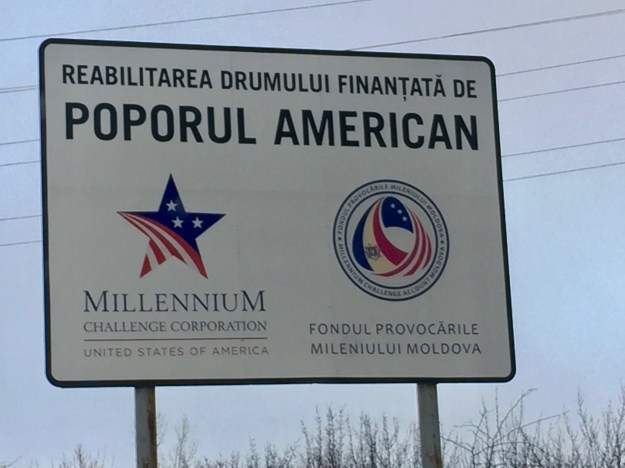
In any case, Peace Corps volunteers definitely enhance the relationship between our two countries as they provide service, live modestly, learn the language and embrace the local culture.You also see signs of American assistance everywhere, from the USAID decals on recycling bins to this sign noting how the United States helped repair a road  in the northern part of the country.

Another RPCV, Ron, who served in Venezuala, asked how younger volunteers are feeling about their job and career prospects, and also about Peace Corps’ future with the new presidential administration. I’ve become friends with many of the volunteers here who are in their 20s and 30s. Those finishing this summer have diverse plans, with many applying to graduate schools or looking for jobs. Their levels of anxiety or anticipation vary, as you’d expect, which is also true among older volunteers. As for the future of Peace Corps with the Trump administration, well, nobody knows yet. We’re all watching and wondering ourselves.

An incoming volunteer, Julie, asked whether I’d read the book Moldovan Autumn by local author Ion Druță. I haven’t, but it’s now on my list. In turn, let me recommend Bessarabian Nights, by Stela Brinzeanu, for anyone interested in Moldova. It’s a recent novel that focuses on trafficking and other social problems. You’ll learn a lot from it.

IMG_7277Julie also asked whether I’ve sent any postcards to people back home. I shared lots of postcards from Durham with two Moldovan groups, as I described recently, and I mailed home local holiday cards to our two sons, but we haven’t yet mailed home any Moldovan postcards. Now that you mention it, Julie, I haven’t seen many for sale here.

Finally, my friend Bob, who stepped down from his job in the White House science office shortly before President Obama completed his term, sent our favorite question of all. He and his wife Karen, shown here,  asked when would be a good time to visit us in Moldova. That’s a question we like to hear, and we’re already discussing the answer.

I’m closing the blog mailbag for now but, trust me, if you write back with a question half as good as Bob’s, I will respond immediately.

Durham in Moldova

img_2950

Duke Chapel, the Durham Bulls Athletic Park and the American Tobacco Campus are among the destinations I’ll be featuring today.

Wait, you’re thinking, isn’t this blog about our experiences as “not exactly retired” Peace Corps volunteers in Eastern Europe?

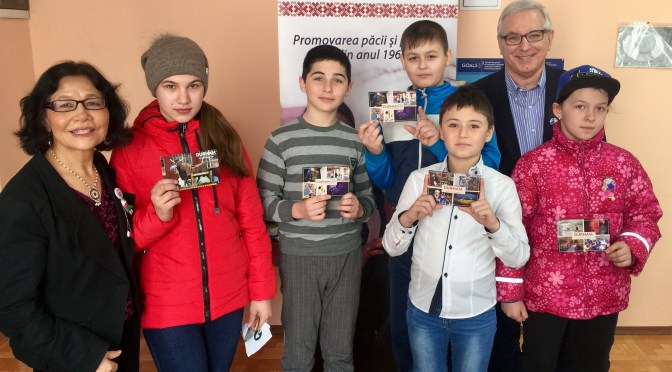
Yes, exactly. On Thursday, we handed out souvenir postcards of Durham, N.C., as prizes for students competing in geography quizzes we held during two presentations we gave in the town of Criuleni. Watching them react to the Durham bull and other landmarks from back home was an experience we won’t forget.

img_2926
Who wants to answer the geography question and win a postcard from Durham, N.C.?

My friends at the Durham Convention & Visitors Bureau gave me the cards before Champa and I left to join the Peace Corps last spring. Thanks anew to Shelly Green (@DCVBPrez) and her colleagues for helping us show off our home town with people we’ve met in Moldova. (Durham! Fresh Daily with great restaurants, arts and entertainment!)

As I’ve written before, North Carolina has a special relationship with Moldova. Just in my group, we have volunteers from Asheville, Boone, Charlotte, Winston-Salem, Raleigh and, of course, Durham.

Champa and I went to Criuleni to help commemorate Peace Corps Week, the annual celebration of  President Kennedy’s founding of the Peace Corps on March 1, 1961. We joined other volunteers and country director Tracey Hébert-Seck in speaking at a week-long series of events organized by volunteers Chris Flowers and Rebecca Lehman. Further to the south, in Causeni, volunteer Anne Reed and her colleagues are planning a big event on Saturday to celebrate Peace Corps Week and International Women’s Month.

img_2938In our two presentations, Champa and I highlighted Peace Corps activities around the world. Our quizzes challenged the students to match photographs of Peace Corps volunteers with the countries where they served. In the middle photo of the three-photo strip above, for example, the boy is guessing which Peace Corps photos came from Albania, China or Swaziland. We also showed a video of our 2015 trip to Nepal and this video featuring people from 156 countries joining together to sing “All You Need Is Love.”

I don’t know whether Moldovan tourists will now start arriving in droves in the Bull City. But if they do, I’m sure they’ll enjoy themselves, whether they watch a show at DPAC, an exhibition at the Nasher Museum of Art, the Hayti Heritage Center, the weekly farmers’ market or a local beer at Fullsteam. After all, I have the postcards to prove it.

screen-shot-2017-03-03-at-8-50-27-am

Making Music

For a hard rock trio, you need a guitar, a bass and drums. For a string quartet: two violins, a viola and a cello. But for traditional music here in Moldova, get an accordion, a cobza, a nai and a tobă, as well as some people with great voices. You know what an accordion is. A cobza is a Moldovan lute, with eight strings. A nai is a pan flute, similar to those played in Bolivia. A tobă is a traditional drum.

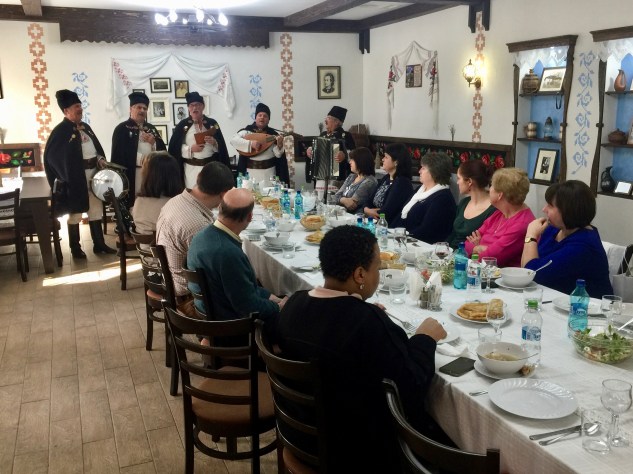
The musicians you see here play these instruments. They come from Constești, the village where Champa lived during her pre-service training. The lead singer, shown in the larger photo, is Tudor Grigoriţă, a colleague and friend of mine at the Consiliul Raional in Ialoveni. He organizes cultural activities for the entire county, or raion, of which Costești is a part. I usually see him wearing a suit, so it’s fun to watch him perform. That’s him in the video interacting with the nai, or flute, player, who is the music teacher in Costești.

Costești is near Ialoveni, where Champa and I live now. On Saturday, we traveled there to visit Champa’s host family and to meet Mary Pendleton, the first American ambassador to Moldova, from 1992-1995, after Moldova gained its independence from the former Soviet Union.

img_2848

We expected an informal gathering where Amb. Pendleton, now retired, would share some memories. Since she was a Peace Corps volunteer herself in Tunisia earlier in her career, she also wanted to meet some current volunteers. The mayor of Costești, Natalia Petrea, surprised us with a much grander event — a delicious meal at a beautiful local resort, with entertainment provided by this reknown local musical group. That’s the mayor, or primara, in the purple dress, next to the former ambassador, in pink.

Moldova, which shares many of its musical traditions with Romania, has other instruments, too, such as the bucium (a long alphorn), the kaval (an end-blown flute) and the cimbalom (a kind of dulcimer). But as you can see and hear for yourself, the ones shown here are quite enough to produce beautiful music together.

Ask a Question

img_1749What have you wondered about what Champa and I are doing in the Peace Corps? What questions do you have about Moldova, our service, our fellow volunteers, etc., or about what it’s been like for us to walk away from our American lives to do something so different? Ask us — either with a comment here or in a private message (djarmul@gmail.com). We’ll try to answer your questions in an upcoming post!