Tag Archives: Nepal

Most Popular Posts

Predicting the outcome of a game or an election is child’s play compared to the uncertainty I face as a blog author. I’ve been writing this blog for a decade and still can’t predict which posts will attract the most readers. 

According to my site statistics, for example, my most successful post of the past 12 months was Stones of Remembrance, about a COVID memorial in Buenos Aires. Back in May 2024, I described the memorial, shown below, and asked why our own country has done so little to honor the million-plus Americans who died during the pandemic.

I never expected that post to build an audience over time and end up first in Google’s rankings for searches on “Argentina Covid Memorial.”

As part of this blog’s 10-year anniversary, I’m pausing my regular content to pop open the blog’s hood and share some insights about it. I’m guessing this may be especially interesting to those of you who are fellow writers, social media users or data geeks. As you’ll see, though, my guess may well be wrong.

So back to the statistics.

My second-most popular piece of the year, Amazing But False, was about tour guides in Portugal, including the one above, who kept telling me a startling story about their country’s divorce rate. I knew the story was nonsense and was amused by their obstinancy in clinging to it. On a whim, I dashed off a quick post, which now ranks higher on Google than similar stories from the BBC and elsewhere.

Third was Momos Down Under, about the delicious Nepalese dumplings we ate in Australia and New Zealand, including at the shop in Christchurch shown above. The post is Google’s top hit for “momos in Australia.” For “momos in New Zealand,” it ranks second, behind a Tripadvisor guide on the topic.

I enjoyed writing all three posts but, honestly, they meant less to me than some others, like my recent story and video about the school we helped build in Nepal. All three were just interesting things I observed while traveling.

I don’t check my traffic statistics often and haven’t discussed them here since 2017, when I reached 200 posts. I write for fun, not as a business, and have resisted inquiries about monetizing this site.

My most popular story back in 2017 remains atop my all-time list. This one isn’t a surprise. Peace Corps After 50, which I wrote while serving in Moldova, was promoted on a PBS website, above, and elsewhere. It’s been attracting views ever since, presumably from older Americans thinking about applying. Over time, it’s slipped in the Google rankings, but that’s unsurprising since Google’s algorithm favors fresher content.

Ah, the Google search engine algorithm. It’s their mysterious, ever-changing formula for ranking pages. Advertisers, political consultants and others obsess about it. I wish I still had my crack Duke University social media team available to advise me why my stories about a foreign memorial and divorce rate have done so well. Maybe it’s because they were both on niche topics where my article could stand out more than one about Middle East autocracies or even Magical Kathmandu.

Or maybe there’s another reason. If you have any insights, please share them with a comment. Don’t wait, though. Before we all know it, artificial intelligence is likely to transform the entire search engine business, which extends beyond Google.

Another measure of user interest is file downloads from a site. At the top of my site’s download list are the lyrics to Orașul Meu, the song and music video I produced with Moldovan singer Laura Bodorin. That song is still being performed in Ialoveni, the city where we created it.

Speaking of users, most of mine live in the United States, followed by Moldova, Germany, the United Kingdom and Canada. Rounding out the top ten are Nepal, Romania, Australia, India and China. Readers in more than 150 countries have visited the site at least once.

I produce the site using the TwentyFourteen theme on WordPress.

I might now close by expressing my deep appreciation to the web designers, editors and others who work with me on the site. However, the entire operation is just me, with 384 posts so far and more to come.

Looking ahead, I hope to keep entertaining you with whatever travels, topics and musings come next, even as I acknowledge my inability to predict which posts you’ll find interesting. 

That unpredictability extends to this post. I have no idea how many people will read it. Maybe nobody. Maybe a lot. Who knows? Now that you’ve reached the end, though, I know that at least one person finished it, so maybe my odds just got a little better.

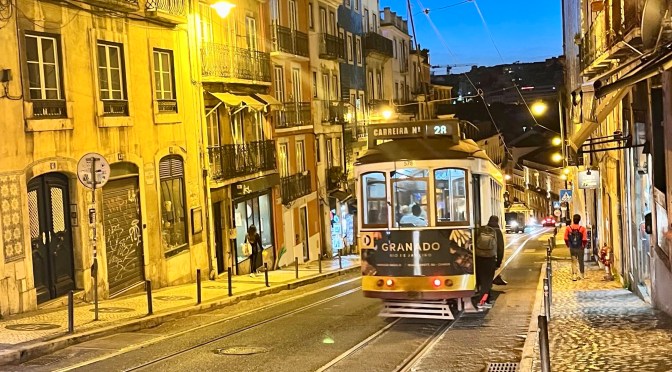
Top photo: Tram near our Airbnb in Lisbon. Photo by Karen Simon.


Subscribe to Not Exactly Retired. It’s free!

Ten Years

It’s been ten years.

One decade ago this month I walked away from a job I loved to shake up my comfortable life and try something new. 

I stepped down as the head of news and communications at Duke University, surprising my outstanding team. We’d been working together for years to respond to research discoveries, sports championships, weather emergencies, campus protests and more, as well as to the rise of social media and other dramatic changes to the media landscape. 

With Keith Lawrence at the Durham Bulls Athletic Park. The photo I’m holding, signed by my colleagues, shows a sign tracking the number of days since Duke’s last scandal.

Duke sent me off with a big reception at a local theater and, as shown in the photo, an informal farewell at the Durham Bulls baseball stadium.

Less than a week later, Champa and I embarked on an 11,000-mile drive around the United States, followed by an extended trip to Nepal. That’s where the two of us met in 1977 when I was a Peace Corps Volunteer, posted to the same school where she was teaching. 

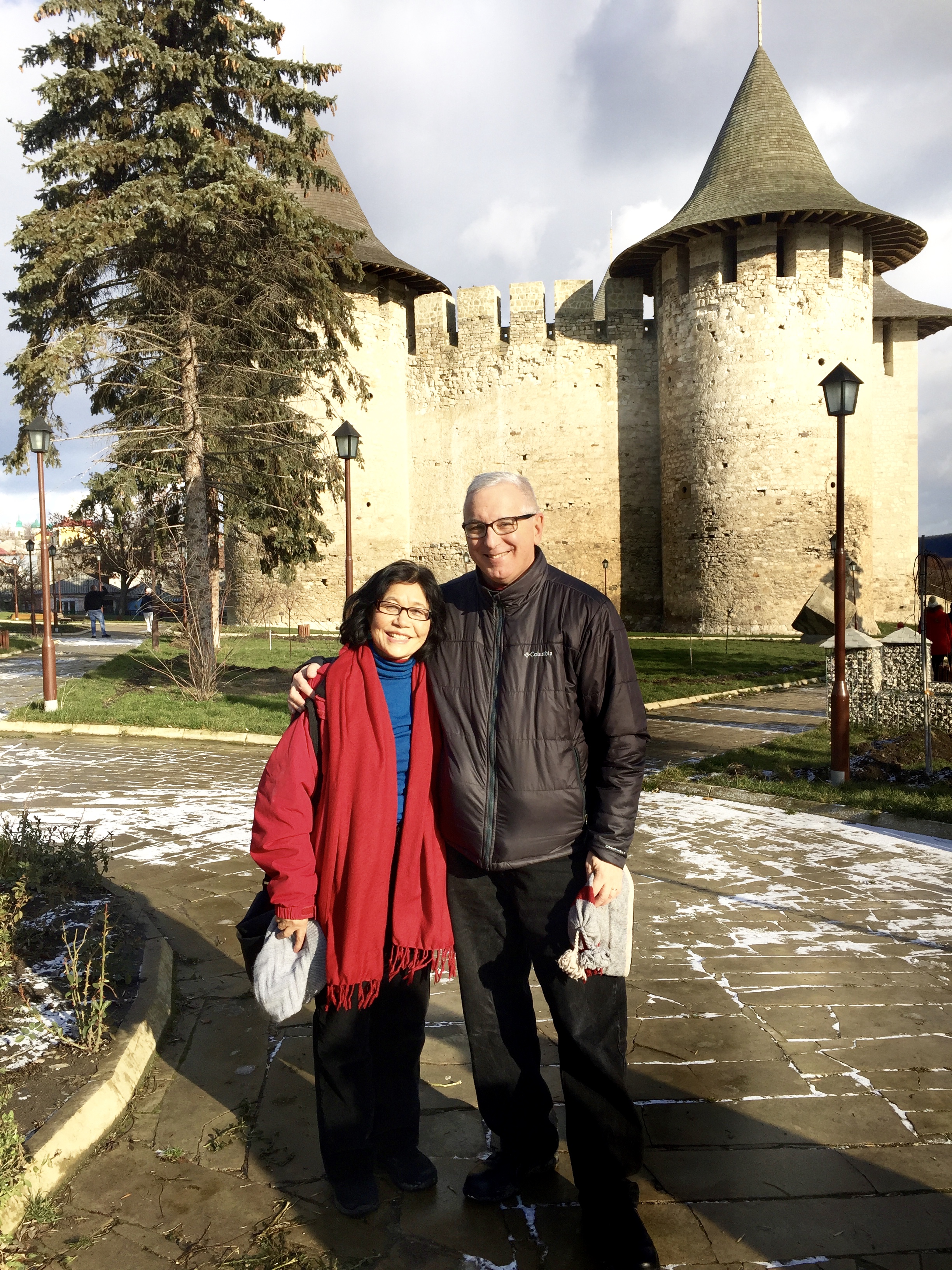
Visiting the Soroca Fortress in Moldova.

Finally, after a short break, we got rid of much of our stuff, rented our house and moved to Moldova, in Eastern Europe, to begin serving together as Peace Corps Volunteers.

I chronicled our three-year adventure on this blog and in my book. Since returning to Durham in 2018, we’ve continued pursuing our “not exactly retired” lifestyle, joining a growing number of older Americans who have been redefining retirement as more than leisure — and redefining themselves in the process. 

Several news outlets profiled us as examples of this trend, which in our case has meant extensive travel, volunteering and spending time with family and a network of friends that reaches around the world.

I’ve never looked back. 

I enjoyed my career and still miss my Duke colleagues, some of whom recently lost their jobs because of federal funding cuts, but I knew it was time for a change. Just like when I graduated college and chose to backpack across Europe, Asia and Africa with a friend instead of following my classmates to graduate school, I wanted to grab life and see what else it offered.

Visiting Tallinn Town Square in Estonia.

As I’ve approached this ten-year milestone, I know how lucky I’ve been. I left my job before the Covid pandemic and current funding crisis. Champa and I finished our service in Moldova before the pandemic and war in neighboring Ukraine forced the Peace Corps to halt its operations. We’ve been fortunate with our finances, health and family responsibilities. We could have encountered some disaster while traveling abroad, or at home, but we’ve been fine.

I launched this blog to share with friends our initial drive around the United States, never expecting it to continue so long or to reach people in more than 100 countries. I’ve loved hearing from readers with questions about the Peace Corps or early retirement, or just seeking encouragement to make a leap themselves.

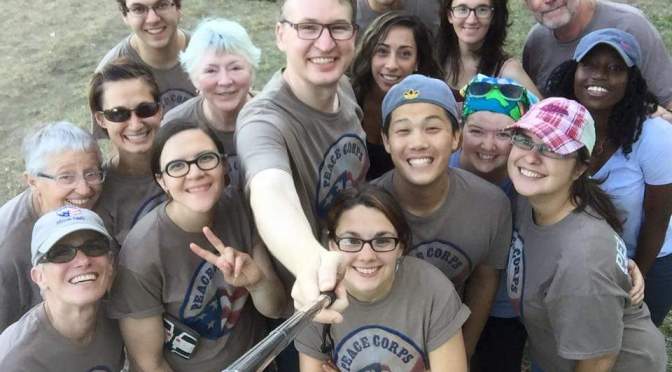
Some of the other older volunteers who served with us in Peace Corps Moldova.

As I’ve told them repeatedly, my message is not “join the Peace Corps!” That’s a good choice for some people but not for others, assuming they get past the rigorous application process. Rather, I’ve urged readers to be intentional about their lives, to choose instead of drift, regardless of their interests. We all have dreams, whether it’s to launch a business, start a nonprofit or master a new skill. It’s often possible to pursue that dream, even on a limited scale, while respecting the real-world complexities that come with it.

Champa and I plan to keep going as long as we can. We’re traveling more than usual now so as to remain outside the United States during its current turmoil. You’ll see soon where we’re heading next. As we approach the next election, however, and as we get older, we will reevaluate. One of the main benefits of the past ten years is how comfortable we’ve become with uncertainty and change. 

Delivering food for the Food Bank of Central & Eastern North Carolina during the pandemic.

Veering from our traditional American lives has enriched us immeasurably. These riches have come not in additional paychecks but in the people we’ve met, the places we’ve seen and the memories we’ve made, all while remaining centered with our family and friends. As we’ve learned on the road, we are far from unique in doing this. Many other older people with widely varying budgets and circumstances are also traveling off the beaten path and blazing their own trails. 

I know how privileged we are to be among them. Not everyone can do this; family obligations, finances, medical limitations and other constraints are real. But it is possible to resist letting fear or habit prevent us from living with purpose. We can choose to make room for what truly matters to us.

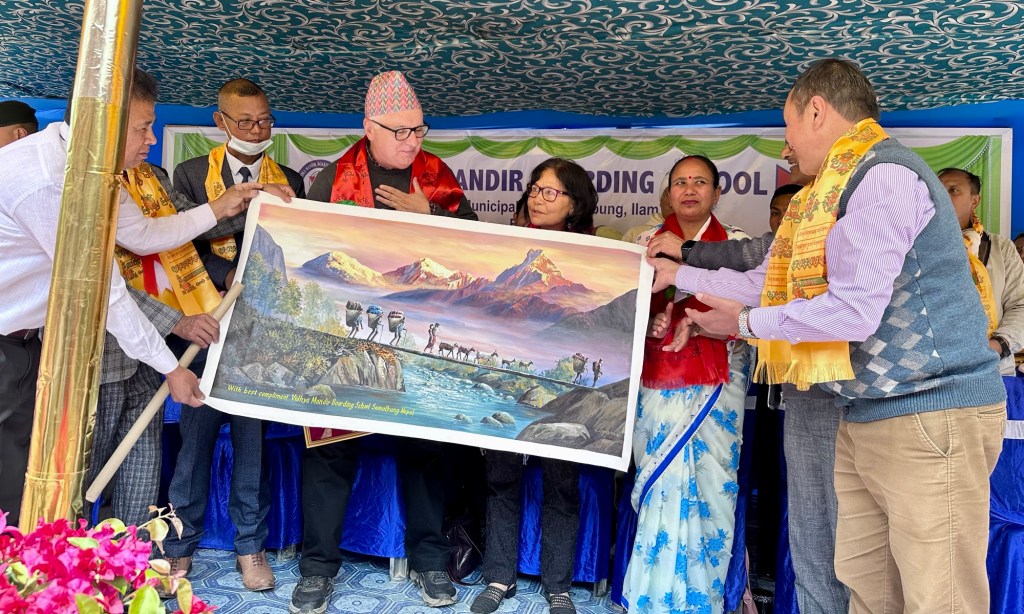
Visiting the new school we recently helped build in Samalbung, Nepal.

An old Peace Corps slogan says: Life is calling. How far will you go? As we wrap up our first decade of being “not exactly retired,” Champa and I are grateful for how far we’ve gone and still looking forward to whatever comes next.

Thanks for joining us on the journey.

Top photo: Resting after a camel ride in Morocco.


Subscribe to Not Exactly Retired. It’s free!

Dazzling Autocracy

Dubai and Abu Dhabi were impressive when we visited last week. Our overlap with President Trump’s trip to the region was coincidental but instructive.

Millions of people have flocked to the United Arab Emirates from around the world. They seek higher-paying jobs and better lives amid growing skylines, bustling airports, a modern metro system and luxurious shopping centers.

What they don’t find are democratic institutions. UAE’s citizens, who comprise a small percentage of the population, cannot change their government and have limited human rights.

The same is true of Qatar and Saudi Arabia, which President Trump also visited last week. Thanks to their oil riches, all three nations have transformed over the past half-century from poor agrarian societies into modern global powers. Champa and I visited Qatar’s capital, Doha, two years ago, and were amazed, just as we were in the UAE.

Yet I wouldn’t want to live in any of these countries. As an American, I am unwilling to compromise my freedom to speak out, criticize the government and write an article like this one. 

I recognize my good fortune in asserting this. If I were poorer and felt no stake in the political system, my overwhelming concern might be to improve my economic situation.

The UAE exemplifies the beguiling appeal of autocracy. Its royal families can act with few constraints from courts, legislatures, reporters or protestors. They have used their extraordinary power and wealth to build schools, hospitals, roads and shopping malls, creating jobs for millions of people while enhancing their own fortunes.

You can make a similar case for China and some other nations that have prospered over the past several decades. Their leaders have immense power and can be ruthless and corrupt, but they often get things done.

In our own country, by comparison, our political system struggles to solve anything, from the price of eggs to protecting our borders. Recent successes have been limited.

It’s not just that these Mideast monarchies have so much money. Consider Bhutan, where we spent several days before flying to Dubai. It’s vastly different from the UAE — poorer, Himalayan and Buddhist. It is remote and idyllic, with a “democratic constitutional monarchy.” Yet its unelected king retains enormous influence.

Here, too, the people we met — a tiny sample — enjoy living there. Bhutan has made great strides in reducing extreme poverty. It’s currently building a “mindfulness city” that was glowingly profiled on 60 Minutes. Many of its young people have left to pursue opportunities abroad, including in the Gulf, but Bhutan has been a success story compared to many of its neighbors. We traveled there from Sri Lanka and Nepal, two fragile democracies beset by poverty and political strife.

Of course, during the past year we’ve also traveled to Portugal, Canada, Australia and New Zealand — countries with both strong democracies and healthy economies. At the other end of the spectrum, I’ve visited autocracies that provide neither freedom nor prosperity. And to be clear, I am appalled by the corruption and cruelty taking hold in my own country, and by the recent attacks on science, education, diversity and other ideals central to my career.

Furthermore, I know the people I met in the UAE may have hidden what they really believe, and people everywhere are motivated by more than economics. Autocracy’s rise in our own country has many roots.

So all of this is complicated, to be sure. And, no, this trip didn’t change my mind about what I value. Yet traveling to the UAE, especially while Trump was there, made me think anew about why so many people, including fellow Americans, are willing to accept autocracy. I don’t agree with them. I think we must solve our problems ourselves, without autocrats who often make things worse. But after seeing these gleaming cities up close, I find it easier to understand why some people might make choices different from mine.

When autocracy dazzles, it’s hard to see anything else.

Rethinking Bhutan

Bhutan has been widely hailed as the champion of “gross national happiness,” but I had my doubts.

I’ve never forgotten its mass deportation of ethnic Nepalis in the 1990s. More than 100,000 people languished for years in refugee camps. Ever since, I’ve avoided going there. Until now.

I kept hearing glowing reports from friends who visited Bhutan. There was also no denying Bhutan’s leadership in showing how a country can advance while protecting its own culture and environment.

So, this past week, I finally traveled there with Champa from Kathmandu. We arranged a quick tour with an excellent local company, visiting Thimphu, Punakha and Paro. 

And now, I have to admit it: Bhutan is pretty wonderful.

It’s like Nepal in many ways, with terraced fields and snow-capped mountains, but it’s cleaner, calmer and easier. As we drove from the airport in Paro to the capital, Thimphu, there was no trash on the road. No blaring horns. The rivers were clear. The air was pure. Everything was well-maintained. 

Many people wear Bhutan’s distinctive national dress — the kira for women and the gho for men. Every building has traditional architectural motifs. Prayer flags are everywhere. So are photos of the royal family. Bhutan’s beauty surrounds you. 

We visited many of the main tourist spots, including several dzongs, or fortified monasteries, and the breathtaking Dochula Pass, whose 108 memorial stupas frame white peaks of the Himalayas. We climbed partway up a mountain to view the Tiger’s Nest monastery, which clings to the side of a cliff (top photo).

We visited a “fertility temple” along a path whose shops feature ornamental penises. We bathed in tubs heated by hot stones, tasted the local momos and drank homemade alcohol with a Bhutanese family. 

Like I said: pretty wonderful. 

So now I’ve joined the ranks of Bhutan’s many admirers. Bhutan requires visitors to travel with a guide and imposes a hefty daily fee, so it’s more expensive than a typical trip to Nepal, which is why our own trip was short. But Bhutan is also gentler for Western visitors, especially those who haven’t experienced South Asia previously. 

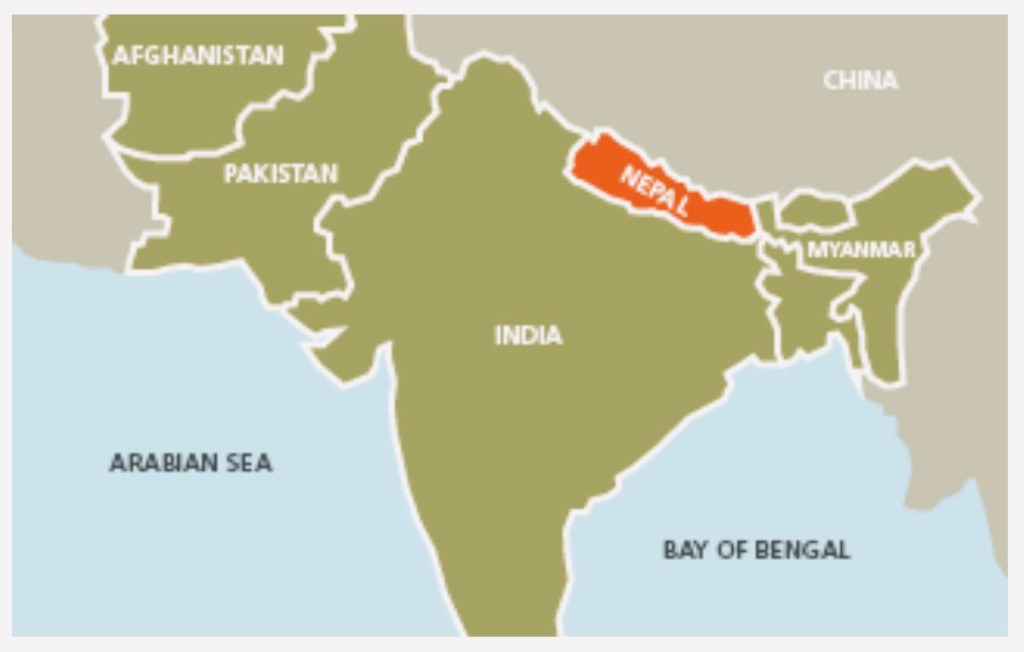
Personally, I’m much more likely to return to Nepal instead of Bhutan in the future. That’s where our family is and where my heart lies. I speak Nepali and feel at home in the chaos of Kathmandu traffic and the paths of Champa’s hometown. Nepal is also a much bigger country, with a population of nearly 30 million people versus 800,000 for Bhutan. 

Yet I’m glad we finally gave Bhutan a chance and I’d recommend it to anyone wanting to explore the Himalayas. The scenery is stunning, the people are friendly and it’s fascinating to learn how this small country is charting its own development path based on gross national happiness — something we could use a lot more of ourselves back home these days. 

New School Video

The school we helped build in Nepal is now open. (See post.) This video tells the story. Also on YouTube.

Samalbung’s New School

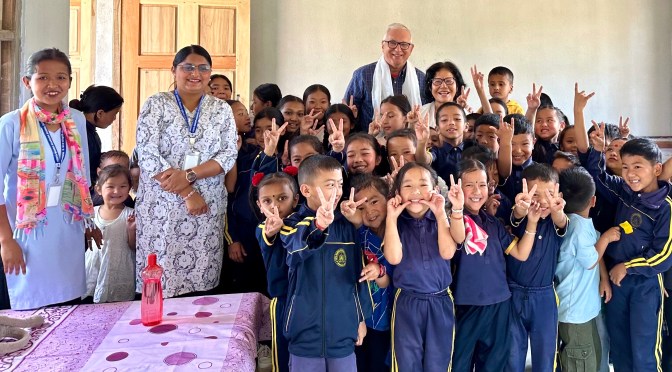
The new school we’ve been helping to build in a Nepalese village has finally opened!

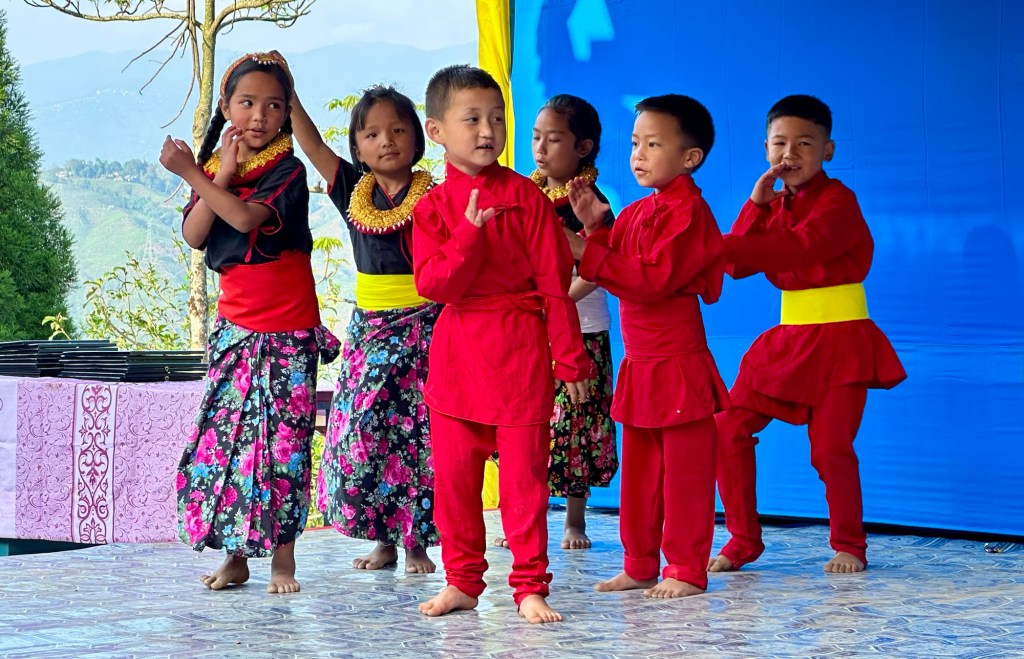
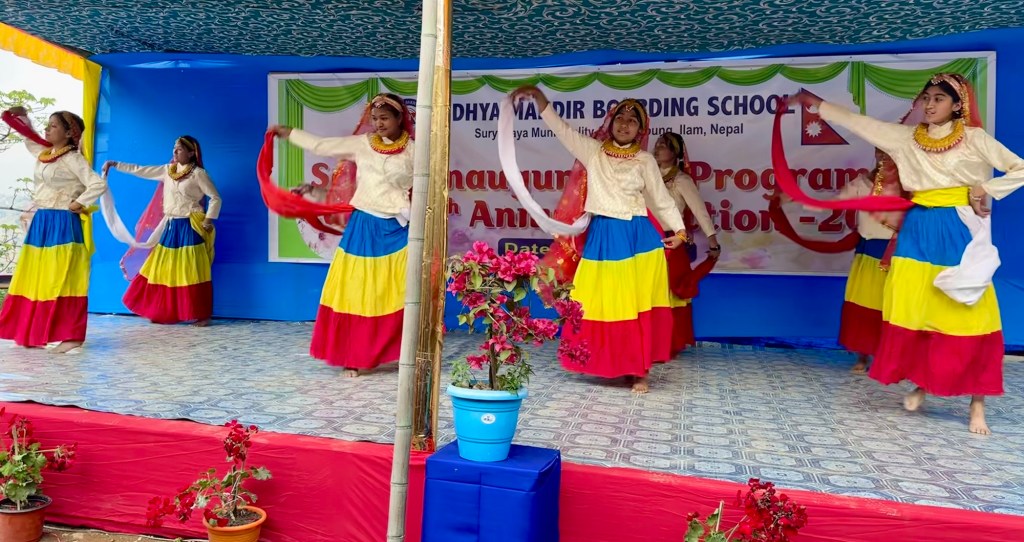
The local community dedicated it on April 30 in a colorful ceremony filled with dances, songs, speeches and food. We traveled there to join the celebration.

The school is more beautiful than we’d dared to dream and the community couldn’t be happier. 

The Vidhya Mandir Boarding School in the eastern village of Samalbung has 126 students, many from indigenous and marginalized groups. School fees are low and some students receive full or partial scholarships. 

The attractive two-story structure, with a lovely view of the Himalayas, is a huge improvement over the previous school, which was in terrible condition. The students now have a much brighter future. 

The two of us have spent the past year working with a team at the school to design and construct the new building. We also raised funds for the project through a GoFundMe site and direct contributions. 

We were overwhelmed by the response from family, friends, Not Exactly Retired readers, Returned Peace Corps Volunteers, Friends of Nepal and others. 

Their generous contributions totaled more than $24,000, which covered a significant share of the costs. The two of us funded most of the budget. The school community prepared the site, donated money, contributed labor and supported the school in other ways, from providing wood from their trees to feeding the workers.

I’ve posted some photos here and produced a short video so you can see the new school and celebration for yourself. You can watch the video above or on YouTube.

We are grateful to everyone who opened their hearts (and wallets) to assist these young people. We extend special thanks to Santosh Khapung, Bindu Suwal, Shankar Limbu, and Pooja and Sabin Shrestha for all of their help to us during this project. 

Thank you — and enjoy the video

The Tea About Ilam

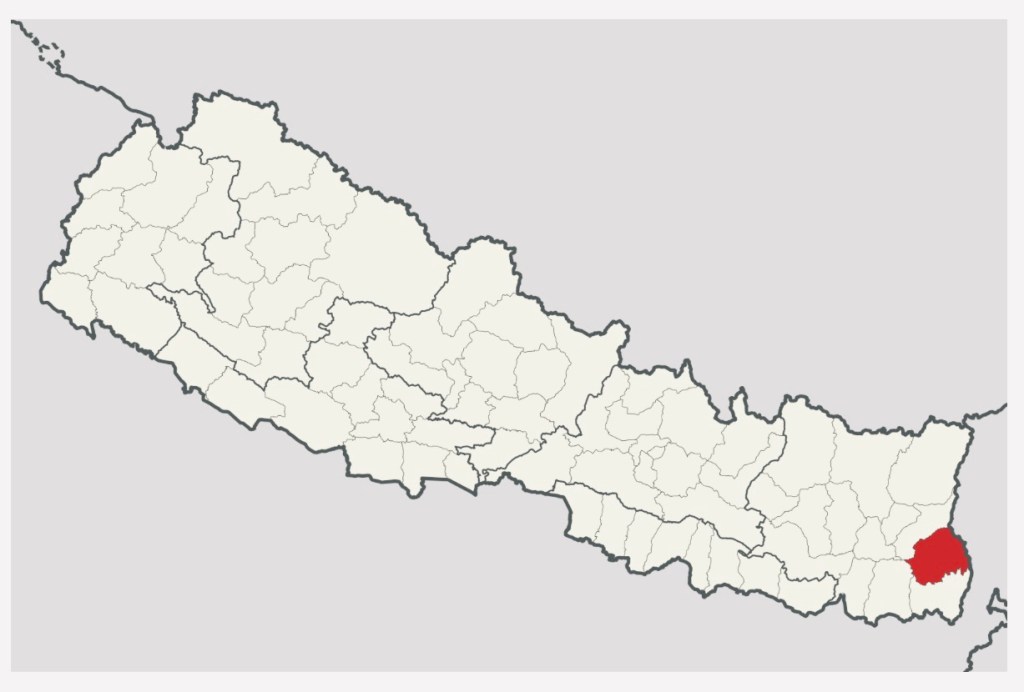
Champa’s hometown of Ilam, Nepal, is bustling these days with new shops, banks, bakeries, schools, hotels and people.

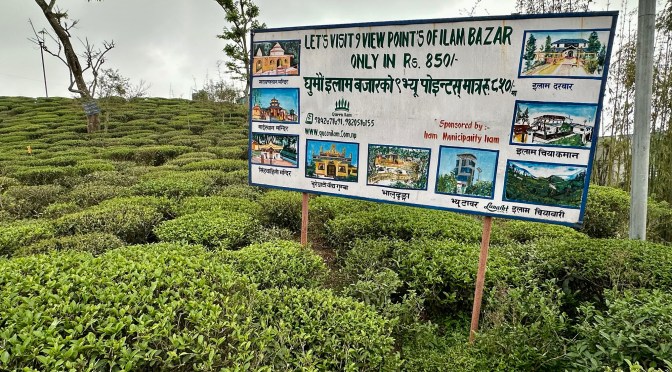
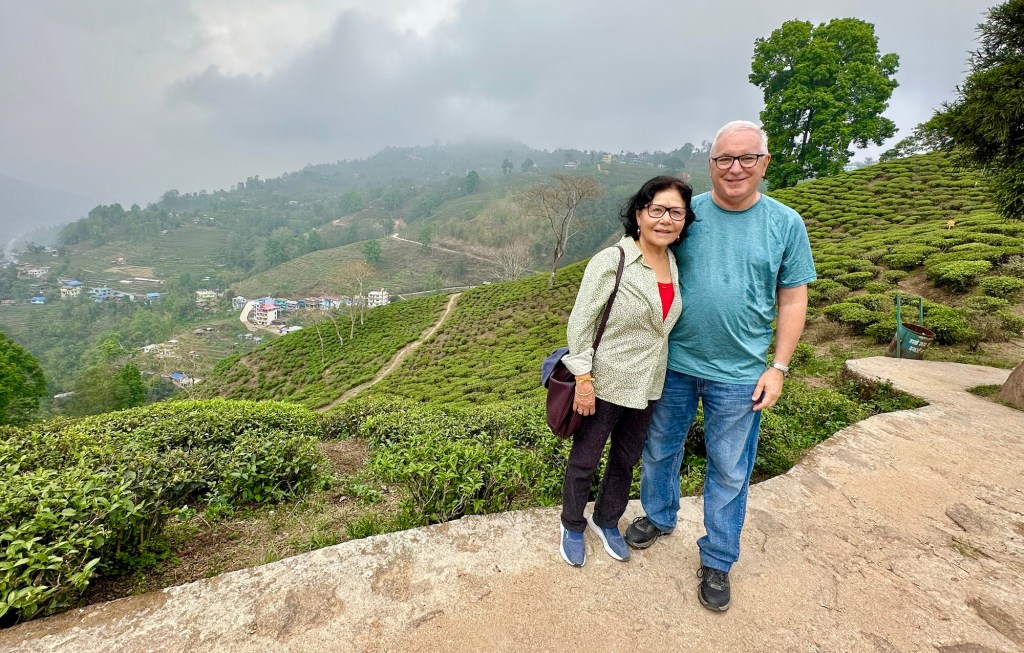
But it’s still best known for tea. Lush plantations surround this town whose population now exceeds 50,000. Ilam is the heart of Nepal’s tea industry, with rolling hills, terraced plantations, and a favorable climate and soil that yield a product similar to the better-known tea of neighboring Darjeeling, India.

We traveled here several days ago, mainly to visit with family and friends. But we’ve also taken time to explore the bazaar and stroll beside the tea gardens, as you see here with our niece Mangila and some of our grandnieces and grandnephew.

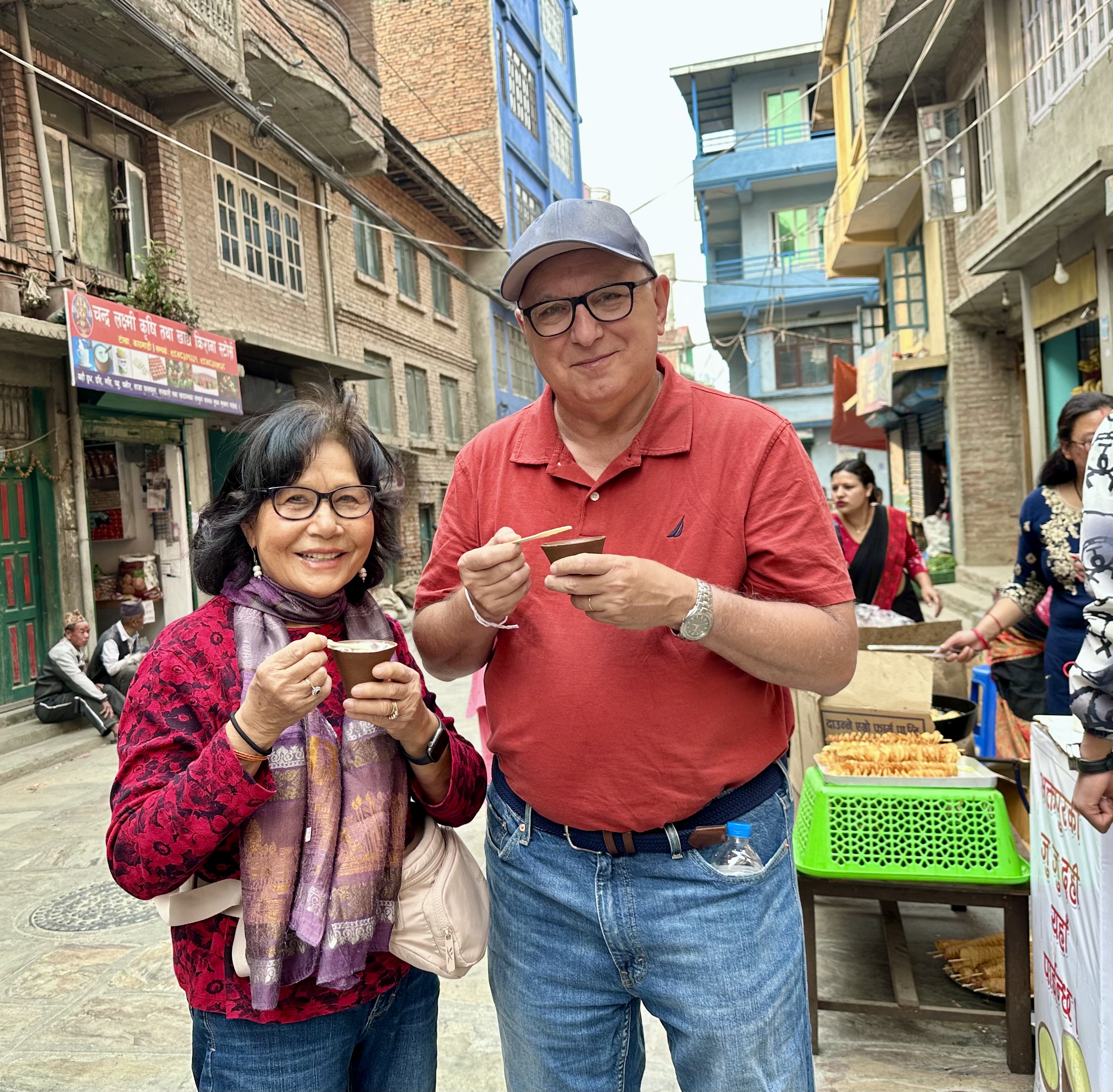
After one walk, we stopped at a shop where I treated all of the kids to ice cream, something that was unavailable when I served in the Peace Corps here in the late 1970s.

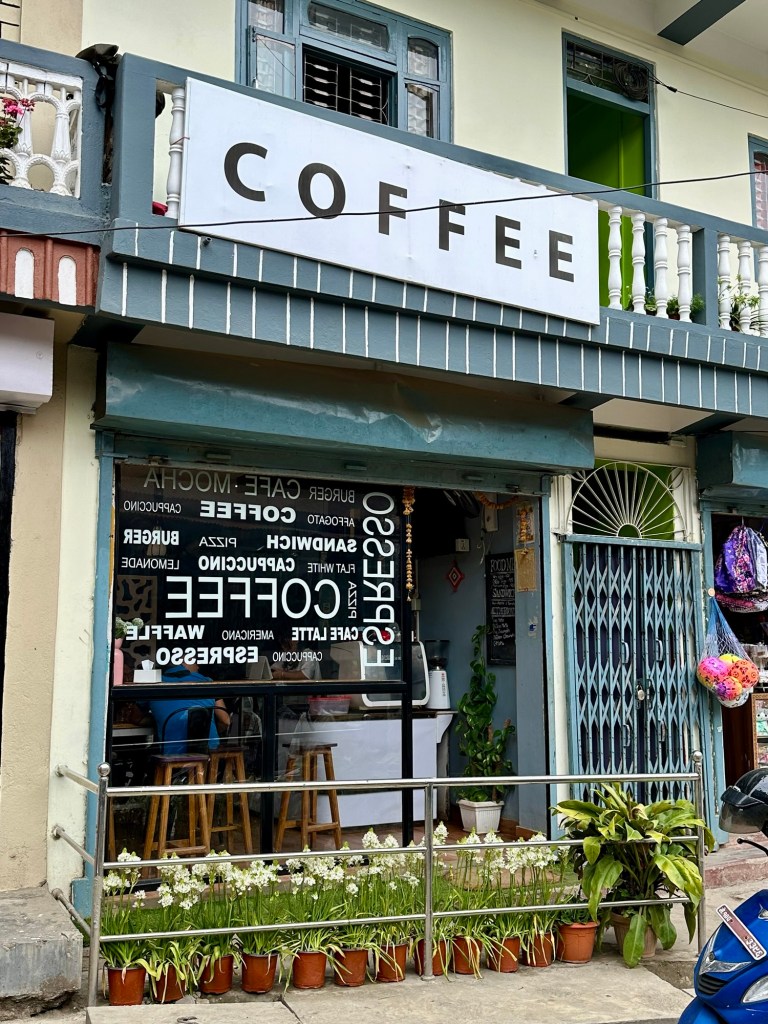
There was a single bakery back then, selling only white bread. Now there are several, with display cases featuring fancy birthday cakes. This tea-growing center even has a coffee shop where you can order a cappuccino.

Something else that was unimaginable when I lived here was cheese. Now there’s a nearby cheese factory run by a Sherpa entrepreneur who learned cheese-making from Swiss experts. He makes a delicious hard cheese that we sampled and brought home to eat.

Ilam’s food scene is not the only thing that’s changed. Notably, there are now vehicles everywhere — mainly motorcycles and scooters, but also buses, jeeps, cars and auto rickshaws. I also discovered some new sights, for me at least, such as a tea garden statue honoring the Limbu ethnic group and the Bhaludhunga ecological park

At almost every turn, I’ve been reminded what a beautiful and interesting place this is. I wish more people knew about it, especially foreign visitors looking to escape Kathmandu’s craziness and discover the “real Nepal.”

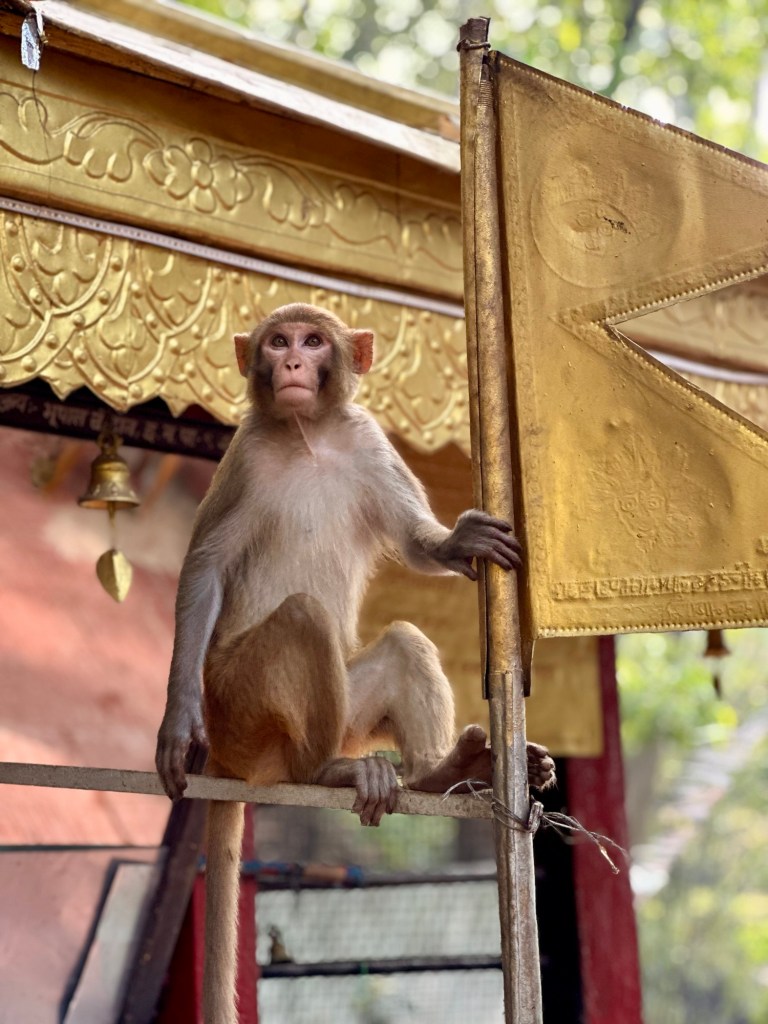
Ilam is relatively easy to reach. It’s a quick flight from Kathmandu to Bhadrapur followed by a 3-4 hour jeep ride on a winding road that is in generally good condition. Good, inexpensive hotels are available. The air is clear. The view is gorgeous when there’s no fog. Monkeys await you at the temples and Ilam’s friendly people are eager to meet you, too.

You should come see for yourself, even if you’re not a tea enthusiast.

Magical Kathmandu

Kathmandu is vastly more crowded, polluted and traffic-jammed than when I lived here during my second year as a Peace Corps Volunteer in the late 1970s.

And yet, it remains magical, at least to me.

Champa and I have had a busy week here following our recent road trip to some of Nepal’s less-visited places. We’re leaving again on Sunday for her hometown, Ilam, in Nepal’s eastern tea-growing region.

While we’ve been in Kathmandu, we’ve been revisiting some of the city’s iconic sights, like the Bodhanath Stupa, above two photos.

We’ve explored new places for us, like the Changu Narayan temple in Bhaktapur, above.

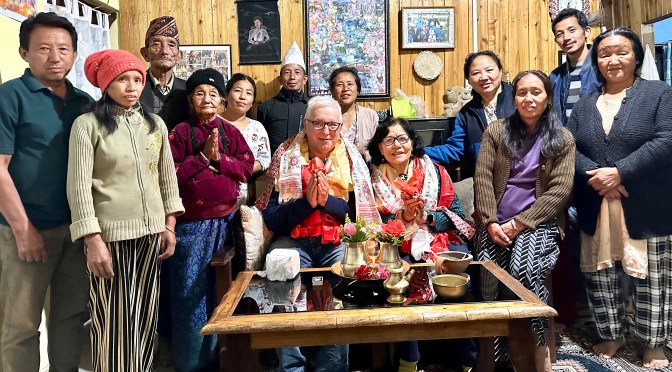
We’ve been visiting with family and friends, such as the Shresthas, who gave us an incredibly warm welcome and dinner.

We’ve met up with friends and family from back home who are also in Nepal now, such as Sarla and Sudhir from Virginia, top photo, and Steve and Muna from Vermont, bottom.

We had tea with our friends Anne and Raju, who once lived in Boston but now make their home in Nepal, something we’ve been thinking about on a shorter-term basis while our own country is so unsettled.

We visited an acupressure doctor, who treated both of us.

We had a great conversation with the director of Peace Corps Nepal, who brought us up to date on their programs and challenges.

Best of all, we’ve enjoyed hanging out at the home of our nephew Shankar and his wife Bindu, who’ve taken very good care of us. That’s their children Senchhen and Lajesha, bottom photo, playing a card game we brought from home.

My week ended with a surprise birthday dinner at a beautiful restaurant outside Bhaktapur. It was a fitting end to our week in a city that still holds magic for me. I’m always happy to return.

Elsewhere in Nepal

First-time travelers to Nepal typically visit the magnificent temples and other treasures of the Kathmandu Valley. If they’re adventurous and have the time, they may also go trekking near Mount Everest or someplace else. 

That’s what I did back in 1975 when I first discovered this magical country. I fell in love with Nepal, even before I met Champa, and I remain smitten with it a half-century later. 

We’ve returned here many times but have usually been so busy visiting our family that we didn’t explore much beyond the tourist trail. 

Until now. 

We just returned from a memorable road trip to several places we’d long been hoping to see: a remote valley unlike the rest of Nepal, a picturesque town atop a mountain and the homeland of the king who unified Nepal. 

We enjoyed all three places — Mustang, Bandipur and Gorkha — as well as our stop in Pokhara, a more familiar destination famous for its beautiful lake and snow-covered peaks. 

If you’re considering a trip to Nepal and want something different from the usual itinerary, you might consider a similar trip. We did ours in five busy days with a private jeep, traveling with our nephew, Shankar, and his wife, Bindu. They hired our driver but you could arrange something similar with a local travel agency. 

Mustang is a distinctive region of stark landscapes and traditional culture. Parts of it were closed to foreigners until recently and permits are still required to visit (although easy to obtain). We stayed in the main town of Jomsom, home of the Thakali people. Apples grow in many of its fields and its stone houses are adorned with prayer flags. We gazed out of our hotel window to see snowy peaks and small planes landing across the street at a tiny airport. 

Mustang is best known for Muktinath, a temple and pilgrimage site for both Buddhists and Hindus. Champa and Bindu visited it while I remained in Jomsom with Shankar since I wasn’t feeling well that day. I was sorry to miss it but still happy to finally see Mustang, which was so mysterious when I first came to Nepal. 

Bandipur, our next stop, was familiar to me since I did my practice teaching there during my Peace Corps training in 1977. I remembered it as being spectacularly beautiful — and it remains so, although much more developed. 

Bandipur is a traditional Newari village built atop a small mountain. Back when I lived there, the usual way to reach it was by climbing a long series of stone steps. Now you can drive up or take a cable car, which we rode for fun. Cars are banned in the town center, which has a growing number of souvenir shops and small hotels catering to tourists who have begun discovering this charming escape from Kathmandu’s traffic and pollution. 

We stayed in a lovely hotel — two private rooms with five dinners and breakfasts for $68 — and the owner was amazed that I’d taught there so many years earlier. He told some friends and the next morning we were joined at breakfast by one of my former fellow teachers and his wife, who’d worked with the Peace Corps. That’s Bidya Prasad Shrestha and Laxmi Shrestha in the photo with us. Amazing. 

Gorkha is a regional center best known as the birthplace of Nepal’s unifier, King Prithvi Narayan Shah. He’s a bit like George Washington in our country and lived at roughly the same time. Gorkha also lends its name to the Gurkha soldiers, who serve in other countries and are known worldwide for their bravery.

We only spent a brief time there, mainly to climb up to the Gorkha Durbar, a 16th-century palace featuring both monkeys and traditional architecture. Nearby is the Manakamana Temple, which we’d visited previously and is a great place to stop and visit via cable car while driving between Kathmandu and Pokhara. 

Pokhara’s tourist crowds are bigger than ever, with hotels, restaurants, shops and travel agencies filling the streets near the famous “fish tail” mountain and lake. Nonetheless, we were happy to return. We strolled beside the lake and enjoyed dinner at one of the many outdoor restaurants along the shore. 

When the rhododendrons are blooming, the lake is shimmering and the famous mountains appear — Annapurna, Dhaulagiri and others — few places on Earth are more stunning than Pokhara. 

We returned to Kathmandu just in time to celebrate Nepali New Year. We’ll be visiting with several friends and family this week and will then head east to Champa’s hometown, Ilam. From there we’ll drive through the tea gardens and mountains to Samalbung, the small village where we’ve been helping to build a new school with generous support from many Not Exactly Retired readers. 

For now, we’re savoring our road trip to some of Nepal’s less-visited places. We’re very glad we finally made it to Mustang, Bandipur and Gorkha — three destinations that I hope others will discover, too. 

Come to the Cabaret

I’ve wondered lately whether I’m like the emcee in the musical Cabaret, amusing myself as darkness spreads across the land.

You probably remember the emcee. He kept singing and leering in a Berlin nightclub as Hitler rose to power, refusing to recognize, much less confront, the nightmare unfolding around him. He distracted his patrons from paying attention to the chaos outside the door. But in the end, there was no escape. The deluge came and they were all swept away,

Following this past November’s election, Champa and I anticipated the nightmare we’d soon be seeing in America. Our strategy for coping, as I wrote previously, was to spend as much time as possible outside the country. 

Soon after the election, we departed for nearly two months in Australia and New Zealand. A few weeks ago we returned home to see our family and take care of some business — doctor’s visits, jury duty and the like. But now we’re planning to leave again, to Nepal and other countries.

Eddie Redmayne in the recent Broadway revival

After that we’ll return home again, but not for long. Just over a month has passed since the inauguration, although it feels much longer. We still have nearly four years to fill.

I don’t regret our decision and don’t plan to change it, at least not yet. I simply don’t have the energy to feel constant outrage. Living abroad gives me distance and perspective. Moreover, from a strategic standpoint, the best thing now may be to wait and let the American people see the consequences of their choice, as devastating as these are proving to be. Of course, that’s easier for me to say than it is for a fired federal employee or a Ukrainian soldier.

Alan Cumming portrays the Cabaret emcee

As I’ve discovered, there’s actually no escaping what’s happening, even far from home. When we were in New Zealand, some Canadians asked me why our president was so hostile to a long-time friend. Australians said they were nervous about U.S. tariff policy and anticipated closer trade with China. A family from Mexico wondered whether they’d be able to visit the United States again. More recently, our friends in Moldova have been shocked by the abrupt shift in U.S. policy towards their neighbor, Ukraine.

Since we returned home, just a week after the inauguration, I’ve witnessed a relentless attack on things I hold dear — justice, democracy, diversity and more. I devoted much of my career to science, higher education and foreign assistance. Now all of these things are on the ropes. Fellow former Peace Corps Volunteers who pursued careers with USAID have had their lives upended. Scientists I know are deeply concerned about their funding. The list goes on and on.

And me? I’ve been researching travel itineraries in Sri Lanka. 

Taylor Mac in the 2013 PlayMakers production

The juxtaposition makes me uneasy. I don’t want to be the cabaret emcee saying: “The world keeps going round and round, but it doesn’t affect me.” It does affect me and many others, most of whom lack the flexibility and resources to leave. Going abroad for months at a time is hardly the same as performing at a sleazy Berlin nightclub, but it’s also a far cry from manning the barricades.

I keep hoping more of my fellow Americans will finally wake up and political options will become more promising. In the meantime, I’m doing my best to focus on things I can actually change. I’m volunteering locally with several groups. I’m finding joy with family, friends, my community and projects like the school in Nepal we’ve been helping to build, which we’ll be dedicating during our upcoming trip. I’m traveling as much as I can before I get too old, especially while things are so grim at home.

I wish I had a better plan right now, but I don’t. I wish things were different, but they’re not. I wish I could turn off the song in my head, but I can’t. It keeps playing: What good is sitting alone in your room? Come hear the music play. Life is a cabaret, old chum. Come to the cabaret.”

Top photo: Joel Grey as the emcee in the original production of Cabaret.

Subscribe to Not Exactly Retired. It’s free!