We’re celebrating two anniversaries this month: two years since I left my job at Duke and one year since Champa and I arrived in Moldova to serve as Peace Corps Volunteers.
 As a new book makes clear, the “not exactly retired” path we’ve charted for ourselves is not exactly for everyone. Many people want to be retired in a traditional sense — playing golf, gardening or relaxing in other ways. Others seek to remain connected to their previous workplace or profession, or to search for new meaning in their life. Some end up watching too much television or getting depressed.
In Too Young to Be Old: Love, Learn, Work, and Play as You Age, sociologist Nancy K. Schlossberg explores the different paths people follow. She describes the six most common routes as “continuers,” “adventurers,” easy gliders,” “involved spectators,” “searchers” and “retreaters.”
Since we made the leap, traveling across the United States and Nepal and then joining the Peace Corps, Champa and I have mostly been “adventurers.” Schlossberg describes this route as “an opportunity to pursue an unrealized dream or try something new.” In my case, there’s also been an element of “continuer,” since I’ve remained active in communications, albeit in a very different way from when I was running a university communications office.

Even though I was more than ready for the transition, it took time to adjust to my new life, just as my sister Nancy had warned me. (She is the author of Second-Act Careers, which I recommend highly.) I had trouble letting go of my professional identity, which I continued to highlight on my LinkedIn profile for several months. Only later did I change it to emphasize my role as a blogger and, later, as a Peace Corps volunteer.
Taking extended trips across the United States and Nepal helped loosen my grip. Serving in the Peace Corps then provided me with a new identity and a well-established mission and structure to serve others.
In one year, though, I will finish Peace Corps and again face the challenge of defining “who am I?” for both myself and others who know me, together with Champa. I will also need to reaffirm my identities within my family and my community back home. It’s a process that will probably never end.
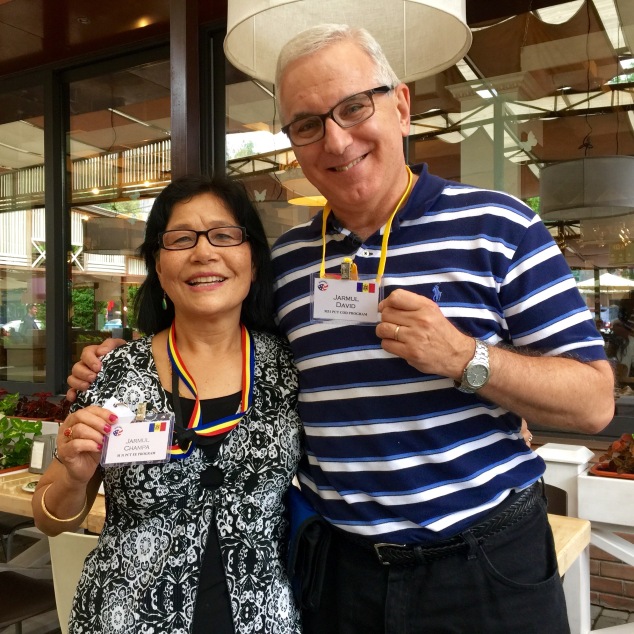
Champa and I know how lucky we are to have these opportunities, even though we really miss our family and are counting the minutes until we see them in a few weeks for a brief vacation.
Schlossberg’s book reminds me how other members of my generation will have their own retirement journeys, which may be very different from our own yet equally valid and compelling. All of us entering this phase of our lives share the challenge of finding the right blend of identity, relationships and purpose to fit our circumstances.
With two years and many miles now behind us, I now recognize our most important choice so far to have been choice itself, to act instead of drifting. What we actually chose is not everyone’s cup of tea (or even Moldovan wine), to be sure, but it’s worked for us. We all face life transitions sooner or later and can either resist or embrace them, however much our destinations and routes may diverge.
I welcome comments about your own dreams and journey, regardless of your age.
Did you enjoy this post? Please share it!



 My country director asked me earlier this year whether I might want to assist with this editing and other communications initiatives for Peace Corps Moldova, as a secondary project to complement my primary job. I’ve been happy to help, working most closely with Liuba Chitaev on the staff, pictured here.
 Together we helped launch a new


 The library has interesting exhibits and memorabilia about Vangheli. It is marking its own 25th anniversary this year, so Ialoveni has been celebrating both the facility and its namesake, who lives nearby in Chișinău. The Vangheli library is tucked away on a small street near the heart of Ialoveni, not far from the city’s main library, which also has a nice collection and programs for children, including a weekly English class taught by Champa.


 One big difference in Moldova, though, is that everyone is addressed as “Domnul” or “Doamna” — Sir or Madam. And when it comes time to schedule the next meeting, they’re more likely to check their paper daybooks instead of the electronic calendar on their smartphone.


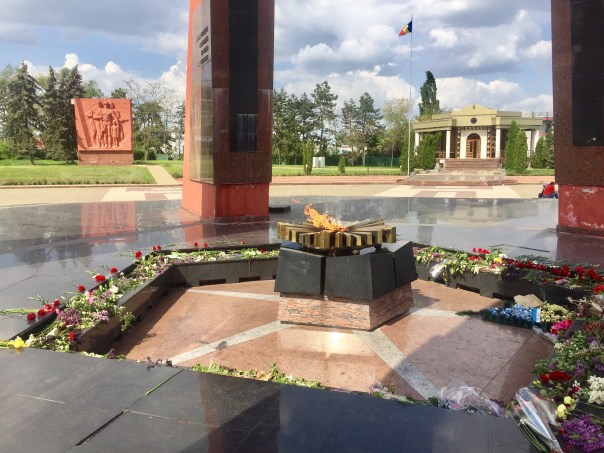
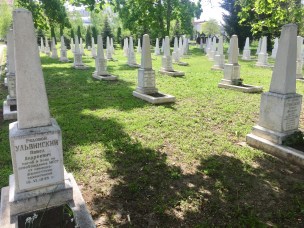
 Nearby are sculpted murals depicting the bloody struggle to defeat Nazi Germany. Smaller monuments honor fallen heroes and show the names of Soviet soldiers who gave their lives to liberate Moldova in August 1944. Rows of white grave markers in the adjacent cemetery are reminiscent of Arlington Cemetery, albeit with Russian inscriptions.
 Moldova was part of the Soviet Union, which was America’s most important ally on the eastern European front of World War II. Yet we inevitably view our joint victory through the lens of the subsequent Cold War. For Moldovans, the legacy is even more complicated since the German occupation was followed by decades of Russian rule.
 Many thousands of Moldovans marched or gathered in Chișinău the same day, as they did around the country, especially in Russian-speaking areas. In places where Romanian is commonly spoken, the emphasis tended to be more on European unity, especially with the West.
 More than 70 years after the war ended, its impact on the history and psyche of this region remains profound. As I have




 "Not Exactly Retired"