

The doctor in the poster looks confident, doesn’t he? He’s wearing a white coat over his shirt and tie, his arms are crossed, his gaze is fixed, his medical equipment is gleaming in the background. The poster tells us he is Hakan Eraslan, an expert in cardiology. Come to him for a second medical opinion, it says, and he may help save your heart.

Now look to the right of the poster. The nicely designed brochures on the rack tell you why you should come to Medpark, the hospital where Dr. Eraslan and others treat patients in Moldova’s capital city. The brochures describe the high quality you can expect for surgery, opthamology, maternity care and other services.


The poster, brochures and other signage at Medpark caught my eye when I went there on Saturday for a routine medical consult. (I’m fine.) They looked like what I used to see on the walls at Duke’s hospital and medical clinics. Other American medical settings have similar posters and signs filled with earnest doctors, loving parents and photogenic children. Medpark also has video monitors showing its caring doctors at work, with narration in Romanian and subtitles in Russian. (See the clip at the bottom of this post.)
 I may pay more attention than most people to signs and videos like these because I work in communications, although even for me they often blended into the background when I was back home. In Moldova, though, I noticed them immediately on Saturday because they were so different from the drab walls and signage I’ve seen in some medical settings here.
Most of Moldova’s medical facilities are public. Their challenges, including a lack of modern equipment and facilities, are much bigger than font choices and graphic design. Their signs tend to be functional and their amenities limited.

Medpark, by contrast, is a fairly new medical center in Chișinău. It operates privately, with patients generally paying out-of-pocket for most services. Its rates are high for Moldova, although lower than in Western Europe and much lower than in the United States. As a result, many of its patients are from wealthier families, visiting home from jobs abroad or, as in my case, foreigners.


The hospital has an attractive coffee bar in its lobby, a free charging station for cell phones and colorful play equipment for children. Its pharmacy sells fancy creams and lotions along with medical prescriptions, and it offers artfully arranged eyeglass frames in a glass kiosk. The corridor signs look like they could have been plucked from a modern American hospital and translated into Romanian.
All of this didn’t happen by accident. Someone in the hospital’s senior management and communications department gave it a lot of thought, right down to the lower-case logo in sans-serif type and the aqua color palette. Once I began to notice and think about this visual environment around me, it was obvious Medpark is deliberately sending a message: We’re modern! You can trust us!
 And do you know what? Its strategy works, at least for me. I felt reassured as soon as I entered through the revolving glass door into a bright lobby. The medical care I received turned out to be good, too, but I was already primed to expect this because of everything I’d seen, even if I wasn’t immediately conscious of why I felt optimistic.
None of this matters, of course, if the hospital doesn’t offer high-quality medical care. But my experience on Saturday reminded me how important thoughtful design and communications can be in advancing an organization’s business strategy. That’s true in Moldova just like back home. It’s why individual American hospitals and health centers and organizations such as the Society for Healthcare Strategy & Market Development, the Association of American Medical Colleges, the Public Relations Society of America and others pay so much attention to these kinds of issues.
Effective communications may be even more important here in Moldova, a former Soviet state striving to assert its identity as a modern European country. This is true not only in the healthcare arena but more generally, a subject I hope to explore further in the future.
For now: Dr. Eraslan, your confident gaze is working for me.


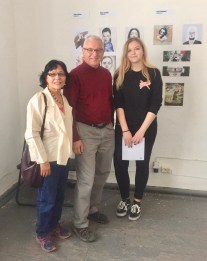 There are few galleries in Moldova where young artists can show their work. This weekend, though, more than 20 of them are taking part in an exhibit inside an old museum, featuring more than 100 portraits ranging from painting to caricature.
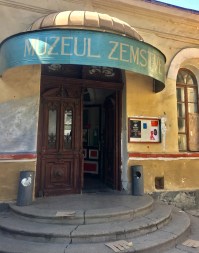 Lucia Codreanu and Maks Graur, both young artists themselves, organized and curated the free show in downtown Chișinău, running through Sunday afternoon. You can see some of the work here.


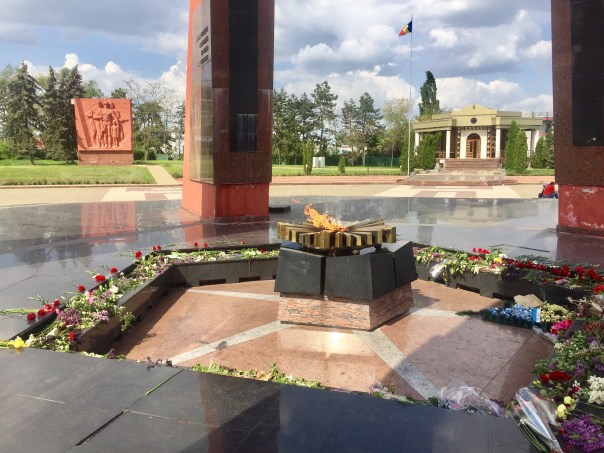
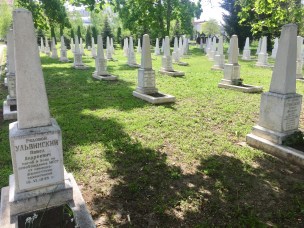
 Nearby are sculpted murals depicting the bloody struggle to defeat Nazi Germany. Smaller monuments honor fallen heroes and show the names of Soviet soldiers who gave their lives to liberate Moldova in August 1944. Rows of white grave markers in the adjacent cemetery are reminiscent of Arlington Cemetery, albeit with Russian inscriptions.
 Moldova was part of the Soviet Union, which was America’s most important ally on the eastern European front of World War II. Yet we inevitably view our joint victory through the lens of the subsequent Cold War. For Moldovans, the legacy is even more complicated since the German occupation was followed by decades of Russian rule.
 Many thousands of Moldovans marched or gathered in Chișinău the same day, as they did around the country, especially in Russian-speaking areas. In places where Romanian is commonly spoken, the emphasis tended to be more on European unity, especially with the West.
 More than 70 years after the war ended, its impact on the history and psyche of this region remains profound. As I have




 “We traveled with Father Desbois to the former Soviet Republic of Moldova, where in one day he took us to four unmarked mass graves,” reporter Lara Logan said in the story. “In this field, he told us, 60 Jews beneath this farm, 100 above this city, under this hill, a thousand.”

 Just outside of town is Europe’s

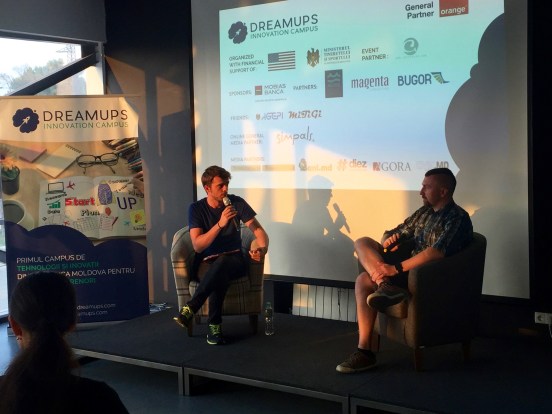

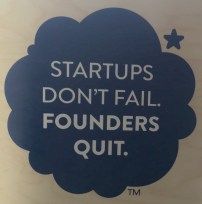 Matei joined Degeler on the stage, both in armchairs, one wearing shorts, the other a black T shirt. A projected slide behind them showed the event’s sponsors — local companies, media partners, the U.S. government and others.
 Back when I was in Durham, I interacted with the thriving local startup scene, which I helped publicize through articles such as
 "Not Exactly Retired"