I am a Peace Corps volunteer in Moldova, in Eastern Europe, serving in the small city of Ialoveni with my wife, Champa. We are from Durham, N.C., where I was the head of news and communications for Duke University. You can follow our adventures on my blog, notexactlyretired.com.
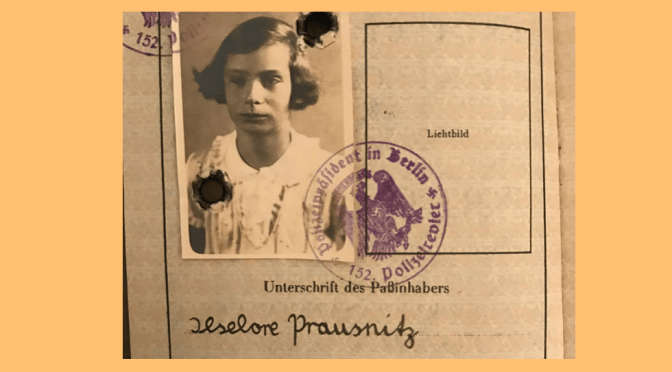
This is my mother’s passport photo taken in Berlin before escaping Nazi Germany to be warmly welcomed into the United States. You can see the swastikas on the stamp.
If the U.S. Government had banned her and she had stayed in Germany, my mother would have been murdered. You would not be reading this because I would not exist. Nor would my children and grandchildren. Instead, my mother grew up to become a proud and productive American citizen who contributed to her society in countless ways. She gave birth to my sisters and me, and we were followed by our children, their cousins and the next generation behind them.
Thanks to one of those cousins, my niece Juliana Collamer, for reminding us of this photo, which our family treasures. We have always been grateful to America. Today it is hard to feel proud of it.
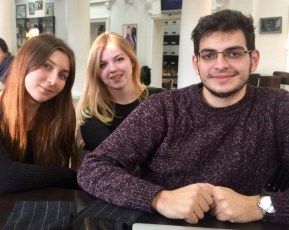
Forget the upcoming Super Bowl. What I am super-excited about right now is whether the three teenagers you see here will win the final round of Diamond Challenge Moldova on Saturday.
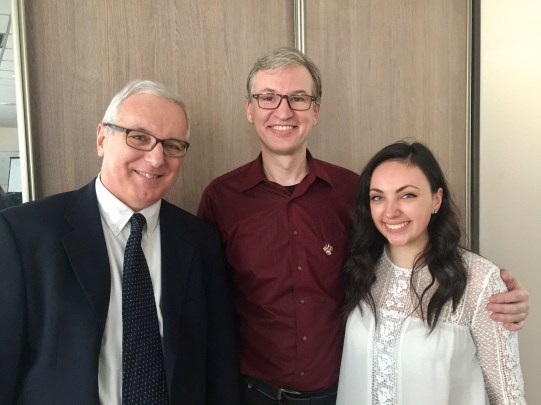
That’s Elizabet on the left, Lucia and Victor. They are three of the most talented and inspiring young people I have ever met — anywhere. I’ve been mentoring their team and will be cheering for them as they vie for the top prize in Moldova’s showcase for aspiring entrepreneurs.
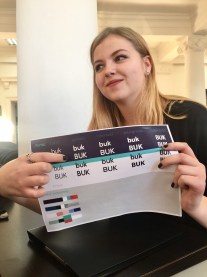
I’ve been meeting with Team BUK regularly for several months, helping them develop and refine their business plan. However, they came up with the ideas and have done all of the work — lots and lots of work. Like the five other finalists in their category, they will now deliver their final pitch in English before a team of judges. They and the other teams attended a training sesson two weeks ago where I described how to do this effectively. All of the teams were impressive and it was fun to work with them.
I’m not discussing our team’s business idea or pitch strategy until after the finals. For now, I ask you to join me in sending good wishes in their direction. That’s what two Duke students, Kiara and Sydney, did with my former colleague Sonja Foust several weeks ago when they unexpectedly sent me this special version of The Week at Duke in 60 Seconds, which I helped to create. Play it to the end for their surprise for Lucia, Elizabet and Victor. It’s been a joy to work with the three of them, no matter how the competition turns out. (The video is also at https://www.youtube.com/watch?v=lj5zHX_S7CY.)
My sisters Ruth, left, and Nancy at the Women’s March in Washington, D.C.
Almost all of the Jarmul women took part in Saturday’s women’s marches: my sisters, my nieces, my daugher-in-law, even two of my granddaughters. You can see some of their photos here. Our friends were protesting, too, in North Carolina, New York, California and elsewhere.
Not Champa and me. We are in Moldova. We sent messages of encouragement but felt like we were missing in action.
I’ve written previously about how hard it is to be away at moments like this, noting after the Orlando shootings in June that “it’s strange to be so distant when something momentous happens back home.” Champa and I felt this frustration even more on Saturday. We were eating placinte and preparing lesson plans in Ialoveni while our family and friends back home were out in the streets.
Here in Moldova, there were no protests in solidarity with the Washington march, as there were in Sydney, Berlin, London, Paris, Nairobi, Cape Town and other cities around the world.
On the other hand, how many Americans noticed or cared who was standing next to Vladimir Putin at his press conference this past Tuesday during Putin’s widely reported remarks about Russian prostitutes? It was Moldova’s new president, Igor Dodon, visiting Putin at the Kremlin. For people here, Dodon’s trip was a big deal. (Even if you don’t speak Russian, watch his amusement when Putin is asked about prostitutes.)
One of the great gifts of Peace Corps is perspective. I am reminded every day that people around the world care about different things, even though they are connected in more ways than they may realize. Through Peace Corps, we and our fellow volunteers are trying to promote friendship and understanding among them. We also remain nonpartisan in our official roles.
So, although Champa and I wish we’d been there on Saturday, we hope our American friends will give us a pass. We were quietly cheering for you. Perhaps you heard us.
The students you see in this post represent Moldova’s brightest hopes for the future.
They are optimistic in a country where many people are pessimistic. They want to start businesses and help others. They are overflowing with great ideas, and they are brave enough to present them on a stage in front of a group of judges — in English.
They are the finalists in this year’s Diamond Challenge Moldova, a competition for high school students interested in becoming entrepreneurs. On Jan. 28, seven student teams will vie to be named the best “social venture,” and six others will compete for the best business idea. Both winning teams will receive $1,000 and a chance to compete in April at the international Diamond Challenge for High School Entrepreneurs competition in Delaware.
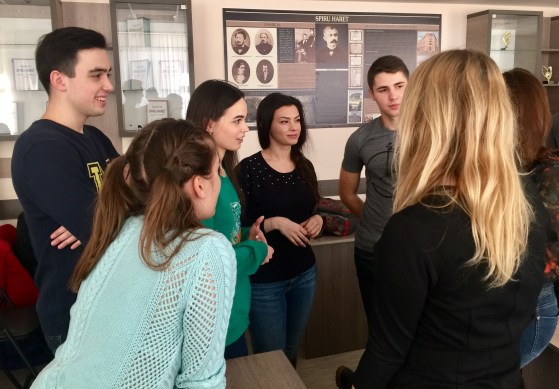
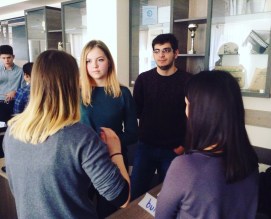
On Sunday, I led a workshop to help the teams sharpen their public speaking skills and pitches. Joining me were several other Peace Corps volunteers who have been mentoring teams, helping to select the finalists and organizing the competition as a whole. I have been mentoring one of the teams myself and will be cheering for them in the finals.
Nearly 2,000 students from around the world have participated in Diamond Challenge since it launched in 2012. Moldovan students have done very well in the competition, with two teams making it to the finals last year. Do It For Bunica won the $10,000 grand prize in the social venture competition with its project to connect expatriate Moldovan workers with teenagers back home who can help care for their aging parents.
Another Moldovan team won the social impact prize a year earlier with its idea of producing clothing with reflective thread that can be seen by seen at night by cars driving along dangerous country roads.
Peace Corps volunteer Chris Flowers, center, and Ana Mirza of A.O. INVENTO organized Sunday’s workshop and many of the other activities for Diamond Challenge Moldova.
Both of those earlier teams gave excellent pitches, which I showed on Sunday, helping the current students learn the best ways of persuading judges, investors or others. My other sources ranged from the television show “Shark Tank” to President Obama to Guy Kawasaki, the renown Silicon Valley entrepreneur. The students will be making their own final pitches before a new group of Moldovan and American judges at the Dreamups Innovation Campus, the local entrepreneurship center about which I’ve written previously.
Peronally, if someone had asked me when I was in high school to speak publicly in a foreign language, I would have been terrified. That’s why I also showed this hilarious video with Steve Martin, to help the students relax. I’ll post again after the finals to tell you how their presentations turned out. Based on what I saw at the workshop, I expect them to be terrific.
One of the joys of being a Peace Corps volunteer, here in Moldova and around the world, is that you never know what’s going to happen next. You’re surprised regularly by holidays and events that people forgot to tell you about.
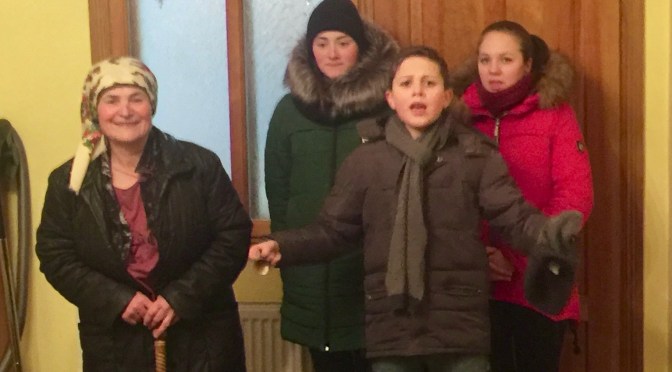
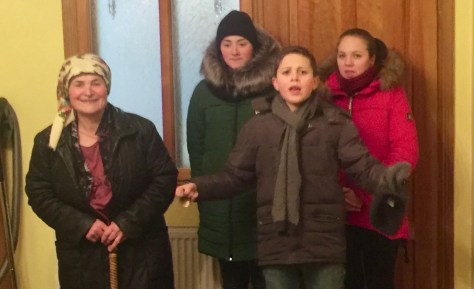
The four people you see in the video above proved this again on Friday evening when they appeared unexpectedly at our home in Ialoveni. [The video is also on YouTube.]
As you can see, they chanted and sang after our host mother, Doamna Nina, invited them into the living room. (That’s Nina in the video between Champa and our grandmother, or Bunica.) It turns out our visitors were celebrating St. Vasile, or Basil the Great, a religious figure born in the year 329. He lived virtuously, established monasteries, served the poor and was canonized by the Orthodox Church shortly after his death.
On the evening of his special day, children across Moldova walk from house to house to sing carols and chants in his honor. The holiday coincides with the Orthodox Christian new year, which occurs shortly after our own new year back home.
Nina gave them all fruit, candy, money and loaves of the traditional round braided bread called colac. She was very generous, and we contributed something, too. Our visitors made out well.
As they left, the older woman you see in the photo crossed herself and then wished Champa and me good luck in the new year.
On Sunday, as Americans prepare to celebrate the birth of Martin Luther King Jr., people here will commemorate the birthday of Mihai Eminescu, a famous Romanian poet. This time I plan to be ready. Well, at least until Monday, when some Moldovans will celebrate still another holiday, this one involving howling wolves. I’m still unsure about that one.
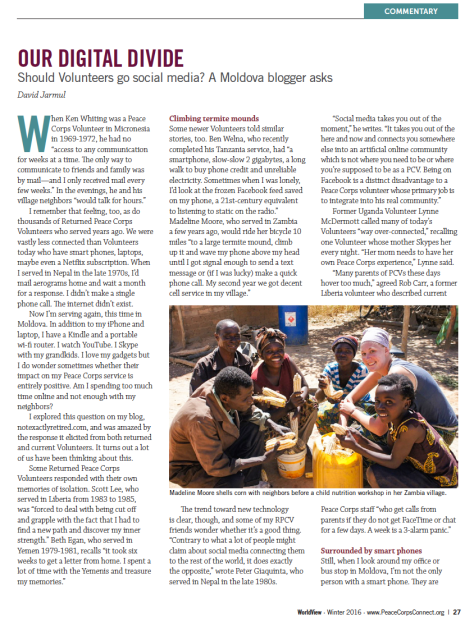
Are today’s Peace Corps volunteers over-connected? That’s the question I explore in this article just published by WorldView, the international magazine of the National Peace Corps Association. (A digital image of the article follows, with a link to a PDF version.)
It helps to have a sense of humor if you’re a Peace Corps volunteer. Over the years, volunteers around the world have produced funny videos about their experiences. Here are three of my favorites. If you know of other funny Peace Corps videos that could be added to this list, please add a comment and share your suggestion.
What’s it like to be an older Peace Corps volunteer in Moldova, in eastern Europe, or in more than 60 other countries around the world?
Not Exactly Retired celebrated its 100th blog post with a special series sharing the experiences of some of Moldova’s older volunteers.
Here are the four stories from the series:
Insights and Advice shares what some older Americans have learned in Peace Corps Moldova.
Expect Surprises explores some of the situations and emotions that most surprised them.
Looking to the Future considers how Peace Corps service has changed their life plans.
Carla’s Story shares the story of one older volunteer from Yuma, Arizona.
Are you or someone you know thinking about joining the Peace Corps? You’ll find lots of helpful information on the agency’s main application site, which also offers a website addressing the special concerns of older applicants. If you’re especially interested in Peace Corps Moldova, check out the Peace Corps Moldova Facebook page, which highlights volunteers of all ages.
[Added later: Peace Corps: Now vs. Then describes the six biggest changes I’ve seen in Peace Corps since serving when I was younger. Mulling What’s Next highlights resources for older Americans looking to combine travel, service and adventure in their lives. The Surprise of Travel encourages travelers to venture off the beaten path. My Unpredicted Birthday reflects on what it’s like to turn 65 while serving in the Peace Corps.
Shortly after we completed our service and returned home, the Kiplinger Retirement Reportprofiled the two of us in an article about older Americans serving as Peace Corps Volunteers. Several years later, we returned to Moldova for a visit and discovered that our impact there was more lasting than we’d imagined.
I discussed many of these issues with reporters, podcasters and others while publicizing my book. Check out these conversations on this page, which highlights some of the coverage.
Learn about the financial impact of being an older Peace Corps Volunteer in this article.
I welcome your comments and invite you tosubscribe to Not Exactly Retired, which has been chronicling our journey since we left our conventional jobs and American lifestyle in mid-2015 to pursue new lives of adventure and service. Perhaps it will inspire you to consider changes in your own life — or just entertain you. It’s free, and more than 30,000 people have visited. Join the journey!
Thanks to all of the Peace Corps Moldova volunteers who assisted with this series, which was published in December 2016. Unfortunately, we were unable to include all of them. Many of the others have great stories, too. See the Facebook page (above) to read some of them.
Thousands of older Americans have served in the Peace Corps, and each has a story to tell. In this final post of our series, Carla Peterson, 64, of Yuma, Arizona, shares hers. She has been serving in Ungheni, Moldova since mid-2015 and is due to return home next summer. She sent this essay — opinionated, moving and honest— to Not Exactly Retired, which edited it with her approval:
I first looked into Peace Corps back in the 70’s while I was still in college. Then I got married, had children and started my career. So much for the Peace Corps.
Carla with her older son, his wife, her daughter and two granddaughters, in Portland, Ore.
Nine years ago, Pete died from melanoma, two years before he was going to retire and three years before I was going to follow. I was 55. I kept working because I had no plan now that The Plan had blown up.
By the time I was 60, I needed a change from my job at a library. I’m not sure why Peace Corps came to mind again. Maybe I saw something online or in the paper. I called and found out their oldest volunteer was 84 — a lot older than me. So I decided to retire and apply to Peace Corps myself.
I applied in June 2014, interviewed in September and was accepted in October. I went ahead and retired in December, then headed for Washington state to begin saying my goodbyes. My mother lives there as do my brothers and sister. My daughter and two granddaughters lived in Oregon then, and I helped them move to Denver. I hoped to go to Japan to see my older son, too, but I ran out of time.
Carla with some of her fellow volunteers in Moldova group M30.
My medical clearance took a lot longer than I expected. I understand they don’t want to send us overseas only to have a stroke or heart attack, but both my doctor and I felt like we had to jump through a lot of hoops.
It turned out to be good preparation for the scrutiny that has followed. As a volunteer, you must check in if you leave your site overnight. You can’t leave the country or change your work partner without permission. I’ve also had some smaller annoyances, such as being told to bring dressy clothes I didn’t need or confronting an excessive number of Peace Corps acronyms.
Some volunteers, especially older ones, arrive in Moldova with impressive work experience. Sometimes it’s under-utilized. Communities may be unsure what to do with their volunteer and don’t really understand what having a volunteer entails. Volunteers who were lawyers back home may end up teaching beginning English rather than working in community development. As a volunteer, you need to be flexible and keep a sense of humor.
Learning Romanian has been difficult for me, as for many older volunteers. I’d always been a good student and was shocked I didn’t pick up the language right away. Even after 19 months, I can’t carry on a conversation beyond the basics.
Before I left, I thought, “Two-plus years. Ha! I can do that in my sleep.” Well, the time has gone fast enough, but 27 months is a long time to be away from your family and friends, and from everything you enjoy back home.
Carla with her host family and work partner
On the other hand, in today’s Peace Corps, and especially in a country such as Moldova, you’re connected constantly through the Internet. Earlier volunteers had to write letters and, if they were lucky, have an occasional phone call. They didn’t have Skype or FaceTime. That must have been rough.
Until recently, the Peace Corps slogan was “the toughest job you’ll ever love.” If I hear that again, I may go screaming from the room. For me, Peace Corps has basically been what I thought it would be. It hasn’t changed my outlook on life. I was a sociology and anthropology major in college, so I have always been fascinated by how different people act together. My time in Moldova has allowed me to compare their customs with our own. As I suspected, we are more alike than different. We work, play, love our families and carry on despite political differences.
Moldova is a lovely country. I love the fields of sunflowers, corn and grapevines, and the grazing animals. There are horse-drawn wagons and people with faces etched with character lines. Flowers decorate every village. People are warm and welcoming but not necessarily interested in changing their lives. Sometimes I think they view us Americans as exotic plants to tend and admire but not necessarily to keep.
Attending a recent conference on enhancing computer security for libraries.
I don’t know whether I’ve helped develop my community here while working in the local library. Like a doctor, I’ve tried to at least do no harm. I hope those I’ve met will think kindly of America because of their contact with me.
As I look to the future, I want to spend time with my mother, who will turn 96 in February. I can’t wait to catch up with my children, grandchildren, siblings and friends. I’ll do volunteer work in Yuma, but I’m also going to travel, update my townhouse, attend all of the Triple Crown horse races and play some golf. I want to drive. I want to use a clothes dryer again. I want my independence back.
This is the final story in a Not Exactly Retired series about older volunteers serving in the Peace Corps. Thanks to everyone who participated. Unfortunately, we didn’t have room to include all of Moldova’s current and recent older volunteers. You can learn more on the Peace Corps Moldova Facebook page and the Peace Corps website for older potential applicants.
Nearly four decades ago, shortly after I served as a Peace Corps volunteer in Nepal, I wrote an op-ed article for The New York Times in which I asked whether I would be able to hold onto everything I had just learned.
“After I’ve lived so long in a truly poor country,” I wrote, “New York seems like Fat City.” I ended the article with the words, “Will I remember?”
For me, as for so many other volunteers, Peace Corps was a transformative experience, changing my view of the world and my own place in it. In fact, I never forgot it, which is what led me to join again years later, this time with Champa, as I approached the other end of my professional career.
Jim Fletcher, left, poses with three other North Carolina volunteers: myself, Reggie Gravely and Tom Harvey.
The older volunteers with whom we are now serving in Moldova say Peace Corps is altering their perspectives, too, as they look to their post-retirement years.
“Service has changed me,” says Jim Fletcher, a fellow North Carolinian. “I have come to realize that my needs are a great deal less than I thought they were. I use less water when I shower, I can buy good used clothes and look good and be happy, I can and will spend more time here and at home helping others who are less fortunate than I am. My vision of the world has changed because of the wonderful people of Moldova and it has changed for the better.
Deborah Sesek from Cleveland, who served as my mentor before I even came to Moldova, said she has “come to appreciate more the opportunities, privileges and rights afforded me as a U.S. citizen. I am especially grateful for my family, friends and life. In turn I have greater respect and concern for those who are vulnerable and without voice. Peace Corps has expanded my knowledge and world view.”
Other volunteers I interviewed for this series generally concur, saying anyone considering serving in the Peace Corps can expect the experience to change their lives.
“I had spent the latter years of my working life and the early parts of my retirement in various volunteer activities,” says Tom Corr, who was previously a lawyer in California. “My part-time volunteer activities had relatively visible results, at a modest cost to myself. I thought Peace Corps would be a ‘scaling up’ of that experience. But it is not. Peace Corps service requires a far more consequential commitment, but the ‘results’ of our service may not be visible to us for weeks or months, or maybe not at all.”
“My service here has really made me understand the concept of knowing that I am where I am supposed to be at any given time, and that making the most of the moment and the opportunities presented, whatever the circumstances, is of the highest importance,” says Sandra Dale Woodruff of Tampa.
Peace Corps service can reveal talents and interests previously unknown to a volunteer, even one with decades of experience. Deeporne Beardsley, who recently completed her tour in Moldova as an English education volunteer, discovered she loves teaching even though she had never received teacher training before. “I intend to make use of this newfound ability for the rest of my life,” she says.
Cynthia Katocs said Peace Corps helped her unwind from the corporate world (as illustrated here with a photo she took in Ialoveni with two familiar mice). “My first days in Peace Corps, I was wound up very tight from working in a corporation for many years,” she says. “The Peace Corps helped me find myself. It helped me look at myself and accept myself for who I am and not what I can bring to a company.”
Serving as a volunteer for two years, far from family and the comforts of home, doesn’t necessarily change what someone does after returning home. “We plan to stick to our plan: remain in Europe after close of service for several months (or we may live abroad), return Stateside (eventually) and continue doing volunteer work in the community where we retire,” says Lisa Gill, who is serving with her husband, Steve. Inevitably, though, being a Peace Corps volunteer makes a person think about not only their new surroundings but also what is inside their own heart.
“I joined the Peace Corps because I felt a need to know the world differently and experience a new way of looking at things,” says Donna Barnes, shown here with Champa and me at a festival in Mileștii Mici. “I am still learning, taking things in and enjoying this new experience even though there are times when you question yourself and ask why? Why am I here?”
Brent Beardsley, who is now making the transition back to “normal life” in Tucson with his wife, Dee, pictured together here in the Peace Corps volunteer lounge, is determined to remain active and “not let life become a dull routine. I need to find new challenges.”
Deborah Sesek has only a half-year to go before she and the other members of her M30 group complete their service and begin the next phase of their lives. “When I return home, I hope to share what I have learned about the beauty of differences and continue to volunteer,” she says.
I am in M31, the group behind Debbie’s, so I don’t have to worry yet about “what’s next?” But I know the question is waiting there, for all of us in Peace Corps, just over the horizon. We will be different people after we finish this intense, challenging, wonderful experience, and we will need to decide anew how to live our lives. What will we hold onto? How will we do it? Just as before: Will we remember?
This is the third story in a Not Exactly Retired series about older volunteers serving in the Peace Corps. Thanks to everyone who participated. Unfortunately, we didn’t have room to include all of Moldova’s current and recent older volunteers. You can learn more on the Peace Corps Moldova Facebook page and the Peace Corps website for older potential applicants.




 I’ve been meeting with Team BUK regularly for several months, helping them develop and refine their business plan. However, they came up with the ideas and have done all of the work — lots and lots of work. Like the five other finalists in their category, they will now deliver their final pitch in English before a team of judges. They and the other teams attended a






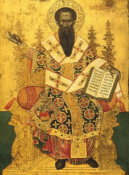 It turns out our visitors were celebrating St. Vasile, or Basil the Great, a religious figure born in the year 329. He lived virtuously, established monasteries, served the poor and was canonized by the Orthodox Church shortly after his death.






 You’ll also find more stories on this blog, Not Exactly Retired, such as


 “I had spent the latter years of my working life and the early parts of my retirement in various volunteer activities,” says Tom Corr, who was previously a lawyer in California. “My part-time volunteer activities had relatively visible results, at a modest cost to myself. I thought Peace Corps would be a ‘scaling up’ of that experience. But it is not. Peace Corps service requires a far more consequential commitment, but the ‘results’ of our service may not be visible to us for weeks or months, or maybe not at all.”
 Cynthia Katocs said Peace Corps helped her unwind from the corporate world (as illustrated here with a photo she took in Ialoveni with two familiar mice). “My first days in Peace Corps, I was wound up very tight from working in a corporation for many years,” she says. “The Peace Corps helped me find myself. It helped me look at myself and accept myself for who I am and not what I can bring to a company.”
 Inevitably, though, being a Peace Corps volunteer makes a person think about not only their new surroundings but also what is inside their own heart.

 "Not Exactly Retired"