Tag Archives: Moldova

Reprogramming A Retirement

img_9907
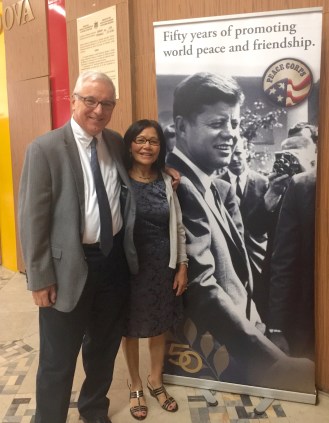
Brent and Deeporn Beardsley, married for 39 years, work together in the Peace Corps volunteer lounge in Moldova.

When Tucson residents Brent and Deeporn Beardsley walked away in their 60s from long-time jobs at IBM to join the Peace Corps, they thought they were saying goodbye to software development projects.

Instead, they ended up applying their programming and project development skills to assist schools across the Republic of Moldova. As they now wrap up their two years as volunteers in the east European nation, their free class-scheduling program is spreading rapidly with the active support of the country’s education ministry.

Class scheduling is much more complicated in Moldova than in the United States, where students generally take courses every day for a semester or a year — English first period, biology second period and so forth. In Moldova, a student may take six hours weekly of the local language, Romanian, four of math and two of English. Some teachers only work on certain days. Others split their time among two or more schools. Still others leave school unexpectedly for personal reasons. Some teachers have their own classrooms; others move around.

Screen Shot 2016-04-07 at 4.29.08 PM“It’s a nightmare to juggle everything,” says Dee, who discovered the problem during her first few days as an English teacher in the small Moldovan city of Calarasi. Her own schedule kept changing along with everyone else’s. School officials could use existing software to develop new schedules, but they had to pay high fees to print each version — this in Europe’s poorest country.
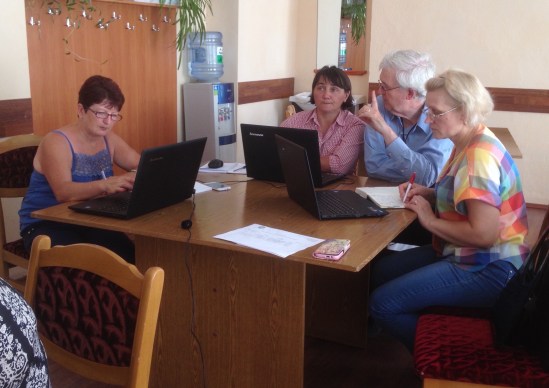
After discussing the problem with Dee’s colleagues, Brent began developing a new class-scheduling system with the coding language Java, eventually writing more than 20,000 lines of code. He completed a prototype within three months. The program worked so well that neighboring schools installed it as well. Dee and Brent then reached out to Peace Corps education volunteers throughout Moldova, many of whose schools also adopted the software, which Brent and Dee kept refining.

A local Peace Corps official, Eugenia Iurco, brought the program to the attention of friends working in Moldova’s education ministry. One of them, senior consultant Inga Cruciescu, recognized the program’s potential to solve a long-standing national problem without incurring new costs. She embraced it and began teaching regional workshops with Brent and Dee, training administrators how to install and use the latest version of the program.

IMG_1477
Inga Cruciescu from Moldova’s national education ministry, left, is taking the lead in promoting the program.

“The program really simplifies the process of planning lessons and improves the quality of education,” Cruciescu says. “”We’ve piloted it in 150 schools and plan to take it to the national level next year.”

Ionela Titirez of the U.S. Agency for International Development got behind the effort, too, providing transportation and refreshments for the workshops and arranging to translate the user’s guide and other materials into both Romanian and Moldova’s other main language, Russian. A small grant from the Peace Corps Partnership Program covered some of the project’s other costs. Brent’s work partners — Victor Ambroci, Valeria Ambroci and Evgheny Tinonov — assisted as well.

“Brent and Dee have done tremendous work,” Cruciescu says. “It’s been amazing to observe how much effort and personal time they’ve dedicated. At first glance you might have expected a language or age barrier, but both of them were very flexible and open. We’ve had an impressive collaboration.”

While working on the project, Brent also helped Stacy Chong, 49, a Peace Corps small enterprise volunteer working to assist Moldova’s fashion industry.

“Brent was an integral part of our project to develop Moldova’s very first textile library,” says Chong, who recently completed her service and began attending graduate school in Boston. “He built the database that enabled us to store information about all of our swatches and books. That enabled us to create an online textile library to assist Moldova’s fashion industry, which is growing rapidly and employs more than 20,000 women. Brent did all of this for no other reason than to help us.”

IMG_1458
Brent Beardsley assists high school officials at a training session in Moldova’s Leova district.

Both projects have been “totally different” from Brent’s previous work in a corporate setting back home. “I used to enjoy working with our customers and, of course the company might give me promotions or financial rewards. Here I feel like I’m really making a difference in people’s lives.”

“We’re not living in poverty as Peace Corps volunteers, but we’re certainly not living as multimillionaires. We’re getting a heck of a lot more than money,” agrees Dee, who grew up in Bangkok before moving to the United States decades ago.

She and Brent encourage other older Americans to consider Peace Corps service. “You get more respect as an older volunteer,” Dee says. “If you still have your health and you have the yearning to help others, you should do it.”

With two adult children and four grandchildren back in America, the couple is looking forward to returning home. However, they don’t expect to stop seeking new challenges and ways to help others.

“Am I just going to sit around on my couch or my porch, waiting to die?” Dee says. “My experience in the Peace Corps has shown me there is so much more I can do.”


Video: First Bell Ceremony

Every school in the Republic of Moldova celebrates its opening on September 1 with a colorful ceremony called Primal Sunet De Clopoțel, or First Bell. Local leaders and school officials give speeches of encouragement, students perform songs and dances and, finally, bells are rung as everyone cheers. This brief video shows highlights from the school in Ialoveni where Champa has begun teaching.

Video: Independence Day

On Saturday, the Republic of Moldova celebrated its 25th birthday as an independent country. Champa and I joined the celebrations in our new home, Ialoveni, and at the nearby winery of Mileștii Mici, home of the world’s largest wine cellar. This video captures some of the highlights:

Peace Corps: Now vs. Then

Can you guess what question I’m asked most often in Moldova, especially by other Americans?

It’s this: How have I found it different being a Peace Corps volunteer now compared to when I served in Nepal four decades ago?

FullSizeRender 59

My short answer is that the experience feels very familiar. As before, I’ve left my family and America to serve people in another country, learning their language and sharing their daily lives.

But serving in Moldova has also been very different from my stint in Nepal in the late 1970s. Here are six of the biggest changes I’ve seen:

  1. I am much more connected to the outside world. I have a smart phone, a laptop and a Kindle, all linked to wifi. I talk regularly with my family. I am following the U.S. election campaign and other news. I interact online with my Moldovan partners and Peace Corps colleagues. In contrast, when I served in Nepal I did not call home even once. The Internet did not exist. I was very alone.
  2. Safety and security have become a much bigger deal. Neither terrorism nor street crime are serious problems in Moldova, yet our training was filled with security briefings. We were given detailed emergency action plans. I can’t leave my post overnight without notifying the staff. I can’t even enter the Peace Corps office without passing through a locked gate, a guard and a metal detector. In Nepal, I used to ride my bicycle past a front gate nominally staffed by a guard, then strolled inside.
  3. The infrastructure is more elaborate. My desk is piled with Romanian language workbooks, brochures on Moldovan culture, a “volunteerism action guide” and more. I have dozens more resources on a thumb drive Peace Corps gave me, not to mention the documents we received before we arrived here. There are detailed protocols for everything from paying a language tutor to taking a trip. In Nepal, our training was also excellent, but we had fewer resources and a lot less red tape.
    IMG_8978
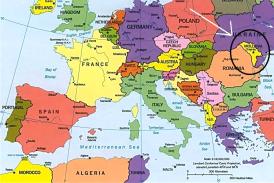
  4. I’m in a different country. Moldova is in eastern Europe, with an agricultural economy best known for wine. Its population is almost entirely white and Orthodox Christian. Nepal is in the Himalayas and mainly Hindu, along with Buddhists, Christians and Muslims. Both countries have delicious food, interesting people and fascinating customs, but they are as different as can be, except for the fact they are both landlocked — Moldova between Romania and Ukraine, Nepal between India and China. Inevitably, the Peace Corps experience is different, too.
  5. The world has changed over the past four decades. When I served in Nepal, the country was ruled by a king, who had not yet been murdered by his son. Now it’s a struggling democracy. The United States was still in a Cold War with the Soviet Union, which included Moldova. China was poor. Personal computers were new. Gay people could not get married. The idea of an African American or woman president back home was almost unimaginable. After four decades, the world is a different place. Peace Corps has evolved with it, such as by launching programs to combat HIV/AIDS or to “let girls learn.”
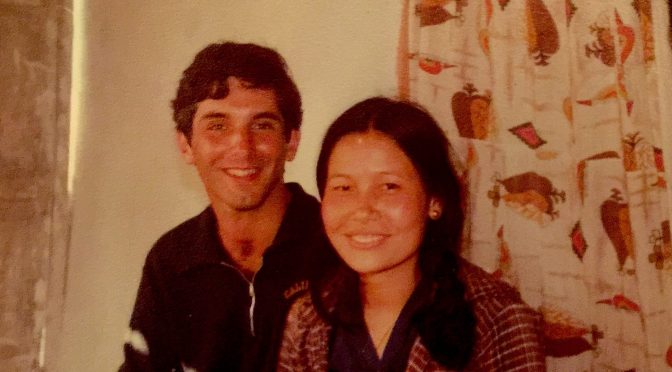
  6. I have changed. I saved this one for last because it’s the variable that affects everything else. When I joined the Peace Corps in Nepal, I was two years out of college, single and eager to save the world. Now I am a father and grandfather, serving with my wife of 37 years, who I met in Nepal. I am older and hopefully a bit wiser. In any case, I’m in a different place in my life, and not only geographically.

So, yes, I can now watch YouTube videos instead of fiddling with a shortwave radio to find a signal from the BBC or the Voice of America. But at least for me, Peace Corps still feels like “the toughest job you’ll ever love,” with the same beating heart. Once again, I’m working alongside a wonderful group of Americans who have taken a break from their lives to serve others and represent our country. Once again, I feel privileged to be among them.

Who knows? Perhaps there’s even a new form I’m supposed to fill out to confirm this.

Video: Student Performances

Champa and her fellow members of the English Education group in Peace Corps Moldova 31, along with their partner teachers, wrapped up their practice teaching on Friday with performances by their students in Costesti. I made this short video so you can enjoy the fun, too:

The Romanian Word Is ‘Dificil’

img_9219

Did you struggle in high school or college to learn Spanish, French or some other foreign language? Great! This question is for you:

I learned Nepali when I was a Peace Corps volunteer four decades ago and am now learning Romanian as a volunteer in Moldova. Which language do you think is harder?

Keep in mind: Romanian is related to many other European languages and to our own. It shares many words with English. Its syntax is similar. Nepali, on the other hand, is a Sanskrit language. Its alphabet, Devanagari, is completely different, as is its syntax. In Nepali, the sentence “What is your name?” literally translates as, “Your name what is?”

Maybe you’re thinking this is a trick. Maybe I’m encouraging you to say Nepali is harder but I actually think Romanian is harder.

Well, I do think Romanian is harder. But the problem is that I’m not sure it really is harder. Perhaps I’m just not as good at learning languages as I used to be.

img_9221To be sure, Nepali was harder for me at the outset. Its sentence structures seemed so bizarre that I walked out of my first language class, ready to quit in despair. Within a few days, though, I got the hang of it. By the end of our training, I was able to have a simple conversation. Today I still speak it easily, if imperfectly.

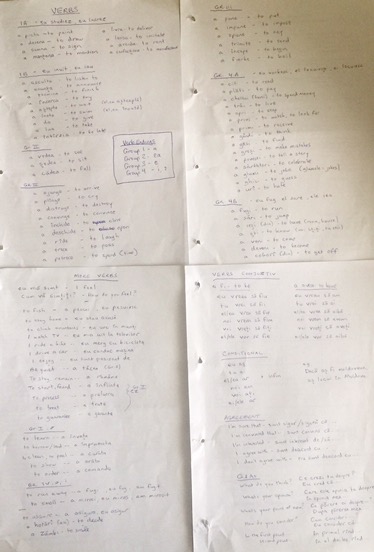
When I first encountered Romanian, it reminded me of French, which I studied in high school. I was relieved so many words looked familiar. For instance, here are some Romanian verbs whose meaning you can probably guess: discuta, studia, dansa, telefona and permite. I am a voluntar who is activ, sociabil, inteligent and optimist. Right now it’s August. Next month is Septembrie.

See what I mean? How hard could it be to learn Romanian, right?

Well, it’s been plenty hard. Accent marks change the pronunciation and meaning of s, t, a and i. Adjectives and verbs must be conjugated as masculine or feminine. Verbs fall into multiple categories, each with their own conjugation. There are endless exceptions.

During our language training, which wrapped up last week, we blasted through lessons on how to describe our families, order food, ask for directions or describe our work as Peace Corps volunteers. We learned how to use present tense, past tense, future tense, reflexive verbs and things like “genitive case” whose meaning I’d long forgotten in English, much less Romanian. We memorized lists of foods, clothing, furniture and more.

I’ve found it much harder to cram all of this into my brain than when I learned French or Nepali. I mutter “Damn you, neural plasticity!” to myself while I study before and after our four-hour classes, make word lists, then make new lists of words I still can’t remember.

img_8923Fortunately, I had an incredible teacher, Diana, who was skillful and tireless in helping my classmates and me learn everything. That’s her in the flower dress with us. With Diana’s help, I ended up with a good score on the exam they administered before we swore in as volunteers last week. She kept telling me I was doing fine, and I guess she was right.

In any case, this is just the first lap. I recently moved in with Champa while her group finishes its training, and I’ve been using the time to keep studying. Whenever I need more motivation, I remind myself I’m moving soon to a post where my partner doesn’t speak much English.

There’s a Romanian word for what this has been like for someone 63 years old. You can probably guess its meaning: dificil. However, I am doing my best to stay focused on another Romanian word: succes. Regardless of how your own language class turned out, please wish me luck.

Video: Park Cleanup and Culture Festival

A few days before we swore in as volunteers for Peace Corps Moldova, our “community and organizational development” group helped clean up a local park and hosted a cultural festival. It was our way of thanking our host families and communities in the two villages, Rusestii Noi and Bardar, where we lived during our training. Here’s a video I produced about the events.

Peace Corps After 50

[An edited version of this post also appears on the PBS website NextAvenue.]

Before Champa and I joined the Peace Corps at the age of 63, people asked us how we’d feel to be surrounded by volunteers younger than our two sons.

Well, many of our fellow volunteers are indeed in their 20s, and most of them are smart, enthusiastic and fun to be around. Yet Champa and I are hardly outliers. Fourteen of the 58 people in our training group — nearly one in four — are 50 or older.

IMG_8252Worldwide, Americans over age 50 comprise about 7 percent of the nearly 7,000 Peace Corps volunteers now serving in 63 countries around the world. With its better medical facilities and programs in fields such as business development that attract people with lots of real-world experience, Moldova attracts higher numbers.
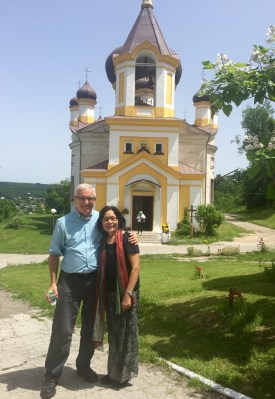
Whatever their reasons for choosing Moldova, the older volunteers here are impressive. They’ve worked as professors, attorneys, IT managers, nonprofit leaders, teachers, city administrators and management consultants. They come from across the country, including two other older volunteers from North Carolina. They are single, widowed, divorced or, as with us and one other older couple, married and serving together. Like the volunteers here generally, they are also diverse, reflecting the country we represent.

IMG_8174We differ from our younger counterparts in some ways. Learning a new language may be tougher for us, although many of us are doing fine in our Romanian classes. We may run slower in a group soccer game, if we participate at all. When several younger friends went to get tattoos recently, they knew better than to invite me along. They also may party harder and make surprising cultural references. When I was in the Peace Corps office the other day, a Carole King song started playing and the young woman next to me said, “Hey, it’s that song from the Gilmore Girls!”

On the other hand, they’re usually polite when we make our own references to people and events from before they were born, so it tends to even out.

In Moldova and other Peace Corps countries, there are advantages to being an older volunteer. Many of these countries show great respect towards older people. Similarly, having children and grandchildren has provided Champa and me with an instant bond with older members of our new communities. Our experience enhances our credibility in our workplaces as well; my future colleagues have already checked me out online. Older volunteers can share their hobbies, too, as Champa hopes to do with art and gardening.

Peace Corps has a special website for older Americans interested in becoming volunteers. The site reviews the application process, which is competitive and includes an extensive medical clearance process.

One of my reasons for writing this blog, and this post in particular, is to encourage older readers to consider the Peace Corps or some other new challenge for themselves. It’s not as strange or exotic as they might think and shouldn’t just be dismissed with “Oh, I could never do that at my age.”

Obviously, many people have family obligations, medical problems and other constraints that make Peace Corps unrealistic. Nonetheless, it’s a proven program through which more than 220,000 Americans of all ages have served their country and the world — and had a great adventure in the process.

Personally, I’m already wondering what it will be like in two years to be back in America and surrounded by friends who are mostly older than the ones I’ve made here.