Tag Archives: David Jarmul

My Unpredicted Birthday

I never could have predicted when I was a boy that I would end up celebrating my 65th birthday in a country called Moldova with my wife from Nepal making a celebratory dinner of foods from our home state of North Carolina.

IMG_2470

I’d never heard of Moldova. I’d never heard of Nepal. Even North Carolina seemed exotic to a boy growing up on Long Island in the 1950s and 1960s. For me, a big trip then was to New York City. There were no ATM machines, Internet or smart phones, much less QR codes to hop on a jet plane and fly halfway around the world.

IMG_2476

Now I find myself in the former Soviet Union, nearing the end of my Peace Corps service alongside a woman from the Himalayas who became my beloved wife, giving me more happiness in my life than I’ve ever deserved. Even after nearly two years together in Moldova, I still sometimes shake my head in wonder: How did I get here? How did a boy from Freeport come to celebrate a special birthday in Eastern Europe, receiving congratulatory Facebook messages in English, Romanian and Nepali from family and friends stretching from Singapore to Seattle?

My life has gone in such unexpected directions. I have been so lucky — and I haven’t even mentioned my greatest blessing of all, our family back home.

IMG_2511

Here in Moldova, people celebrating a birthday are expected to arrange and pay for the party. So on Tuesday, one day before my birth date, I organized an American-style pizza-and-cake lunch for my colleagues at the library. They surprised me with several wonderful gifts and sang “Mulți Ani Trăiască!” in my honor.

The next evening, our host family joined us for a traditional North Carolina barbecue dinner, which Champa spent several days preparing. As you can see in the video clip, they sang both “Happy Birthday to You” and “Mulți Ani Trăiască!” when they brought out a cake and candles. I received more wonderful gifts.

Thank you to everyone who helped me mark this special occasion, either here, by phone or online. If I’ve learned nothing else over the past 65 years, it is that all of us around the world have so much more in common than the differences that separate us or make us fear one another. We can all touch each other’s lives. We can touch each other’s hearts. We can become friends, even families, together.

IMG_2505

In one of my very first posts on this blog, I wrote: “When people asked me over the past several months why I would walk away from a job and colleagues I love to travel around the United States and Nepal, I spoke often of how Champa and I love to travel — which we do — and of our desire to take a break from the conventional routine. But it was more than that. After being tied to calendars and project schedules for so many years, I wanted to embrace the unknown.” In a later post I added: “One of my goals in being ‘not exacty retired’ is to recognize the richness of life’s surprises and make the most of them.”

IMG_2543

I am so thankful Champa and I decided three years ago to pursue this dream, to veer off the usual path and open our lives to new experiences and ways of serving others. We’ve had good luck, to be sure. Things could have gone badly. But we’ve ended up discovering a new country and new friends while learning new things about ourselves.

Now we are looking forward to reuniting with our family and friends back home. I expect to remain “not exactly retired” after 65 but don’t really know what will happen next. I am eager to be surprised anew. Celebrating this birthday has reminded me how rich your life can become when you let it take you places you never predicted.

IMG_2486

Ten Surprising Sights

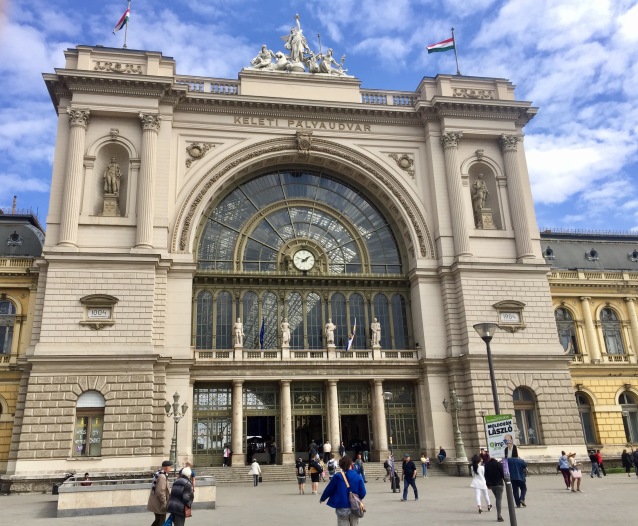
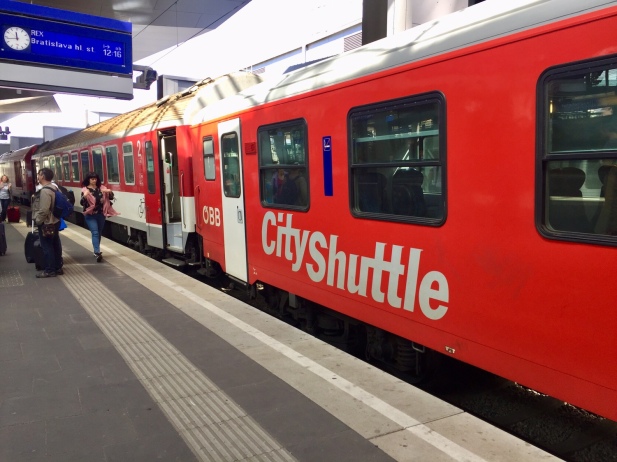
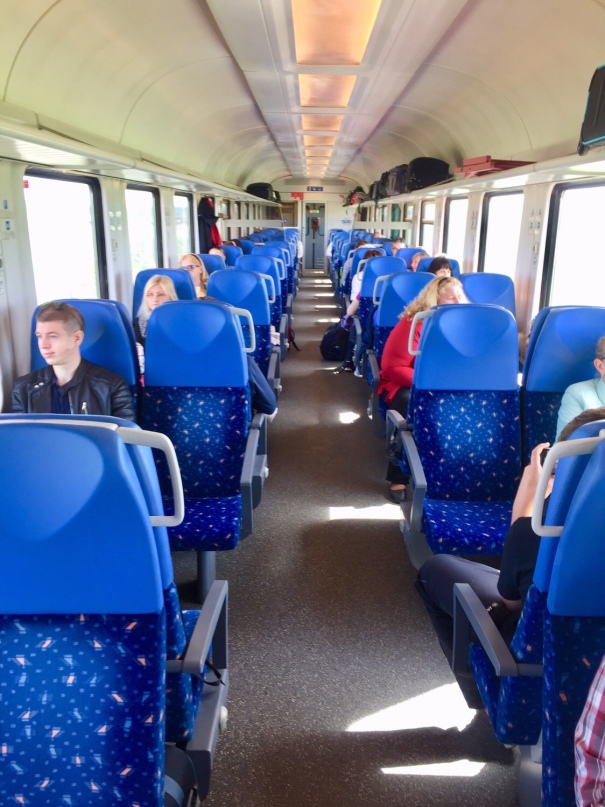
We saw lots of beautiful sights in Vienna, Budapest and Bratislava when we visited this past week. We also saw things that surprised or amused us, like the ten shown here:

Vienna

1. Narrow streetcarsimg_2011-e1523885067610.jpg

2. A Rabbit Outside the Opera House

img_2125

3. Lots of Windmills

img_2140

4. More Openness About the Holocaust

img_2041.jpg

Budapest

5. Reagan Beside a Soviet Memorial

img_2272

6. Delicious Matzo Ball Soup

img_2306

Bratislava

7. An Unexpected Book Enthusiast

8. A (Tarheel) Blue Church 

9. A Street Memorial for a Slain Journalist

10. A ‘UFO Tower’ and Bridge


Three Favorite Spots

If you could visit just one place in a great city, where would you go? The Eiffel Tower or the Louvre in Paris? The Statue of Liberty or Central Park in New York? Tiananmen Square or the Forbidden City in Beijing?

I have answers for three cities we just visited along the Danube River: Vienna, Budapest and Bratislava. My picks aren’t necessarily the most famous spots in these cities but they’re the ones Champa and I will remember the most. 

In Vienna, it was the opera house. Not inside the opera, where two tickets can cost more than our monthly Peace Corps budget, but the sidewalk outside. You can sit in chairs there and watch a performance live on a giant screen for free. We discovered this after we arrived in Vienna and saw the ballet Raymonda starting as we strolled by. We sat and enjoyed it for nearly an hour, returning the next day to catch part of Richard Wagner’s opera Die Walküre.

img_2129

It was magical to sit outside on a beautiful evening and watch world-class performances in the Austrian city reknown for its music and culture.

In Budapest, we’ll most remember the Chain Bridge and adjacent funicular, which provide stunning views of a picturesque city. We’d already taken a boat ride down the Danube, sailing under the bridge and past the Parliament building and other sites. As in Vienna, we’d also toured the city with Big Bus.

However, nothing topped the view from the historic bridge that spans the river between Buda and Pest, the western and eastern sides of Hungary’s capital. Well, nothing except the historic cable car that climbs to an even better view from Buda Castle. 

IMG_2265

Our biggest Bratislava memory will be St. Martin’s Cathedral, and not only because it’s a landmark of the Slovakian capital. For us, it was also the view in the window of the Airbnb we rented across the square. We could admire the three-nave Gothic church while sipping our morning coffee and then walk a few steps to tour the interior.

A sidewalk, a bridge and a cathedral weren’t the only places we enjoyed during our eight-day trip, the last vacation of our Peace Corps service. We saw lots of other things, too. Some were surprising, as I’ll explain in my next post. For now, you can see for yourself that many of them were amazing.

Vienna, Austria:

Budapest, Hungary:

Bratislava, Slovakia:


Jimmy Kimmel, PCV

Should Jimmy Kimmel join the Peace Corps?

That’s what Rep. Joe Kennedy III jokingly encouraged on Wednesday when he appeared as a guest on the comedian’s late-night show. (The exchange begins at 2:00.)

The exchange was light-hearted but highlighted how little many Americans know about the Peace Corps, and how even fewer regard it as something they might do themselves.

Kimmel opened by asking Kennedy about his famous relatives, then switched to his volunteer service in the Dominican Republic. “What goes on in the Peace Corps?” Kimmel asked with a smile. “Do they come to your house and they take you to another country?”

Screen Shot 2018-04-06 at 4.45.00 PM“No, you actually have to get on a plane,” replied Kennedy. “That’s the ‘volunteer’ part.”

The Massachusetts Democrat went on to describe the Peace Corps as “an organization close to my heart [that] does an awful lot of good around the world” and his service as “the most impactful experience” of his life. 

Back in 2011, Champa and I heard Joe Kennedy speak eloquently about his Peace Corps service at an event at Arlington National Cemetery honoring the organization’s 50th anniversary. He announced his candidacy for Congress a few weeks later.

On Wednesday, when he said Peace Corps is “not for everybody,” Jimmy Kimmel quickly agreed. “It is probably a great experience,” he said, “one that I and no one in my family will ever have.” Both he and Kennedy laughed.

Screen Shot 2018-04-06 at 4.46.26 PMFair enough. If I were Jimmy Kimmel, I wouldn’t walk away from a network talk show and millions of dollars, especially with a young family. More to the point, if the thought of leaving America for two years to serve in a distant community sounds unappealing, then it’s not a good fit for Jimmy Kimmel or anyone else. Especially during the past year, he has emerged as an important voice on health care, immigration and other issues. He and others can pursue meaningful lives in so many ways.

Indeed, Kimmel said, “You know if I did that, everyone would think it was a joke. Nobody would believe I went to volunteer for the Peace Corps.”

I’m a big Jimmy Kimmel fan, so I’m glad he didn’t take the idea seriously. But maybe some of his viewers did. The Peace Corps is mentioned so rarely on television that it’s all but invisible to many Americans, some of whom might make great volunteers. I hope this exchange caused at least a few of them to give it some thought.

Screen Shot 2018-04-06 at 4.42.42 PM

That’s one of the things I’ve been trying to do with this blog, albeit on a smaller scale. Some readers of Not Exactly Retired, especially those nearing retirement, have written me to say it helped them picture Peace Corps service and consider it for themselves. I’ve treasured those messages. (If you’re reading this and have a similar story, please let me know!)

As Joe told Jimmy: “There’s no age limit on volunteers. You could sign up today.”

Subscribe to Not Exactly Retired.

Goodbye Winter (Photos)

Winters in this part of the world are a lot colder than in our home town of Durham, N.C. Now that it’s April, here are some memories of what we saw the past few months. We’re hoping we don’t have an unexpected spring snowfall like we did last year.

IMG_9829

IMG_1768

IMG_9376

IMG_0468

IMG_9824

IMG_2570

IMG_2561

IMG_2458

IMG_2572

IMG_0197

IMG_2597

IMG_2590

I Love Moldova. Really.

Moldovans sometimes ask me whether Champa and I like Moldova. IMG_7936When I tell them we’ve come to love Moldova and will miss it when we return home, they are often surprised.

Their eyebrows go up. Their eyes widen. “Really?” they ask in disbelief that an American might admire their country.

Yes, really.

IMG_5608Inevitably, they respond with “but what about”: But what about the bad roads? What about the overcrowded buses? What about the low salaries? What about so many people leaving the country to work elsewere? What about the corruption?

In a recent poll, 73 percent of Moldovans said the country is going in the wrong direction; 76 percent said young people do not have a good future.

These and other problems are very real. No question about it. But so is the beauty of Moldova’s countryside, its glorious churches, its delicious fruits, vegetables and wine. I love the laughter of its children. IMG_5584I love the grandmothers talking in the market, the mothers carrying babies, the dads holding their children’s hands. I love everyone’s hospitality and generosity.

I love so much about Moldova. It’s been a privilege to serve here. Champa and I are both grateful to have had this opportunity.

We will return in July to a country with profound problems of its own. Yet even though recent events have sometimes led me to despair, I have never wavered in my pride about my homeland. Yes, we have a messy democracy and corruption in our own politics. But we also have backyard barbecues, Saturday Night Live, Fourth of July parades and Little League. We have LeBron James and Beyonce, overstuffed aisles at Costco and food trucks lined up beside our farmer’s market in Durham.

img_7900

Living abroad has reminded me how lucky I am to be an American.

I wish more Moldovans would recognize and celebrate the wonderful things about their country. After living here for two years, I’ve come to believe their biggest problem is not politics or the economy. It’s the “glass half empty” view of life I encounter so often. I’ve lived and traveled in other countries much poorer than Moldova, with deep challenges of their own, but the people I’ve met have generally been proud of their homelands. Here in Moldova, there is a “cloud of pessimism,” as Eric Weiner described in The Geography of Bliss. Not always, not with everyone, but often.

IMG_1785

To my foreign eyes, Moldova’s negative self-image is out of alignment with its reality. Even recognizing its many challenges, I’ve come to know it as a beautiful place with dedicated, hard-working people who have the skills and hearts to make it prosper.

First, though, they have to believe in themselves. When they ask someone from another country whether they like Moldova, they have to expect the answer to be yes.

In any case, that’s my answer, and I know other Peace Corps Volunteers who feel the same way: I don’t just like Moldova; I love Moldova. Maybe that’s something Moldovans need to hear. Really.

Laminated Memories

I got my latest certificate on Friday, an especially nice one from our city’s mayor, Sergiu Armașu. He gave it to me during an event honoring library projects, librarians and volunteers from across the district. Our library in Ialoveni, the district capital, hosted the program.

IMG_1857

IMG_8995Certificates and diplomas are a big deal here in Moldova. They are awarded at sporting competitions, school ceremonies and other events. A certificate typically includes the official stamp of the organization and may be laminated.

Moldovans start collecting certificates as students. By the time they graduate from high school, they often have a thick folder of them, which they may proudly show to you.

This seemed strange to me at first. During our Peace Corps training, the local librarian arranged for us to meet some kids in our village. She asked one of the girls, a talented artist, to show us her certificates from painting competitions. The girl explained the certificates one by one.

IMG_1820

As I thought about her later that evening, I recalled the many trophies and medals my two sons accumulated from their sports teams, science fairs and other activities. Their trophies filled two large boxes when we cleaned out our house before joining the Peace Corps. I also had my own stash of certificates, diplomas and congratulatory letters.

IMG_1276In other words, as the walls of many American doctors’ offices make clear, our traditions are similar in many ways. Here in Moldova, though, certificates are way more popular, not to mention cheaper, than sports trophies. Kids here sometimes also receive medals, like the boys on our robotics team shown below.IMG_0968

Last month, before Champa’s school held its big celebration of its new drama costumes, we needed to produce nearly 30 certificates to give to the teachers, students and parents who assisted the project. We also needed certificates for my partners in our library’s Bebeteca project. I was able to laminate all of these certificates with a machine at the Peace Corps office, which has undoubtedly been put to good use over the years.

img_1392.jpgCertificate ceremonies in Moldova are usually filled with pride and appreciation. The speeches are heartfelt, the smiles are genuine and the certificates themselves are lovely. The moment is always captured with a poza — a pose for the camera.IMG_7617

After they receive a certificate, Moldovans may use it to prove their eligibility to receive a job promotion or a raise in salary, or to apply for a new position. More often, they hold onto it as a souvenir of a memorable activity.

When I told a Moldovan friend what I planned to write in this article, she laughed and said, “I don’t want a certificate. Give me some cash.” She had a point, just as one might reasonably ask whether Moldova’s teachers would be better off receiving fewer flowers and bigger paychecks. As a foreign visitor, these questions are not for me to answer. I can only say I have come to enjoy these certificate ceremonies as a distinctive part of Moldova’s culture.

IMG_9731

Champa and I now have our own folder of certificates, which we look forward to bringing home to America with us. They’ll be laminated memories of our time here.

dsc_0202.jpg


New Library Website

Ialoveni’s library has a new website, one with lots of new features and a much cleaner design, all of which the library can manage itself for free instead of paying someone else.

The site is at bibliotecaialoveni.wordpress.com.

Screen Shot 2018-03-29 at 12.35.52 PM

My library colleagues scrapped their outdated previous site for this new version, which is easier to manage and will serve their customers better. Having worked on several web redesign projects back home, I was able to help guide them through the process of organizing their data into logical categogies and presenting it in ways that put user needs ahead of internal organizational lines.

Screen Shot 2018-03-20 at 11.48.38 AMThe new site features the library’s many new services, such as its clubs for robotics and film animation, and its “Bebeteca” room for kids and families. It highlights a library blog that previously existed on a separate site and was often overlooked. There’s an automated calendar that lists upcoming events. Screen Shot 2018-03-20 at 11.45.51 AMA map provides directions. An online exhibit offers a video, photo exhibits and historical information about the library’s namesake, folklorist Petre Ștefănucă. A multimedia section shows YouTube videos about the library. Another section provides the annual work plans for the main library and its two branches.

We built the site on WordPress, which offers templates and operating systems in multiple languages, including Romanian. I’m a fan of WordPress, which is easy to learn and has a lot of useful features even in its free versions. Since I use WordPress for my own blog and have become comfortable with it, I took the lead in designing and assembling the new library site, using a free template called Rowling. I worked closely with library director Valentina Plamdeala and my partner Lidia Russu, who I am now training to update and manage the site.


Like many Moldovan companies and institutions, Ialoveni’s library relies heavily on Facebook for its communications. We made sure the new website includes prominent links to its Facebook site and features its latest Facebook posts automatically. WordPress “widgets” made this easy to do this, as well as to highlight the library’s schedule, link to the blog archives and do other tasks that used to require custom programming.

We hope the new site will enable Ialoveni’s library to serve its community more effectively and attract new users. If anyone reading this works at another library in Moldova and wants to learn more about our experience, we’d be happy to share it with them.

Screen Shot 2018-03-29 at 12.33.54 PM

Kids, Moms, Bebeteca (Video)

Our library’s new Bebeteca room, created with Peace Corps support, is bringing together kids and moms to enjoy fun and educational programs. Video also available on YouTube.


How to Call Home

Screen Shot 2018-03-24 at 10.52.20 AMMy head spins sometimes when I try to remember the best way to call someone while I’m serving as a Peace Corps Volunteer in Eastern Europe. My older son back home uses Skype. His wife and my older sister prefer Facebook Messenger. My other son and his wife use FaceTime, as does my younger sister. Our nieces in England like Viber. We also speak with our nephew who recently finished his medical studies in China, where he used WeChat.

Screen Shot 2018-03-24 at 10.51.55 AMHere in Moldova, I can call a friend’s number with my cell phone but they may respond faster to a text, unless of course they prefer to receive a message via Facebook or WhatsApp.

Most of my fellow Peace Corps Volunteers use Facebook, but some don’t, even before the recent controversy about Facebook’s handling of confidential data. For them, I generally need to call with my cell phone or send a text or e-mail message.

Screen Shot 2018-03-24 at 10.53.16 AM

Most of my Moldovan friends still prefer telephone calls to electronic messages, although that’s changing, too, especially with younger people. This was a problem for me when I first got here, since I couldn’t understand or speak Romanian well enough to have a conversation. Now I’ve begun using the telephone, too.

Screen Shot 2018-03-24 at 10.54.30 AM

Peace Corps gave me a local SIM card for my iPhone when I arrived here, and it pays for a monthly plan that includes a generous amount of free calling minutes and Internet access. I supplement the latter with a portabler router and wireless plan I purchased from Orange, the big local telecommunications company. Screen Shot 2018-03-24 at 11.38.00 AMPCVs who didn’t bring a phone received one from Peace Corps, together with a SIM card. When I travel outside Moldova, I add extra money to my phone account and activate its international roaming feature, for prices far below what companies charge back home.

Screen Shot 2018-03-24 at 10.55.09 AMIt’s great to have all of these communications options, particularly since so many of them are free or cheap, but remembering everyone’s preferences reminds me of planning a dinner party where one guest is a vegetarian, another is lactose intolerant and another doesn’t eat gluten. Who can keep track of it all?

Communications were much simpler when I served as a Peace Corps Volunteer in Nepal four decades ago. Back then, I didn’t call home at all during my two years abroad. Not once. If I’d wanted to call the United States, I would have had to ride my bicycle to an office near the Kathmandu stadium and pay an exhorbitant fee to sit in a booth and hope they could make a connection. Screen Shot 2018-03-24 at 10.51.16 AMI never bothered with it. Neither did most of my PCV friends. We mailed letters instead.

I just learned from an online thread with some Peace Corps Moldova friends that I can now call the United States on Skype for two cents a minute, or with Yolla for less than a penny per minute or connect to a U.S. number for free with Google Hangouts Dialer. Of course, Messenger and FaceTime are still free, assuming I have a wireless connection. I also have plenty of minutes left on my telephone account this month.

I may need to call my son and ask for his advice.

Screen Shot 2018-03-24 at 11.38.47 AM