Video: Welcome to Ialoveni

Ialoveni, Moldova is a great place to visit and do business. That’s the message of this short video I produced for the Consiliul Raional, where I serve as a Peace Corps volunteer. The video, now posted on the council’s home page, is in English to help attract foreign visitors and investors. You may recognize the narrator’s voice.

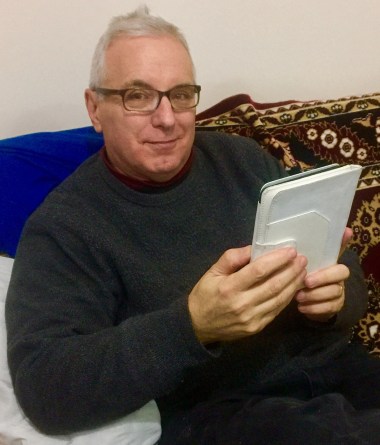
Reading in OverDrive

img_1817

Before I joined the Peace Corps as a volunteer in May, after working for 14 years at Duke University, I used to borrow books regularly from both the Duke and Durham County libraries.

I still do, although I no longer check out bound books. Instead, I download electronic versions halfway around the world.

screen-shot-2016-12-03-at-9-51-39-am

I just finished reading Weapons of Math Destruction, Cathy O’Neil’s description of the dangers posed by big data, which I’d seen on the New York Times 100 notable books list for 2016.

I downloaded it for free onto my Kindle Paperwhite using the OverDrive “Digital Library Reserve” system offered by both the Duke and Durham libraries, which I access as a Duke retireee and Durham resident.

screen-shot-2016-12-03-at-11-22-25-amMore than 2,000 Duke users will check out more than 10,000 books from OverDrive this year, according to Aaron Welborn at Duke University Libraries. Roughly two-thirds will be audiobooks. I mainly check out ebooks since I prefer to use my “headphone time” for podcasts and music.

“We chose to subscribe to OverDrive precisely because we know that our Duke community extends way beyond the campus, and we want all users, no matter how far-flung, to have access to a wide array of e-books,” Deborah Jakubs, the university librarian and vice provost for library affairs, explained to me in an e-mail message.

Working as a community development volunteer in Moldova, in eastern Europe, together with my wife, I certainly qualify as “far-flung.” It’s difficult to find current American books here and I can buy nearly a week’s groceries for what it costs to download one best-seller from Amazon.

The Duke and Durham libraries each allow me to download up to three books at a time, generally for three weeks. Champa and I don’t have a television or a subscription to Netflix, Hulu or Amazon Prime, like some other volunteers. Instead, I usually read in the evening before going to sleep.

“We selected OverDrive to serve Durham residents who prefer to read books electronically or can’t come easily to one of our branches,” Tammy Baggett, director of the Durham County Library, wrote me. “We didn’t have Peace Corps volunteers in mind but it makes our hearts happy to know they are benefitting, too.”

screen-shot-2016-12-03-at-9-53-19-am

Since I arrived, I’ve read popular current novels such as Donna Tartt’s The Goldfinch, Chris Pavone’s The Expats and Anne Tyler’s A Spool of Blue Thread, as well as more harrowing tales such as Delicious Foods by James Hannaham and Station Eleven by Emily St. John Mandel. I’ve enjoyed short stories by Alice Munro, history from Erik Larson, science from Malcolm Gladwell, humor from Kurt Vonnegut, inspiration from Nicholas Kristof and Sheryl WuDunn and thrillers from John Grisham, David Baldacci and Gillian Flynn.

I loved Patti Smith’s book about her friendship with artist Robert Mapplethorpe, Just Kids, which led me to borrow a copy of Bob Dylan’s Chronicles from the Peace Corps library here, shortly before he won the Nobel Prize. One of the few other “hard copies” I’ve read was a terrific short-story collection from George Saunders that one of my former academic advisees and favorite Duke students gave me as a farewell present. (Shout out, Katie Fernelius!)

I’m now finishing up Chaos Monkeys, a book about Silicon Valley, and starting soon on Jeffrey Toobin’s book about Patty Hearst.

Separate from the OverDrive system, I downloaded free copies of more than a dozen classics from Project Gutenberg. So far, I’ve only skimmed a few of them. Bram Stoker’s Dracula was a treat since the castle that inspired the book is near where I now live. I keep meaning to read the others, especially while I am in Peace Corps, but I return again and again to OverDrive.

screen-shot-2016-12-07-at-10-45-07-am

I told OverDrive’s David Burleigh about my favorable experience and he said, “Yours is a great example of libraries serving their readers even when they’re traveling or working abroad. We’re happy to play a role and make it easy for you.”

OverDrive also allows me to recommend books for my libraries to add and to reserve books currently checked out. As you can see in the photo above, I’m currently waiting on four books from the Durham library, all of which I’m excited to read.

Of course, Amazon and other online retailers would prefer that I buy books, which I did recently with Bessarabian Nights, a new novel by Stela Brinzeanu about trafficking and other problems in Moldova. It’s not in the OverDrive system and I was happy to give some business to the author, who fondly remembers being taught here by Peace Corps volunteers.

If you want to try OverDrive yourself, their home page lets you check whether your local library participates. I hope it does. For me, an active reader living far from home with a limited budget, it’s been a godsend. (I do, however, miss drinking coffee in Duke’s Perkins Library.)

Mail Time

img_1822-2I did something retro on Monday morning: I mailed a letter at the local post office instead of communicating electronically.

Two letters, in fact, with Moldovan holiday cards for our sons and their families. You can see the colorful stamps, which totaled about 75 cents for each letter.

img_1825Our post office is in the center of Ialoveni, a block away from the Consiliul Raional, or county center, where I work. That’s typical in Moldova, where almost every town has a government office, a post office and a casa de cultura, or cultural center, along with at least one church, school and market.

screen-shot-2016-12-03-at-11-22-25-amI waited in line behind two elderly customers who were collecting their monthly pensions. The man in front of me was at least 75 years old, possibly much older.

Moldovans use their local post office for much more than mail. It’s also where they can pay utility bills, transfer money, send a fax or collect their pension. In Bardar, where we had our training, there was even a hair salon downstairs.

img_1826

Moldova’s post offices do not offer as many services as some others in Europe, which sell everything from toys to umbrellas. As the New York Times reported a few years ago, “With mail volumes decreasing 1 to 2 percent annually in many countries, European postal services from Germany to Sweden to Switzerland have reinvented themselves over the past decade as multifaceted delivery and information companies tailored to the virtual age.”

img_1835

That’s an interesting contrast with post offices in the United States, which are restricted legislatively from entering businesses unrelated to mail delivery. In that respect, what I thought was a retro visit actually got me thinking about the future of our own system back home, in our supposedly more advanced country.

Peace Corps surprises you like that. Feel free to ponder it while you’re waiting in line to mail your own cards and gifts in time for the holidays.

Trip to Soroca

Nice fortress, no?

It’s in Soroca, in northern Moldova, just across the Nistru River from Ukraine. One of the country’s most famous sights, it was built in the 1540s to replace a wooden fortress established by the great leader Ştefan cel Mare.

Champa and I visited it on Sunday with our host family, who arranged a road trip to Soroca that included not one but two picnics en route.

Here we are in the family van with our host mother, Nina, who is in the white coat with her friend Tamara. Nina’s husband, Mihail, is driving.  We stopped just before Soroca to eat our first meal, which Nina set up in the van because it was too cold to dine outside.

screen-shot-2016-12-05-at-10-43-56-amMoldova is so small that we were able to drive from our home in Ialoveni, near the capital city Chisinau, to Soroca in well under three hours, not including stops.

screen-shot-2016-12-03-at-11-22-25-amMore than 35,000 people live in Soroca, making it one of Moldova’s larger cities and an important industrial and administrative center. It once had a large Jewish population, now almost entirely gone, and still has a sizable Roma population. Many Roma people live in the neighborhood known as Gypsy Hill, where majestic homes mimic St Peter’s Basilica at the Vatican, Moscow’s Bolshoi Theatre, even the U.S. Capitol. Like many visitors, we drove through the neighborhood to see for ourselves. (I can report there are no signs yet of a Trump Tower.)

On the outskirts of Soroca we climbed 662 steps to Lumânarea Recunoştinţei, or Candle of Gratitude Monument. Opened in 2004, it’s a 97-foot tall tower honoring heroes who have preserved Moldova’s language and culture. That’s our host sister, Alisa, jumping in front of the monument and the two of us posing with the Nistru River behind us, Moldova on the left and Ukraine on the right.

After visiting the monument, the fortress and other sites, we stopped for lattes and tea at the local Andy’s Pizza, a popular restaurant chain in Moldova. There we met several Peace Corps friends posted in the area, including Annelise, a health educator from Minnesota pictured here. Then we drove back to Ialoveni, stopping along the way for a second picnic, this one featuring turkey and rabbit, cheese, stuffed cabbage, cake and small cups of homemade wine.

We are so lucky to live with the Bordei family, who treated us to this unforgettable excursion. We saw one of the most beautiful places in Moldova and many interesting sights along the way. Even if we’d had only one picnic, it was a great day.

Time for a Drink

img_1642

What’s a good time for a drink?

Here in Moldova, it’s not only at at parties with family and friends. Alcohol is also prominent at some business functions, as I was reminded on Friday when I joined my colleagues at an event to honor local farmers, winemakers and food manufacturers — our district’s most important industries.

img_1576

National officials joined our district’s president in handing out awards at the gleaming local conference center. Music played. A woman recited a poem, Everyone applauded. Then they all moved to a room where tables were overflowing with traditional foods and glasses of local wine and other alcoholic beverages.

I joined my friends at a table where they brought not only filled glasses but also bottles of cognac and plum wine. The toasts began: “Noroc!” (Good luck.)  “La mulți ani!” (Long life.) Sănătate! (Good health.) “Succes!” (You can guess that one.)

Others at the event were toasting each other, too. A DJ played old American songs such as “Feelings” and “I Just Called to Say I Loved You,” mixed with “Besame Mucho,” Moldovan tunes and a sort of East European Muzak.

Mind you, this was all happening a day after Champa and I hosted a large Thanksgiving party, which featured homemade wine along with the turkey. I did my best to drink moderately and resist most of the invitations to join more rounds.

As the party wound down, one friend took over the sound system to replace the outdated music with Ne Bucuram In Ciuda Lor, a song by the popular Moldovan band Carla’s Dreams (see the video below). People took home flowers and leftovers, just as they might at an American party. I got a ride back to our office with a farmer who gave me a bag of delicious dried plums from his trunk.

img_8137

Alcohol is enjoyed not only in our city but across Moldova. During our Peace Corps training, my group visited a village where the mayor and her staff welcomed us with a fabulous masa, or feast, which you see here. It included carafes of local wine along with bottles of mineral water.

Wine is offered routinely at meals and in abundance at weddings or birthday parties. Champa and I have enjoyed it regularly while managing to keep it under control. So do most of my Moldovan friends.

That’s not always the case here in Moldova.  According to a 2014 report from the World Health Organization, Moldovans drink nearly three times the global average of 6.1 litres per person per year, a per capita total second only to Belarus worldwide.

As I’ve described previously, you can buy a bottle of delicious wine for two dollars in the local market or refill a bottle for less than a dollar — assuming your host family doesn’t have its own wine, which it probably does.

Throughout our training, the Peace Corps medical and security officers urged everyone to exercise good judgment with alcohol. We’ve tried to take their advice to heart (and to mouth). After all, when you’re in wine country — Napa Valley, Bordeaux or Moldova — the temptations are everywhere.

Thanksgiving in Moldova

img_1549If you bought your Thanksgiving turkey at a local supermarket this year, you probably didn’t get the entire bird.

I did — head, feet and other body parts included.

img_1542

In fact, I ordered two turkeys from a local farmer here in Moldova for a Thanksgiving feast we just finished eating with seven other Peace Corps volunteers and our host family. I cooked them all a traditional meal of turkey, gravy, stuffing, mashed potatoes, vegetables and cranberry sauce — well, actually, a sauce I devised from dried cranberries, apricot jam and pomegranate juice, since you can’t buy fresh or canned cranberries here. Champa made a delicious beet salad for the first course.

For dessert, I baked an apple pie and improvised a pound cake with a package of evaporated milk that I found in the market, which I served with cherries harvested this summer from the family tree. I was also lucky to find a can of whipped cream.

img_1533One of our Peace Corps guests, who once managed a restaurant, made a sweet potato pie and also brought a jar of cranberry sauce sent from home by her daughter. Our main beverage was our family’s house wine, which they call Vin Champa, or Champa Wine, since she helped them make it.

All in all, it tasted like a real Thanksgiving feast, brightening the mood of all of us who were thinking of our families and friends back in America. For Champa and me, Thanksgiving is our biggest holiday of the year, the one time when both of our sons and their families come to our North Carolina home with their families, an occasion we treasure. In this blog, I’ve avoided writing about my family, wanting to keep that part of our lives private, but there’s no way to describe our Thanksgiving here today without saying how much we miss them.

img_1562Our Peace Corps friends missed their families, too. Peace Corps encouraged all of us to find ways to get together, so nobody would be alone unless they wanted to be. Champa and I were among those able to host a dinner. Others went together to restaurants, even if it was to eat pizza. Others gathered in the capital city, Chisinau, to watch an American football game airing at a local barbecue restaurant opened by former volunteers.

img_1522One reason I wanted to host our dinner was because I remembered being invited to a Thanksgiving feast in Kathmandu when I served in Nepal four decades ago. I am still grateful for the turkey and other dishes served by Ashton and Bill Douglass, who was working then for USAID in Nepal. It took a long time, but today I was finally able to repay my debt to them, albeit indirectly.

Incidentally, we now have some leftover turkey, apple pie and other goodies. If you’re hungry and in the area, stop by and join us. I promise, we won’t serve you the turkey heads.

Here’s our menu:

screen-shot-2016-11-24-at-2-04-38-pm

Humptydumpty(200, 198, 200, 305);

img_1468

Does this drawing remind you of a certain nursery rhyme — you know, the one about an egg, a wall and a “great fall”?

img_1467Humpty Dumpty immediately came to my mind on Wednesday afternoon when I looked at the drawing, which was created by Chris, a student in my weekly computer coding class.

“Humpty who?” he said.

“Humpty Dumpty!” I replied. “I can’t believe you figured out so quickly how to draw him.”

Chris, who you see here in the photo, had no idea who I was talking about, either in my halting Romanian or in English, so I searched on Google and showed him this video:

Several of his friends began watching, too. None of them had ever heard of Humpty Dumpty either, but they were impressed that Chris had unknowingly recreated a famous character. Here’s the code he wrote to do this:

img_1468-2

As you can see from the green banner at the top, they were all doing a lesson on Khan Academy, the free website that offers excellent tutorials on everything from algebra to history. My students have been learning JavaScript, the popular programming language. The site guided them to write simple commands for ellipses and rectangles, which they then resized and moved around their screens to form snowmen and robots. Chris took it a step further and created Humpty.

img_1469

I began teaching computer coding at our local library a month ago, using the Hour of Code website to challenge local students to write simple commands for the computer game Minecraft. They enjoyed it so much that they moved on to similar modules based on Star Wars and Frozen. Then several of the boys said they wanted to learn JavaScript, so we began working our way through some of the lessons on Khan Academy and other sites.

img_1472Note that I said “boys.” My biggest disappointment has been my inability to attract more girls to the class. I asked the librarians to help recruit girls, and they’ve reached out to a nearby school, but so far we haven’t had much luck, even when I offered to teach a separate class for girls. I asked the girls you see here to participate on Wednesday, but they were too busy checking out a dance site on Facebook.

img_1477Not all of the boys are interested, either. The one you see here programmed the first snowman with us but then, when I was busy on the other side of the room, switched to a computer game featuring shooting and soldiers.  You can also see part of the computer next to him, where a girl is checking out a photo of other girls dressed up for a performance. Just outside the photo are computers where several other boys were also playing action games. I did convince one older boy to try Hour of Code, which he enjoyed, but after competing the module he switched to Facebook and YouTube instead of moving on to the next module.

Since I’m learning JavaScript along with the students, generally teaching myself each lesson one day in advance, it’s probably just as well that I don’t have a huge class. I’m barely keeping up with Chris and the other boys as it is. Now that we’ve all learned a bit about drawing, they want to try creating a simple computer game.

We’ll be starting that next week. All the king’s horses and all the king’s men couldn’t stop us.

Message in a Bottle

14997180_10153924733611625_773040510_n
Signor Rana, when he was one of my students in Nepal

Just a few days before the stunning U.S. election, I received a message out of the blue that confirmed something Peace Corps told us during our training: You never know whose life you may touch, no matter what happens in the wider world.

The message came from Signor Rana, one of my students when I taught English at a school near Kathmandu as a Peace Corps volunteer four decades ago, long before I began serving again in Moldova.

It came to me on Facebook: “Hi, are you the same David Jarmul who was peace corp volunteer back in late 70 in Nepal? Remember Lab times in lab school? I was one of your student? I was looking for you since 1988.”

14937051_10153924733201625_1765370125_n
Signor and his classmates at the Lab School near Kathmandu, where I taught as a Peace Corps volunteer. He is second from the left in the second row.

Of course I remembered the Lab Times, the wall newspaper I started at the school, but I didn’t remember Signor — one of several hundred students I had there and in Champa’s village, Ilam. Still, I wrote him back, and he responded quickly.

“Wow, I was looking for you since I came to US as a student back in 1989,” he replied, describing how he is now married, living in Maryland and working as a software engineer for the federal government.

“You used to tell a story of America and show us moon landing documentary and made me participate in play Snow White. That made me dream of America and came here. You do plant a seed on a boy who was 10 years old. Thanks for helping me. Please let me know when you visiting back to US.”

Coincidentally, I’d responded just a few days earlier to another unexpected message, this one from Australia. It was from the son of a friend of mine from Ilam.

Perhaps there were others, too. I don’t really know. Neither do most other Peace Corps volunteers who completed their service years ago.

15007801_10153924753216625_1540116291_o
Signor and his family today

Signor’s timing could hardly have been more auspicious. His was like a message in a bottle, washing ashore just when I needed to discover it.

It reminded me that no matter what happens in politics, we all have the power to make a difference in some lives, even if our impact is not revealed until years later, if ever. That remains true today for the nearly 7,000 other Peace Corps volunteers and trainees serving around the world, in more than 60 countries. As it has for more than 50 years, the Peace Corps touches lives every day, with strong bipartisan support from Republicans and Democrats alike.

That’s a fact worth treasuring at a moment when our country is struggling to heal after a bitter presidential campaign. Indeed, perhaps some of the lives that need touching right now are Americans who feel uncertain about the future.

I don’t mean the election’s results don’t matter. They do, profoundly, and I will be watching what happens along with everyone else. But as someone who is old enough to have lived through presidents from both parties who did both good and bad things, I choose to take the counsel of our current leader: The sun will still rise tomorrow. We can still find meaning in our own lives. We can still make the world a better place.

No matter whether we are abroad or back home, in the Peace Corps or among our neighbors, regardless of politics, we can all try to touch lives or, as Signor put it, to plant seeds.

Sometimes they will bloom. You never know.

Fashion Show

Models strutted, judges scribbled and photographers clicked away on Friday afternoon as Champa and I attended a Moldovan fashion show to cheer for an aspiring designer we know. Ludmila Cotelea-Condrea’s latest collection featured painted blouses and leather skirts, as shown here:

Her husband, Igor, with whom I work at the Consiliul Raional in Ialoveni, watched anxiously from the end of the runway as each model walked before the judges on either side. img_1327(That’s him in the photo.) Beside him was another friend, filming the event. Ludmila remained backstage until her collection, “Autumn Dream,” was finished, then appeared with one of the models to receive a bouquet of flowers and walk the runway to applause.

She was among a series of young designers showing their work at a 4-day Fashion Expo at MoldExpo, Chisinau’s convention center. Just beyond the runway were booths where local companies displayed their dresses, lingerie, handbags and other wares. There were also booths offering sewing machines, design software and other products for the industry, as well as models handing out advertisements.

img_1345

According to one recent estimate, more than 25,000 people in Moldova are employed in the production of textiles, apparel, footwear and leather goods. Many of them are doing traditional work in villages, but more than 30 Moldovan companies now export to international markets. As I observed previously, small factories are springing up across the country, including one near Champa’s school. USAID and others have been supporting these efforts, as have several Peace Corps volunteers.

img_1311

Champa and I never expected to attend our first fashion show when we signed up for the Peace Corps. It’s not exactly what we anticipated when we became “not exactly retired.” But we enjoyed ourselves thoroughly, admiring anew how local traditions intersect with modern aspirations here.

Ludmila was among the winners of the competition. If anyone reading this post has a connection to Anna Wintour, feel free to tell her that Ludmila speaks English and will be happy to take Anna’s call.

Halloween, The Election and Home

I awoke Monday morning to find my Facebook feed filled with adorable photos of children back home dressed up as monsters, princesses, cows and witches. My news feeds featured the latest polls about the presidential election.

img_1258
Admiring the Facebook photo of my favorite Halloween cow (along with her twin sister).

When I talked with my Moldovan friends, though, few of them cared about Halloween or our election, just as they won’t care about Thanksgiving or the Super Bowl.

Most Moldovans are oblivious to the controversies involving Hillary Clinton’s e-mails or Donald Trump’s tax returns. If Sean Hannity and Megyn Kelly fight again on Fox News, well, who are they? What’s Fox News? Why should someone here care?

I’m humbled as an American to be reminded every day that most people around the world know or care little about many things we consider important. It’s one of the insights I treasure most as a Peace Corps volunteer. I’ve been given the gift of a new vantage point to view my country and its place in the world.

Did you know Moldova just had its own presidential election, which is now heading to a second round? Perhaps you actually paid attention to this because you know me. (Some of you even sent me stories about it.) But otherwise, would you have even glanced at this news, which people here are following closely?

What Champa and I are seeing here is like what we saw in Nepal when we spent time there a year ago. People live their own lives. They have their own country. They’re curious to talk with us about America, but then they go home and get ready for another day of work.

img_1097
Champa’s partner teacher, Elena, in front wearing the black striped shirt, organized a fun Halloween play at their school.

This past Friday, Champa’s partner teacher organized a Halloween play at their school. It went great. Several other Peace Corps volunteers around Moldova also organized Halloween events, as did volunteers in other countries. Most of those events probably went well, too. Some of the kids who participated may remember Halloween for the rest of their lives. In small but immeasurable ways, our cultures grew closer together, all of which is wonderful.

Similarly, there’s no doubt millions of people around the world are paying close attention to the American election. They know it affects them, too. In general, they pay more attention to our country than we do to theirs. We are all more connected across nations than ever before.

Still, here in Moldova and around the world, most people will tuck their kids into bed tonight without thinking about Halloween, Donald Trump or all of the other things that loom so large in our American lives, sometimes even overwhelming us. They will sleep soundly just the same.

Personally, I have found it not only humbling but comforting to relearn this reality, which offers a different perspective on our own problems and obsessions. All of us, whether in the United States or someplace else live largely out of sight from one another. We share the world yet most of the world doesn’t care who will win the World Series tonight.


Join us on the journey.