
Our Bygone Tech

If you know a teenager, ask them whether they’re familiar with an electronic device that has a spinning circular mat, on top of which a vinyl disc rotates at 33 1/3 revolutions per minute. What happens when you place the device’s arm onto the grooves of the spinning disc?

For any of us who grew up collecting records by the Beatles, Bob Dylan, Aretha Franklin and others, the answer is obvious: it’s a turntable that plays music.
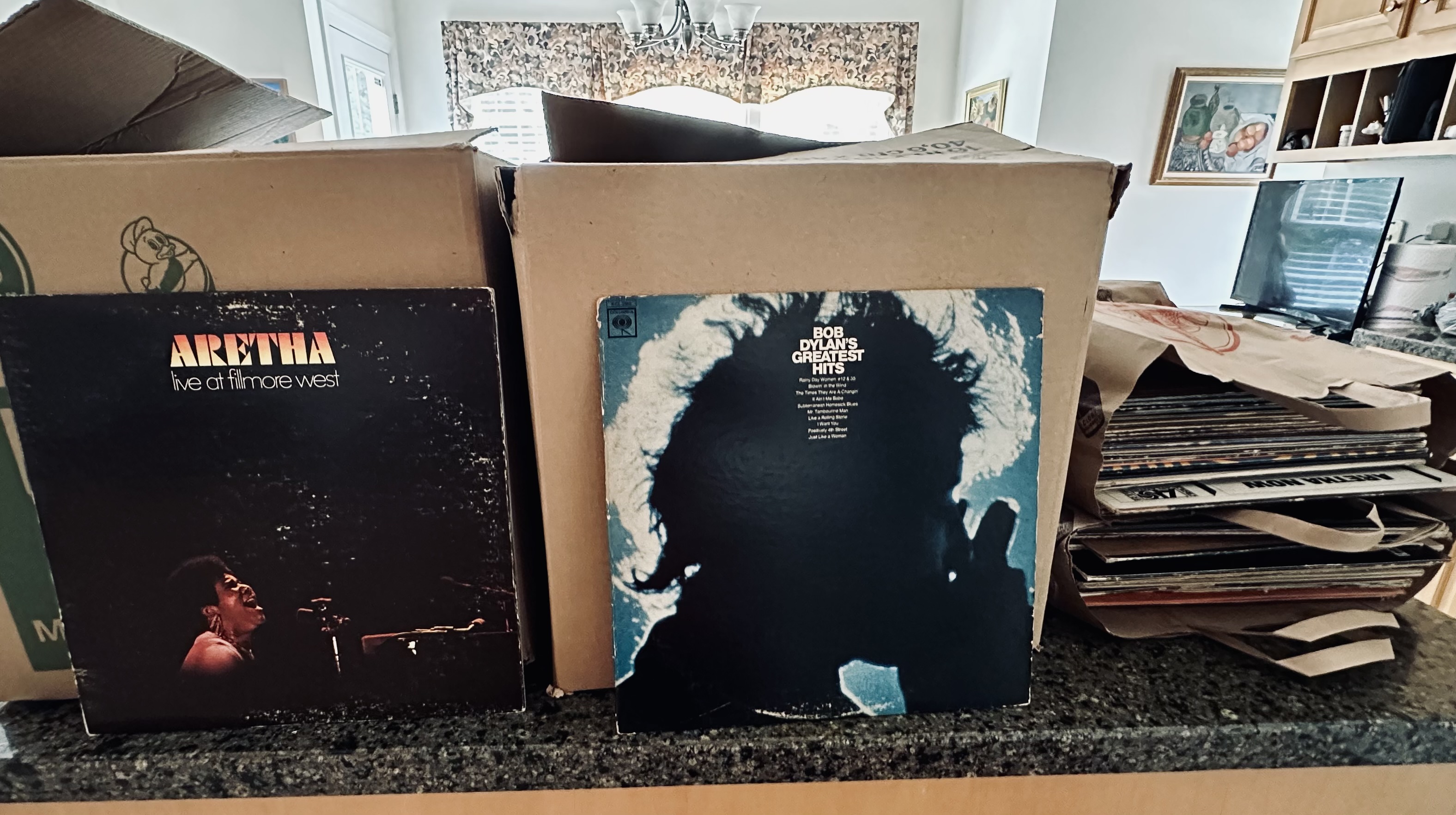


When I asked my grandson recently, he had no idea. He’s a smart kid about to enter high school but to him a turntable was like an ice box, a buttonhook or a laundry board were to me when I was his age.

I showed him my turntable because I was about to sell my entire vinyl collection (above) to a local store. I loved my records, which evoked happy memories, but I switched long ago to CDs and then to streaming options. My LPs were collecting dust in a closet and belonged with an audiophile who still loves vinyl.

My grandson and I were both amused that he didn’t know what a turntable is so, with help from AI, I then asked him whether he could identify the following:



  1. Massive, heavy paper directories delivered to your doorstep every year. You had to flip through thousands of thin, yellow pages to find the phone number of a local plumber, bakery or car dealership. Answer: the Yellow Pages.
  2. Thin, ink-coated paper placed between two sheets of writing paper. When you type or write on the top sheet, the pressure transfers the ink to the bottom sheet to create an instant duplicate. Answer: Carbon paper.
  3. Small, four-sided plastic cubes that attach to the top of a camera. Every time you take a photo with a flash, the cube explodes with a tiny burst of fire and rotates to the next side. You throw it away after four shots. Answer: A flashcube.
  4. Large wooden cabinets in libraries filled with hundreds of small pull-out drawers, each containing cards with book listings. Answer: Card catalogs.
  5. Tiny paper stamps given to you by grocery stores and gas stations based on how much money you spent. You saved them, pasted them into booklets and traded them at a local redemption center for household appliances. Answer: Green stamps.
  6. A cylindrical metal knob inside a car that heats up until it’s glowing red. Answer: A cigarette lighter.


My grandson and I laughed together as we went through the list, which also included 8-track tapes, milk chutes, microfilm, paper maps, rabbit ears, slide rules and manual window cranks. He knew some of these, guessed correctly at others and was baffled by many. The list might also have included typewriters, floppy disks, photographic film, phone booths and more,

If you don’t believe me, try this yourself with a teenager. Just don’t trip over your grandmother’s treadle sewing machine when you go to call them on your rotary phone. 

Better yet, text them.


Subscribe to Not Exactly Retired. It’s free.


Go-Go, Slow-Go

Go-Go, Slow-Go, No-Go.

It’s a phrase we’ve begun using as we think about what lies ahead for us, much as it does for millions of other people in their 70s.

When Champa and I walked away from our traditional lives in 2015, at age 62, we didn’t see ourselves as “retiring.” Rather, we hoped to engage with the world in new ways, in our case by joining the Peace Corps (above) and then traveling and volunteering extensively.

Still wearing a suit shortly before leaving for the Peace Corps.

No shuffleboard for us, thanks.

I started this blog then and called it “Not Exactly Retired” to emphasize its focus on alternatives to traditional retirement. Eleven years and 422 posts later, I feel fortunate to have pursued that vision and helped some readers think more boldly about their own dreams.

Back when we started, I was so concerned with transitioning away from the workplace without “retiring” that I barely considered what might happen later when we inevitably needed to slow down. That seemed so far away.

Melbourne, Australia

Recently, though, it’s begun to feel closer. 

Both of us remain active. We’re leaving soon on a new trip and have others planned. We’re going to the gym, spending time with our family and friends, volunteering and living full lives. We know how lucky we’ve been to do this and are grateful for our blessings.

Slowly, though, our bodies have begun to creak a bit. Some friends have moved to retirement communities. A few have died. Our two oldest grandchildren are in college. It’s finally dawning on us that “not exactly” can’t last forever. At some point — not yet — we’re going to need to slow down.

Which is why we now find ourselves discussing the phrase “no-go, slow-go, no-go,” which Champa read in an article several weeks ago.

Morocco

It’s popular among financial planners. who use it to help clients think about how much money to budget for the different stages of their retirements. Writing in Kiplinger, one advisor said “it’s best to expect to do the big (and more expensive) stuff early on, when you’re healthier, then slow things down as you get older.”

The stages apply beyond financial considerations to life more generally. In a lovely essay on the Sixty + Me website, Renee Langmuir discussed her journey from beginning retirement “with a fresh start and big dreams” to encountering physical and other challenges in her 70s that “ambushed me, the former ‘can-do’ gal!” She found the transition challenging, writing: “Until very recently, my inner critic was cracking the whip with shrieks of ‘you can do more!’”

Cooking class, Chiang Mai, Thailand

I know how she feels. Champa and I love the life we’ve pursued and are reluctant to tap the brakes on it even slightly. But off in the distance we can see the highway ending for “Go-Go” and glimpse the exit ramp for “Slow-Go.” Like it or not, that’s where we and others in our age cohort are heading.

Champa and I met in Nepal, the birthplace of Buddha, and we know how Buddhism emphasizes the impermanence of life. Wisdom comes from recognizing this reality, embracing it and finding meaning in every changing moment. Even though we’ve treasured our decade of Go-Go and plan to keep pursuing it, we need to accept that it will give way inevitably to Slow-Go, and then to No-Go, unless something worse intervenes. 

“Not exactly retired” remains our mantra for now. We hope to keep chanting it as long as we can. It won’t last forever.

Subscribe to Not Exactly Retired. It’s free.