Tag Archives: RPCV

Expats in Moldova

They’re leading lives I’ve sometimes imagined for myself: American expats in Moldova who are running businesses, managing programs, assisting refugees and tackling other challenges far from home.

Many of them first came to Moldova as Peace Corps Volunteers, like us. Unlike us, they’ve made a new home here. We’re friends with several of them and it’s been fascinating this week to catch up on our lives.

Chris Flowers, a fellow former Volunteer, is now the country director for the American Councils, managing educational and cultural programs. He recently married a Moldovan attorney, Diana, who’s done heroic work assisting refugees, especially since Russia invaded Ukraine. We met up with them at an Uzbek restaurant.
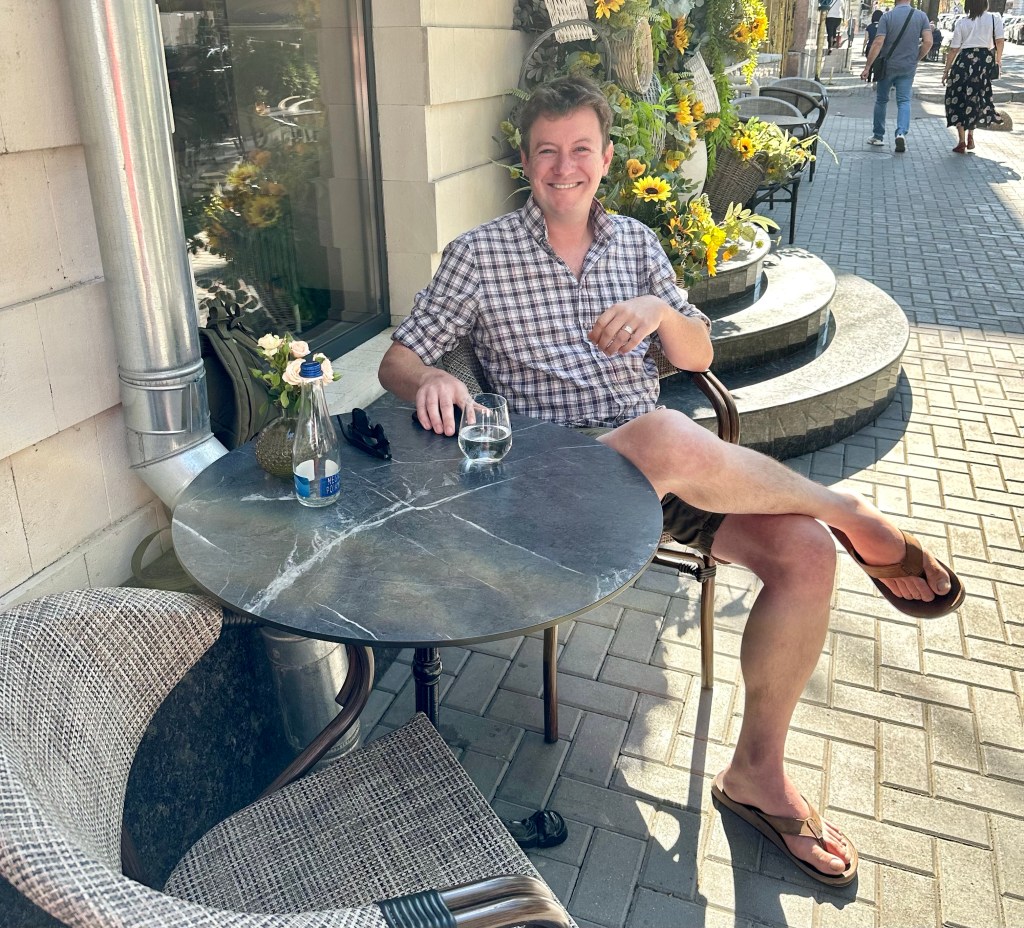
David Smith opened and ran an American-style barbecue restaurant for several years. He’s also been active in the local small business community and writes a newsletter with excellent analyses of what’s happening in Moldova. He, too, married a Moldovan woman.

Andrew Blakely was two years behind me in leaving Duke University to serve in Peace Corps Moldova. Now he’s back with Church World Service, managing programs to assist Ukrainian refugees and others. He’s working with Casey O’Neill, who previously served in the Peace Corps group between ours.

Bartosz Gawarecki is here, too, working with refugees near Bălți, where he served as a Peace Corps Volunteer. Bartosz is the president of Friends of Moldova. When the war broke out, he left his business in Michigan to join David and others in rapidly creating some of the first centers to provide desperate Ukrainian families with food and assistance.

That’s Bartosz in the photo, in the white shirt, along with Joseph Lutz of Indiana, who’s returned as a Peace Corps Response Volunteer. He and I are working together, with Marjory David, on a project to establish a national Jewish museum here.

The American expat community also includes diplomats, teachers, missionaries and others, along with a Facebook group and other community resources. On Sunday, we reunited with a couple from Alabama, Kathryn and Brian, who lived near us in Ialoveni. They’ve devoted their lives to helping vulnerable young women avoid trafficking, a serious problem here. They live now in Chișinău and continue to pursue this mission along with efforts to promote better foster care and education for young people with disabilities.

I admire Kathryn and Brian, as I do everyone I’ve mentioned in this post. While so many Americans tear each other apart back home, they’re quietly making the world a better place. I could also have highlighted other Returned Peace Corps Volunteers (RPCVs) here, including Courtney Jackson, who’s working with refugees, or Kelsey Walters, who’s raising a family with her Moldovan husband and promoting new agricultural approaches. (Apologies to those not mentioned.)

Back in December, when Champa and I were in Nepal, we had lunch with another RPCV, Anne Kaufman, who served in Peace Corps Nepal a year behind me in the late 1970s. She married a Nepali man, Raju, and has lived mostly in Kathmandu, working with development organizations and raising two daughters. For me, she represented the road not taken, the life I might have had if Champa and I had remained in Nepal instead of moving to America.

I don’t regret our decision. I’ve loved our life back home, especially our family, but this trip has been a reminder that it’s also possible to pursue a rich, impactful existence abroad, especially if it’s in a country you already know. The roads before us are far wider than many Americans realize.

Op-Eds for Ukraine

As the world prepares to mark the one-year anniversary of Russia’s brutal invasion of Ukraine, on Feb. 24, few Americans are better qualified to comment than Returned Peace Corps Volunteers who served there.

These RPCVs lived and worked alongside Ukrainians. They learned the local language. They care deeply about what’s been happening, as do many of us who served in Moldova and other countries affected by the conflict. Some of us also visited Ukraine during our service.

This past week, I helped train a group of Ukraine RPCVs how to write op-ed articles to share their stories. I joined with Dylan Hinson, an RPCV who served in Namibia, in teaching the workshop organized by the RPCV Alliance for Ukraine and the National Peace Corps Association.

This video of my presentation is excerpted from the larger program. If you’re interested in learning more about writing effective op-eds, check out my earlier post. A short YouTube video features Dylan encouraging RPCVs to become op-ed authors.

The Ukraine RPCV group and our Friends of Moldova organization both continue to assist Ukrainians affected by the conflict. Especially as Russia prepares to launch a new military offensive, please consider donating to their life-saving work.

Top photo: The Odessa Opera House, which we visited in 2018.

Ukraine’s Refugees: Still There

Civilians murdered. Soldiers killed. Buildings bombed. It’s all still happening in Ukraine, even as we Americans let our attention drift to newer problems.

Those millions of Ukrainians who fled their homes? More than 90,000 of them remain in neighboring Moldova.

Returned Peace Corps Volunteers (RPCVs) from Moldova have been working hard to help them. Since the war began in February, the Friends of Moldova group has served 60,000 Ukrainians, supported 175 other relief efforts in Moldova and raised nearly $700,000. All of the RPCVs work as volunteers; several have returned to Moldova to provide direct assistance.

This past week, the Friends of Moldova, in concert with a Moldovan Rotary club, received a $25,000 Rotary Foundation Disaster Response Grant to buy food and other resources for refugees in northern Moldova.

North Carolina’s Rotary District 7710 initiated the grant after I described the urgency of the situation in a talk at the Rotary Club of Raleigh. Kim Dixon, who served with the Peace Corps in Georgia, and I developed the grant with her Rotary colleagues.

Friends of Moldova President Bartosz Gawarecki and other RPCVs also worked on the grant, which Bartosz will now oversee in Bălți. He lived there as a volunteer, leading a recycling initiative and youth sports programs, and returned recently from his Michigan home to establish a refugee assistance center for the region. That’s him on the left in the photo below.

Rotarians in Oklahoma City have been pursuing a similar collaboration with Moldova, inspired by another RPCV, Kelsey Walters, who married and remained in Moldova but returned to Oklahoma with her children recently after hearing explosions across the border. The two districts joined in a conference call hosted by N.C. Sec. of State Elaine Marshall, who oversees the state’s long-standing formal partnership with Moldova. We discussed how to expand these efforts and encourage other Rotary districts around the country to pursue similar grants. 

That’s where you come in, readers.

First and foremost: Please continue to donate online to the Friends of Moldova. Your support has enabled the organization to transport refugees from a freezing border, feed children and provide hope to families.

Now you can make an even bigger impact by working with a Rotary group in your area to pursue one of these grants. The Friends of Moldova cannot do this centrally; it needs supporters across the country to initiate grants locally. If you’re willing to help, please contact me directly and we’ll guide you through the process, which isn’t complicated. If you are a Rotarian or served with the Peace Corps in Moldova, that’s great, but it isn’t necessary. (I’m not a Rotarian myself.)

I wish I didn’t need to keep writing about this but, as you’ve seen on television, Russia’s aggression has been bloody and relentless. Ukrainians keep dying. Millions of innocent families remain dislocated, overwhelming their generous hosts across the border. As Americans, we can feel anger, outrage or despair about all of this, but I hope you will join the Friends of Moldova in providing something more useful: help.

[Top photo: RPCV Clary Estes, Ukraine Stories. Other photos: Friends of Moldova]

Why PCVs Serve

If you think Americans sign up to become Peace Corps Volunteers because they’re altruistic and want to help people around the world, you’re right but not completely right.

A national survey of more than 11,000 Returned Peace Corps Volunteers (RPCVs) several years ago found their top three reasons for joining were “wanting to live in another culture,” “wanting a better understanding of the world,” and “wanting to help people build a better life.”

nepal

Simultaneously, the survey reported “a significant generational shift” in the importance volunteers place on acquiring job skills and experience during their service. Volunteers who served more recently placed “a greater emphasis on career development as a motivation for joining the Peace Corps,” it said.

Just 30 percent of volunteers who served in the 1960s identified “wanting to develop career and leadership skills” as an important motivation.” Among volunteers who served in the 2000s, 68 percent cited this motivation, with 36 percent saying it was “very important.” Growing numbers of applicants also want to expand their language skills.

philippines.png
A few years ago, a volunteer who returned from Guatemala wrote: “I’m sure that my Peace Corps service helped me gain acceptance to a selective master’s degree program (because my grades as an undergraduate were disappointing, at best). Over the years, many people have told me that having the words ‘Peace Corps’ on my resume would only help me.”

vanuatuIndeed, Peace Corps itself touts the career benefits of service. Its recruitment materials emphasize the importance of selfless service and cultural outreach but also highlight medical benefits, student loan deferrals, tuition reductions and career networking opportunities.

peruAll of this is consistent with the changes I’ve seen myself since I first served as a volunteer in Nepal in the late 1970s. My friends and I didn’t talk much about resumes, grad school applications and job prospects. America was the world’s dominant economic power then. Jobs were plentiful.timor-leste

Before I joined Peace Corps this second time, I met regularly at my university with undergraduates who were considering Peace Corps, serving as an informal advisor for the campus placement office. At first, I was taken aback by how many of their questions were about how Peace Corps service might afftect their career paths. Would it help them get into law school, or a public health program or the Foreign Service? They asked whether I agreed with advice like this from The Princeton Review: “Altruism distinguishes a strong medical school applicant from a mediocre one. Volunteer work and community service [such as] the Peace Corps … speak most strongly to this quality.”south-africa

I always responded positively. Seeing how impressive these students were, I also came to understand their questions reflected new economic realities, not a diminishment in the applicant pool’s sincerity. Just like my colleagues now in Moldova, most of whom are much younger than me, they were wonderful people and every bit as committed as those who served before.

I’ve developed even greater admiration for today’s generation of PCVs as political winds back home shift towards “making America great again.” They face a more challenging economic environment than my generation did but have still chosen to devote more than two years of their lives to serve others. Yes, doing so may enhance their resumes and career prospects. That’s also true for young people who choose to serve in Teach for America or, for that matter, the Marines. Life is complicated.

So, too, for me. Champa and I joined the Peace Corps mainly to serve others, and to serve our country, after having so many blessings in our American lives. But we also were looking for some adventure and an interesting transition away from the conventional workplace.

mexico
The Guatemala RPCV, Taylor Dibbert, emphasized what he and many of us ultimately consider most important about Peace Cops service: “Volunteers are doing important, unglamorous work that’s consistently underappreciated – from health to education, agriculture, the environment and more. Besides, volunteers are connecting with foreigners from across the globe and humanizing the U.S. for thousands upon thousands of non-Americans.”

Political winds and job markets will continue to evolve. What endures, he wrote, is “the culture of altruism, adventure and patriotism that has permeated the Peace Corps since the organization’s inception.”

I think he’s right, perhaps even completely right.

[All photos except featured image are from the Peace Corps online library.]

***

How else has Peace Corps changed? My post Peace Corps: Now vs. Then identified six of the biggest changes I’ve seen. Subscribe to receive all of this blog’s future posts. 

Fourth of July Parade

We carried flags for Moldova and Nepal in Philadelphia’s big Independence Day parade. There was a “small problem” with Champa’s flag. Video also online at YouTube.