Which is more remarkable: (a) a flamenco band whose musicians are all Polish, or (b) someone in their audience who stared at her cell phone the entire time they and two other bands played?
To help you decide, here’s a snippet of the band, Viva Flamenco!
Pretty great, right? I’d like to now show you my photo of the woman who sat in front of me chewing gum and flipping nonstop through Facebook as her phone illuminated the darkness. I won’t, though, since Champa says I may sound like an angry old man screaming at kids to “get off my lawn!”
So I’ll just say I loved the Polish flamenco band, and also really liked the act before them, the Antonio Silva Quartet, whose members came from Portugal, Ireland and Sweden. Both groups played on Saturday evening at Chișinău’s national philharmonic hall in an “Ethno Jazz Festival.” We went to the second of three concerts there, with the series also organizing events in Cahul, Soroca and Tiraspol.
As you can see, the theater itself is magnificent, its wooden walls lined with the portraits of famous composers and a giant chandelier shimmering overhead.
There was also an opening act: a Norwegian pianist playing with a Russian accordionist who wailed, chirped and otherwise vocalized in ways that seemed to elude most of the audience, including us. Nonetheless, she played her accordion with enthusiasm, advancing the concert’s theme of international harmony, if not necessarily musical harmony.
So we had a great time. Now, get off my lawn. 😃 Happy face!
The doctor in the poster looks confident, doesn’t he? He’s wearing a white coat over his shirt and tie, his arms are crossed, his gaze is fixed, his medical equipment is gleaming in the background. The poster tells us he is Hakan Eraslan, an expert in cardiology. Come to him for a second medical opinion, it says, and he may help save your heart.
Now look to the right of the poster. The nicely designed brochures on the rack tell you why you should come to Medpark, the hospital where Dr. Eraslan and others treat patients in Moldova’s capital city. The brochures describe the high quality you can expect for surgery, opthamology, maternity care and other services.
The poster, brochures and other signage at Medpark caught my eye when I went there on Saturday for a routine medical consult. (I’m fine.) They looked like what I used to see on the walls at Duke’s hospital and medical clinics. Other American medical settings have similar posters and signs filled with earnest doctors, loving parents and photogenic children. Medpark also has video monitors showing its caring doctors at work, with narration in Romanian and subtitles in Russian. (See the clip at the bottom of this post.)
I may pay more attention than most people to signs and videos like these because I work in communications, although even for me they often blended into the background when I was back home. In Moldova, though, I noticed them immediately on Saturday because they were so different from the drab walls and signage I’ve seen in some medical settings here.
Most of Moldova’s medical facilities are public. Their challenges, including a lack of modern equipment and facilities, are much bigger than font choices and graphic design. Their signs tend to be functional and their amenities limited.
Medpark, by contrast, is a fairly new medical center in Chișinău. It operates privately, with patients generally paying out-of-pocket for most services. Its rates are high for Moldova, although lower than in Western Europe and much lower than in the United States. As a result, many of its patients are from wealthier families, visiting home from jobs abroad or, as in my case, foreigners.
The hospital has an attractive coffee bar in its lobby, a free charging station for cell phones and colorful play equipment for children. Its pharmacy sells fancy creams and lotions along with medical prescriptions, and it offers artfully arranged eyeglass frames in a glass kiosk. The corridor signs look like they could have been plucked from a modern American hospital and translated into Romanian.
All of this didn’t happen by accident. Someone in the hospital’s senior management and communications department gave it a lot of thought, right down to the lower-case logo in sans-serif type and the aqua color palette. Once I began to notice and think about this visual environment around me, it was obvious Medpark is deliberately sending a message: We’re modern! You can trust us!
And do you know what? Its strategy works, at least for me. I felt reassured as soon as I entered through the revolving glass door into a bright lobby. The medical care I received turned out to be good, too, but I was already primed to expect this because of everything I’d seen, even if I wasn’t immediately conscious of why I felt optimistic.
None of this matters, of course, if the hospital doesn’t offer high-quality medical care. But my experience on Saturday reminded me how important thoughtful design and communications can be in advancing an organization’s business strategy. That’s true in Moldova just like back home. It’s why individual American hospitals and health centers and organizations such as the Society for Healthcare Strategy & Market Development, the Association of American Medical Colleges, the Public Relations Society of America and others pay so much attention to these kinds of issues.
Effective communications may be even more important here in Moldova, a former Soviet state striving to assert its identity as a modern European country. This is true not only in the healthcare arena but more generally, a subject I hope to explore further in the future.
For now: Dr. Eraslan, your confident gaze is working for me.
My schedule lately rivals the busy American lifestyle I thought I’d left behind.
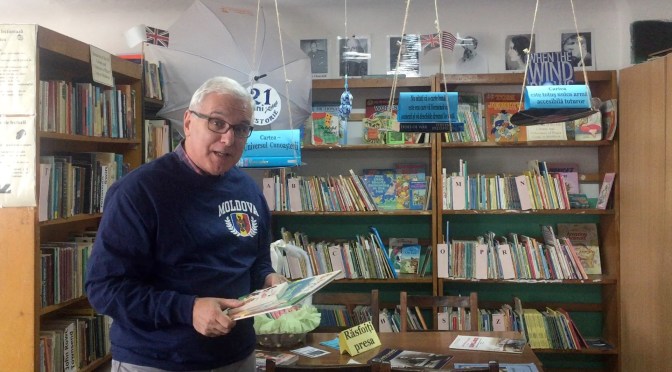
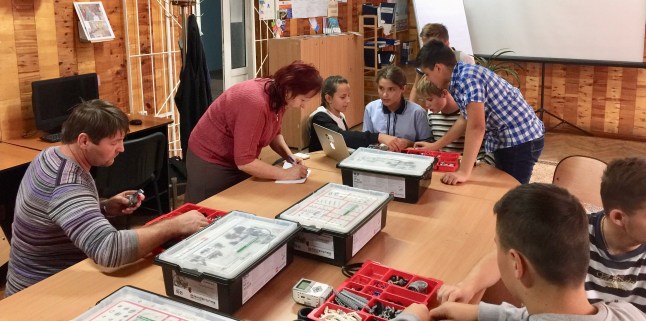
At my primary job at the Ialoveni library, I’m co-teaching three robotics classes, tutoring a student in English and working with the director and others on various projects.
I’m mentoring a team of four girls for the upcoming Diamond Challenge competition that promotes youth entrepreneurship.
I’m working with several other Peace Corps volunteers to develop training materials for Moldova’s tourism industry.
I’m helping a local Romani leader trying to establish radio stations to serve her community in Moldova.
I’m traveling to the Peace Corps office every Friday and working with them online throughout the week on Peace Corps Stories and other communications tasks.
I’ve been helping several volunteers and community members individually with articles, grad school applications, media challenges and other things.
I also write regularly for this blog and elsewhere, trying to advance the Peace Corps goal of promoting understanding between Americans and other people.
Champa’s been busy lately, too, with school and other activities ever since classes opened again on September 1. The two of us also do everyday things like buy groceries, cook dinner, read books and, of course, hang out with our host family. This past Saturday we hosted a dinner party. This coming weekend we plan to attend both a jazz concert and a local cultural festival.
In other words: We’re busy. My life is not quite as intense as when I was running a university news office, but it’s a long way from being “retired.”
We have only about ten months before we complete our service and return home. Until then we’re trying to do as much as we can to serve the people of Moldova. We’re not alone in this. As I wrote recently after a conference with the other Peace Corps volunteers in our group, many of them have abundant to-do lists as well.
Simultaneously, many Peace Corps volunteers in Moldova and around the world, especially those serving in smaller communities, have found a quieter life where they may still be having a big impact. Each of our experiences is different; “busy” does not mean “better.”
And here’s another thing: Many Moldovans, especially women, are even busier than we are. They’re raising families, working in offices, sowing crops, feeding animals, tending gardens, cooking meals and helping neighbors wth vastly fewer resources than we have back home. Yet I’ve never heard any of them refer to a “fast-paced Moldovan lifestyle.” Maybe they just haven’t had the time to tell me.
There are few galleries in Moldova where young artists can show their work. This weekend, though, more than 20 of them are taking part in an exhibit inside an old museum, featuring more than 100 portraits ranging from painting to caricature.
Lucia Codreanu and Maks Graur, both young artists themselves, organized and curated the free show in downtown Chișinău, running through Sunday afternoon. You can see some of the work here.
Lucia, who just graduated from high school and will soon begin studying art at a university in Romania, is amazing. She’s already assembled an impressive portfolio that includes my own favorites, her whimsical Moldovan reinterpretations of famous paintings.
I came to know Lucia well during last year’s Diamond Challenge competition that encourages entrepreneurship among young Moldovans. She was one of the three high school students on the team I mentored, which ended up placing second nationally in the business category. It was a joy to work with her and the other two students. Lucia was the designer for their project to create a personalized children’s book, which she showed in this video clip:
I encouraged one of that competition’s judges, an American who runs a web development company here, to give her a look. He loved her work, hired her and says she did a great job working part-time on web projects while finishing her final year of high school.
Lucia’s partner in this weekend’s “Faces” exhibit is also impressive. Maks Graur, who you see with Lucia in the gallery here, has been studying art in England. He recently completed a Draw for Dogs project in which he drew portraits for people who donated to charities that assist stray dogs.
When Champa and I visited on Saturday morning, Lucia told me the question she and Maks have been asked most often is why they organized the show for free. Volunteering, at least as we know it in America, is not a strong tradition in Moldova, which is why people here often have a hard time understanding why Peace Corps Volunteers would leave their homes to serve others.
Young people like Lucia give me hope that things can change. Surrounded by the portraits she and Maks pulled together, she looked to me on Saturday like the face of Moldova’s future.
Champa and I came to Moldova in June 2016 with about 60 other Americans. We shared the rigors of Peace Corps training for two months before swearing in as volunteers and moving to our individual posts across the country.
That was the last time we were all together until Peace Corps reassembled us on Monday for a three-day “mid-service” conference at a hotel in Vadul liu Voda, near the Nistru River.
It was great to see everyone, albeit without some who left during the past year. We compared experiences, swapped stories and spent time with friends who understand personally how transformative this past year has been. Our four program groups had met separately during the year and we’d seen colleagues around town, but not all together.
We feel a bond with everyone despite the differences in our ages, backgrounds and job assignments. Champa and I are living as an older married couple in a small city near the capital, while some other volunteers are fresh out of college and living alone in villages. Members of our group, M31, work with teachers or are assigned to libraries, mayor’s offices, business incubators or other settings.
As we were reminded at the conference, though, we share our mission of service and international friendship. We’ve all taken a break from our American lives to interact every day with our Moldovan host families, work partners, neighbors, students and friends.
Our conference included sessions on community development, helping people with disabilities, service learning, teaching life skills and other topics. We discussed our journeys as volunteers and how to stay healthy and resilient during the year ahead. We had a session on Moldova’s history. Since most of us learned to speak Romanian, we also got a crash course in how to say a few expressions in Russian, which is widely spoken here.
The most inspiring moment for me came during our final session, when the members of my community development group took turns describing their plans for the coming year. They spoke about dance programs, journalism clubs, robotics teams, English clubs, youth projects, women’s groups and much more. Their lists were so long, in fact, that the session ran well past its deadline. I was humbled to be part of such an amazing group of people, whose dedication is reflected in our three other groups as well.
The next time we assemble will be for our “completion of service,” or COS, conference shortly before we return home. In the meantime, we’ll continue interacting on projects, sharing news on our Facebook page and getting to know the volunteers in the group behind us, who just started their own assignments.
It’s an adventure we’re all experiencing together, even when we are apart.
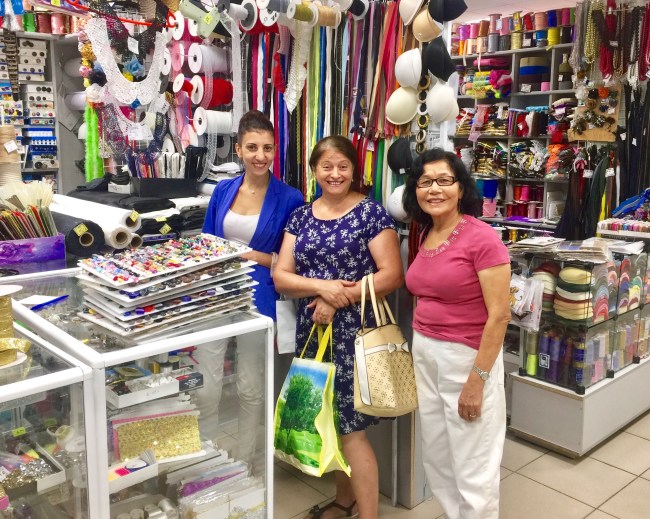
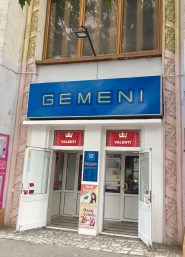
No one is going to confuse Gemeni, a department store in the heart of Chișinău, with Milan or Paris, or even with an American fabric shop. Located next to a McDonald’s on the city’s main street, Gemeni is old. It’s cramped. It has no parking, no food court, no modern rest rooms. It’s more of a bazaar than a modern department store. Most of its shops are small or tiny.
But if you’re looking to sew anything from a simple shirt to an elaborate gown, it’s a great place to shop. The third and fourth floors, especially, are abundant with fabric, yarn, buttons, ribbons, zippers, thread and everything else you need. The prices are nothing special but the selection is great.
Champa and I learned this recently when we bought supplies for a big grant project she has begun to create a costume wardrobe for her school’s drama program. We shopped with Ana, the head of the program (middle in the photo below), and Ina, a designer and seamstress (left) who is helping with the project.
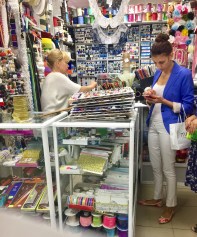
Most of Gemeni’s vendors are women. They rent the stalls, which are arranged by category throughout the store. On the first floor, for example, are shops selling perfume, stationery and jewelry.
The store, whose name means twins in Romanian, evokes its Soviet heritage. It’s functional, not glamorous. Customers almost always pay in cash. They receive their purchases in cheap plastic bags rather than the store bags we expect back home. Customer service desks? Benches for resting? Fountains? As we say here at the blog: not exactly.
Bolts of velvet, cotton and other material surrounded many of the shops we visited. Champa and her partners visited one place after another to select the best cloth for the costumes they’re planning. They also bought buttons, gold braid, ribbons and other haberdashery supplies. Within a few hours, we were loaded down with bags, which we carried on a bus across town to Ina’s studio. She is now cutting and assembling the cloth for each costume — Romeo, Juliet, kings, queens and more.
During the next several months, Ina will join with students and parents at Champa’s school to sew these pieces into more than 40 glorious costumes, which I’ll describe in future posts. For now, one thing is for sure: They have great material to get started.
For protesters around the world, that’s become a popular chant at rallies. Here in Ialoveni, it’s what I saw Thursday evening at a community meeting, one of whose livelier moments is captured in this brief video clip:
Nearly 50 citizens gathered to discuss a proposed high-rise building project in the center of town that would add residential and commercial space but affect traffic, municipal services and the environment. It also would disrupt a neighboring park and church. Some residents are concerned about the project’s impact on their own homes and property.
I didn’t understand everything people were saying, and sometimes shouting, in Romanian. I may have missed something essential, not to mention whatever people were saying privately. But the meeting was both impressive and fascinating nonetheless.
Both men and women participated. Everyone was dressed comfortably for the late-summer heat, including the mayor, Sergiu Armașu, who presided at the end of the table in a short-sleeved red shirt.
People took turns standing to speak around a long table in the meeting room on the second floor of Ialoveni’s Primăria, or town hall. Some held up documents. Some tended to children. Some listened quietly, sipped water or tapped on smart phones. A city expert pointed to one of several maps on the wall, explaining the project in detail. A local journalist recorded everything. A woman from the Primăria’s newspaper snapped photos and took notes.
The meeting began at 5 p.m. and broke up shortly before 7 p.m. The mayor shook hands with citizens as they exited. Several people remained behind to argue about the project. As best I could tell, the situation remained unresolved, with a decision about the project still pending. On this one night in Ialoveni, Moldova, it’s what democracy looked like.
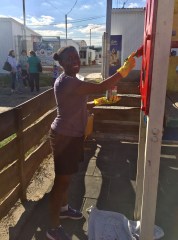
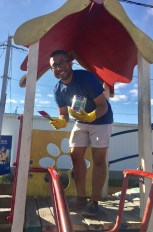
These “Before” and “After” photos tell the story of what Peace Corps can accomplish with a local community, sometimes within a couple of hours.
All three photos above show a playground in central Ialoveni. The left photo, which I shot on Tuesday morning, shows how faded and dingy the equipment looked. The middle and right photos show some of the same equipment on Tuesday evening after a Peace Corps group joined with local residents to give the playground a paint job and makeover. (“Vopsit” means “painted.” The sign on the left says: Help us put the “love” in Ialoveni.)
Nine Peace Corps trainees who’ve been living in Ialoveni for the past two months organized the event, which included ice cream and games for children. They’ve been staying with host families and studying every day at Liceul Teoretic “Petre Ştefănucă,” a school near the library where I work.
Next week they will swear in as volunteers and begin serving in the community and organizational development (COD) program for Peace Corps Moldova. They’ll serve with a companion COD group of trainees who’ve been living and taking language classes in the nearby village of Sociteni. Those trainees held their community service event last week, a clean-up of Sociteni’s main street.
Both groups of COD trainees are looking forward to finally finishing their preparation and moving to their permanent posts to begin assisting local governments, libraries, nongovernmental organizations and others across Moldova. Two other groups of trainees— in English education and health education — will also swear in next week. Altogether, more than 50 trainees are expected to join Peace Corps Moldova’s current volunteers, most of whom swore in a year ago and will continue serving until next summer, Champa and me among them.
You can see the Ialoveni trainees posing here at the end of Tuesday’s event with Mayor Sergiu Armașu and a couple of local girls, Champa and me. We participated along with two other current volunteers (Reggie and Beth) and an impressive number of community members.
For both of us, it was gratifying to watch our two communities — Peace Corps and Ialoveni — come together for such a worthwhile cause. Ialovei is our home for another year and this playground next to the main piața, or shopping area, looks so much better now. If the kids loved it before, they’re going to love it even more after the makeover.
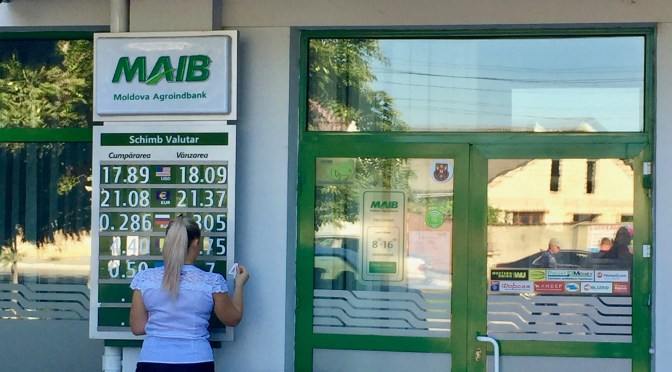
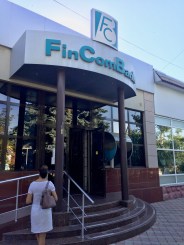
These three photos show what’s happened to the U.S. dollar during the past several months.
I shot all of the photos here in Ialoveni, Moldova: the left one on October 26, the middle one on April 3 and the right one this past Wednesday, August 2. As you can see, a dollar sold here for 19.98 Moldovan lei on October 26, before briefly climbing above 20. Now it sells for only 17.89 lei, a decline of more than 10 percent.
That’s consistent with what’s been happening to the dollar around the world, as the New York Times reported on Tuesday, juxtaposing the dollar’s decline with a rise in the U.S. stock market.
How does this affect Peace Corps volunteers in Moldova? Actually, not much. We are paid in Moldovan lei, buy things in lei and have little reason to track exchange rates. Champa and I have lived comfortably within our Peace Corps budget, so have never sold U.S. dollars for lei except when we first arrived and exchanged a small amount. We rarely use our credit cards since Moldova is largely a cash economy. We also don’t buy much online, transactions generally calculated in dollars anyway.
Many Moldovans work abroad and send money home, so exchange rates matter to them. However, they generally pay more attention to the Euro than the dollar; indeed, prices for some goods and services here are quoted in Euros rather than lei, as we learned when we considered renting an apartment. The Euro has not fluctuated as much as the dollar recently.
Banks and money exchange centers here also focus on the Romanian leu, the Russian ruble and the Ukrainian hryvnia — not so different from Americans paying attention to neighboring currencies such as the Mexican peso or the Canadian dollar.
Peace Corps Moldova calculates its budget annually, so it’s not affected immediately by currency shifts except in a few ways. For example, a small percentage of volunteer paychecks is designated for personal travel and pegged to exchange rates. The overall impact is so small, though, that many volunteers probably didn’t notice the recent dip. (That included me until I started writing this post.)
Moldova faces serious economic challenges but currency fluctuations here have been far less dramatic than in some Peace Corps countries. The agency’s financial planners elsewhere sometimes have to scramble in response to big swings, as do the State Department and other parts of the U.S. government, along with international companies, travelers and others.
A few months before we arrived here in June 2016, the dollar was even lower than it is now, so the rise above 20 may have been outside the usual range. I’m told it was a response to Brexit, the U.S. presidential election, Federal Reserve policy and other things I cannot claim to fully understand, much less explain here.
Nor do I really care. For me, a person who enjoys math and numbers, it’s just been something to notice occasionally as I walk to work.
One doesn’t become a Peace Corps volunteer to get rich. For all of us serving in more than 60 countries around the world, our mission is to serve our local communities and promote friendship between Americans and other people. Ultimately, that’s the currency that matters, not the ones shown on the ever-changing bank signs.



 I may pay more attention than most people to signs and videos like these because I work in communications, although even for me they often blended into the background when I was back home. In Moldova, though, I noticed them immediately on Saturday because they were so different from the drab walls and signage I’ve seen in some medical settings here.


 And do you know what? Its strategy works, at least for me. I felt reassured as soon as I entered through the revolving glass door into a bright lobby. The medical care I received turned out to be good, too, but I was already primed to expect this because of everything I’d seen, even if I wasn’t immediately conscious of why I felt optimistic.

 I’m helping a local Romani leader trying to establish radio stations to serve her community in Moldova.


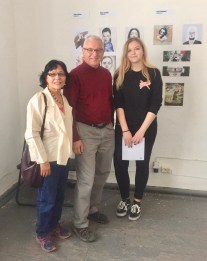 There are few galleries in Moldova where young artists can show their work. This weekend, though, more than 20 of them are taking part in an exhibit inside an old museum, featuring more than 100 portraits ranging from painting to caricature.
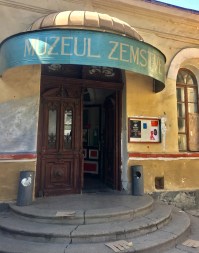 Lucia Codreanu and Maks Graur, both young artists themselves, organized and curated the free show in downtown Chișinău, running through Sunday afternoon. You can see some of the work here.


 Bolts of velvet, cotton and other material surrounded many of the shops we visited. Champa and her partners visited one place after another to select the best cloth for the costumes they’re planning. They also bought buttons, gold braid, ribbons and other haberdashery supplies. Within a few hours, we were loaded down with bags, which we carried on a bus across town to Ina’s studio. She is now cutting and assembling the cloth for each costume — Romeo, Juliet, kings, queens and more.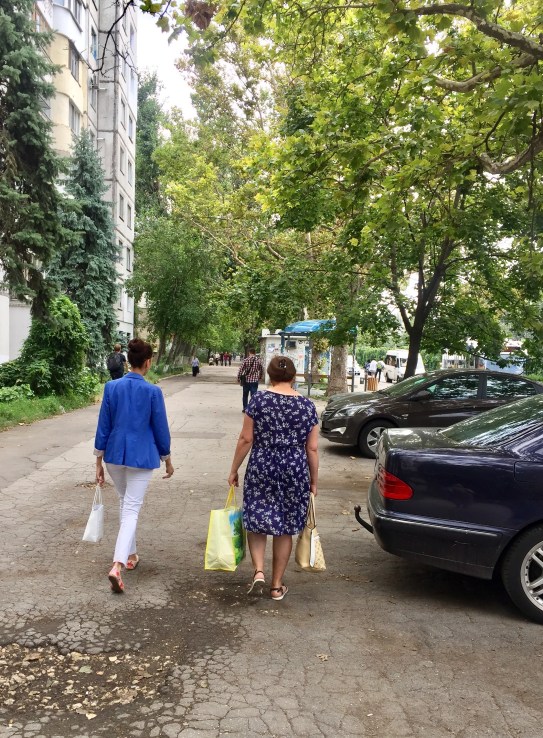


 Those trainees held their community service event last week, a clean-up of Sociteni’s main street.
 Two other groups of trainees— in English education and health education — will also swear in next week.
  Altogether, more than 50 trainees are expected to join Peace Corps Moldova’s current volunteers, most of whom swore in a year ago and will continue serving until next summer, Champa and me among them.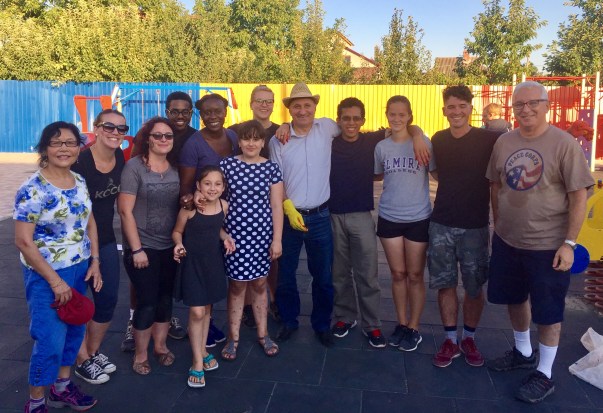



 However, they generally pay more attention to the Euro than the dollar; indeed, prices for some goods and services here are quoted in Euros rather than lei, as we learned when we considered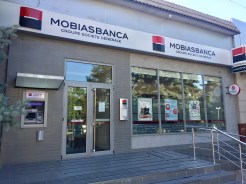
 (That included me until I started writing this post.)
 "Not Exactly Retired"