
Champa and I watched our first Moldovan soccer match on Saturday, in the Ialoveni stadium. Our local team won! This one-minute video, also on YouTube, has the highlights.

Champa and I watched our first Moldovan soccer match on Saturday, in the Ialoveni stadium. Our local team won! This one-minute video, also on YouTube, has the highlights.
Which is more remarkable: (a) a flamenco band whose musicians are all Polish, or (b) someone in their audience who stared at her cell phone the entire time they and two other bands played?
To help you decide, here’s a snippet of the band, Viva Flamenco!
Pretty great, right? I’d like to now show you my photo of the woman who sat in front of me chewing gum and flipping nonstop through Facebook as her phone illuminated the darkness. I won’t, though, since Champa says I may sound like an angry old man screaming at kids to “get off my lawn!”


So I’ll just say I loved the Polish flamenco band, and also really liked the act before them, the Antonio Silva Quartet, whose members came from Portugal, Ireland and Sweden. Both groups played on Saturday evening at Chișinău’s national philharmonic hall in an “Ethno Jazz Festival.” We went to the second of three concerts there, with the series also organizing events in Cahul, Soroca and Tiraspol.
As you can see, the theater itself is magnificent, its wooden walls lined with the portraits of famous composers and a giant chandelier shimmering overhead.


There was also an opening act: a Norwegian pianist playing with a Russian accordionist who wailed, chirped and otherwise vocalized in ways that seemed to elude most of the audience, including us. Nonetheless, she played her accordion with enthusiasm, advancing the concert’s theme of international harmony, if not necessarily musical harmony.
So we had a great time. Now, get off my lawn. 😃 Happy face!
The doctor in the poster looks confident, doesn’t he? He’s wearing a white coat over his shirt and tie, his arms are crossed, his gaze is fixed, his medical equipment is gleaming in the background. The poster tells us he is Hakan Eraslan, an expert in cardiology. Come to him for a second medical opinion, it says, and he may help save your heart.

Now look to the right of the poster. The nicely designed brochures on the rack tell you why you should come to Medpark, the hospital where Dr. Eraslan and others treat patients in Moldova’s capital city. The brochures describe the high quality you can expect for surgery, opthamology, maternity care and other services.


The poster, brochures and other signage at Medpark caught my eye when I went there on Saturday for a routine medical consult. (I’m fine.) They looked like what I used to see on the walls at Duke’s hospital and medical clinics. Other American medical settings have similar posters and signs filled with earnest doctors, loving parents and photogenic children. Medpark also has video monitors showing its caring doctors at work, with narration in Romanian and subtitles in Russian. (See the clip at the bottom of this post.)
 I may pay more attention than most people to signs and videos like these because I work in communications, although even for me they often blended into the background when I was back home. In Moldova, though, I noticed them immediately on Saturday because they were so different from the drab walls and signage I’ve seen in some medical settings here.
Most of Moldova’s medical facilities are public. Their challenges, including a lack of modern equipment and facilities, are much bigger than font choices and graphic design. Their signs tend to be functional and their amenities limited.

Medpark, by contrast, is a fairly new medical center in Chișinău. It operates privately, with patients generally paying out-of-pocket for most services. Its rates are high for Moldova, although lower than in Western Europe and much lower than in the United States. As a result, many of its patients are from wealthier families, visiting home from jobs abroad or, as in my case, foreigners.


The hospital has an attractive coffee bar in its lobby, a free charging station for cell phones and colorful play equipment for children. Its pharmacy sells fancy creams and lotions along with medical prescriptions, and it offers artfully arranged eyeglass frames in a glass kiosk. The corridor signs look like they could have been plucked from a modern American hospital and translated into Romanian.
All of this didn’t happen by accident. Someone in the hospital’s senior management and communications department gave it a lot of thought, right down to the lower-case logo in sans-serif type and the aqua color palette. Once I began to notice and think about this visual environment around me, it was obvious Medpark is deliberately sending a message: We’re modern! You can trust us!
 And do you know what? Its strategy works, at least for me. I felt reassured as soon as I entered through the revolving glass door into a bright lobby. The medical care I received turned out to be good, too, but I was already primed to expect this because of everything I’d seen, even if I wasn’t immediately conscious of why I felt optimistic.
None of this matters, of course, if the hospital doesn’t offer high-quality medical care. But my experience on Saturday reminded me how important thoughtful design and communications can be in advancing an organization’s business strategy. That’s true in Moldova just like back home. It’s why individual American hospitals and health centers and organizations such as the Society for Healthcare Strategy & Market Development, the Association of American Medical Colleges, the Public Relations Society of America and others pay so much attention to these kinds of issues.
Effective communications may be even more important here in Moldova, a former Soviet state striving to assert its identity as a modern European country. This is true not only in the healthcare arena but more generally, a subject I hope to explore further in the future.
For now: Dr. Eraslan, your confident gaze is working for me.
My schedule lately rivals the busy American lifestyle I thought I’d left behind.
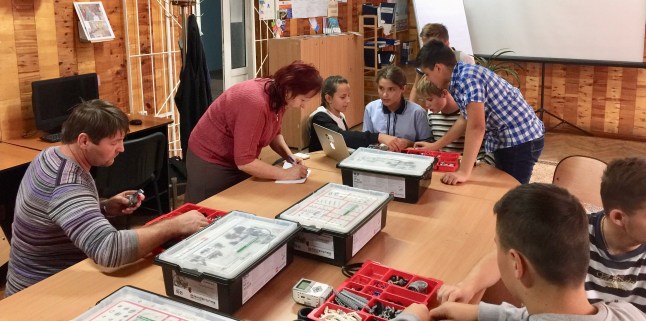
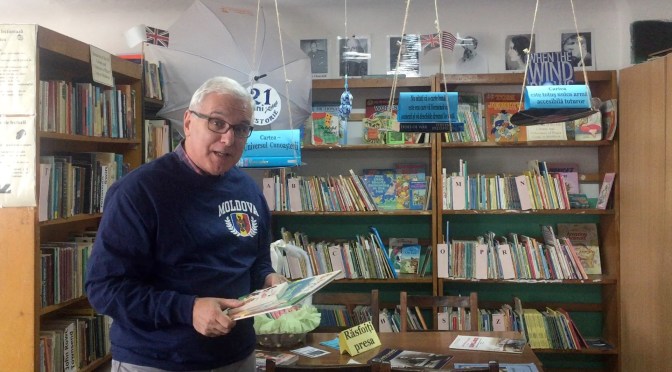
At my primary job at the Ialoveni library, I’m co-teaching three robotics classes, tutoring a student in English and working with the director and others on various projects.

I’m mentoring a team of four girls for the upcoming Diamond Challenge competition that promotes youth entrepreneurship.
I’m working with several other Peace Corps volunteers to develop training materials for Moldova’s tourism industry.
 I’m helping a local Romani leader trying to establish radio stations to serve her community in Moldova.
I’m traveling to the Peace Corps office every Friday and working with them online throughout the week on Peace Corps Stories and other communications tasks.
I’ve been helping several volunteers and community members individually with articles, grad school applications, media challenges and other things.
I also write regularly for this blog and elsewhere, trying to advance the Peace Corps goal of promoting understanding between Americans and other people.

Champa’s been busy lately, too, with school and other activities ever since classes opened again on September 1. The two of us also do everyday things like buy groceries, cook dinner, read books and, of course, hang out with our host family. This past Saturday we hosted a dinner party. This coming weekend we plan to attend both a jazz concert and a local cultural festival.
In other words: We’re busy. My life is not quite as intense as when I was running a university news office, but it’s a long way from being “retired.”

We have only about ten months before we complete our service and return home. Until then we’re trying to do as much as we can to serve the people of Moldova. We’re not alone in this. As I wrote recently after a conference with the other Peace Corps volunteers in our group, many of them have abundant to-do lists as well.
Simultaneously, many Peace Corps volunteers in Moldova and around the world, especially those serving in smaller communities, have found a quieter life where they may still be having a big impact. Each of our experiences is different; “busy” does not mean “better.”
And here’s another thing: Many Moldovans, especially women, are even busier than we are. They’re raising families, working in offices, sowing crops, feeding animals, tending gardens, cooking meals and helping neighbors wth vastly fewer resources than we have back home. Yet I’ve never heard any of them refer to a “fast-paced Moldovan lifestyle.” Maybe they just haven’t had the time to tell me.
I produced this dramatic “movie trailer” on iMovie to highlight new services available at Ialoveni’s library. Also available on YouTube.
Disney Pixar? These young animators are producing original videos at Ialoveni’s library for children. Watch what they’re doing! (1:40. Also on YouTube.)
I yearned for Duke’s famous basketball coach when I took the #9 bus to the Moldova Peace Corps office on Friday.

The bus drove along a street named for the Moldovan writer and artist Gheorghe Asachi, turned at a street named for the poet Vasile Alecsandri and continued past a street named for a lawyer, Avram Iancu. I got off at a street named for another writer, Alexandru Hâjdeu.
Finally, at a street named for a Moldavian historian, Grigore Ureche, I reached the Peace Corps, which is named for … well, nobody. Here in Moldova they might have called it “Peace Corps John F. Kennedy” or “Peace Corps Sargent Shriver.”


Moldovans are passionate about naming streets and institutions after prominent people, especially writers and political figures. The central street in Chișinau, the capital, is named for the beloved king Ștefan cel Mare și Sfânt, or “Steven the Great and Holy.”
Other large streets in the city honor everyone from Orthodox church leaders to Yuri Gagarin, the first man in space. There are also streets named for famous dates, like “31 August 1989,” when Moldova adopted Romanian as its official language.


In Ialoveni, where we currently live, we have adjacent streets named after famous dates in May, as well as many streets and buildings named for people. The library, where I work, and one of the two main schools are named for Petre Ștefănucă, a Bessarabian sociologist who died in a Russian gulag. The other main school, where Champa works, is named after Andrei Vartic, a writer and physicist.

Seeing all of these names has been a learning experience for me. I grew up near New York City, which has a systematic grid of streets and avenues with numbers. Many other U.S. cities have numbered streets as well. For many years, Champa and I lived near Washington, D.C., where many streets are named after U.S. states. In Durham, our home now back in the States, our subdivision has streets named after trees; ours is Pine Bark Trail.


To be sure, New York also has the George Washington Bridge, Lincoln Tunnel and FDR Drive, and many cities in America have streets named for Martin Luther King or other people. My personal favorite is Champa Street in Denver. But we also have plentiful streets with simple names like “Main Street” or “Market Street.”


Well, simple if you’re an American, I suppose. For a Moldovan visitor, “Lexington Avenue” or “Rock Creek Parkway” may sound as foreign as “Strada Mihail Kogălniceanu” does to me.
I’m sure Mihail was a great guy. I can’t help but think, though, it would have been easier if they’d handled him like our own famous Mike in Durham and just called him Coach K.

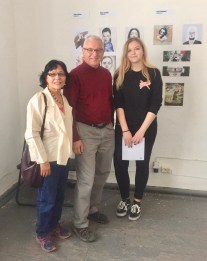 There are few galleries in Moldova where young artists can show their work. This weekend, though, more than 20 of them are taking part in an exhibit inside an old museum, featuring more than 100 portraits ranging from painting to caricature.
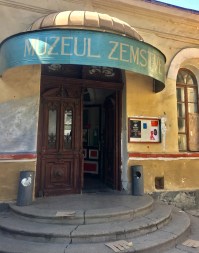 Lucia Codreanu and Maks Graur, both young artists themselves, organized and curated the free show in downtown Chișinău, running through Sunday afternoon. You can see some of the work here.
Lucia, who just graduated from high school and will soon begin studying art at a university in Romania, is amazing. She’s already assembled an impressive portfolio that includes my own favorites, her whimsical Moldovan reinterpretations of famous paintings.


I came to know Lucia well during last year’s Diamond Challenge competition that encourages entrepreneurship among young Moldovans. She was one of the three high school students on the team I mentored, which ended up placing second nationally in the business category. It was a joy to work with her and the other two students. Lucia was the designer for their project to create a personalized children’s book, which she showed in this video clip:
I encouraged one of that competition’s judges, an American who runs a web development company here, to give her a look. He loved her work, hired her and says she did a great job working part-time on web projects while finishing her final year of high school.

Lucia’s partner in this weekend’s “Faces” exhibit is also impressive. Maks Graur, who you see with Lucia in the gallery here, has been studying art in England. He recently completed a Draw for Dogs project in which he drew portraits for people who donated to charities that assist stray dogs.


When Champa and I visited on Saturday morning, Lucia told me the question she and Maks have been asked most often is why they organized the show for free. Volunteering, at least as we know it in America, is not a strong tradition in Moldova, which is why people here often have a hard time understanding why Peace Corps Volunteers would leave their homes to serve others.
Young people like Lucia give me hope that things can change. Surrounded by the portraits she and Maks pulled together, she looked to me on Saturday like the face of Moldova’s future.

Suppose America organized a big party every year to celebrate the English language.
That’s what Moldova does with Romanian through its annual Limba Noastră holiday, which it celebrated again on Thursday. 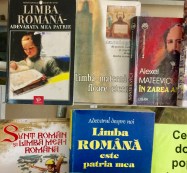 The words mean “our language” in Romanian, which is the official national language here.
Simultaneously, one in four Moldovans speak another language as their native tongue, mainly Russian, Ukranian or Gagauz, all of which have official status in certain regions.

Limba noastră is also the title of Moldova’s national anthem. Just as The Star-Spangled Banner honors the American flag, Moldova’s anthem proclaims the Romanian language to be a “treasure” that is “more than holy,” a heritage that “surges from deep shadows the past.” You can see a video of the anthem at the top of this post or on YouTube.
The Limba Noastră holiday goes beyond language to celebrate Moldova’s heritage more broadly. It occurs immediately after the country’s Independence Day, adding a cultural counterpoint to the politics of Moldova’s identity. Both celebrations are followed by First Bell, on September 1, when schools across Moldova hold colorful ceremonies to open the new year and ring out summer.


Here in Ialoveni, hundreds of people gathered at the Casa de Cultură, or cultural center, on Thursday to celebrate Limba Noastră. There were musical performances, dramas, dances and poetry, some of which you can see here. The library where I work, Biblioteca publică orăşenească „Petre Ştefănucă,” organized the program together with the town hall, or primăria, and the cultural section of the county government, or Consiliul Raional. It also created a series of exhibits celebrating Moldovan authors and the Romanian language. That’s library director Valentina Plamadeala speaking at the ceremony in the photo above.
During its Soviet period, Romanian was called Moldovan to distinguish it from the adjacent country with which so many Moldovans feel connected. Some people still insist on calling the language “Moldovan” even though its differences with the Romanian spoken in Romania are slight.

In places like Ialoveni that have strong ties to Romania, most people embrace the holiday, seeing the Romanian language as part of their ethnic identity. One speaker at Thursday’s ceremony recalled how he and others were forced to speak Russian in the years before Moldova’s independence. For them, limba noastră has a resonance that goes deeper than the language itself.
Elsewhere in Moldova, the holiday can be perceived differently. One of my fellow volunteers who lives in a Russian-speaking area said his host father calls it limba voastră, or your (not our) language.
The relationship between language and identity is complicated, in other words, and not always easy for an American to understand. We have plenty of experience with these issues back home, though, so the story can sound familiar despite the translation.
***
Want to learn more? This article offers useful background about Moldova’s languages. Also interesting is this article about how language is perceived by different groups in Moldova. [Hat tip for the second article to my volunteer colleague Haley Bader, whose excellent blog you should check out.]
Our group got back together this past week.
Champa and I came to Moldova in June 2016 with about 60 other Americans. We shared the rigors of Peace Corps training for two months before swearing in as volunteers and moving to our individual posts across the country.

That was the last time we were all together until Peace Corps reassembled us on Monday for a three-day “mid-service” conference at a hotel in Vadul liu Voda, near the Nistru River.


It was great to see everyone, albeit without some who left during the past year. We compared experiences, swapped stories and spent time with friends who understand personally how transformative this past year has been. Our four program groups had met separately during the year and we’d seen colleagues around town, but not all together.

We feel a bond with everyone despite the differences in our ages, backgrounds and job assignments. Champa and I are living as an older married couple in a small city near the capital, while some other volunteers are fresh out of college and living alone in villages. Members of our group, M31, work with teachers or are assigned to libraries, mayor’s offices, business incubators or other settings.

As we were reminded at the conference, though, we share our mission of service and international friendship. We’ve all taken a break from our American lives to interact every day with our Moldovan host families, work partners, neighbors, students and friends.
Our conference included sessions on community development, helping people with disabilities, service learning, teaching life skills and other topics. We discussed our journeys as volunteers and how to stay healthy and resilient during the year ahead. We had a session on Moldova’s history. Since most of us learned to speak Romanian, we also got a crash course in how to say a few expressions in Russian, which is widely spoken here.

The most inspiring moment for me came during our final session, when the members of my community development group took turns describing their plans for the coming year. They spoke about dance programs, journalism clubs, robotics teams, English clubs, youth projects, women’s groups and much more. Their lists were so long, in fact, that the session ran well past its deadline. I was humbled to be part of such an amazing group of people, whose dedication is reflected in our three other groups as well.
The next time we assemble will be for our “completion of service,” or COS, conference shortly before we return home. In the meantime, we’ll continue interacting on projects, sharing news on our Facebook page and getting to know the volunteers in the group behind us, who just started their own assignments.
It’s an adventure we’re all experiencing together, even when we are apart.




 "Not Exactly Retired"