
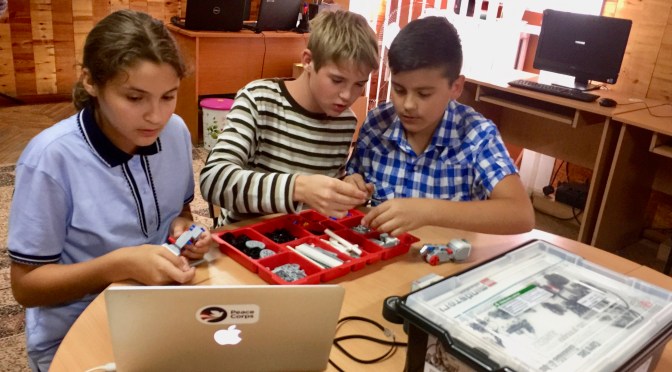
Students at Ialoveni’s library are learning to make, program and operate robots. See post with the full story.
Tag Archives: Ialoveni


Robots at the Library
If “robotics” sounds daunting to you, well, it did to me, too.
Then I agreed to help launch a robotics program at the library where I work as a Peace Corps Volunteer in Ialoveni. Now I can program a small robot to roam around the room, pick up objects, avoid collisions and roar like a dinosaur.
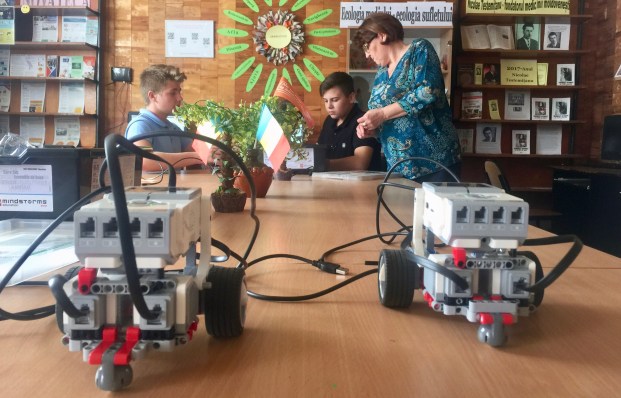
More important, so can the students that my library colleagues and I have been teaching to do this and more with the Lego Mindstorms EV3 kits we received from Novateca, a nonprofit organization that promotes innovation among Moldova’s libraries.
We started with two weekly robotics classes. Word spread, more kids came, and we added a third class, and then a fourth, including one especially for girls. The kids keep coming, with their parents often lingering to watch.

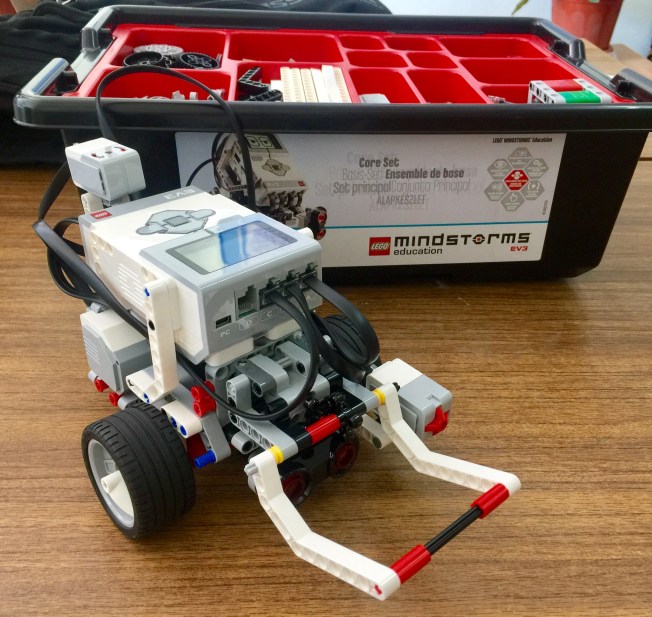
Students in the United States and around the world use the same kits, which combine familiar Lego components with a brick-shaped computer. You program the brick and then snap it together with the other pieces to create a vehicle that moves, a dog that barks or something else.

The software is colorful and easy to learn. Here in Ialoveni, we now give new students a brief introduction and then set them loose on the first program, which tells a robot to drive forward, back and forward again. Within a few minutes, they’re clicking away. On Thursday, several new students needed less than 15 minutes to finish the first program. Then they started modifying it to make their robots rotate, pause, speed up or make funny sounds.
We’re hoping to form a Ialoveni library team to compete in Moldova’s upcoming Lego League competition, where the winner will move on to compete internationally. (Here’s a YouTube video of last year’s event in Chișinău. My own video about Ialoveni’s program is posted above and also is on YouTube.)

Lidia Rusu and Sergiu Blajinschi are my fantastic partners. They form groups for each lesson, work with every student, explain everything patiently and cheer as the robots perform. It’s no wonder the students are so enthusiastic.
The Lego EV3 core set costs $500 on Amazon back home. An expansion kit to build an elephant and other projects costs $154 more. That’s expensive, so it’s worth looking for a school program or club to join. If you have the money, though, and want to get a young person excited about engineering, you won’t be disappointed, so long as you both have some basic computer skills and comfort with technology. No one needs to know when you spend hours playing with it, too.
Did you enjoy this post? Please share it!


Fotbal Gooaaalll!
Champa and I watched our first Moldovan soccer match on Saturday, in the Ialoveni stadium. Our local team won! This one-minute video, also on YouTube, has the highlights.
Did you enjoy this post? Please share it!

Busy, Busy
My schedule lately rivals the busy American lifestyle I thought I’d left behind.
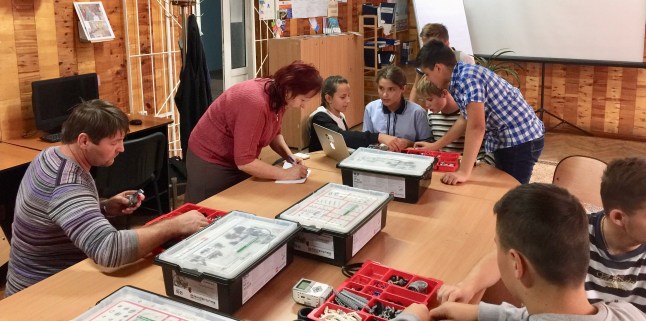
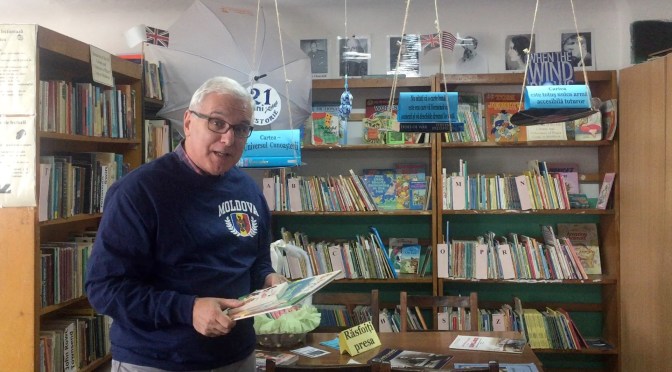
At my primary job at the Ialoveni library, I’m co-teaching three robotics classes, tutoring a student in English and working with the director and others on various projects.

I’m mentoring a team of four girls for the upcoming Diamond Challenge competition that promotes youth entrepreneurship.
I’m working with several other Peace Corps volunteers to develop training materials for Moldova’s tourism industry.
 I’m helping a local Romani leader trying to establish radio stations to serve her community in Moldova.
I’m traveling to the Peace Corps office every Friday and working with them online throughout the week on Peace Corps Stories and other communications tasks.
I’ve been helping several volunteers and community members individually with articles, grad school applications, media challenges and other things.
I also write regularly for this blog and elsewhere, trying to advance the Peace Corps goal of promoting understanding between Americans and other people.

Champa’s been busy lately, too, with school and other activities ever since classes opened again on September 1. The two of us also do everyday things like buy groceries, cook dinner, read books and, of course, hang out with our host family. This past Saturday we hosted a dinner party. This coming weekend we plan to attend both a jazz concert and a local cultural festival.
In other words: We’re busy. My life is not quite as intense as when I was running a university news office, but it’s a long way from being “retired.”

We have only about ten months before we complete our service and return home. Until then we’re trying to do as much as we can to serve the people of Moldova. We’re not alone in this. As I wrote recently after a conference with the other Peace Corps volunteers in our group, many of them have abundant to-do lists as well.
Simultaneously, many Peace Corps volunteers in Moldova and around the world, especially those serving in smaller communities, have found a quieter life where they may still be having a big impact. Each of our experiences is different; “busy” does not mean “better.”
And here’s another thing: Many Moldovans, especially women, are even busier than we are. They’re raising families, working in offices, sowing crops, feeding animals, tending gardens, cooking meals and helping neighbors wth vastly fewer resources than we have back home. Yet I’ve never heard any of them refer to a “fast-paced Moldovan lifestyle.” Maybe they just haven’t had the time to tell me.
Did you enjoy this post? Please share it!


Action! at the Library
I produced this dramatic “movie trailer” on iMovie to highlight new services available at Ialoveni’s library. Also available on YouTube.
Did you enjoy this post? Please share it!


Animation Club
Disney Pixar? These young animators are producing original videos at Ialoveni’s library for children. Watch what they’re doing! (1:40. Also on YouTube.)
Did you enjoy this post? Please share it!


Street People
I yearned for Duke’s famous basketball coach when I took the #9 bus to the Moldova Peace Corps office on Friday.

The bus drove along a street named for the Moldovan writer and artist Gheorghe Asachi, turned at a street named for the poet Vasile Alecsandri and continued past a street named for a lawyer, Avram Iancu. I got off at a street named for another writer, Alexandru Hâjdeu.
Finally, at a street named for a Moldavian historian, Grigore Ureche, I reached the Peace Corps, which is named for … well, nobody. Here in Moldova they might have called it “Peace Corps John F. Kennedy” or “Peace Corps Sargent Shriver.”


Moldovans are passionate about naming streets and institutions after prominent people, especially writers and political figures. The central street in Chișinau, the capital, is named for the beloved king Ștefan cel Mare și Sfânt, or “Steven the Great and Holy.”
Other large streets in the city honor everyone from Orthodox church leaders to Yuri Gagarin, the first man in space. There are also streets named for famous dates, like “31 August 1989,” when Moldova adopted Romanian as its official language.


In Ialoveni, where we currently live, we have adjacent streets named after famous dates in May, as well as many streets and buildings named for people. The library, where I work, and one of the two main schools are named for Petre Ștefănucă, a Bessarabian sociologist who died in a Russian gulag. The other main school, where Champa works, is named after Andrei Vartic, a writer and physicist.

Seeing all of these names has been a learning experience for me. I grew up near New York City, which has a systematic grid of streets and avenues with numbers. Many other U.S. cities have numbered streets as well. For many years, Champa and I lived near Washington, D.C., where many streets are named after U.S. states. In Durham, our home now back in the States, our subdivision has streets named after trees; ours is Pine Bark Trail.


To be sure, New York also has the George Washington Bridge, Lincoln Tunnel and FDR Drive, and many cities in America have streets named for Martin Luther King or other people. My personal favorite is Champa Street in Denver. But we also have plentiful streets with simple names like “Main Street” or “Market Street.”


Well, simple if you’re an American, I suppose. For a Moldovan visitor, “Lexington Avenue” or “Rock Creek Parkway” may sound as foreign as “Strada Mihail Kogălniceanu” does to me.
I’m sure Mihail was a great guy. I can’t help but think, though, it would have been easier if they’d handled him like our own famous Mike in Durham and just called him Coach K.

Did you enjoy this post? Please share it!


Celebrating ‘Our Language’
Suppose America organized a big party every year to celebrate the English language.
That’s what Moldova does with Romanian through its annual Limba Noastră holiday, which it celebrated again on Thursday. 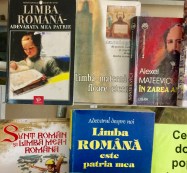 The words mean “our language” in Romanian, which is the official national language here.
Simultaneously, one in four Moldovans speak another language as their native tongue, mainly Russian, Ukranian or Gagauz, all of which have official status in certain regions.

Limba noastră is also the title of Moldova’s national anthem. Just as The Star-Spangled Banner honors the American flag, Moldova’s anthem proclaims the Romanian language to be a “treasure” that is “more than holy,” a heritage that “surges from deep shadows the past.” You can see a video of the anthem at the top of this post or on YouTube.
The Limba Noastră holiday goes beyond language to celebrate Moldova’s heritage more broadly. It occurs immediately after the country’s Independence Day, adding a cultural counterpoint to the politics of Moldova’s identity. Both celebrations are followed by First Bell, on September 1, when schools across Moldova hold colorful ceremonies to open the new year and ring out summer.


Here in Ialoveni, hundreds of people gathered at the Casa de Cultură, or cultural center, on Thursday to celebrate Limba Noastră. There were musical performances, dramas, dances and poetry, some of which you can see here. The library where I work, Biblioteca publică orăşenească „Petre Ştefănucă,” organized the program together with the town hall, or primăria, and the cultural section of the county government, or Consiliul Raional. It also created a series of exhibits celebrating Moldovan authors and the Romanian language. That’s library director Valentina Plamadeala speaking at the ceremony in the photo above.
During its Soviet period, Romanian was called Moldovan to distinguish it from the adjacent country with which so many Moldovans feel connected. Some people still insist on calling the language “Moldovan” even though its differences with the Romanian spoken in Romania are slight.

In places like Ialoveni that have strong ties to Romania, most people embrace the holiday, seeing the Romanian language as part of their ethnic identity. One speaker at Thursday’s ceremony recalled how he and others were forced to speak Russian in the years before Moldova’s independence. For them, limba noastră has a resonance that goes deeper than the language itself.
Elsewhere in Moldova, the holiday can be perceived differently. One of my fellow volunteers who lives in a Russian-speaking area said his host father calls it limba voastră, or your (not our) language.
The relationship between language and identity is complicated, in other words, and not always easy for an American to understand. We have plenty of experience with these issues back home, though, so the story can sound familiar despite the translation.
***
Want to learn more? This article offers useful background about Moldova’s languages. Also interesting is this article about how language is perceived by different groups in Moldova. [Hat tip for the second article to my volunteer colleague Haley Bader, whose excellent blog you should check out.]
Did you enjoy this post? Please share it!


The Material World
No one is going to confuse Gemeni, a department store in the heart of Chișinău, with Milan or Paris, or even with an American fabric shop. Located next to a McDonald’s on the city’s main street, Gemeni is old. It’s cramped. It has no parking, no food court, no modern rest rooms. It’s more of a bazaar than a modern department store. Most of its shops are small or tiny.


But if you’re looking to sew anything from a simple shirt to an elaborate gown, it’s a great place to shop. The third and fourth floors, especially, are abundant with fabric, yarn, buttons, ribbons, zippers, thread and everything else you need. The prices are nothing special but the selection is great.
Champa and I learned this recently when we bought supplies for a big grant project she has begun to create a costume wardrobe for her school’s drama program. We shopped with Ana, the head of the program (middle in the photo below), and Ina, a designer and seamstress (left) who is helping with the project.
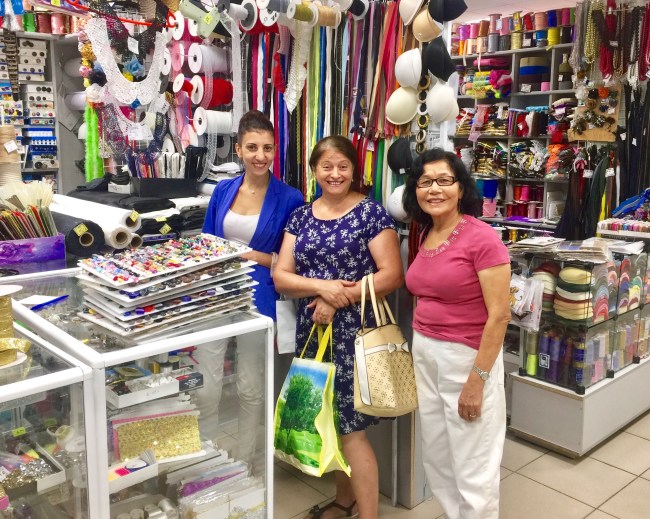
Most of Gemeni’s vendors are women. They rent the stalls, which are arranged by category throughout the store. On the first floor, for example, are shops selling perfume, stationery and jewelry.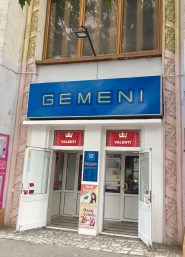
The store, whose name means twins in Romanian, evokes its Soviet heritage. It’s functional, not glamorous. Customers almost always pay in cash. They receive their purchases in cheap plastic bags rather than the store bags we expect back home. Customer service desks? Benches for resting? Fountains? As we say here at the blog: not exactly.
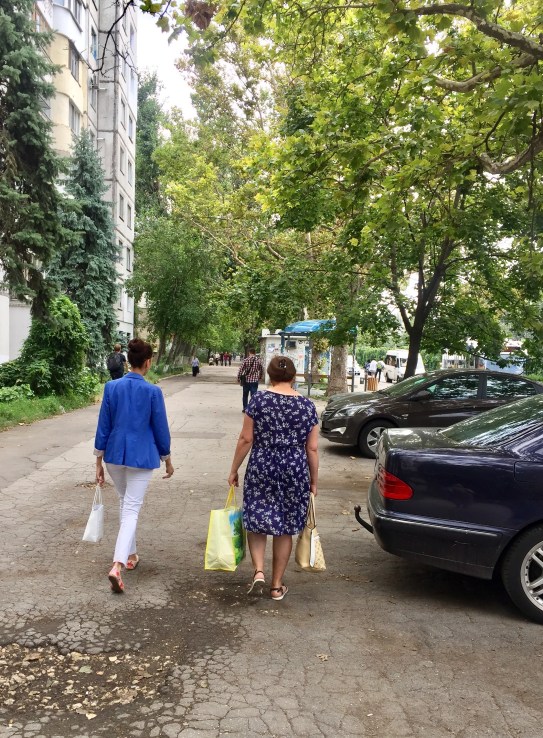
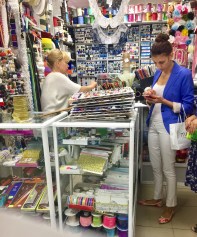 Bolts of velvet, cotton and other material surrounded many of the shops we visited. Champa and her partners visited one place after another to select the best cloth for the costumes they’re planning. They also bought buttons, gold braid, ribbons and other haberdashery supplies. Within a few hours, we were loaded down with bags, which we carried on a bus across town to Ina’s studio. She is now cutting and assembling the cloth for each costume — Romeo, Juliet, kings, queens and more.
During the next several months, Ina will join with students and parents at Champa’s school to sew these pieces into more than 40 glorious costumes, which I’ll describe in future posts. For now, one thing is for sure: They have great material to get started.
Did you enjoy this post? Please share it!


Painting the Playground
These “Before” and “After” photos tell the story of what Peace Corps can accomplish with a local community, sometimes within a couple of hours.


All three photos above show a playground in central Ialoveni. The left photo, which I shot on Tuesday morning, shows how faded and dingy the equipment looked. The middle and right photos show some of the same equipment on Tuesday evening after a Peace Corps group joined with local residents to give the playground a paint job and makeover. (“Vopsit” means “painted.” The sign on the left says: Help us put the “love” in Ialoveni.)
Nine Peace Corps trainees who’ve been living in Ialoveni for the past two months organized the event, which included ice cream and games for children. They’ve been staying with host families and studying every day at Liceul Teoretic “Petre Ştefănucă,” a school near the library where I work. 
Next week they will swear in as volunteers and begin serving in the community and organizational development (COD) program for Peace Corps Moldova. They’ll serve with a companion COD group of trainees who’ve been living and taking language classes in the nearby village of Sociteni.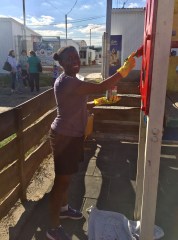 Those trainees held their community service event last week, a clean-up of Sociteni’s main street.
Both groups of COD trainees are looking forward to finally finishing their preparation and moving to their permanent posts to begin assisting local governments, libraries, nongovernmental organizations and others across Moldova. 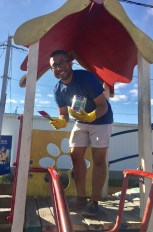 Two other groups of trainees— in English education and health education — will also swear in next week.
  Altogether, more than 50 trainees are expected to join Peace Corps Moldova’s current volunteers, most of whom swore in a year ago and will continue serving until next summer, Champa and me among them.
You can see the Ialoveni trainees posing here at the end of Tuesday’s event with Mayor Sergiu Armașu and a couple of local girls, Champa and me. We participated along with two other current volunteers (Reggie and Beth) and an impressive number of community members.
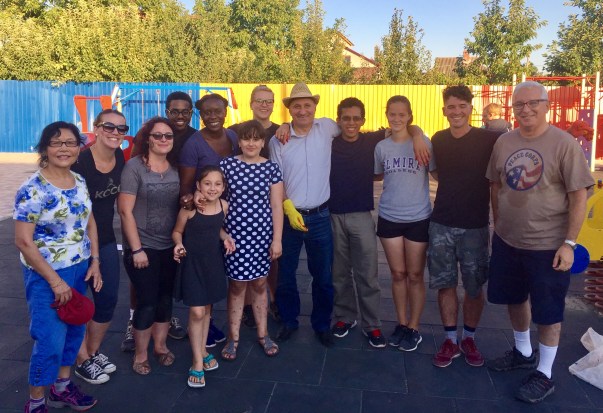
For both of us, it was gratifying to watch our two communities — Peace Corps and Ialoveni — come together for such a worthwhile cause. Ialovei is our home for another year and this playground next to the main piața, or shopping area, looks so much better now. If the kids loved it before, they’re going to love it even more after the makeover.

 "Not Exactly Retired"