
Older Americans who think about joining the Peace Corps have lots of questions. Those who actually sign up have even more questions as they prepare to quit their jobs, say goodbye to their families and head overseas for 27 months.
Valerie Harden, for example (pictured above studying Romanian). Lately she’s been wondering “what will it be like to live with people whose everyday routines are so different from anything I’m accustomed to.” Or Julie Allison. She’s unsure what clothes to buy and whether she’ll be able to learn a new language. “Will I have any friends my age?” she asks. “Will my closest PCV friend be the age of my granddaughter?”
Harden and Allison are both scheduled to leave next spring to become Peace Corps volunteers in Moldova, Europe’s poorest country. They will join hundreds of other Americans age 50 or older now serving worldwide, accounting for about 7 percent of nearly 7,000 Peace Corps volunteers in 63 countries.
What awaits them? Not Exactly Retired sought answers from some current and recently returned older volunteers in Moldova, the small former Soviet state located between Romania and Ukraine.

“Peace Corps is a challenging and difficult undertaking, and your image of service is probably very different from the reality of service,” says Deborah Sesek of Cleveland, a community development volunteer in Moldova pictured here feeding dogs at an animal shelter in Ciorescu where she volunteers. “Having practiced law for 35 years and learned to deal with surprises and expect the unexpected, I think it is critically important that volunteers — especially those who are older — approach Peace Corps service with no expectations. Each volunteer’s service is uniquely their own.”
Donna Barnes, a professor at Howard University, thought she was following this advice but found the transition “easier said than done.” Looking back now after seven months in Moldova, she says “I don’t think I was that honest with myself. There are just some things that I am not willing to accept when it comes to living arrangements or personal hygiene.” Now that she’s largely figured it out, she generally loves her job as a health educator in a small village.

Tom Corr, a former attorney in Berkeley, Calif., has been settling into his village, too, working with colleagues such as Ilie Leahu, the deputy mayor of Băcioi, with whom he is pictured above. The “steady comfort” of his previous life has been “replaced by a confusing and challenging environment” — but he welcomes the change. “You will amaze yourself with your ability to learn and adapt,” he says. “Each day will be measured by small victories and small defeats, and somehow the accounts always balance net positive.”
Corr and other older volunteers from Moldova cite language learning as a particular challenge. They and the other trainees all began Romanian classes shortly after arriving in the country and moving to villages to live with host families.
“Language training is intense,” recalls Jim Fletcher, a retired commercial real estate broker from Raleigh. “It’s a firehose of information six days a week that can be overwhelming.”
Tom Harvey, also from North Carolina, was “tired at the end of the day and could not study well later, so I had to adjust; I would get out of bed early in the morning and study that which I most needed to learn. Afternoons and nights were for reviewing the day’s information. It took me much longer than I expected to settle on a schedule.”

“Language learning can be more difficult for older volunteers, especially if they have never spoken a language other than English,” says Sandra Dale Woodruff, who came to Moldova from Tampa, pictured above reviewing a Thanksgiving poster with her student Valeria Condrea. “Recognize that even if you never make it to the fluency level to which you aspire, you can still make a big difference in your community. As the English teacher from my village once told me, ‘You only need Romanian for two years, but they are going to need English for their entire lives.’”
Being older has advantages, too. “The older one becomes, the more life experiences one has,” says Deeporne Beardsley, who recently completed her service as an English teacher in Moldova. “They are huge assets that greatly enhance one’s chance of success. In my group, the oldest person was 73 years old and she successfully finished her service.”
Dee’s husband Brent, with whom she served, agrees, saying he came to view his “grey hair as an asset.” Now back together in Tucson, he says, “Moldovans have a lot of respect for older people and the experience that come with their years. This will very likely be true wherever you end up serving.”
That’s been true for Champa and me, who came to Moldova this past June. Being parents and grandparents has given us an instant connection with many of the people we’ve met here.

“Depending upon your country of service, you may be treated like a frail oldster (and you’re visibly so not) and they will absolutely invade your bubble. Let it go,” says Lisa Gill, who has been serving with her husband, Steve, both in their 60s. (That’s her in the photo, working with a student at a career program in Bălți, where she and Steve live.) “This is not a job. This is a choice. Be openminded, patient and flexible and lead from behind.
Cynthia Katocs, who came to Moldova from Seattle, says, “This is your time to explore the world and use your skills to assist. While volunteering you will pick up many new skills to take with you. Peace Corps pays your bills. They have excellent medical personnel and are there to help you along your way. All you need to do is learn to relax, learn a new culture and be helpful. It is difficult at times but the positive will always outnumber the difficulties.”

Ultimately, success depends less on a volunteer’s age than on what’s in their heart, says Andrea Benda, 66, from Virginia, shown above with her students at the end of teacher training in Costești. “I would say to anyone considering Peace Corps service that, in whatever manner your age impacts your work and life at home, it will be the same serving in the Peace Corps.”
This is the first story in a Not Exactly Retired series about older volunteers serving in the Peace Corps. Thanks to everyone who participated. Unfortunately, we didn’t have room to include all of Moldova’s current and recent older volunteers. You can learn more on the Peace Corps Moldova Facebook page and the Peace Corps website for older potential applicants.
Did you enjoy this post? Please share it!


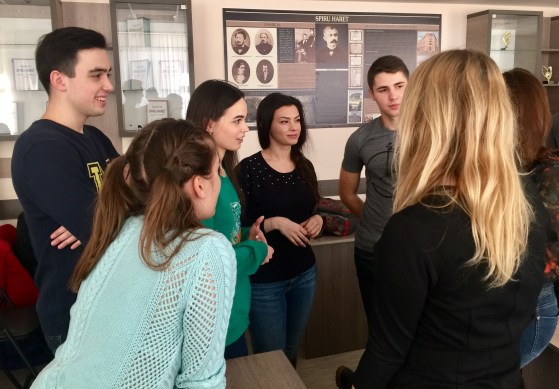


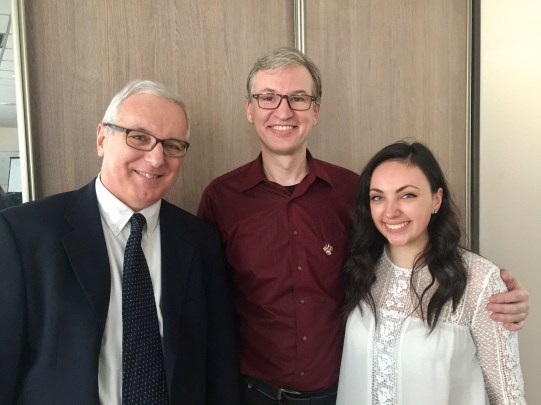


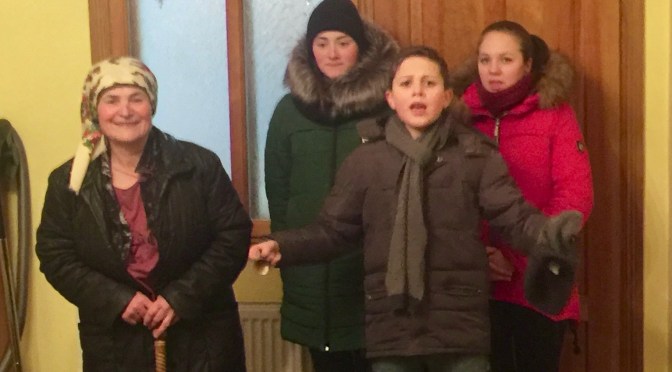
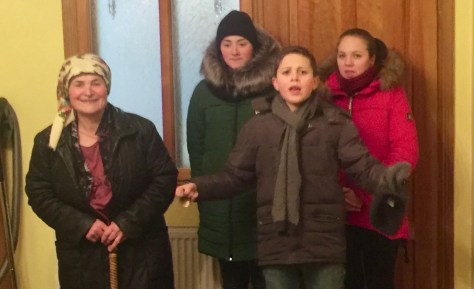
 It turns out our visitors were celebrating St. Vasile, or Basil the Great, a religious figure born in the year 329. He lived virtuously, established monasteries, served the poor and was canonized by the Orthodox Church shortly after his death.






 You’ll also find more stories on this blog, Not Exactly Retired, such as


 “I had spent the latter years of my working life and the early parts of my retirement in various volunteer activities,” says Tom Corr, who was previously a lawyer in California. “My part-time volunteer activities had relatively visible results, at a modest cost to myself. I thought Peace Corps would be a ‘scaling up’ of that experience. But it is not. Peace Corps service requires a far more consequential commitment, but the ‘results’ of our service may not be visible to us for weeks or months, or maybe not at all.”
 Cynthia Katocs said Peace Corps helped her unwind from the corporate world (as illustrated here with a photo she took in Ialoveni with two familiar mice). “My first days in Peace Corps, I was wound up very tight from working in a corporation for many years,” she says. “The Peace Corps helped me find myself. It helped me look at myself and accept myself for who I am and not what I can bring to a company.”
 Inevitably, though, being a Peace Corps volunteer makes a person think about not only their new surroundings but also what is inside their own heart.


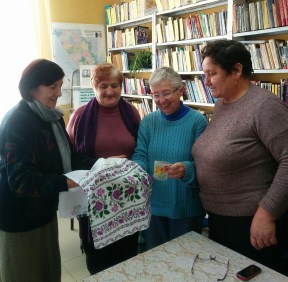 “I’ve been surprised by host country nationals’ reaction to my age,” says Deborah Sesek, a former labor lawyer in Cleveland, shown here (in the blue sweater) attending a meeting with the Association for the Elderly in Ruseștii Noi, where she is posted. “Here in Moldova, most people retire in their late fifties. They assume I was retired before I joined Peace Corps, which isn’t true. When I tell them I was working until I left, they often just shake their heads.”


 "Not Exactly Retired"