Tag Archives: Argentina

Most Popular Posts

Predicting the outcome of a game or an election is child’s play compared to the uncertainty I face as a blog author. I’ve been writing this blog for a decade and still can’t predict which posts will attract the most readers. 

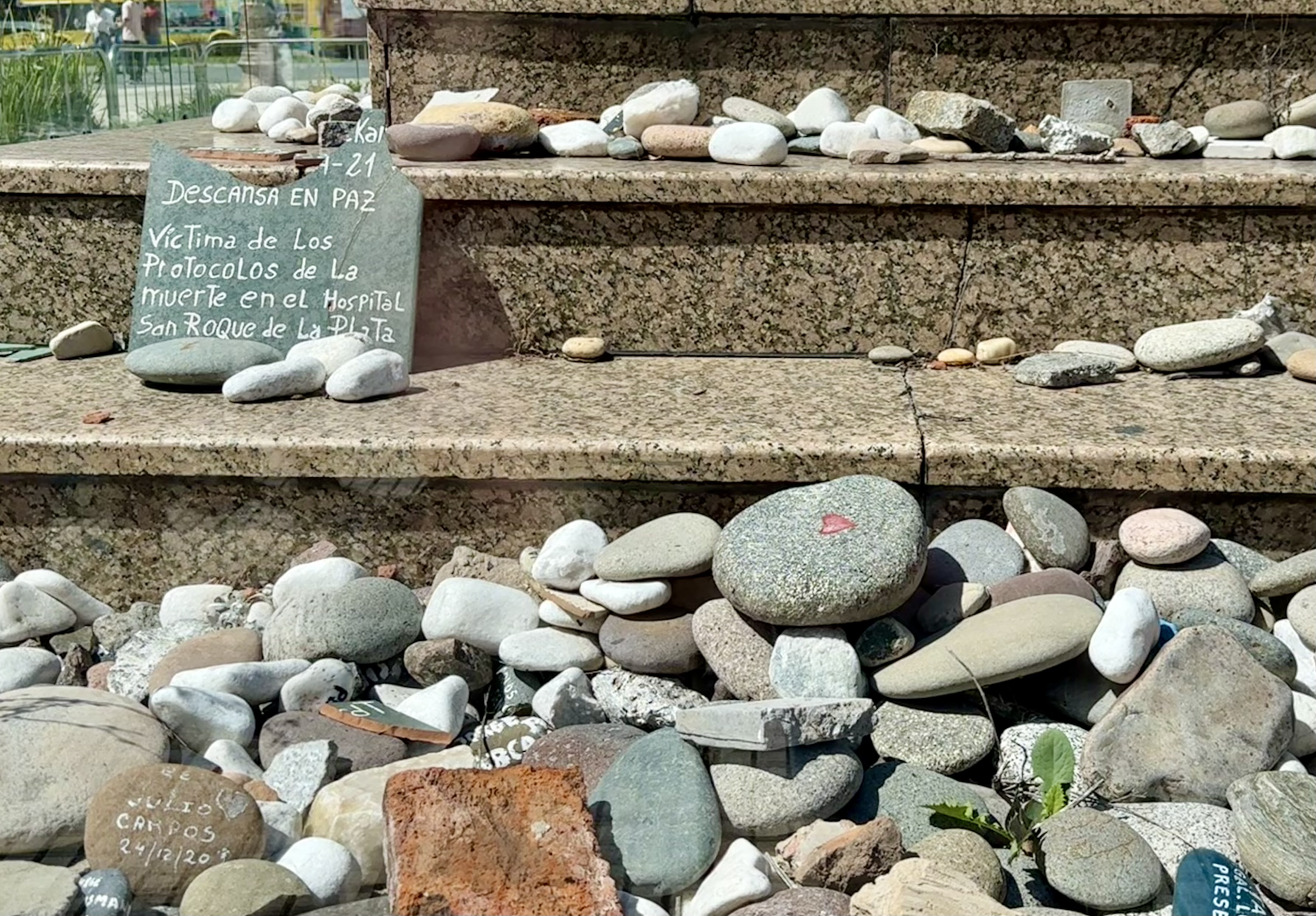
According to my site statistics, for example, my most successful post of the past 12 months was Stones of Remembrance, about a COVID memorial in Buenos Aires. Back in May 2024, I described the memorial, shown below, and asked why our own country has done so little to honor the million-plus Americans who died during the pandemic.

I never expected that post to build an audience over time and end up first in Google’s rankings for searches on “Argentina Covid Memorial.”

As part of this blog’s 10-year anniversary, I’m pausing my regular content to pop open the blog’s hood and share some insights about it. I’m guessing this may be especially interesting to those of you who are fellow writers, social media users or data geeks. As you’ll see, though, my guess may well be wrong.

So back to the statistics.

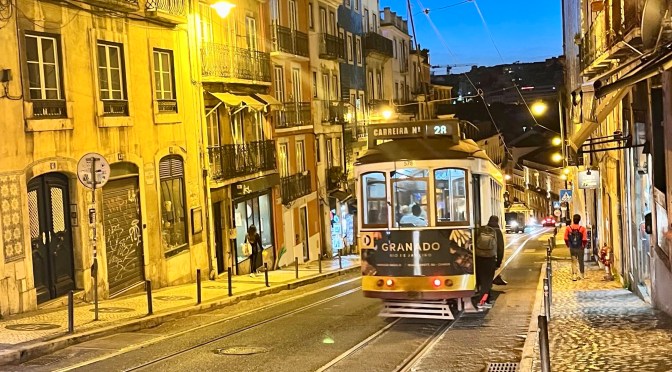
My second-most popular piece of the year, Amazing But False, was about tour guides in Portugal, including the one above, who kept telling me a startling story about their country’s divorce rate. I knew the story was nonsense and was amused by their obstinancy in clinging to it. On a whim, I dashed off a quick post, which now ranks higher on Google than similar stories from the BBC and elsewhere.

Third was Momos Down Under, about the delicious Nepalese dumplings we ate in Australia and New Zealand, including at the shop in Christchurch shown above. The post is Google’s top hit for “momos in Australia.” For “momos in New Zealand,” it ranks second, behind a Tripadvisor guide on the topic.

I enjoyed writing all three posts but, honestly, they meant less to me than some others, like my recent story and video about the school we helped build in Nepal. All three were just interesting things I observed while traveling.

I don’t check my traffic statistics often and haven’t discussed them here since 2017, when I reached 200 posts. I write for fun, not as a business, and have resisted inquiries about monetizing this site.

My most popular story back in 2017 remains atop my all-time list. This one isn’t a surprise. Peace Corps After 50, which I wrote while serving in Moldova, was promoted on a PBS website, above, and elsewhere. It’s been attracting views ever since, presumably from older Americans thinking about applying. Over time, it’s slipped in the Google rankings, but that’s unsurprising since Google’s algorithm favors fresher content.

Ah, the Google search engine algorithm. It’s their mysterious, ever-changing formula for ranking pages. Advertisers, political consultants and others obsess about it. I wish I still had my crack Duke University social media team available to advise me why my stories about a foreign memorial and divorce rate have done so well. Maybe it’s because they were both on niche topics where my article could stand out more than one about Middle East autocracies or even Magical Kathmandu.

Or maybe there’s another reason. If you have any insights, please share them with a comment. Don’t wait, though. Before we all know it, artificial intelligence is likely to transform the entire search engine business, which extends beyond Google.

Another measure of user interest is file downloads from a site. At the top of my site’s download list are the lyrics to Orașul Meu, the song and music video I produced with Moldovan singer Laura Bodorin. That song is still being performed in Ialoveni, the city where we created it.

Speaking of users, most of mine live in the United States, followed by Moldova, Germany, the United Kingdom and Canada. Rounding out the top ten are Nepal, Romania, Australia, India and China. Readers in more than 150 countries have visited the site at least once.

I produce the site using the TwentyFourteen theme on WordPress.

I might now close by expressing my deep appreciation to the web designers, editors and others who work with me on the site. However, the entire operation is just me, with 384 posts so far and more to come.

Looking ahead, I hope to keep entertaining you with whatever travels, topics and musings come next, even as I acknowledge my inability to predict which posts you’ll find interesting. 

That unpredictability extends to this post. I have no idea how many people will read it. Maybe nobody. Maybe a lot. Who knows? Now that you’ve reached the end, though, I know that at least one person finished it, so maybe my odds just got a little better.

Top photo: Tram near our Airbnb in Lisbon. Photo by Karen Simon.


Subscribe to Not Exactly Retired. It’s free!

You Call These Mountains?

When I visited the Andes and Patagonia’s rugged landscape recently, I said the same thing as when I first saw the Grand Tetons: 

“You call these mountains?”

They were spectacular but I couldn’t resist pointing out they were much lower than the Himalayas of Nepal, where I served as a Peace Corps Volunteer 47 years ago and have returned regularly since marrying Champa. I still speak Nepali, am close to our family there and think of Nepal as my second home.

Like many converts, I’ve become a zealot, in my case about Nepal’s status as the home of the world’s highest mountain, Everest, and eight of the top ten overall. I promote them even when I should be praising others.

As you can see from these photos from our trip last month, the mountains of Argentina and Chile are actually stunning. I was spellbound by the snow-covered peaks of Patagonia. When we drove across the Andes from Argentina to Chile, the views were magnificent, such as at Bariloche, below.

The same was true of the Alps when Champa and I hiked there on previous trips (below).

I loved the Cascades, too, when we visited Oregon recently. Despite being less than half the size of the Himalayas — Mount Rainier’s peak is 14,411 feet compared to 29,029 for Everest — they were glorious to hike or just admire from a chair (below).

It’s not like I’m a mountain climber myself, especially at this stage of my life. The highest I ever got in Nepal was 18,519 feet at Kala Patthar, overlooking the Everest base camp. That’s where summit expeditions start, not finish. I could barely walk in the thin air.

Moreover, altitude doesn’t define beauty. Nor does location. The highest peaks, like those in Nepal, can be more deadly than delightful.

Sunrise at Kanchenjunga, the world’s third-highest mountain, near Champa’s home.

My comments are just Himalayan chauvinism and, as Champa reminds me, they’re ridiculous. She glows whenever she visits mountains, whether in Nepal or elsewhere.

In comparison, I sound like a Parisian who sneers at someone else’s cuisine or a New Yorker mocking life beyond the Hudson River. It’s not a good look, so I’m confessing to it here and vowing to finally overcome it. 

In that spirit, let me now state clearly what I thought of the Andes: They were gorgeous, marvelous and impressive. 

That is, if you like hills.

(Top two photos by Nancy Collamer)

Stones of Remembrance

I used to work near the Vietnam Veterans Memorial in Washington, D.C. I could leave my office at the National Academy of Sciences and walk across Constitution Avenue to the stark black granite wall where millions of visitors come each year to honor American servicemen and women who died in the war.

A few blocks away, the AIDS memorial quilt was spread across the Mall, each of its panels remembering someone who died. 

After I left Washington in 2001, new museums opened to remind visitors of the injustices endured by Blacks and Native Americans in our country. The Holocaust Museum commemorates the millions of murdered Jews.

So how about COVID?

More than one million Americans died during the recent pandemic, the deadliest in our nation’s history. One million. It’s understandable that we don’t yet have a national memorial to honor them and to acknowledge that many of their deaths could have been prevented. But given how politicized the pandemic became, and remains today, I wonder if we will ever do right by them.

All of this occurred to me when I visited Buenos Aires recently and was startled to see a COVID memorial directly in front of the Casa Rosada, Argentina’s White House. It’s a collection of stones, each painted with the name of someone who died. The stones surround a statue of General Manuel Belgrano, a military leader in Argentina’s war for independence. 

Argentina lost more than 100,000 people to COVID. In August 2021, hundreds of their family members and friends marched to protest the government’s handling of the pandemic. They placed the stones around the statue, creating a new memorial that’s now protected by a fence. It’s just across the Plaza de Mayo from another recent memorial, to the mothers who led a peaceful resistance movement against the military dictatorship that “disappeared” their children. Both memorials speak truth to power, side by side.

Other countries have also commemorated COVID’s victims, such as with a memorial wall in London and a forest grove in Italy. In our country, there have been memorial flags in Texas, a “drive around” in Detroit and, in 2021, a memorable display that covered the National Mall with small white flags.

I admire these and other initiatives but wish more attention was being paid to the nascent efforts in our country to produce more official remembrances of the pandemic that affected us so profoundly.

I’m not holding my breath to see a permanent memorial in Washington, especially if the upcoming election restores to power the person responsible for so many of the pandemic’s deaths. Right now, with Argentina fresh in my mind, I’d settle for a million stones across from the White House.

I didn’t go to Argentina expecting to think about COVID but I can’t get their memorial out of my mind. If Argentina, with its own deep political divisions, can do this, why can’t we?

Argentina and Chile

I anticipated the tango dancers, wineries and Messi jerseys when Champa and I visited Argentina and Chile with my sisters and their husbands last month. I also knew that Patagonia’s glaciers, which are receding because of global warming, would still be amazing. (See my video below, which is also available on YouTube.)

However, I wasn’t quite ready for the thousand-peso notes and people obsessed with their dogs.

Both of these countries at the bottom of South America were beautiful but complicated. Argentina is savoring its recent World Cup triumph while grappling with rampant inflation and political division. Chile is more stable but still coping with the legacy of a brutal dictatorship. There’s a European vibe in both places, not to mention great steaks and wine — and all of those dogs.

We packed a lot into our 2-week itinerary, which we organized ourselves with help from an Argentine planner. We learned a lot, too.

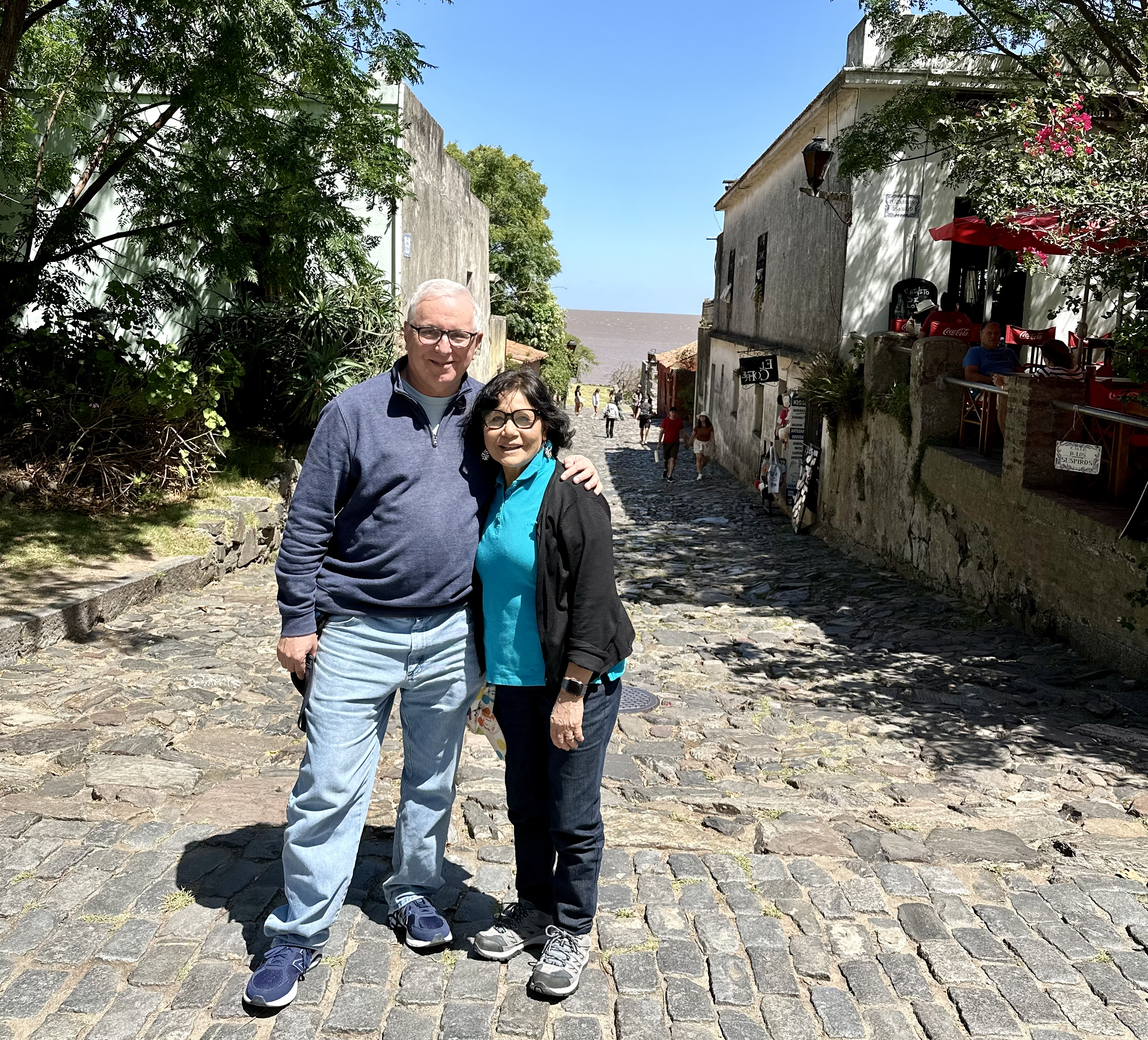
We began in Buenos Aires, renting an Airbnb in Palermo near South America’s largest mosque. We took a city tour, then visited several places on our own, including parks, gardens and the Museo de Arte Latinoamericano, which had special exhibits about Frida Kahlo and Chilean artist Cecilia Vicuña. We traveled by international ferry one day to Colonia del Sacramento (below), where we enjoyed strolling and learning about Uruguayan history.

Next was Patagonia, whose mountains and landscapes were even more stunning than we expected. We spent a full day exploring the glaciers near El Calafate (below), by boat and on foot, and then another day hiking in El Chaltén, not far from where Butch Cassidy and the Sundance Kid lived for several years. We also had memorable meals near a rugged, windswept hill and in a cave beside an archaeological site.

Then it was on to Bariloche, home of scenic mountain lakes, designer chocolates and Nazi war criminals. We stayed at the El Casco Art Hotel, where every room is devoted to an Argentine artist and the public spaces are filled with original paintings and sculptures.

Our final stop in Argentina was Mendoza, where we toured downtown plazas (below), visited wineries and shared a hotel with a visiting soccer team from Santiago whose boisterous fans gathered at the entrance.

Finally we traveled to Santiago, by bus so we could see local communities and the Andes Mountains. Despite some online warnings, the bus was luxurious and the border crossing manageable, with views far more interesting than we would have seen in an airport.

After arriving in Chile, we toured both Santiago and nearby Valparaiso (above), a historic port city abounding with colorful murals and street art. We rode a funicular to the top of Santiago’s San Cristóbal Hill and visited the Museum of Memory and Human Rights, which presents the grim history of the Pinochet dictatorship.

We saw a lot and could have seen more, such as Iguazu Falls and the Atacama Desert, if we’d had more time. Perhaps we should return. 

Perhaps you should visit, too, if you’re able. There’s no better place to escape winter in the northern hemisphere while immersing yourself in great history, culture, food and Malbec wines. The tango lessons and the dogs are optional.