Packing Up

If you have a house, cars, a dog and a modern American life, how hard would it be to leave it all behind?

It would be hard. Really hard. Trust me.

The hardest thing Champa and I will be leaving to serve in the Peace Corps is our two sons and their families, especially our grandchildren. We expect to stay in regular contact but will miss them terribly.

During the past several weeks, though, we’ve been so busy taking care of everything else that we’ve barely had time to think about this.
FullSizeRender 7

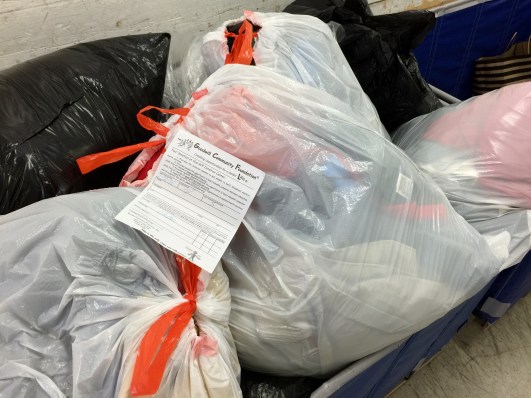
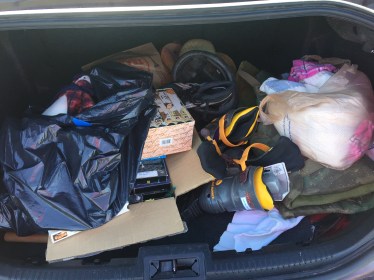
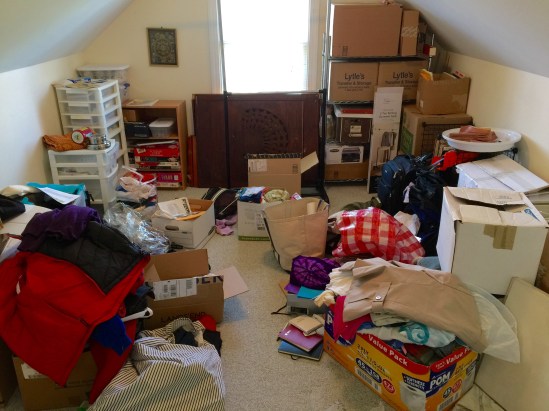
This photo shows the stuff we’ve begun moving into a storage room in our Durham house, which we’re renting while we’re gone. We hired a local property manager a few weeks ago and just heard yesterday he might have found renters for the first year.

Tomorrow we’re driving to Winston-Salem to meet again with a family that may adopt our beloved dog, Bailey. A friend is buying Champa’s car and I’m giving my car to my son.

I still need to cancel everything from my library card to our gym memberships, forward our mail and shut off our electricity, gas and other utilities. I have to call our bank and credit card companies to alert them to our travel plans. I already ordered an additional card from a company that pays for foreign ATM withdrawls.

Absentee ballots? You bet, since North Carolina is likely to be a swing state in the election. Medical insurance? I’m suspending our current coverage while we’re covered through Peace Corps. I can’t forget the EZ-Pass device in my car, which bills me every month. So does Netflix, so I’ll need to cancel both of those. I’ve also been scouring our bills to make sure I don’t miss anything else.

On Tuesday, I’m visiting our bank to add my sister to our checking account and give her power of attorney while we’re gone. I still need to check our wills, buy souvenirs for our host families and create electronic copies of important documents in my file cabinet.

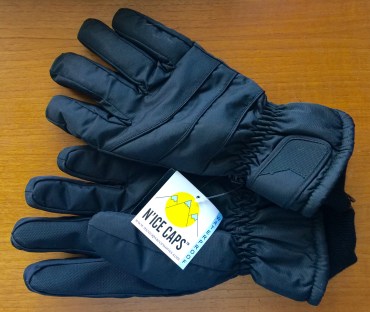
We just bought Champa her own laptop and spent several hours loading it with apps and documents. We bought shoes to walk on Moldova’s muddy roads and boots to survive its winters. I now have a new winter coat, too. We still need new suitcases. In fact, as I look through the “suggested packing list” we got from Peace Corps Moldova, we need a lot of things.

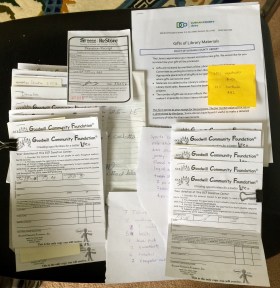
Simultaneously, and ironically, we’ve been downsizing and purging 36 years of stuff from our house. We’ve donated hundreds of books to the Durham library and dozens of bags of clothing and household goods to local charities.

Back when I joined Peace Corps the first time, as a 24-year-old in 1979, I threw some stuff in a couple of suitcases, said goodbye to my parents and headed for the airport. Now I feel like we’ve already proven the old Peace Corps slogan that serving as a volunteer is the “toughest job you’ll ever love.” Who knew it would be so tough even before we left?

Not Exactly Unusual

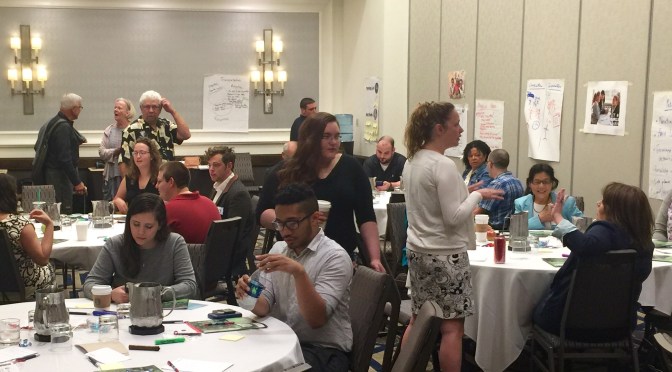
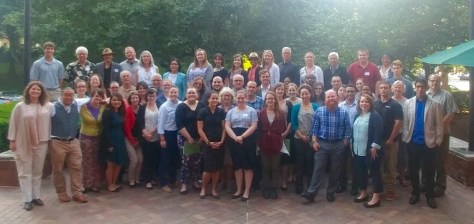
As we get ready to begin our service with the Peace Corps, Champa and I are not exactly unusual in being not exactly retired. A surprising number of the other new volunteers in our group are also 50 or older — in several cases, considerably older.

Several weeks ago, we met for coffee with one of them, a commercial real estate broker from Cary in his late 60s. We liked him immediately and discovered much in common in our motivations to challenge ourselves and serve society in new ways.

imageOne of the other new volunteers going to Moldova now heads a program at Howard University to prevent suicides among people of color. Another started a special needs dance program in Harlem and was a foster mother for nine children. Our group also includes an IT manager from Iowa, a software expert from Minnesota and others, all over the age of 50.

We’ll be joining several 50+ volunteers already in Moldova, one of whom is serving as a mentor for me and some of the other newbies. Before signing up for the Peace Corps, she worked for more than 35 years in Cleveland as an attorney specializing in business and employment law. Champa’s mentor is younger but worked for many years as a teacher in California.

Worldwide, 50+ volunteers now account for about 8 percent of the total. Peace Corps encourages them to apply, as at this website. NPR recently broadcast a fun story about the oldest volunteer of all, Alice Carter, 87, from Boston, who was serving in Morocco.

It's been less than a year since my farewell parties at Duke. Champa and I were not alone among people our age in saying goodbye to dear friends to pursue new adventures.
It’s been less than a year since my farewell parties at Duke. It turns out Champa and I were hardly alone among people our age in leaving conventional lives to explore other opportunities like the Peace Corps.

To be sure, many new Peace Corps volunteers are still recent college graduates, as well as people in their 30s and 40s. Whatever their ages, the ones who will be serving with Champa and me are impressive, with expertise ranging from social work to farming to financial analysis. Indeed, I am already inspired by many of the younger volunteers. I also know how fortunate we are to be in a position to join them, since we’re not tied to home by aging parents or children who still need active support. Financially, we figure Peace Corps will be a wash — no real income, but also little need to touch our savings.

How do I know so much about our fellow volunteers? Mainly through Facebook. Just like high school seniors getting ready to attend the same university, our group has its own Facebook group. We’ve been getting to know each other online. Several people have also met in person, as we did with our new friend from Cary.

It’s just one of the many ways in which Peace Corps has changed since I last served as a volunteer, in Nepal in the the late 1970s. Back then, I didn’t know any of my fellow volunteers until I showed up at staging. This time I’ll be looking for familiar faces, some of them as seasoned as ours.

Countdown to Moldova

We drove 11,000 miles around the United States. We wandered around Nepal. But now, still less than a year since I stepped down from my job at Duke,  Champa and I are entering the countdown for our biggest adventure yet.

At the end of May, we’ll leave the United States to serve as Peace Corps Volunteers in Moldova. (That’s Moldova in yellow on the right side of this map, the small country between Romania and Ukraine.)

Screen Shot 2016-04-07 at 4.29.08 PM

We’ll initially gather with the other new volunteers for a brief “staging,” probably in Philadelphia. Then we’ll all fly to Chisinau, Moldova’s capital. Immediately after we arrive there, we’ll begin three of months of training — learning to speak Romanian and perhaps some Russian, studying the local culture and getting prepped for our jobs. If all goes well, we’ll then swear in as volunteers and be posted together somewhere in the country.

Champa will be a teacher in the Peace Corps program for elementary English education, drawing on her many years of teaching experience in both Nepal and Maryland. I’ll be in a program called “community and organizational development,” probably working with a local nonprofit group of some kind. We’re due to serve for two years, or 27 months if you add in the training period. That takes us to the end of the summer of 2018.

As someone who served in the Peace Corps previously, in Nepal in the late 1970s, I thought I knew what to expect as I approached the Peace Corps launch pad again. But I’ve encountered lots of surprises. Things have changed since then. So have I. My perspective now is so different from when I began my previous service at the age of 24. For that matter, it’s changed a lot even since I decided to stop wearing a suit every day.

During the past year, many people have asked me how I’ve been doing since I retired. My response has often been, “Well, I haven’t retired. I’ve just decided to do something different.”

That’s indeed what Champa and I have been doing and it’s also why I’m now giving this blog a refreshed look and a new name: Not Exactly Retired. There’s a new URL, too:  notexactlyretired.com. I invite you to follow the blog by clicking on the button at the top-right of the screen, not just via Facebook. If you find it interesting or entertaining, please tell your friends. I’ve got some fun stories planned for the next few weeks, even before the real action starts.

Are you ready to join us on the journey? Welcome back.


Nepal Trip Video

In the fall of 2015, as chronicled earlier in this blog, Champa and I took an extended trip to Nepal. We visited her home town of Ilam and a small village, Samalbung, and spent time in the Kathmandu Valley. During the second half of the trip we welcomed eight members of our American family for an unforgettable tour, highlighted by the two families coming together. This video has the highlights.

Peaks in the Fog

image

Look carefully at the photo. Very carefully. I snapped it on Sunday morning at Sarankot, near Pokhara, in central Nepal. People come here from around the world to see the spectacular sunrise over Fishtail, Annapurna and other famous mountains.

Do you see those amazing white peaks, just behind the big hill in the middle of the photo? That’s where they’re located.

Well, we didn’t see them either.

We awoke early and left our hotel at 5:15 a.m., hoping to watch the sun cast a golden glow on these snow-covered giants. Instead, we saw fog — layers upon layers of dense fog.

imageWe weren’t alone. All around us, people were poised with their cameras and tripods, waiting to snap a photo of a lifetime. Instead, they ended up taking photos of each other, or selfies.

imageNovember is usually among the best months to see Nepal’s famous mountains, especially at sunrise. As they say here, it’s peak season, long past the summer monsoons. But nothing is certain in this country, and Mother Nature has her own ideas about who gets to see her jewels, and when.

We experienced the same disappointment a week earlier when we visited Nagarkot, a resort town north of Kathmandu with a famous view of the eastern Himalayas. There, too, the sunrise and setting were beautiful but we saw only glimpses of the white peaks hidden by fog.

At Sarankot, we waited an hour, hoping the fog would clear. Finally, we gave up and drove back down the hill, stopping at the Bindhyabasini Temple to watch morning puja, or prayers. Sure enough, that’s when the skies finally cleared enough to give us a partial, but wonderful, view of the peaks. The video shows how we were able to see the mountains in one direction and the temple scene in the other.

That’s Nepal. It rarely works the way it’s supposed to. But if you have faith and patience, it usually gives you more than you hoped for.

Comparing Two Trips

With only one week left before we return home, we know how fortunate we have been to have had not one, but two, great adventures since hitting the road in early July 2015. First we traveled around the United States, then in Nepal.

Here are just a few of the many differences we’ve seen along the way:

Memorable Mountains

Glacier National Park, Montana
Mount Everest
Mount Everest

Memorable Fish

IMG_3014
Catfish Museum, Belzoni, Mississippi
FullSizeRender 369
Weekly fish market, Ilam

Memorable Vehicles

Janis Joplin's Car, Rock and Roll Hall of Fame, Cleveland
Janis Joplin’s Car, Rock and Roll Hall of Fame, Cleveland
FullSizeRender 351
Highway in Kathmandu

Memorable Snack Foods

IMG_2847
Beignets, New Orleans
FullSizeRender 368
Plate of malpwa, Sanjaya Dewan’s kitchen, Ilam

Engineering Marvels

IMG_2599
Hoover Dam, Nevada/Arizona border
Swayambou Monastary, Kathmandu

Moonrises and Sunrises

Herb shop, Arcata, California
FullSizeRender 575
Sunrise over Himalayas at Antudanda

Temples

Japanese Garden, Spokane, Washington
Durbar Square, Kathmandu

Blue Devil Fans

G, the Blue Devil gnome, in Indiana
Raj Bahadur Dewan (Champa's brother), in Ilam
Raj Bahadur Dewan (Champa’s brother), in Ilam

Two Lucky People

FullSizeRender 226
Badlands National Park, South Dakota
IMG_3947
On the trail, Ilam, Nepal

Tikas and More Tikas

FullSizeRender 808One and done?

Not when it comes to getting tikas during Dashain, Nepal’s biggest holiday.

I received five from various friends and family members during the past few days, and was honored each time.

FullSizeRender 815

Tikas are a mixture of red powder, rice and yogurt, with a little sugar sometimes blended in. The person who bestows a tika is usually an older relative, to whom you are showing respect.

FullSizeRender 838

Here’s how it works: You sit at a table with your hands raised in front of you. The tika-giver uses his or her thumb and finger to apply a dab to your forehead, then places jamara — yellowish rice plant shoots — behind your ear or on your hair. While doing this, they chant blessings for your happiness and future.

FullSizeRender 832Next, they give you a piece of fruit and an envelope containing a bit of lucky money. Three of the envelopes I received were adorned with swastikas, which are a traditional Hindu symbol of prosperity. People gave them to me with love and generosity, so I let pass what the symbolism might mean for a Westerner, especially one whose mother fled from Nazi Germany.

After you receive the tika, you bow towards the person and thank them for their blessing. You’re supposed to wear the tika for at least the rest of the day, if not longer. Later, you can wash it off easily in the sink.

FullSizeRender 823This year I gave someone a Dashain tika for the first time, as you can see here. That’s Mamata, whose mother Usha, gave me a tika just a moment earlier. I watched Usha didi’s technique carefully but, even so, was relieved that I didn’t screw up and commit some religious faux pas.

During the first five days of the Dashain season, people travel from house to house, receiving tikas from grandparents, parents, uncles, aunts and others. Each visit is accompanied by delicious snacks before the tika and an even more delicious meal afterwards. This year, tika season ended with the full moon on Sunday. Next year’s season is now less than a year away. I’m already getting my thumb and finger ready.

FullSizeRender 773

Nepal’s Death-Defying Taxi

Americans who complain about potholes in their roads should take a ride on one of the taxis that serve Samulbung, a village in eastern Nepal.

FullSizeRender 561These four-wheelers climb and swerve along unpaved roads made of potholes. They bounce over cobblestones along the better stretches, then struggle across longer stretches where the pockmarked dirt often becomes mud.

FullSizeRender 556During the monsoon season, the mud resembles a swamp. Even when rain is intermittent, as it was when we visited a few days ago, water collects into pools. Drivers have to place one tire on either side of a pool and avoid slipping into the middle, or else charge through and try to reach the other side before losing traction.

FullSizeRender 611Sometimes the driver doesn’t make it. That’s what happened when our driver, Arpan, was a split-second late in down-shifting over a depression in the road. Since his four-wheel-drive was temporarily broken, he swerved into a ditch, as shown in the photo, then nearly burned off his left rear tire trying to regain contact. We all had to get out as he and his assistant gathered stones and gravel to provide traction. Eventually we got back on the road.

FullSizeRender 555Tires puncture regularly, which also happened to us. Once again, we disembarked as Arpan and his assistant made a quick roadside repair, as you can see here.

Such repairs provide a break from a journey that routinely steers to the edge of precarious roads lacking side barriers. If the vehicle went over the edge, it might fall hundreds of feet before crashing amid the world’s biggest mountains. Keep in mind there is no Life Flight helicopter service here. For that matter, there are hardly any doctors.

FullSizeRender 544Just to make the experience more interesting, the vehicles are piled high with luggage, grain and goods, all of which raise the center of gravity and reduce stability. Fortunately, the vehicles are usually crammed with passengers, who provide a counterweight

Many of the drivers are young men, who remain cheerful despite working long hours and earning little money. They stop regularly to pick up passengers and goods, and also to run errands — such as delivering a cell phone or money — for people along the route.

FullSizeRender 553Champa and I took two trips and found them simultaneously terrifying and hilarious. As happens so often in Nepal, we soon got used to the situation and begin joking with the other passengers at each new unexpected turn. We embraced the “No Tension” sticker on the driver’s door.

FullSizeRender 547Our fare for four passengers to travel three hours to Fikkal, the local town, was $11, luggage included. If you find that price unbelievable, well, you’re right: It’s not what you’d expect. We paid nearly double the usual fare to ensure we had only one person in the front passenger seat (me) and only three in the second row. Champa and Bindu, shown here, shared the second row with Bindu’s husband, our nephew Shankar. Business class rocks.

Prayers at the Stream

These faces of devotion are gathered along a stream to wash away curses, evil spirits and bad luck, to be replaced by prosperity, health and good luck.

FullSizeRender 616Their maanghope ceremony, all but unknown in the West, took place Saturday morning along a stream in Samalbung, a small village in eastern Nepal. Families gathered to pray, light candles, beat drums and toss flower petals and grain into the water.

FullSizeRender 675Jai Kumar, with the large white hat, led the ceremony. He is the local sikhsamba, or religious leader, for a growing number of Kirati people in this part of Nepal who have begun turning away from Hinduism and returning to animist traditions. They also have rejected animal sacrifices.  Instead, they follow the teachings of Falgunanda, whose temple in Kathmandu I described in a previous post.

FullSizeRender 690Jai Kumar, a second cousin of ours, expects no payment for leading the ceremony, which calls on everyone to pray not only for themselves and their families, but for the entire community. He lives next door to the home of Champa’s older sister, Sumitra, who died earlier this year. A day earlier, he led another ceremony at the house to coincide with our arrival.

Champa and I came here from Ilam along a breathtakingly bumpy road to pay our respects at the graves of Sumitra and her husband, Naina, and to visit with our nieces, nephews and extended family.

FullSizeRender 625They and their neighbors are the people you see in the photos, gathering as they do every year during the harvest season for the maanghope ceremony. Another annual ceremony, ubhawli, occurs during planting season.

Few Westerners have ever observed the ceremony, which lasted about an hour. I felt honored, as a member of the family, to be invited to participate. The sights were even more colorful and dramatic than you see here. The drums, cymbals and chanting voices blended with the flowing water and chirping birds to compose a symphony of serenity that still lingers.

The Animal Market

FullSizeRender 739Being a goat in Nepal during the Dashain holiday season is like being a turkey in America just before Thanksgiving: Your odds of surviving aren’t great.

So it was for these goats being sold in Ilam’s market this past Thursday. Farmers brought them there by the hundreds from throughout the surrounding area. Shoppers came to buy a goat or two for their family feasts, and wholesalers bought truckloads to sell in Jhapa, about three hours to the south.

FullSizeRender 752Dashain (pronounced: dah-sy) is Nepal’s biggest holiday, taking place during a week each October. (This year, Nepal’s government extended the holiday by a few days to ease scarce petrol supplies.) Schools and offices close and people travel across the country to their family homes. Almost every day during the festival, they perform designated forms of puja, or worship.

Ilam’s animal market takes place every Thursday, part of a larger market centered in the main bazaar. As Dashain approaches, business booms, as we saw for ourselves from the window of Champa’s house, just up the road. For hours on end, goats bleated their way past our gate.

Families typically hire a butcher to slaughter the goat and prepare it for consumption. Likewise for pigs and buffalo, if they eat these. They usually slaughter chickens themselves.

FullSizeRender 750

For a Western visitor, all of this can be grim to watch. However, if you’re someone who eats meat, it’s also more honest than going to a local supermarket and tossing a package of steak or chicken wings into your cart without giving any thought to its origin. Here in Nepal, there’s no avoiding the question. In Ilam and many other towns across the country, the answer can be found in the weekly animal market.

Join us on the journey.