

[An edited version of this post also appears on the PBS website NextAvenue.]
Before Champa and I joined the Peace Corps at the age of 63, people asked us how we’d feel to be surrounded by volunteers younger than our two sons.
Well, many of our fellow volunteers are indeed in their 20s, and most of them are smart, enthusiastic and fun to be around. Yet Champa and I are hardly outliers. Fourteen of the 58 people in our training group — nearly one in four — are 50 or older.
 Worldwide, Americans over age 50 comprise about 7 percent of the nearly 7,000 Peace Corps volunteers now serving in 63 countries around the world. With its better medical facilities and programs in fields such as business development that attract people with lots of real-world experience, Moldova attracts higher numbers.
Whatever their reasons for choosing Moldova, the older volunteers here are impressive. They’ve worked as professors, attorneys, IT managers, nonprofit leaders, teachers, city administrators and management consultants. They come from across the country, including two other older volunteers from North Carolina. They are single, widowed, divorced or, as with us and one other older couple, married and serving together. Like the volunteers here generally, they are also diverse, reflecting the country we represent.
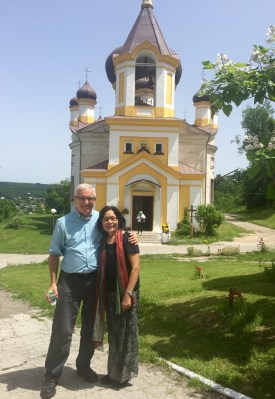 We differ from our younger counterparts in some ways. Learning a new language may be tougher for us, although many of us are doing fine in our Romanian classes. We may run slower in a group soccer game, if we participate at all. When several younger friends went to get tattoos recently, they knew better than to invite me along. They also may party harder and make surprising cultural references. When I was in the Peace Corps office the other day, a Carole King song started playing and the young woman next to me said, “Hey, it’s that song from the Gilmore Girls!”
On the other hand, they’re usually polite when we make our own references to people and events from before they were born, so it tends to even out.
In Moldova and other Peace Corps countries, there are advantages to being an older volunteer. Many of these countries show great respect towards older people. Similarly, having children and grandchildren has provided Champa and me with an instant bond with older members of our new communities. Our experience enhances our credibility in our workplaces as well; my future colleagues have already checked me out online. Older volunteers can share their hobbies, too, as Champa hopes to do with art and gardening.
Peace Corps has a special website for older Americans interested in becoming volunteers. The site reviews the application process, which is competitive and includes an extensive medical clearance process.
One of my reasons for writing this blog, and this post in particular, is to encourage older readers to consider the Peace Corps or some other new challenge for themselves. It’s not as strange or exotic as they might think and shouldn’t just be dismissed with “Oh, I could never do that at my age.”
Obviously, many people have family obligations, medical problems and other constraints that make Peace Corps unrealistic. Nonetheless, it’s a proven program through which more than 220,000 Americans of all ages have served their country and the world — and had a great adventure in the process.
Personally, I’m already wondering what it will be like in two years to be back in America and surrounded by friends who are mostly older than the ones I’ve made here.


 When most Americans think of World War II, they think of Normandy, Iwo Jima and other battles where our soldiers died. My own father fought at D-Day, navigating a plane that was shot and almost didn’t return to England. He was part of the “greatest generation” whose enormous sacrifices kept our country free.
 morial. They are everywhere in Moldova. The second photo shows one in Dereneu, a small village we visited a few weeks ago. In Chisnau, Moldova’s capital, one of the main tourist sites is the Victory Memorial and eternal flame, five giant marble pillars representing the five years of Moldovan involvement in the conflict.


 Peace Corps brought all of us all together in Chisinau, Moldova’s capital, to align our plans and expectations over the next two years. After reviewing the history of the Peace Corps and its activities in Moldova, the conference leaders reminded our partners that we are volunteers with a special role: We’ve come to share our skills and perspective, empowering our colleagues and others to blaze their own paths after we leave.
 These ideals were fundamental to the Peace Corps when I served four decades ago, and they remain so today. My service in Moldova differs in so many ways from what I experienced in Nepal, from the local food to the speed of communications, but the mission is unchanged, still reflecting the original vision of President Kennedy.
 The other trainees in my “community and organizational development” group came to the conference with their partners from across Moldova — mayors, village librarians, NGO leaders and others. Each pair worked together to clarify how the volunteer will learn about his or her post, develop a work schedule and deal with inevitable disappointments.
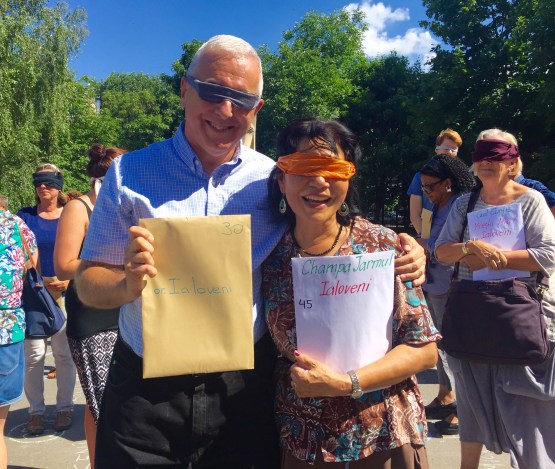
 The name on the envelopes for Champa and me was Ialoveni (pronounced Yah-lo-ven). It’s a big town close to Chisinau, not far from our training sites. After Champa and I finish our training and swear in on July 29, it’s where we’ll be living.
 At my group’s tech class on Tuesday, we discussed how Moldovans and Americans differ. One of the charts we filled out, shown in the photo, compared each culture’s tolerance for risk. The green tags represent Moldovans; the red tags represent Americans. As you can see, our group saw Americans as being more willing to take chances in life.

 Why has the Peace Corps sent me and others to Moldova, a small country in eastern Europe that many Americans have never heard of?

 I’m looking forward to the challenge. I was impressed by Ekaterina, Petru and Elena, and by the young people I met at the library. I’m hoping to find similar people wherever we’re sent, and am eager to work with them to tackle local problems.
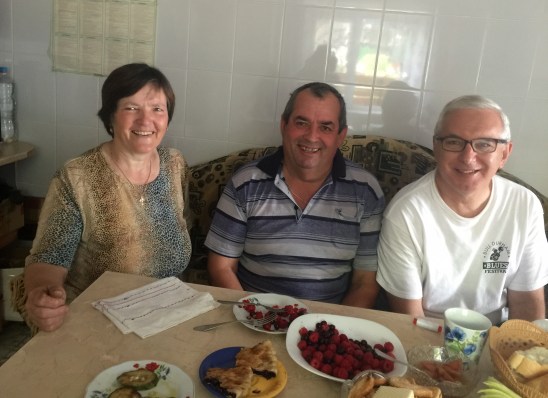
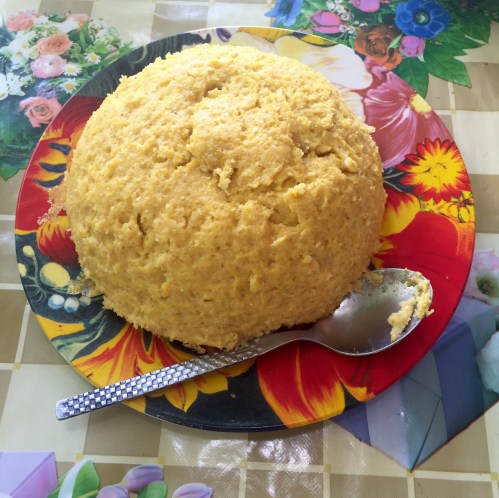 Not here in Moldova. My host mother, Maria, shown here with her husband Vladimir, is an amazing cook, so I’m going to feature her in occasional posts about Moldovan cuisine. On Sunday, while Champa was visiting, she served us mamaliga, which is a denser version of American cornbread.
 In this brief video, she demonstrates the traditional method of slicing mamaliga with a string. You can hear Champa in the background admiring her technique. (You’ll find a recipe for mamaliga and other Moldovan foods at this
 My current day-to-day reality is this: I go to language class all morning. I have tech training in the afternoon. I talk with Champa on the phone. I eat and try to communicate with my host family. I cram vocabulary lists and verb conjugations whenever I can. Then I go to sleep. The photos show what we did on Wednesday.
 So I should have known what to expect emotionally when I heard the terrible news about Orlando, followed by the controversy over Donald Trump’s response and everything else that has happened in the past few days. But familiarity is not a vaccination. It’s still been strange to watch all of this from a distance, discussing it with the other trainees when we get a moment between language classes. Soon enough, we’re back to memorizing the Romanian words for fruits and vegetables, or how to conjugate the feminine plural form of an adjective.

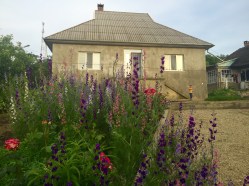
 Like me, Champa has a nice living situation. Her house has a modern kitchen and bathroom, wifi and a dining room, as well as her own bedroom. Maria is very friendly and even speaks some English. Champa does have a long uphill walk to the school where she has her language classes and technical training, but she says it reminds her of walking in Nepal.


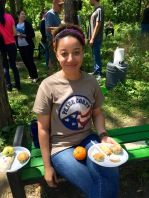 Here are Chelsea, left, and Rose, right, making their own fashion statements in support of peace and the Peace Corps.
 Champa and I have been training in different villages, so we enjoyed being together. We both have made lots of new friends, though, so we also spent time catching up with them. Here’s Champa with Reggie, a member of my language group and a fellow North Carolinian.


 "Not Exactly Retired"