
I’m starting my annual Top Ten book list with a confession:
I ended last year’s list with a vow to finally read The Power Broker, Robert Caro’s epic biography of Robert Moses, the ruthless builder of New York’s roads, bridges and parks. Alas, I only made it halfway through this 1,344-page masterpiece.
That’s because there were so many new books I couldn’t wait to read. Now that we’ve reached year’s end, I have ten great ones to recommend, starting with four nonfiction picks.

In Careless People, former Facebook executive Sarah Wynn-Williams provides a devastating look inside the company. She portrays a toxic corporate culture, unfettered power and and leaders “devoid of any normal human feeling.” Mark Zuckerberg, Sheryl Sandberg and their team pursue profit relentlessly while avoiding moral consequences. I wondered about the author’s own role in all of this but still found her account compelling.
Source Code: My Beginnings is an origin story for another tech giant. It’s Bill Gates’s memoir about his early life, ending with him establishing Microsoft. He’s remarkably open about his childhood. He struggles with his immense, but neurologically atypical, intelligence, often acting like a privileged brat. I felt compassion for his parents and teachers but especially for young Bill as he careens through adolescence before finding his calling in the emerging world of personal computers. It’s a surprisingly moving journey.
Original Sin by Jake Tapper and Alex Thompson describes how Joe Biden and his inner circle covered up his physical decline, resisting calls to drop out of the 2024 presidential race. I was disgusted as I read the details of how his enablers misled the country and paved the way for Donald Trump’s return to the White House. I already knew the basic story, of course, but still couldn’t stop reading this account based on more than 200 interviews. It would have been even sharper with a closer examination of the role of the press, including Tapper’s own network, CNN.
Miracles and Wonder: The Historical Mystery of Jesus is my last nonfiction pick. Elaine Pagels, a religious scholar at Princeton, draws on her decades of research to assess why early Christian narratives may have veered from what actually happened to Jesus. The story of his virgin birth, for example, may have emerged to counter claims of his illegitimacy. Accounts of his resurrection may be responding to the humiliating nature of his death. Ultimately, though, the story is one of hope emerging from darkness. I’m not a Christian but I found her analysis fascinating.
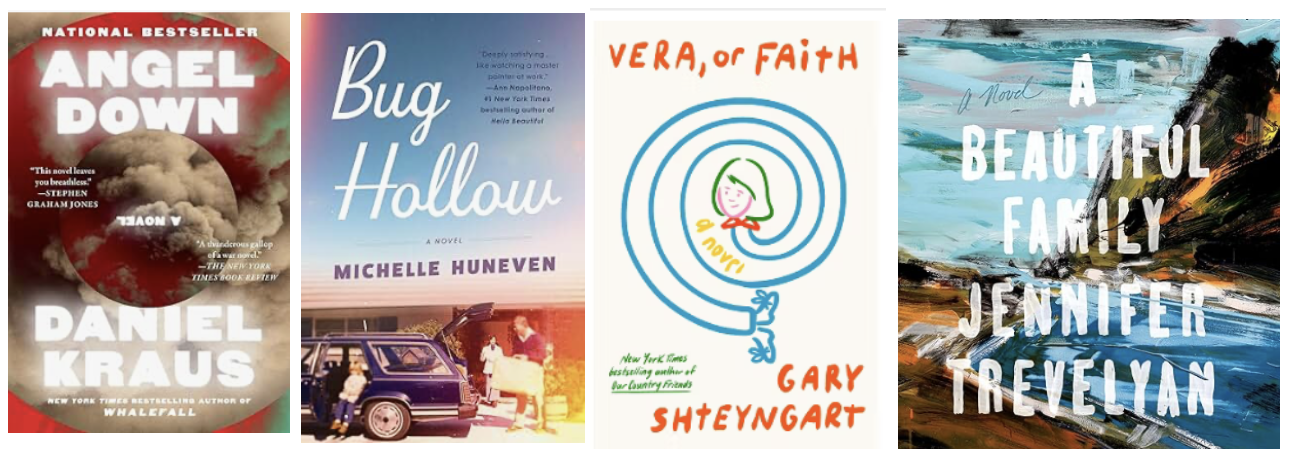
My favorite novel of the year was Angel Down, which Daniel Kraus writes in a single sentence divided into paragraphs and sections. It’s a supernatural horror tale set in World War One. Five soldiers encounter an actual angel stranded in No Man’s Land and try to rescue her despite the unimaginable carnage around them. Amid this horror, the soldiers demonstrate greed, paranoia, faith and hope, showing what it means to be human in the most extreme circumstances.
Death plays a central role in another fiction pick, Bug Hollow. Here it’s a single death in a much gentler setting. Michelle Huneven brings us to California to meet the Samuelson family, whose beloved son Ellis drowns in a freak accident shortly after leaving for college. The family is still reeling when Ellis’s former girlfriend appears and reveals she is pregnant, needing help. The characters navigate their grief and, especially after the baby is born, slowly come together to rebuild a family. It’s a powerful story of human resilience.
Another family drama is Vera, Or Faith, the latest from Gary Shteyngart. It’s the story of a socially awkward 10-year-old girl who must navigate both her unusual family and a country racing towards fascism. Vera’s father is a hipster Russian magazine editor, her step-mother a WASP and her biological mother a Korean woman whom Vera longs to meet. She leaves home to find her, confronting an America where white power is enacted into law and women’s rights are trampled. This bittersweet coming-of-age story is filled with Shtenygart’s usual social satire and wit.
Like Vera, the central character in Jennifer Trevelyan’s A Beautiful Family is a young girl who sees life differently. This time it’s in 1980s New Zealand. Young Alix is trying to make sense of both family tensions and the mystery of another girl who drowned in the beach town where her family is staying. Trevelyan tells the story through Alix’s eyes as she slowly gathers clues about what was actually a murder, as well as the truth about her parents’ fragile marriage.

Another of my favorite novels, Daikon, by Samuel Hawley, is set in Japan in the final days of World War II. Its premise is that the United States developed a third atomic bomb in addition to those dropped on Hiroshima and Nagasaki. This bomb fails to explode and ends up in the hands of Japan’s military, which races to reactivate it to drop on the Americans. The urgent task is assigned to a nuclear physicist who wants the war to end but is desperate to rescue his wife from prison. The fate of San Francisco and the war hang in the balance of how he responds.
Last on my Top Ten list is The Doorman by Chris Pavone, which reminded me of Tom Wolfe’s Bonfire of the Vanities with its biting depiction of race, class and wealth in New York City. Interlocking stories play out in an expensive apartment building on the Upper West Side. A loathsome billionaire, his beautiful wife and an arts dealer with a mid-life crisis find their futures wrapped up with the building’s doorman as racial tensions explode nearby. It’s a satiric page turner with a satisfying climax.
Other novels I enjoyed, some of which were published a year or two earlier, included Beautiful Ugly by Alice Feeney; King of Ashes by S.A. Cosby; Hotel Ukraine by Martin Cruz Smith; All the Colors of the Dark by Chris Whitaker; The Midnight Library by Matt Haig; The Quiet Tenant by Clémence Michallon; The Midnight Feast by Lucy Foley; Drowning: The Rescue of Flight 1421, by T.J. Newman; Karla’s Choice by Nick Harkaway; and Wild Houses by Colin Barrett.
Other favorites of the year included books set in countries we visited in 2025. These included A Field Guide to Happiness, by Linda Leaming, and Radio Shangri-La, by Lisa Napoli, both set in Bhutan. Black Butterflies, by Priscilla Morris, and The Tiger’s Wife, by Téa Obreht, both unfold amid war in the Balkans. David Diop’s Beyond the Door of No Return takes place in Senegal, where we hope to visit.
My favorite travel book of the year was On the Hippie Trail, by Rick Steves, which recounts the journey he and a friend made across Asia in the 1970s. That’s what my friend, Mitch, and I did as well, following a similar path. Steves’s book brought back many memories of a trip that transformed my life.
Looking ahead, I hope to finish The Power Broker, and this time I really mean it. I even took this anticipatory photo in The New York Historical gift shop claiming “I finished The Power Broker.” For now, I wish you a great year of reading and, as always, invite you to share your own suggestions in the comments section.

Subscribe to Not Exactly Retired. It’s free!

 "Not Exactly Retired"
Thank you! This is far better than the reviews I’m gonna get in my fancy newspapers. I think I will start with the doorman
~~~~~~~~~~~~~~~~~~~ Karl Leif Bates Durham & Chapel Hill North Carolina ~~~~~~~~~~~~~~~~~~~
LikeLiked by 1 person
David – The Power Broker is on my list and has been for a long time. A good friend basically yells at me every time we talk because i haven’t read it. Any reason I shouldn’t take it on?
Enjoyed this list, by the way.
LikeLike
Everything great you’ve heard about The Power Broker is true. It’s a masterpiece of biography, beautifully written, that makes you think hard about the benefits and perils of power. The only problem is that it’s 1300+ pages. As much as I liked it, I needed to take a break. Listen to your friend, Eric, but only when you have lots of time to spare.
LikeLike
I always enjoy your book lists, David! I too, aspire to read The Power Broker but haven’t gotten past the 1st chapter! Here are some books I DID complete this year and recommend (not all new, so you’ve likely already read most of them) — Non-fiction: I Am, I Am, I Am by Maggie O’Farrell (an unconventional memoir) and Between Two Kingdoms by Suleika Jaouad. Fiction: Covenant of Water by Abraham Verghese, Demon Copperhead by Barbara Kingsolver, and my very favorites – This is Happiness and Time of the Child by Niall Williams. Both books are set in a fictional Irish village in the 1950s and 60s. It’s not essential but helps to read This is Happiness first. The writing is beautiful.
LikeLike
Thanks Linda. I welcome your recommendations, too! I’ll check out Maggie O’Farrell’s book since I loved Hamnet (and plan to see the movie soon). I’ll also pursue your Niall Williams recommendations. I’ve read the other three and share your enthusiasm for all of them. Happy reading!
LikeLike