
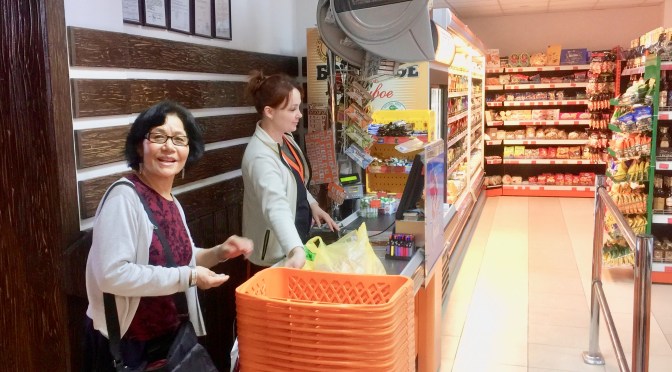
Shopping in Moldova can include Heinz ketchup, Lay’s potato chips, Tide detergent, Nescafe and a Coke. Add a bag of Skittles, too, if you want.


When Champa and I shop for groceries in Ialoveni, however, we usually buy products made in Moldova or in nearby countries such as Ukraine, Russia or Romania.
We cook our own food, a mixture of Nepalese, American and Moldovan dishes. There’s no doubt we eat better than some other Peace Corps volunteers around the world, especially since we live in a small city, but we always stay within our official food budget. Our daily diet is more modest than some of these photos suggest.


The local bread comes in many forms and is cheap and delicious. Cheeses are great, too. As you see, they come in many varieties. Salami is a local favorite. We love the fresh chicken and pork, which is much tastier than our supermarkets sell back in Durham. (Yes, that’s a pig’s head in the photo.)
Moldova is famous for wine and, as I’ve noted previously, its grocery shelves are stocked with local merlots, cabernet sauvignon, chardonnay and more, as well as cognacs, brandies and sparkling wines. The Ialoveni Winery is just up the street from us.


Our neighborhood markets also offer cakes from local bakeries, noodles from local pasta makers, candies from local confectioners and, of course, local fruits and vegetables that will soon be abundant and delicious. No surprise, we eat a lot of rice. We also can enjoy cheeses from Holland, persimmons from Israel and beer from Germany. One block from our house is the Sandra ice cream factory, with flags from both France and Moldova.


Champa and I have become regular customers at all of Ialoveni’s grocery stores, including two Victoria Markets and a UniMarket. We also shop at the Casa Cărnii store shown above, where I shot many of the photos in this post, and at some of the kiosk shops we pass on the main street as we walk home. Local farmers and vendors sell goods along the sidewalk, too.

Just up the street is an apartment complex with a corner market where we often buy groceries. If you look carefully at the photo, to the left of the door, you’ll see it also offers an ATM machine for our bank. The “Farmacie” to the right of the door is actually a separate shop. Downstairs, by the yellow brick, is another shop, selling meat. The windows to the right are yet another shop, selling soaps and toiletries.
In other words, shopping in Ialoveni is a mixture of small grocery stores, neighborhood shops resembling bodegas and smaller shops specializing in certain kinds of products. At the other end of the spectrum is Moldova’s “super store,” Metro, which resembles Costco. We’ll visit there in a future post. Right now, I’m hungry.
***
Have you responded yet to my reader survey? I would love to hear from you. Since we’re probably too far apart to talk in person, this is my best way to know what you and other readers want. Please click here; the survey takes just a moment. Thank you!




 At the bottom of this post is a video of Bunica showing the rolling process. When she says “Gata” at the end, it means “Ready!” My own job came after the placinte emerged from the oven, tasting them to see whether they were even more delicious than the placinte we buy in local stores.

 “We traveled with Father Desbois to the former Soviet Republic of Moldova, where in one day he took us to four unmarked mass graves,” reporter Lara Logan said in the story. “In this field, he told us, 60 Jews beneath this farm, 100 above this city, under this hill, a thousand.”

 Just outside of town is Europe’s


 The Consiliul Raional of Ialoveni district, of which Bardar is a part, is carrying out the project collaboratively with Moldova’s Regional Development Agency Center (ADR Centru) and the Regional Development Agency Senec-Pezinok in Bratislava, Slovakia’s capital.

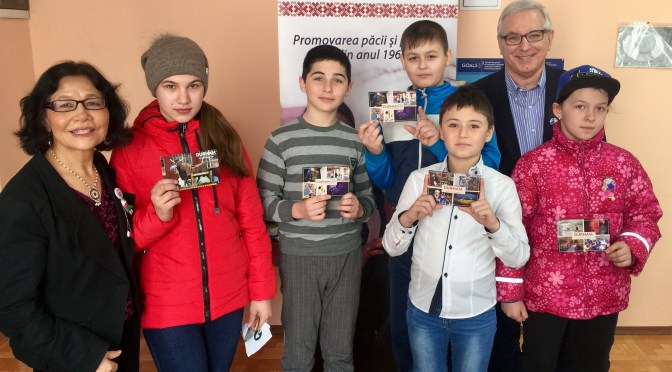
 Julie also asked whether I’ve sent any postcards to people back home. I shared



 "Not Exactly Retired"