
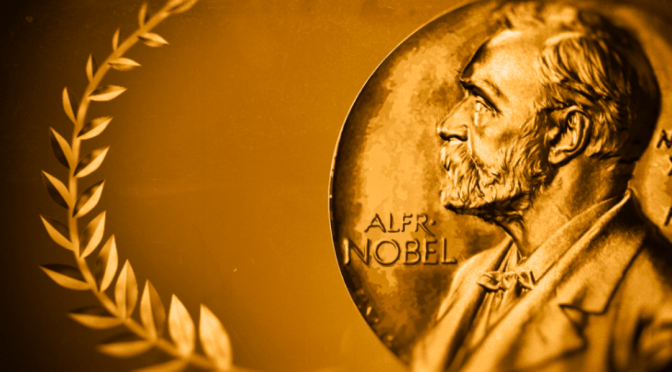
Back when I was a science writer in the Washington, D.C. area, I interacted with three of the scientists who received Nobel Prizes this past week, a fact that’s reminded me of the career I left behind and led me to reflect on what I’m doing now.

I worked on an op-ed article with Richard Thaler, who won this year’s economics prize for his pioneering work showing how people make decisions less rationally than models may predict. I later included his article, “The Economics of Reality,” in an anthology I produced for the National Academy of Sciences, which you can download for free. I loved working with Thaler, who was brilliant and fun. (You may have seen his cameo with Selena Gomez in “The Big Short.”) He’s definitely having a better year than Bill Cosby, whose article began the anthology.

Joachim Frank was among this year’s three chemistry winners. I visited with him in his lab when he was at the Wadsworth Center in Albany. His innovations with cryo-electron microscopy helped transform how scientists visualize biological molecules. Both he and Michael Rosbash, who shared this year’s prize in physiology or medicine, were investigators of the Howard Hughes Medical Institute (HHMI), where I worked in the communications office.
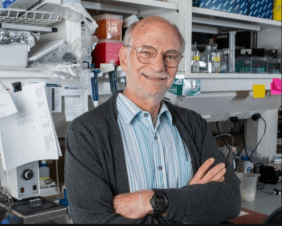
Rosbash’s research helped change how we think about sleep and “circadian rhythms,” a subject he discussed eloquently in a televised lecture series on which I worked.
I used to pay close attention to “Nobel season” every October when I was at HHMI, whose researchers seemed to get the call from Stockholm every other year or so for the medicine or chemistry prize. I was sometimes awoken by reporters seeking to interview the winner. I remember being called one year by a reporter friend at NPR. “Who won?” I asked him, half-asleep. “Günter Blobel,” he responded, citing a scientist who showed how proteins move within cells. If I remember correctly, one of my colleagues, who took the lead on these requests, was able to connect them quickly.
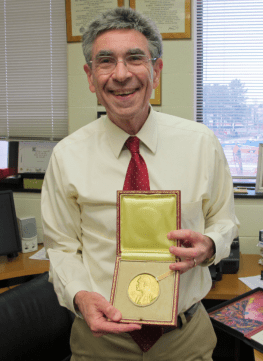
 I left Washington to run the news and communications office at Duke. A decade later, the university claimed its first Nobelist, ironically someone also affiliated with HHMI. In fact, I’d commissioned and edited a major profile of Bob Lefkowitz for HHMI’s magazine. He shared the 2012 chemistry prize for his discoveries about how biological signals pass into and through cells. After we were alerted early in the morning to his happy news, our Duke team pulled together a press conference and media package within a few hours. As usual, Bob was moving, funny and inspiring as he spoke with reporters.
Some of those reporters were star-struck, even more than when they met Coach K for the first time. They didn’t know what I had learned over the years, which is that Nobel Prize winners and other eminent scientists are pretty much like the rest of us, just really smart.
I was reminded at such moments of how lucky I was to work with people whose groundbreaking research was saving lives and transforming human knowledge.
This week, as I’ve been cheering for Rosbash, Frank and Thaler, I’ve also reflected on how memories like these evolve with our own lives. When I worked with each of them — briefly, to be sure — it was just an ordinary part of my job. Now I savor those moments.
In the same way, things that now appear routine to me as a second-year Peace Corps Volunteer in Moldova will probably seem different in the future. A decade or two from now, I may look back and think: “Wow, did Champa and I really do that when we were in our 60s?” Perhaps the same thing has happened to you, too: The ordinary becomes extraordinary without actually changing, a quantum motion of the heart. No one has won a Nobel Prize yet for explaining why this happens. Maybe next October.


 I may pay more attention than most people to signs and videos like these because I work in communications, although even for me they often blended into the background when I was back home. In Moldova, though, I noticed them immediately on Saturday because they were so different from the drab walls and signage I’ve seen in some medical settings here.


 And do you know what? Its strategy works, at least for me. I felt reassured as soon as I entered through the revolving glass door into a bright lobby. The medical care I received turned out to be good, too, but I was already primed to expect this because of everything I’d seen, even if I wasn’t immediately conscious of why I felt optimistic.
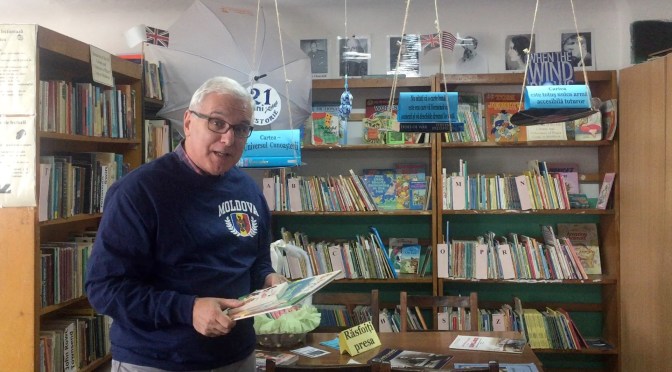
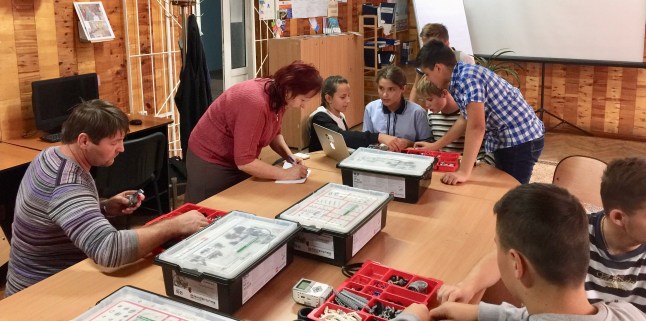

 I’m helping a local Romani leader trying to establish radio stations to serve her community in Moldova.


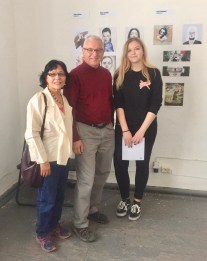 There are few galleries in Moldova where young artists can show their work. This weekend, though, more than 20 of them are taking part in an exhibit inside an old museum, featuring more than 100 portraits ranging from painting to caricature.
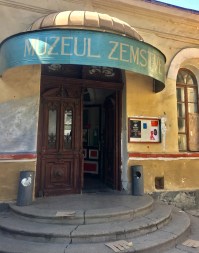 Lucia Codreanu and Maks Graur, both young artists themselves, organized and curated the free show in downtown Chișinău, running through Sunday afternoon. You can see some of the work here.


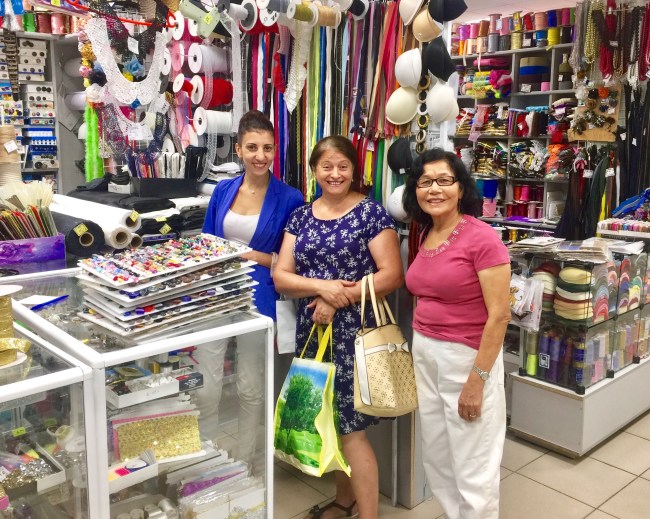
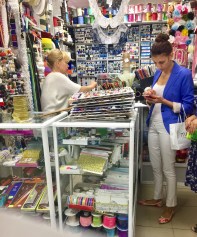 Bolts of velvet, cotton and other material surrounded many of the shops we visited. Champa and her partners visited one place after another to select the best cloth for the costumes they’re planning. They also bought buttons, gold braid, ribbons and other haberdashery supplies. Within a few hours, we were loaded down with bags, which we carried on a bus across town to Ina’s studio. She is now cutting and assembling the cloth for each costume — Romeo, Juliet, kings, queens and more.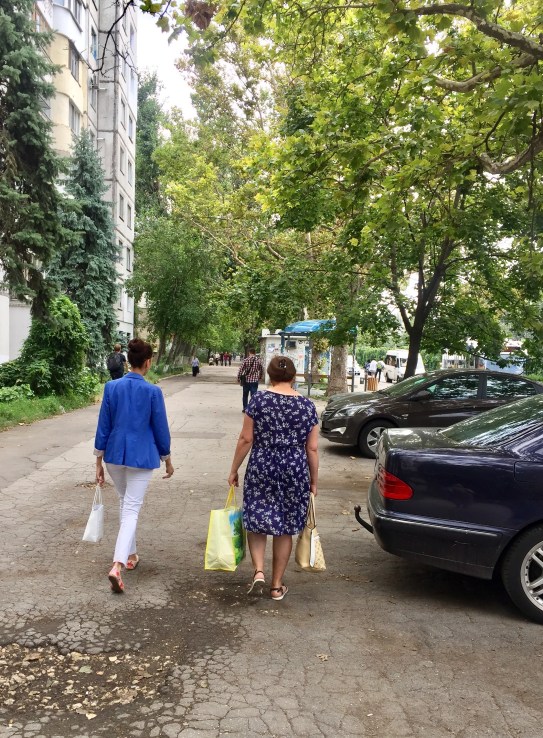


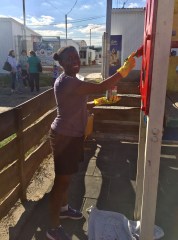 Those trainees held their community service event last week, a clean-up of Sociteni’s main street.
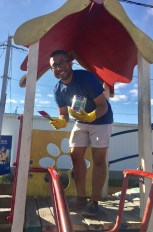 Two other groups of trainees— in English education and health education — will also swear in next week.
  Altogether, more than 50 trainees are expected to join Peace Corps Moldova’s current volunteers, most of whom swore in a year ago and will continue serving until next summer, Champa and me among them.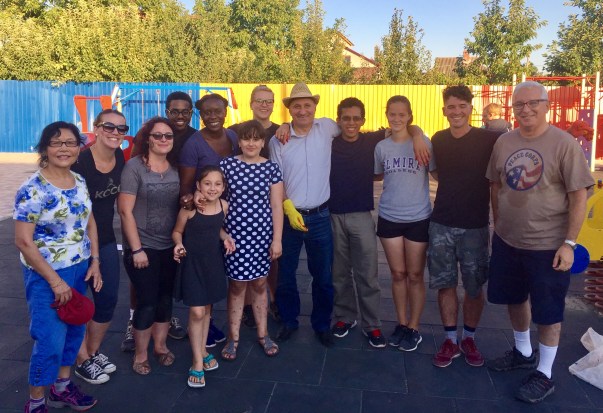

 "Not Exactly Retired"