Tag Archives: nonfiction

Top Ten Books 2025

I’m starting my annual Top Ten book list with a confession:

I ended last year’s list with a vow to finally read The Power Broker, Robert Caro’s epic biography of Robert Moses, the ruthless builder of New York’s roads, bridges and parks. Alas, I only made it halfway through this 1,344-page masterpiece.

That’s because there were so many new books I couldn’t wait to read. Now that we’ve reached year’s end, I have ten great ones to recommend, starting with four nonfiction picks.

In Careless People, former Facebook executive Sarah Wynn-Williams provides a devastating look inside the company. She portrays a toxic corporate culture, unfettered power and and leaders “devoid of any normal human feeling.” Mark Zuckerberg, Sheryl Sandberg and their team pursue profit relentlessly while avoiding moral consequences. I wondered about the author’s own role in all of this but still found her account compelling.

Source Code: My Beginnings is an origin story for another tech giant. It’s Bill Gates’s memoir about his early life, ending with him establishing Microsoft. He’s remarkably open about his childhood. He struggles with his immense, but neurologically atypical, intelligence, often acting like a privileged brat. I felt compassion for his parents and teachers but especially for young Bill as he careens through adolescence before finding his calling in the emerging world of personal computers. It’s a surprisingly moving journey.

Original Sin by Jake Tapper and Alex Thompson describes how Joe Biden and his inner circle covered up his physical decline, resisting calls to drop out of the 2024 presidential race. I was disgusted as I read the details of how his enablers misled the country and paved the way for Donald Trump’s return to the White House. I already knew the basic story, of course, but still couldn’t stop reading this account based on more than 200 interviews. It would have been even sharper with a closer examination of the role of the press, including Tapper’s own network, CNN.

Miracles and Wonder: The Historical Mystery of Jesus is my last nonfiction pick. Elaine Pagels, a religious scholar at Princeton, draws on her decades of research to assess why early Christian narratives may have veered from what actually happened to Jesus. The story of his virgin birth, for example, may have emerged to counter claims of his illegitimacy. Accounts of his resurrection may be responding to the humiliating nature of his death. Ultimately, though, the story is one of hope emerging from darkness. I’m not a Christian but I found her analysis fascinating.
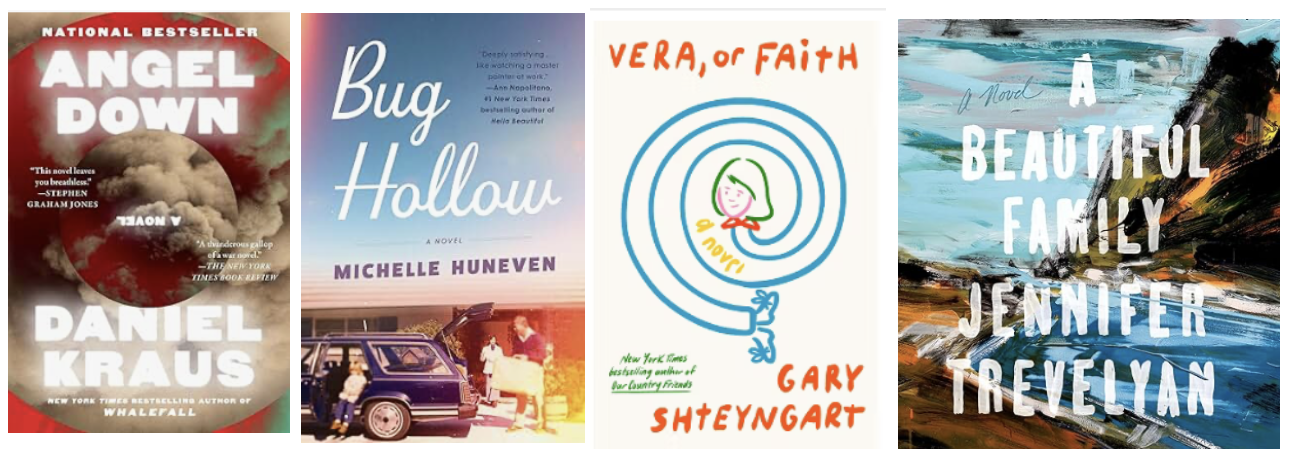
My favorite novel of the year was Angel Down, which Daniel Kraus writes in a single sentence divided into paragraphs and sections. It’s a supernatural horror tale set in World War One. Five soldiers encounter an actual angel stranded in No Man’s Land and try to rescue her despite the unimaginable carnage around them. Amid this horror, the soldiers demonstrate greed, paranoia, faith and hope, showing what it means to be human in the most extreme circumstances.

Death plays a central role in another fiction pick, Bug Hollow. Here it’s a single death in a much gentler setting. Michelle Huneven brings us to California to meet the Samuelson family, whose beloved son Ellis drowns in a freak accident shortly after leaving for college. The family is still reeling when Ellis’s former girlfriend appears and reveals she is pregnant, needing help. The characters navigate their grief and, especially after the baby is born, slowly come together to rebuild a family. It’s a powerful story of human resilience.

Another family drama is Vera, Or Faith, the latest from Gary Shteyngart. It’s the story of a socially awkward 10-year-old girl who must navigate both her unusual family and a country racing towards fascism. Vera’s father is a hipster Russian magazine editor, her step-mother a WASP and her biological mother a Korean woman whom Vera longs to meet. She leaves home to find her, confronting an America where white power is enacted into law and women’s rights are trampled. This bittersweet coming-of-age story is filled with Shtenygart’s usual social satire and wit.

Like Vera, the central character in Jennifer Trevelyan’s A Beautiful Family is a young girl who sees life differently. This time it’s in 1980s New Zealand. Young Alix is trying to make sense of both family tensions and the mystery of another girl who drowned in the beach town where her family is staying. Trevelyan tells the story through Alix’s eyes as she slowly gathers clues about what was actually a murder, as well as the truth about her parents’ fragile marriage.

Another of my favorite novels, Daikon, by Samuel Hawley, is set in Japan in the final days of World War II. Its premise is that the United States developed a third atomic bomb in addition to those dropped on Hiroshima and Nagasaki. This bomb fails to explode and ends up in the hands of Japan’s military, which races to reactivate it to drop on the Americans. The urgent task is assigned to a nuclear physicist who wants the war to end but is desperate to rescue his wife from prison. The fate of San Francisco and the war hang in the balance of how he responds. 

Last on my Top Ten list is The Doorman by Chris Pavone, which reminded me of Tom Wolfe’s Bonfire of the Vanities with its biting depiction of race, class and wealth in New York City. Interlocking stories play out in an expensive apartment building on the Upper West Side. A loathsome billionaire, his beautiful wife and an arts dealer with a mid-life crisis find their futures wrapped up with the building’s doorman as racial tensions explode nearby. It’s a satiric page turner with a satisfying climax.

Other novels I enjoyed, some of which were published a year or two earlier, included Beautiful Ugly by Alice Feeney; King of Ashes by S.A. Cosby; Hotel Ukraine by Martin Cruz Smith; All the Colors of the Dark by Chris Whitaker; The Midnight Library by Matt Haig; The Quiet Tenant by Clémence Michallon; The Midnight Feast by Lucy Foley; Drowning: The Rescue of Flight 1421, by T.J. Newman; Karla’s Choice by Nick Harkaway; and Wild Houses by Colin Barrett.

Other favorites of the year included books set in countries we visited in 2025. These included A Field Guide to Happiness, by Linda Leaming, and Radio Shangri-La, by Lisa Napoli, both set in Bhutan. Black Butterflies, by Priscilla Morris, and The Tiger’s Wife, by Téa Obreht, both unfold amid war in the Balkans. David Diop’s Beyond the Door of No Return takes place in Senegal, where we hope to visit.

My favorite travel book of the year was On the Hippie Trail, by Rick Steves, which recounts the journey he and a friend made across Asia in the 1970s. That’s what my friend, Mitch, and I did as well, following a similar path. Steves’s book brought back many memories of a trip that transformed my life.

Looking ahead, I hope to finish The Power Broker, and this time I really mean it. I even took this anticipatory photo in The New York Historical gift shop claiming “I finished The Power Broker.” For now, I wish you a great year of reading and, as always, invite you to share your own suggestions in the comments section.

Subscribe to Not Exactly Retired. It’s free!

Top 2023 Books

Bless your heart, Demon Copperhead. You’ve beaten my annual Top Ten book list like a borrowed mule and now I’m madder than a rattlesnake in a forest fire.

Barbara Kingsolver’s brilliant novel about young Demon’s perilous life in Appalachia was published last year but I read it too late for my 2022 Top Ten list. It turned out to be my favorite book of the year. I also admired its co-winner of the Pulitzer Prize for fiction, Trust, Hernan Diaz’s novel about wealth and deceit in New York. Likewise for another prize-winner, Nobel Prize recipient Abdulrazak Gurnah, whose spellbinding Afterlives transported me to colonial East Africa.

I’m not a professional critic who receives free advance copies, so I read these three books too late for my list. So, too, for some other excellent novels: Tomorrow, and Tomorrow, and Tomorrow; Olga Lies Dreaming; The Trees and The Measure.

My new list again highlights ten books published during the year but, as in 2022, 2021 and 2020, it’s limited to those I read by mid-December. Here’s my 2023 Top Ten: 

James McBride’s The Heaven & Earth Grocery Store was my favorite (so far). Set in Pottstown, Pa., it unravels the mystery of a skeleton found in the bottom of a well. McBride draws on his own Jewish and Black heritage to paint a rich portrait of Chicken Hill, a neighborhood whose diverse residents grapple with poverty, discrimination and a rapidly changing world. It’s a whodunit with a huge heart

My other favorite was Birnam Wood by Eleanor Catton, an eco-thriller set in New Zealand. A guerrilla collective of environmental activists forms an uneasy alliance with an elusive American billionaire who wants to build a survivalist bunker. His real goals prove more sinister, leading to an apocalyptic confrontation. The title comes from Macbeth and the final act is just as bloody.

Action and violence also abound in Small Mercies, but here the conflict revolves around the Boston school desegregation battles of the 1970s. As in Mystic River, author Dennis Lehane captures that city’s voices. His central character is Mary Pat, a tough “project chick” from Southie with two failed marriages and a son lost to heroin. When she learns her daughter may be involved in the murder of a young black man, she is caught in a whirlwind, just like the city around her.

In Hello Beautiful, Ann Napolitano tells the story of a boy growing up in a loveless house who finds refuge among his basketball teammates. William goes to college on a scholarship and seems to finally find happiness with an ambitious classmate whose Chicago family embraces him. When their marriage falls apart, he discovers even deeper love — and then tragedy — with an unexpected partner. He nearly dies before reconciling at the end with a figure from his past.

Tom Lake, by Ann Patchett,is set mainly in a cherry orchard in northern Michigan. The farm’s mother, Lara, slowly shares with her daughers — and us — the story of her brief acting career and love affair with an actor who became one of the world’s most famous movie stars. One daughter thinks the actor is her father. Her mother reveals the truth while gently prodding her daughters to contemplate deeper truths about family and what matters in life.

For more action, consider All the Sinners Bleed, the latest thriller from S.A. Cosby, whose Blacktop Wasteland and Razorblade Tears appear on my previous lists. This time Cosby opens with a shooting at a rural Virginia school that leads to chilling revelations about the murders of local Black children. The sheriff slowly makes sense of the case while confronting racism, religious zealots, snake charmers and a former girlfriend who became a podcaster.

The remaining four books on my list are nonfiction, led by Jonathan Eig’s masterful biography of MartinLuther King Jr., which draws on a trove of previously unreleased White House telephone transcripts, F.B.I. documents, letters, oral histories and other documents. I thought I knew a lot about King, but I learned many new things about him as both a man and historical figure, as well as about Malcolm X, the Kennedys and others. Most of all, Eig shows us King’s incredible determination and heroism. I came away with even greater gratitude for his life.

Considerably less admirable are many of the characters in David Grann’s The Wager. Set mainly in South America in the 1740s, it’s a page-turner about a British vessel that wrecks off the coast of Patagonia while pursuing a Spanish galleon. Its survivors are marooned and then embark on a harrowing journey. Those who reach Brazil are hailed as heroes until several other castaways appear and accuse them of mutiny. Who is telling the truth? Author Grann, who wrote Killers of the Flower Moon, presents the evidence he uncovered during years of research.

Timothy Egan’s A Fever in the Heartland takes place closer to home, in Indiana during the 1920s. A charismatic charlatan named D.C. Stephenson leads the Ku Klux Klan to national power, culminating with a march through Washington, D.C. He recruits politicians and others to his movement, which appears unstoppable until his abuse of a local woman leads to his downfall. Especially in today’s world, it’s a sobering reminder of how easily hate groups can attract followers.

My final book, also nonfiction, is a memoir by the historian Drew Gilpin Faust. Necessary Trouble describes her childhood in rural Virginia, a life filled with horses, privilege and racism. Young Drew is a precocious child, as you’d expect of someone who would become Harvard’s president, and she struggles to make sense of her life. Her perspective keeps changing as she travels to Eastern Europe, gets involved in the Civil Rights Movement and protests the Vietnam War. I was moved by her empathy and beautiful writing.

I’ll also salute two excellent nonfiction books that didn’t make my Top Ten: The Undertow, Jeff Sharlet’s journey into far-right extremism, and Traffic, Ben Smith’s origin story about online disinformation, featuring his time at Buzzfeed.

Equally disturbing, although fiction, was Emma Cline’s The Guest, about a young woman who uses sex and manipulation to con her way through the luxurious world of the Hamptons. I was engrossed by her odyssey of desperation and, after finishing it, went on to read Cline’s earlier (and even more chilling) The Girls, based on the women who followed Charlie Manson.

Other novels I enjoyed were much lighter, such as Pineapple Street, about Brooklyn’s wealthy elite; Romantic Comedy, featuring a writer who finds love at a show resembling Saturday Night Live; and The Chinese Groove, about an overly optimistic immigrant who confronts the realities of America.

I love crime fiction and this year discovered Don Winslow, specifically City of Dreams and City on Fire. They’re both set in Providence, where I once lived. I also enjoyed a pair from Ruth Ware: Zero Days and The It Girl. I liked two other thrillers, Crook Manifesto by Colson Whitehead and Every Man a King by Walter Mosley, but found both less compelling than previous work from these two distinguished writers.

A book even older than those I cited at the beginning is Richard Ford’s 2014 novel Let Me Be Frank With You. It’s the fourth in Ford’s series of novels about Frank Bascombe of New Jersey, who is now confronting the indignities of older age. It made me laugh (and cringe) more than any other book this year.

I was less enthusiastic about two of the year’s most honored books, The Bee Sting by Paul Murray (too long; couldn’t finish) and The Rediscovery of America by Ned Blackhawk (an overdue history of Native America but too scholarly for me). I also gave up on Under the Wave at Waimea by Paul Theroux, usually one of my favorites.

Finally, a salute to Cormac McCarthy, who died in June. I’d read several of his books but never All the Pretty Horses, whose brilliance reminded me of his singular talent. I will miss his voice even as I look forward to 2024 and a new year of great books — regardless of their publication dates.

As always, if you have suggestions of your own, please share them here.

The Missing Genre

Where are our “coming of older age” novels?

Our society celebrates “coming of age” novels, from Huckleberry Finn to The Catcher in the Rye. Newer books fit into this genre, too, from The Fault in Our Stars to blockbuster series like Harry Potter or The Hunger Games.

Screen Shot 2018-03-30 at 8.24.08 AM

But how many novels can you name whose central characters are retired or aging?

You might be able to think of some after awhile if you’re a dedicated reader ike me. But they are not so obvious and, as best I can tell, not recognized as a genre even though more than 46 million Americans are now over the age of 65, a total projected to more than double by 2060. I looked online and found lists here, here, here and here, all filled with examples of great books with older characters, but they still don’t feel like a “thing” to me.

screen-shot-2018-03-30-at-8-26-00-am.png
The recent death of Philip Roth got me thinking about this. (Another great writer, Tom Wolfe, also died. It was a bad week.) Roth famously explored the challenges of older age. When I learned of his passing, I had just finished The Hate U Give by Angie Thomas, a powerful story about an African American teenager who sees her friend killed by police. I loved her book but it’s worth noting its central character was a young person, just as in The Goldfinch and some of the other books I’ve read while serving in the Peace Corps.

Screen Shot 2018-03-30 at 8.27.14 AM

My list just topped 100 and, out of curiousity, I went back to see how many of the novels had older protagonists. There were a few, such as Everybody’s Fool by Richard Russo and A Spool of Blue Thread by Anne Tyler. But most of the books dealing with older age were nonfiction, such as two good ones I read recently: Michael Kinsley’s Old Age: A Beginnner’s Guide, about his experience with Parkinson’s Disease, and Marc Freedman’s Prime Time, about people creating new careers and identities after leaving the conventional work force. Many nonfiction books for older readers focus on financial planning and other practical questions. Those books are often suggested even when you search online for fiction about older people, as shown below.

Screen Shot 2018-03-30 at 8.25.36 AM

The percentage of American adults who read books has remained relatively unchanged in the past few years, according to a 2016 report from the Pew Research Center’s Internet & American Life Project. The median American reads four books a year. Print books continue to be more popular than audiobooks or e-books, which are more popular among younger readers, who read slightly more books than older Americans.

Younger adults are more likely to read for work or school while adults of all ages are equally likely to read for pleasure or to keep up with current events. In other words, the readers are still there, even as independent bookstores struggle to survive. So why aren’t more novelists focusing on “the coming of older age” — and why aren’t these books treasured as a genre in the same way we celebrate stories about people at the other end of the age span?

Screen Shot 2018-03-30 at 8.29.05 AM

Sure, there are classics such as Shakespeare’s King Lear or Hemingway’s Old Man and the Sea, and more recent characters such as Roth’s Nathan Zuckerman or John Updike’s Harry “Rabbit” Angstrom. But their ubiquity or cultural impact are small compared to, say, Harry Potter. (I don’t think Disney World is considering a thrill ride yet about Medicare, with parts A, B, C and D.)

I wish more great novels featured characters my age. I don’t understand why they don’t. Obviously, the books assigned in our high schools are more likely to feature characters and stories of interest to younger readers. But how about for the majority of readers who are older than that — people like me? Why don’t our bookstores have shelves devoted to these audiences on topics other than how to apply for Social Security or deal with dementia?

Maybe it has to do with the economics of the book industry, but books don’t sell advertising like television shows, which want younger viewers to buy their beer and cars. Maybe older characters are harder to fit into genre fiction, like mysteries or romance novels. Maybe they’re not taken seriously by younger Americans, a thought that occurred to me this past week while reading Dan Lyon’s Disrupted, his hilarious but unsettling account of working at a startup company in his mid-50s.

Maybe it’s something else. I guess I’m too old to figure it out myself.