Tag Archives: book-review

Top Ten Books 2025

I’m starting my annual Top Ten book list with a confession:

I ended last year’s list with a vow to finally read The Power Broker, Robert Caro’s epic biography of Robert Moses, the ruthless builder of New York’s roads, bridges and parks. Alas, I only made it halfway through this 1,344-page masterpiece.

That’s because there were so many new books I couldn’t wait to read. Now that we’ve reached year’s end, I have ten great ones to recommend, starting with four nonfiction picks.

In Careless People, former Facebook executive Sarah Wynn-Williams provides a devastating look inside the company. She portrays a toxic corporate culture, unfettered power and and leaders “devoid of any normal human feeling.” Mark Zuckerberg, Sheryl Sandberg and their team pursue profit relentlessly while avoiding moral consequences. I wondered about the author’s own role in all of this but still found her account compelling.

Source Code: My Beginnings is an origin story for another tech giant. It’s Bill Gates’s memoir about his early life, ending with him establishing Microsoft. He’s remarkably open about his childhood. He struggles with his immense, but neurologically atypical, intelligence, often acting like a privileged brat. I felt compassion for his parents and teachers but especially for young Bill as he careens through adolescence before finding his calling in the emerging world of personal computers. It’s a surprisingly moving journey.

Original Sin by Jake Tapper and Alex Thompson describes how Joe Biden and his inner circle covered up his physical decline, resisting calls to drop out of the 2024 presidential race. I was disgusted as I read the details of how his enablers misled the country and paved the way for Donald Trump’s return to the White House. I already knew the basic story, of course, but still couldn’t stop reading this account based on more than 200 interviews. It would have been even sharper with a closer examination of the role of the press, including Tapper’s own network, CNN.

Miracles and Wonder: The Historical Mystery of Jesus is my last nonfiction pick. Elaine Pagels, a religious scholar at Princeton, draws on her decades of research to assess why early Christian narratives may have veered from what actually happened to Jesus. The story of his virgin birth, for example, may have emerged to counter claims of his illegitimacy. Accounts of his resurrection may be responding to the humiliating nature of his death. Ultimately, though, the story is one of hope emerging from darkness. I’m not a Christian but I found her analysis fascinating.
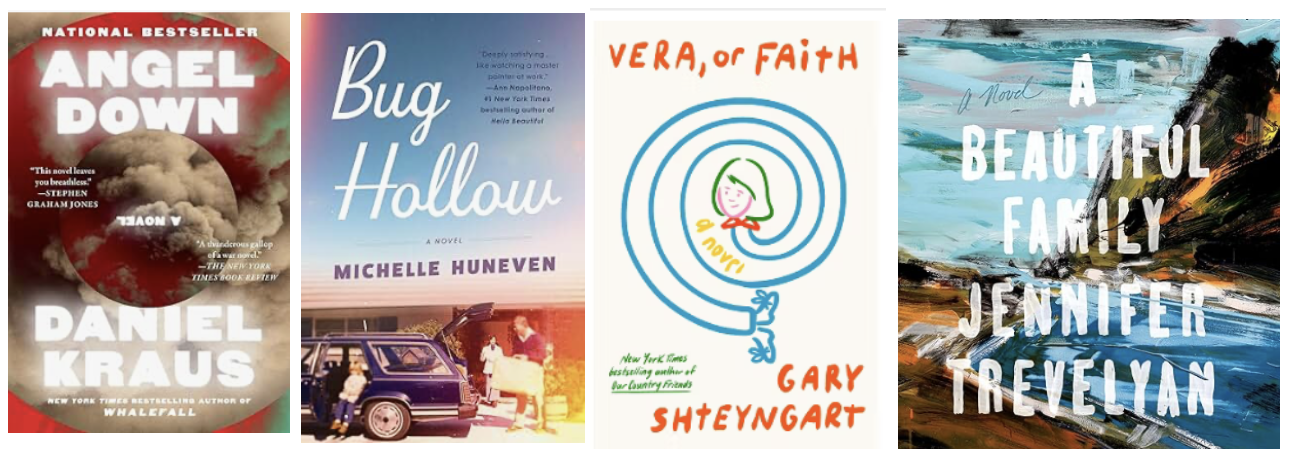
My favorite novel of the year was Angel Down, which Daniel Kraus writes in a single sentence divided into paragraphs and sections. It’s a supernatural horror tale set in World War One. Five soldiers encounter an actual angel stranded in No Man’s Land and try to rescue her despite the unimaginable carnage around them. Amid this horror, the soldiers demonstrate greed, paranoia, faith and hope, showing what it means to be human in the most extreme circumstances.

Death plays a central role in another fiction pick, Bug Hollow. Here it’s a single death in a much gentler setting. Michelle Huneven brings us to California to meet the Samuelson family, whose beloved son Ellis drowns in a freak accident shortly after leaving for college. The family is still reeling when Ellis’s former girlfriend appears and reveals she is pregnant, needing help. The characters navigate their grief and, especially after the baby is born, slowly come together to rebuild a family. It’s a powerful story of human resilience.

Another family drama is Vera, Or Faith, the latest from Gary Shteyngart. It’s the story of a socially awkward 10-year-old girl who must navigate both her unusual family and a country racing towards fascism. Vera’s father is a hipster Russian magazine editor, her step-mother a WASP and her biological mother a Korean woman whom Vera longs to meet. She leaves home to find her, confronting an America where white power is enacted into law and women’s rights are trampled. This bittersweet coming-of-age story is filled with Shtenygart’s usual social satire and wit.

Like Vera, the central character in Jennifer Trevelyan’s A Beautiful Family is a young girl who sees life differently. This time it’s in 1980s New Zealand. Young Alix is trying to make sense of both family tensions and the mystery of another girl who drowned in the beach town where her family is staying. Trevelyan tells the story through Alix’s eyes as she slowly gathers clues about what was actually a murder, as well as the truth about her parents’ fragile marriage.

Another of my favorite novels, Daikon, by Samuel Hawley, is set in Japan in the final days of World War II. Its premise is that the United States developed a third atomic bomb in addition to those dropped on Hiroshima and Nagasaki. This bomb fails to explode and ends up in the hands of Japan’s military, which races to reactivate it to drop on the Americans. The urgent task is assigned to a nuclear physicist who wants the war to end but is desperate to rescue his wife from prison. The fate of San Francisco and the war hang in the balance of how he responds. 

Last on my Top Ten list is The Doorman by Chris Pavone, which reminded me of Tom Wolfe’s Bonfire of the Vanities with its biting depiction of race, class and wealth in New York City. Interlocking stories play out in an expensive apartment building on the Upper West Side. A loathsome billionaire, his beautiful wife and an arts dealer with a mid-life crisis find their futures wrapped up with the building’s doorman as racial tensions explode nearby. It’s a satiric page turner with a satisfying climax.

Other novels I enjoyed, some of which were published a year or two earlier, included Beautiful Ugly by Alice Feeney; King of Ashes by S.A. Cosby; Hotel Ukraine by Martin Cruz Smith; All the Colors of the Dark by Chris Whitaker; The Midnight Library by Matt Haig; The Quiet Tenant by Clémence Michallon; The Midnight Feast by Lucy Foley; Drowning: The Rescue of Flight 1421, by T.J. Newman; Karla’s Choice by Nick Harkaway; and Wild Houses by Colin Barrett.

Other favorites of the year included books set in countries we visited in 2025. These included A Field Guide to Happiness, by Linda Leaming, and Radio Shangri-La, by Lisa Napoli, both set in Bhutan. Black Butterflies, by Priscilla Morris, and The Tiger’s Wife, by Téa Obreht, both unfold amid war in the Balkans. David Diop’s Beyond the Door of No Return takes place in Senegal, where we hope to visit.

My favorite travel book of the year was On the Hippie Trail, by Rick Steves, which recounts the journey he and a friend made across Asia in the 1970s. That’s what my friend, Mitch, and I did as well, following a similar path. Steves’s book brought back many memories of a trip that transformed my life.

Looking ahead, I hope to finish The Power Broker, and this time I really mean it. I even took this anticipatory photo in The New York Historical gift shop claiming “I finished The Power Broker.” For now, I wish you a great year of reading and, as always, invite you to share your own suggestions in the comments section.

Subscribe to Not Exactly Retired. It’s free!

Top Ten Books 2024

I knew my favorite book of 2024 months before it recently won this year’s National Book Award. Percival Everett’s James tops my annual Top Ten list and it’s a masterpiece. 

Everett retells Mark Twain’s Adventures of Huckleberry Finn through the eyes of its enslaved runaway Jim — now James –,who travels with Huck on a perilous journey down the Mississippi River. The story is familiar but its new perspective is chilling, with a voice as powerful as Twain’s. I loved Everett’s earlier Trees, was less enthusiastic about Erasure — which was adapted for the film American Fiction, but James is in a different class. It’s my book of the year.

My other favorite was The Covenant of Water by Abraham Verghese. It was published in 2023 but, as I noted in last year’s Top Ten, I’m bending the rules to accommodate books I didn’t read until after year’s end. There’s no way I can exclude this sweeping epic abut three generations of a family in southern India. As in his previous work, Verghese draws on his medical background and deep knowledge of Indian history to create a saga that encompasses leprosy, genetic disorders and, above all, the human heart. It’s more than 700 pages but I could barely put it down.

Colm Tóibín’s Long Island is another historical novel whose setting is closer to home. It picks up the story of Eilis Lacey, who Saoirse Ronan portrayed in the film version of Tóibín’s earlier Brooklyn. Eilis has now settled into married life with her husband and his Italian family on Long Island. When she is confronted with a shocking discovery about him, she returns to her native Ireland for a visit and sees the man she almost married there. We feel her anguish as she ponders whether to reunite with him or return to an American husband and children who still love her.

Rachel Kushner’s Creation Lake was as smart and gripping as I’ve come to expect of her. It’s the story of a 34-year-old dropout from a Ph.D. program who’s become a spy for hire. Sadie’s shadowy employer asks her to infiltrate a French commune that may threaten their agricultural business. It’s a thriller that, as with Kushner’s previous novels, weaves in fascinating diversions on everything from Neandertal consciousness to Italian food. Kushner is also very funny. After reading The Flamethrowers, The Mars Room and now this, I can’t wait for whatever she creates next.

As I look at my list, I realize that most of my books are by authors I’ve enjoyed previously. Another is City in Ruins, the last of a terrific crime trilogy by Don Winslow. It completes the story of Danny Ryan, a former Providence waterfront worker from a tough Irish American family connected to the mob. Danny has become a successful casino operator in Las Vegas but can’t escape his past. I lived in Providence for several years, so these characters were familiar to me, but they will be compelling to readers anywhere. This is a gripping tale of honor and revenge whose heroes keep surprising us.

Liz Moore’s The God of the Woods is also a thriller, this one involving a summer camp in the Adirondacks that is less bucolic than it seems. A camper disappears and, as people search for her, secrets emerge about the rich family that runs the camp and the earlier disappearance of their own son. The novel explores the tenuous relationship between parents and children, and between wealthy people and those who serve them. I enjoyed Moore’s earlier Long Bright River, set in the far grittier streets of Philadelphia, and hope she develops the following she deserves.

The last of my “repeat authors” is Tana French, whose engrossing 2020 novel, The Searcher, introduced me to Cal Hooper, a retired Chicago police detective who moves to an Irish village for a quieter life but cannot escape the criminality around him. In her new book, The Hunter, it’s three years later and Cal is drawn again into mayhem, this time with the grifter father of a troubled teenage girl he’s taken under his wing. As the story reaches a bloody conclusion, Cal struggles to maintain his moral compass amid cultural differences and deep family secrets.

Kaveh Akbar’s Martyr! is about a young man who moves with his father from Iran to the United States after losing his mother on an airliner shot down by American forces. He struggles with depression and addiction, drifting through life until traveling on a whim to New York to see a dying artist, an encounter that reveals truths he never imagined. Told from different perspectives and filled with imaginary conversations with the likes of Lisa Simpson and Kareem Abdul-Jabbar, it’s a haunting tale of someone overcoming racism, alienation and grief to redefine himself.

My last novel has ties to the first. Danzy Senna is married to Percival Everett and is a gifted writer herself, as she demonstrates in Colored Television, a funny, poignant story about a biracial author with a struggling academic career. Seduced by a luxurious house-sitting gig, she begins writing for a celebrated but devious television producer, setting her on a journey that threatens her marriage, her family and her own sense of identity. It’s a novel makes you laugh, cringe and keep turning the pages. 

I enjoyed several nonfiction books this year but am singling out just one for my list. Anthony Fauci’s On Call is a deeply personal, well-written memoir by the famed physician whose career stretches back much further than the COVID pandemic to include AIDS and other health crises. I was a science writer in Washington, D.C. for many years, so have been following Dr. Fauci for decades. I have enormous respect for everything he has done as a scientist and public servant and was disgusted by the abuse he endured during COVID. His book is riveting and empathetic, reminding us of the collective debt we owe him.

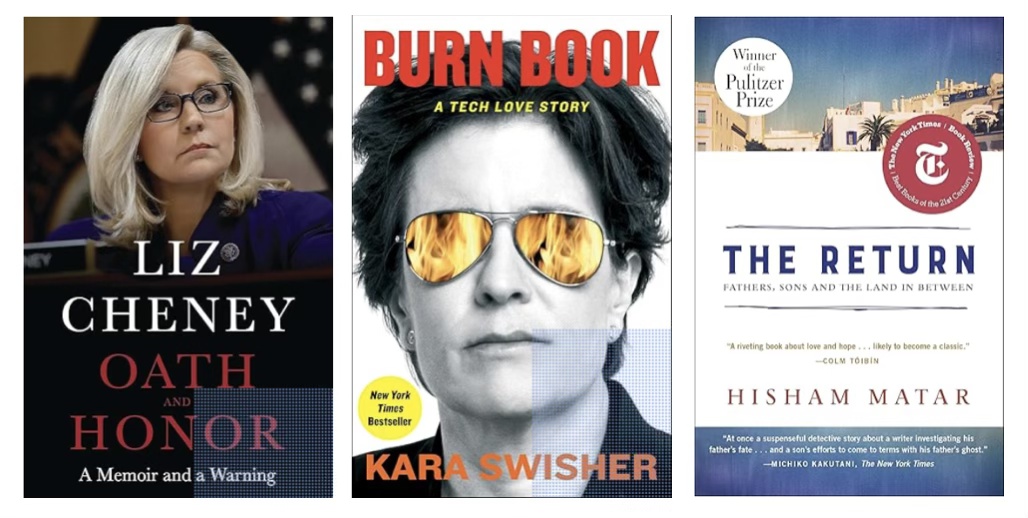
Another memoir, not quite on my Top Ten list, evoked a similar sense of gratitude. Liz Cheney’s Oath and Honor is filled with fascinating details about her courageous journey to uncover the truth about the January 6 insurrection and the first Trump administration. 

I enjoyed other memoirs, too. In her long-awaited Burn Book, tech writer Kara Swisher brings us back to the birth of Silicon Valley and the early days of Steve Jobs, Elon Musk and others. As in her popular podcasts, Swisher can be self-indulgent but she’s often insightful and never boring. Another memoir, Hisham Matar’s The Return, describes how his Libyan family endured the murderous regime of Muammar Gaddafi

Two older memoirs also held personal interest, for different reasons. In Ten Years a Nomad, Matthew Kepnes — known as “Nomadic Matt” — describes how he spent years wandering around the globe, a journey I am about to emulate on a much smaller scale. In Waiting for the Monsoon, journalist Rob Nordland tells how his life filled with writing and travel was imperiled by a health crisis — one worse than anything I have experienced, but resonant nonetheless.

I also enjoyed McKay Coppins’ excellent biography of Mitt Romney; John Vaillant’s harrowing account of Fire Weather; and Jessica Roy’s American Girls, about a young woman from a religious family in Arkansas ending up with the Islamic State in Syria. Bianca Bosker’s Get the Picture provided a devastating tour of New York’s art scene.

On the political front, I also enjoyed The Age of Grievance, by Frank Bruni; The Age of Revolutions by Fareed Zakaria; The Truths We Hold by Kamala Harris (remember her?) and — older but still interesting — The Paradox of Tar Heel Politics by Rob Christensen.

My final non-fiction nod goes to The Catalyst, which describes how RNA science has become central to our understanding of cancer, aging and more. Author Thomas Cech, a Nobel laureate, introduces us to the people behind the discoveries and explains in non-technical language how RNA is changing our world. I worked with Tom for several years and admire both his brilliance and his ability to explain complex science.

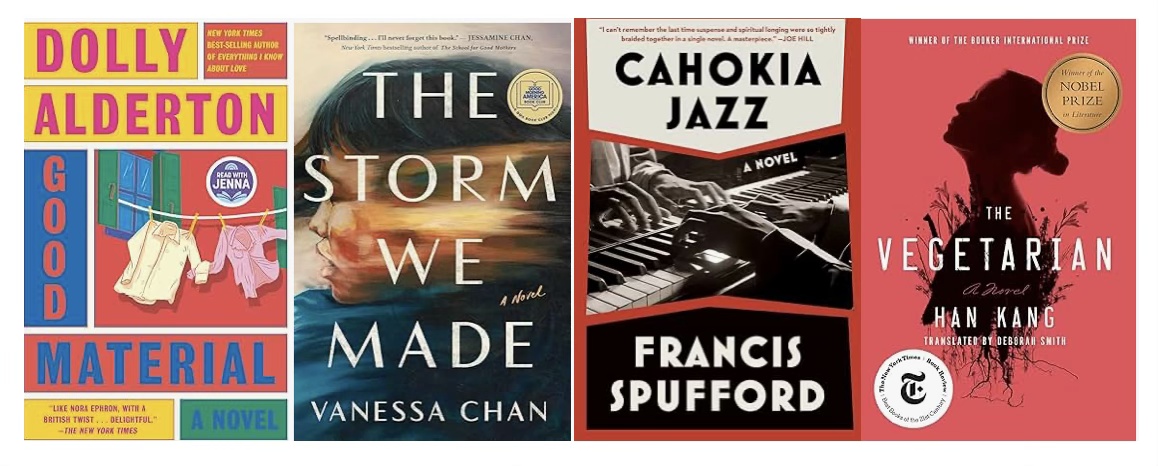
Other new fiction favorites included Dolly Alderton’s Good Material, a British rom-com about a struggling stand-up comedian; Vanessa Chan’s The Storm We Made, about the complex choices Malaysians made during the Japanese occupation; Francis Spufford’s Cahokia Jazz, a noir thriller set in a reimagined Midwestern state; and The Vegetarian, a dark novel from Korea by Han Kong, who won this year’s Nobel Prize in Literature. I also inherited a friend’s copy of Larry McMurtry’s classic Cadillac Jack, which was worth the long wait, as was Alistair MacLeod’s lovely No Great Mischief, which I read before traveling to his native Nova Scotia.

As usual, some titles disappointed, notably four you may see on “best books” lists elsewhere: Long Island Compromise by Taffy Brodesser-Akner; This Strange Eventful History by Claire Messud; There’s Always This Year: On Basketball by Hanif Abdurraqib; and Wandering Stars by Tommy Orange. I gave up on all of them before finishing. Maybe I stopped too soon.

Looking ahead, I’m preparing to tackle a 1,336-page classic that I’ve downloaded to read during our upcoming trip to Australia and New Zealand: Robert Caro’s The Power Broker, about Robert Moses’s transformation of New York. I hope to finish it in time for my 2025 list. Until then, I invite you to share your own suggestions in the comments section and wish everyone another year of great books. Happy reading!