Tag Archives: Balkans

Our ‘Free’ Local Guides

We traveled on our own but were guided by others during our 6-week trip in the Balkans and elsewhere, from which we just returned home.

In Slovenia, a local professor showed us around the capital, Ljubljana. That’s her, Nina, in the red shirt. 

In Zagreb, Croatia, we received an excellent tour from a lifelong resident, Mirjana, wearing the white hat.

We learned about Split, Croatia, from Roko, top photo, a guide whose family has lived there for generations. In Dubrovnik, our guide was Marko, who you see holding a notebook filled with maps and historical photos he showed us. Like Roko, he said Croatian guides work hard during the busy summer season, then relax during the winter.

As I’ve written previously, we’re fans of free walking tours, which have become available worldwide. We usually book them for our first full day in a city, to get oriented and learn about local history and culture. The guides work for tips, so are motivated to be enthusiastic and helpful. With few exceptions, the ones we’ve used have been excellent.

A group’s size is unpredictable. We were Nina’s only customers in Ljubljana, and also with our guide in Durrës, Albania, the port town where we spent a day before sailing overnight by ferry to Italy. After we landed in Bari and dropped off our bags, we got some fresh pasticciotto at a bakery, then took a walking tour that included more than twenty people.

We’ve also traveled with more traditional guides, such as Ana, an Albanian woman who led the two of us and five Brazilian guys during our driving tour of the Balkans. That’s her in the black outfit at a historic castle in Krujë, Albania.

Our final guide, in Frankfurt, was Haotong, who shared his perspective on growing up there in a Chinese immigrant family. In turn, Haotong was interested to learn about our Asian-American marriage and about my mother’s flight from Nazi Germany as a girl. Conversations like these are as memorable as any of the sights we see.

We’ve used several of the big companies that offer these tours, such as Guru Walk and Sandemans, as well as local companies. We research them online, find a tour that matches our schedule, then book a reservation. They respond with instructions about where to go and what to expect. They send reminders before the tour and, if necessary, let us cancel without a problem. That’s what we did in Naples, where we opted instead for a free Rick Steves audio tour I’d downloaded. We also used Rick’s excellent audio tours in Rome and Florence.

Free walking tours are helpful in another way, too. When we’re figuring out where to stay in a city, we check where the tours start, then seek lodging nearby. That puts us close to major attractions even if we don’t take the tour.

We always tip the guides and post good reviews. After all, they work hard and provide a great service. Are they really “free”? Well, not exactly, but when it comes to learning about the places we travel, “not exactly” is working just fine for us.

Signs of Death

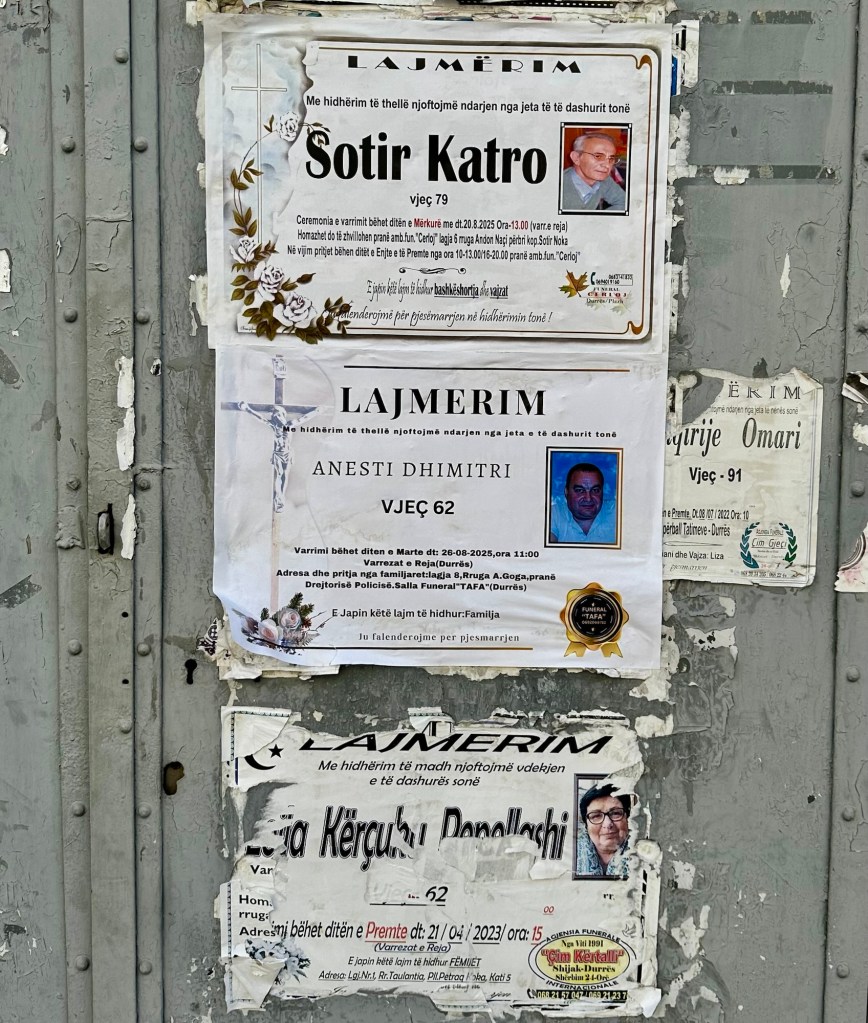
Here’s something you don’t expect to see if you’re an American taking a walk near your home: a poster telling you that one of your neighbors just died.

We’ve seen these death notices throughout our travels in the Balkans and now in Italy.

Gjakovë, Kosovo

Across the region, families place notices about their departed loved ones on public walls and elsewhere. The posters typically include a photo of the deceased and facts such as their age and next of kin, along with funeral plans. In other words, much like a death notice or brief obituary in the United States.

Mostar, Bosnia and Herzegovina

However, the posters are much more public than a typical American notification. They’re a quick way to alert neighbors who may not be connected online or read a newspaper.

As the comedian George Burns famously said, “I get up every morning, read the obituary page. If my name’s not there, I have breakfast.”

Durrës, Albania

I’ve found something comforting in how this tradition is being maintained, in both Christian and Muslim communities here, while our own methods of announcing deaths evolve rapidly. Published obituaries in local U.S. papers have given way to Legacy.com, Facebook memorials, e-mail chains and other online systems. Social media is now the first place we learn of many deaths. The notifications themselves may be less formal, more personal, even funny.

Bari, Italy

I didn’t expect to spend time thinking about death customs during this trip but the posters are omnipresent. As someone who publishes almost exclusively online these days, I like how these posters brave the elements and slowly decay, like death itself.

When I’m back home in North Carolina and taking my daily walks, I’ll miss seeing them.

Naples, Italy

Top photo: Naples

Exploring the Balkans

We loved the Balkans during a three-week visit we just completed — well, except for one famous spot I’ll mention in a moment. (Hint: we survived it better than Cersei Lannister did.)

American tourists have visited Greece for years but only recently began exploring the rest of the Balkans in southeastern Europe. Croatia has become very popular. Both Montenegro and Bulgaria, which we visited previously, are attracting growing numbers, too. Albania is emerging from decades of mystery to become a new hot spot. 

Zagreb, Croatia

Other Balkan countries we visited on this trip — Kosovo, North Macedonia and Bosnia and Herzegovina— still feel off the beaten track, but their tourism infrastructure is expanding as well. Slovenia, which was among our favorite stops, was part of the former Yugoslavia but is northwest of the Balkan Peninsula.

Kotor, Montenegro

Why are Americans and other foreigners finally taking note of the Balkans? For starters, they’re beautiful, with a history that spans the Roman and Ottoman Empires through Communism and the breakup of Yugoslavia. Bloody conflicts that raged in the 1990s have given way to peace and growing prosperity, as we saw in Bosnia and Herzegovina. Tourists find reasonable prices, safe streets and local people eager to welcome foreigners.

Mostar, Bosnia and Herzegovina

We wanted to experience the Balkans before they become just another stop on the European tourist trail. We’re glad we went when we did. 

The map shows where we stopped. We visited Slovenia and Croatia on our own (see my post about Ljubljana and Zagreb), then joined a small group with an excellent Albania-based company, Choose Balkans, to tour the rest. We spent extra time in Albania’s capital, Tirana, then ended in the historic port city of Durrës for an overnight ferry to Italy — the next leg of our trip. 

Lake Bled, Slovenia

Here are just some of the many memorable places we visited, ending with the one place I didn’t like, namely Dubrovnik. It’s Croatia’s spectacular walled city, the most popular spot in the Balkans, attracting 1.35 million visitors in 2024. Dubrovnik was the setting for King’s Landing and the Lannisters in Game of Thrones. To me, though, it felt like an overpriced Disney theme park, swarming with tour groups and people taking selfies even after the peak summer season. 

I’m sorry to say this about your home town, Cercei. Thanks for not tossing me off the fortress walls or blowing up our Airbnb.

Sarajevo, Bosnia and Herzegovina


Shkodër, Albania


Prizren, Kosovo

Dubrovnik, Croatia

Top photo: Church of St. John at Kaneo, Lake Ohrid, North Macedonia 

Rest Stop Paradise

I’ve discovered paradise in an unlikely place: highway rest stops in the Balkans. 

They have great food at reasonable prices, comfortable dining rooms, immaculate bathrooms and other amenities. They’re places you want to stop. 

By contrast, most highway rest stops in the United States are, at best, functional. Their food options typically range from vending machine candy bars to overpriced Auntie Anne’s Pretzels and Cinnabons. You often have to wait in a long line to buy coffee or a burger from an overworked employee, then eat with plastic utensils at a nondescript table. Toilet stalls in the rest rooms may be broken and noise from the hand dryers can be deafening. 

Not all U.S. rest stops are so grim, of course, but plenty are. They have to serve a much larger number of people and vehicles, with facilities that may be aging, but few even aspire to genuinely good food and ambiance. (They are vastly better, however, than some disgusting places I’ve seen in South Asia and elsewhere.)

I was surprised when I encountered the first highway rest stop of our Balkans trip, in Croatia. Their cafeteria served a variety of attractive entrees along with freshly baked breads and pastries. I enjoyed a pistachio croissant with a cappuccino. 

As we continued to travel during the next two weeks, I kept finding good food, good prices and pleasant surroundings — all in a part of the world that’s still “developing.”

By way of example, here are some photos from our stop on Wednesday at the NBT Oil gas station in the Mirdita region of northern Albania, heading on the highway towards Kosovo.

Their cafeteria offered steak, chicken, fish, lasagna and other entrees, along with local specialties, homemade soups, fresh vegetables and desserts. The prices were the same as you’d find in a local restaurant, without the big markup we expect at rest stops back home.

They also had a well-stocked convenience store, a fresh fruit stand, a car wash, an outdoor cafe, a bar (presumably for non-drivers) and a Buddha statue outside the bathrooms, which were large and clean. The gas pump areas were sparkling.

Take a look:

Unexpected discoveries like this often linger the longest with me after a trip. The next time I find myself at the Vince Lombardi Service Area on the New Jersey Turnpike, I expect I’ll recall the Balkans fondly. 

Plitvice Waterfalls

Plitvice Lakes National Park is a national gem in Croatia filled with waterfalls and scenic views. This one-minute video, also available on YouTube, shows highlights: