
The library at my Peace Corps site in Ialoveni has great English-language storybooks for kids. In this video, also on YouTube, I urge families to take advantage of them.


Faces of Change
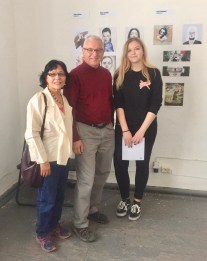 There are few galleries in Moldova where young artists can show their work. This weekend, though, more than 20 of them are taking part in an exhibit inside an old museum, featuring more than 100 portraits ranging from painting to caricature.
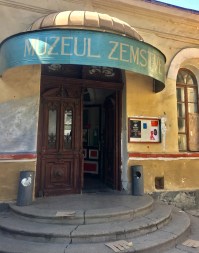 Lucia Codreanu and Maks Graur, both young artists themselves, organized and curated the free show in downtown Chișinău, running through Sunday afternoon. You can see some of the work here.
Lucia, who just graduated from high school and will soon begin studying art at a university in Romania, is amazing. She’s already assembled an impressive portfolio that includes my own favorites, her whimsical Moldovan reinterpretations of famous paintings.


I came to know Lucia well during last year’s Diamond Challenge competition that encourages entrepreneurship among young Moldovans. She was one of the three high school students on the team I mentored, which ended up placing second nationally in the business category. It was a joy to work with her and the other two students. Lucia was the designer for their project to create a personalized children’s book, which she showed in this video clip:
I encouraged one of that competition’s judges, an American who runs a web development company here, to give her a look. He loved her work, hired her and says she did a great job working part-time on web projects while finishing her final year of high school.

Lucia’s partner in this weekend’s “Faces” exhibit is also impressive. Maks Graur, who you see with Lucia in the gallery here, has been studying art in England. He recently completed a Draw for Dogs project in which he drew portraits for people who donated to charities that assist stray dogs.


When Champa and I visited on Saturday morning, Lucia told me the question she and Maks have been asked most often is why they organized the show for free. Volunteering, at least as we know it in America, is not a strong tradition in Moldova, which is why people here often have a hard time understanding why Peace Corps Volunteers would leave their homes to serve others.
Young people like Lucia give me hope that things can change. Surrounded by the portraits she and Maks pulled together, she looked to me on Saturday like the face of Moldova’s future.

Did you enjoy this post? Please share it!


Celebrating ‘Our Language’
Suppose America organized a big party every year to celebrate the English language.
That’s what Moldova does with Romanian through its annual Limba Noastră holiday, which it celebrated again on Thursday. 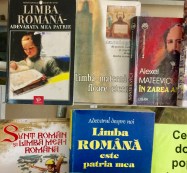 The words mean “our language” in Romanian, which is the official national language here.
Simultaneously, one in four Moldovans speak another language as their native tongue, mainly Russian, Ukranian or Gagauz, all of which have official status in certain regions.

Limba noastră is also the title of Moldova’s national anthem. Just as The Star-Spangled Banner honors the American flag, Moldova’s anthem proclaims the Romanian language to be a “treasure” that is “more than holy,” a heritage that “surges from deep shadows the past.” You can see a video of the anthem at the top of this post or on YouTube.
The Limba Noastră holiday goes beyond language to celebrate Moldova’s heritage more broadly. It occurs immediately after the country’s Independence Day, adding a cultural counterpoint to the politics of Moldova’s identity. Both celebrations are followed by First Bell, on September 1, when schools across Moldova hold colorful ceremonies to open the new year and ring out summer.


Here in Ialoveni, hundreds of people gathered at the Casa de Cultură, or cultural center, on Thursday to celebrate Limba Noastră. There were musical performances, dramas, dances and poetry, some of which you can see here. The library where I work, Biblioteca publică orăşenească „Petre Ştefănucă,” organized the program together with the town hall, or primăria, and the cultural section of the county government, or Consiliul Raional. It also created a series of exhibits celebrating Moldovan authors and the Romanian language. That’s library director Valentina Plamadeala speaking at the ceremony in the photo above.
During its Soviet period, Romanian was called Moldovan to distinguish it from the adjacent country with which so many Moldovans feel connected. Some people still insist on calling the language “Moldovan” even though its differences with the Romanian spoken in Romania are slight.

In places like Ialoveni that have strong ties to Romania, most people embrace the holiday, seeing the Romanian language as part of their ethnic identity. One speaker at Thursday’s ceremony recalled how he and others were forced to speak Russian in the years before Moldova’s independence. For them, limba noastră has a resonance that goes deeper than the language itself.
Elsewhere in Moldova, the holiday can be perceived differently. One of my fellow volunteers who lives in a Russian-speaking area said his host father calls it limba voastră, or your (not our) language.
The relationship between language and identity is complicated, in other words, and not always easy for an American to understand. We have plenty of experience with these issues back home, though, so the story can sound familiar despite the translation.
***
Want to learn more? This article offers useful background about Moldova’s languages. Also interesting is this article about how language is perceived by different groups in Moldova. [Hat tip for the second article to my volunteer colleague Haley Bader, whose excellent blog you should check out.]
Did you enjoy this post? Please share it!


Oui. Da. Yes, Dinner
Can you say “dinner” in five languages?
That’s the challenge we faced last week when our host family welcomed some friends.

One guest was a Moldovan psychologist (below in the green blouse) who now lives in Paris. She speaks both French and English but her French boyfriend, who came with her, speaks neither Romanian nor English.


Champa and I try to converse with our host family in Romanian but often speak some English with them, especially with Alisa, who speaks English well. (That’s Alisa with Champa in the photo below.) The two of us also speak some Nepali, just like back home.
Our host family is fluent in both Romanian and Russian, like most Moldovans. When people visit, their conversation is often a mishmash of both languages.
 In other words … well, yes: in other words. It made for an interesting dinner. I tried to speak French with the boyfriend (shown here, with the beard) since I studied it in high school and once spoke it fairly well. But it was frustrating. I understood much of what he said but sputtered in Romanian when I tried to reply.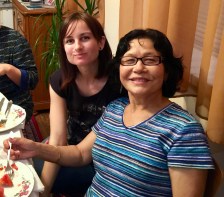
Just to make the situation more confusing, Champa and I studied Spanish years ago, and she occassionally says por favor instead of vă rog here in Moldova.
So our dinner conversation was complicată, compliquée and complicated. As you can see, though, the food was delightful, as were the company and the conversation. We all laughed, toasted, ate too much and made new friends. It was a memorable evening of speaking and eating with many tongues.
Did you enjoy this post? Please share it!


Our Group Reunites
Our group got back together this past week.
Champa and I came to Moldova in June 2016 with about 60 other Americans. We shared the rigors of Peace Corps training for two months before swearing in as volunteers and moving to our individual posts across the country.

That was the last time we were all together until Peace Corps reassembled us on Monday for a three-day “mid-service” conference at a hotel in Vadul liu Voda, near the Nistru River.


It was great to see everyone, albeit without some who left during the past year. We compared experiences, swapped stories and spent time with friends who understand personally how transformative this past year has been. Our four program groups had met separately during the year and we’d seen colleagues around town, but not all together.

We feel a bond with everyone despite the differences in our ages, backgrounds and job assignments. Champa and I are living as an older married couple in a small city near the capital, while some other volunteers are fresh out of college and living alone in villages. Members of our group, M31, work with teachers or are assigned to libraries, mayor’s offices, business incubators or other settings.

As we were reminded at the conference, though, we share our mission of service and international friendship. We’ve all taken a break from our American lives to interact every day with our Moldovan host families, work partners, neighbors, students and friends.
Our conference included sessions on community development, helping people with disabilities, service learning, teaching life skills and other topics. We discussed our journeys as volunteers and how to stay healthy and resilient during the year ahead. We had a session on Moldova’s history. Since most of us learned to speak Romanian, we also got a crash course in how to say a few expressions in Russian, which is widely spoken here.

The most inspiring moment for me came during our final session, when the members of my community development group took turns describing their plans for the coming year. They spoke about dance programs, journalism clubs, robotics teams, English clubs, youth projects, women’s groups and much more. Their lists were so long, in fact, that the session ran well past its deadline. I was humbled to be part of such an amazing group of people, whose dedication is reflected in our three other groups as well.
The next time we assemble will be for our “completion of service,” or COS, conference shortly before we return home. In the meantime, we’ll continue interacting on projects, sharing news on our Facebook page and getting to know the volunteers in the group behind us, who just started their own assignments.
It’s an adventure we’re all experiencing together, even when we are apart.
Did you enjoy this post? Please share it!


The Material World
No one is going to confuse Gemeni, a department store in the heart of Chișinău, with Milan or Paris, or even with an American fabric shop. Located next to a McDonald’s on the city’s main street, Gemeni is old. It’s cramped. It has no parking, no food court, no modern rest rooms. It’s more of a bazaar than a modern department store. Most of its shops are small or tiny.


But if you’re looking to sew anything from a simple shirt to an elaborate gown, it’s a great place to shop. The third and fourth floors, especially, are abundant with fabric, yarn, buttons, ribbons, zippers, thread and everything else you need. The prices are nothing special but the selection is great.
Champa and I learned this recently when we bought supplies for a big grant project she has begun to create a costume wardrobe for her school’s drama program. We shopped with Ana, the head of the program (middle in the photo below), and Ina, a designer and seamstress (left) who is helping with the project.
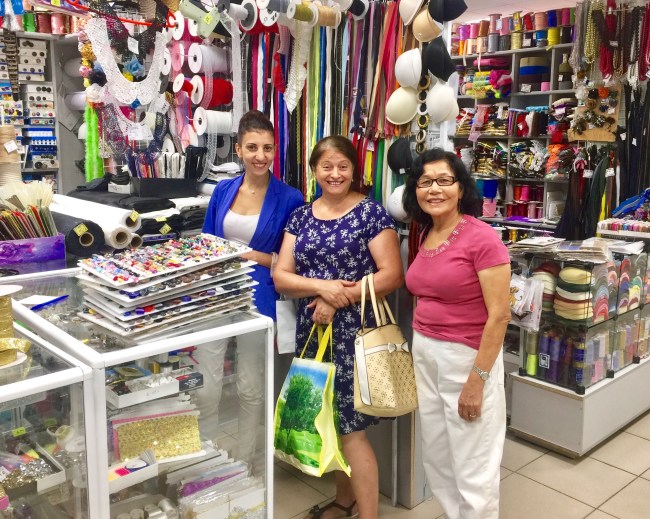
Most of Gemeni’s vendors are women. They rent the stalls, which are arranged by category throughout the store. On the first floor, for example, are shops selling perfume, stationery and jewelry.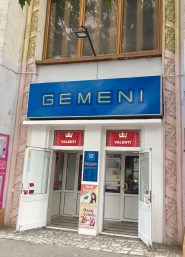
The store, whose name means twins in Romanian, evokes its Soviet heritage. It’s functional, not glamorous. Customers almost always pay in cash. They receive their purchases in cheap plastic bags rather than the store bags we expect back home. Customer service desks? Benches for resting? Fountains? As we say here at the blog: not exactly.
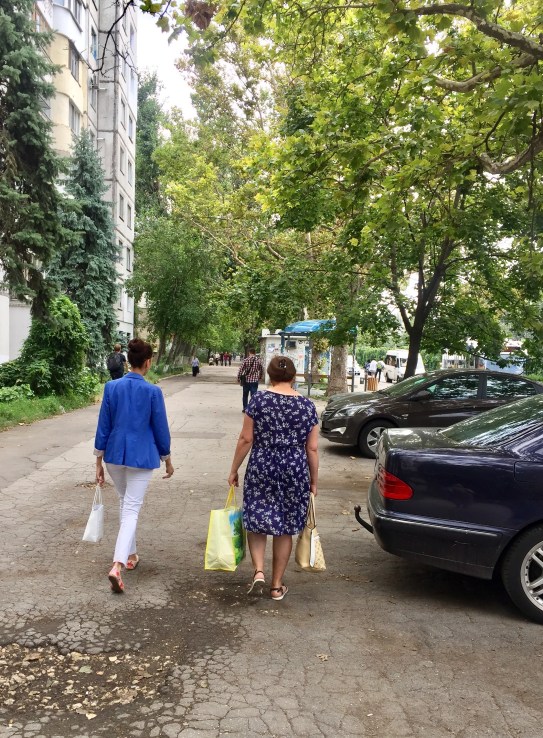
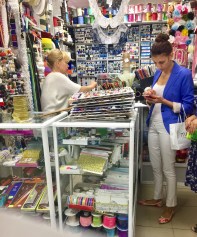 Bolts of velvet, cotton and other material surrounded many of the shops we visited. Champa and her partners visited one place after another to select the best cloth for the costumes they’re planning. They also bought buttons, gold braid, ribbons and other haberdashery supplies. Within a few hours, we were loaded down with bags, which we carried on a bus across town to Ina’s studio. She is now cutting and assembling the cloth for each costume — Romeo, Juliet, kings, queens and more.
During the next several months, Ina will join with students and parents at Champa’s school to sew these pieces into more than 40 glorious costumes, which I’ll describe in future posts. For now, one thing is for sure: They have great material to get started.
Did you enjoy this post? Please share it!


Summer Camps
Many Peace Corps Volunteers in Moldova enjoyed summer camp recently — not as campers, but as counselors and mentors.


Some participated in Wave Week Moldova, an intensive residential leadership and community service program that empowers young people to become volunteers and leaders. Two of them, Morgan and Chris, wrote eloquently about how Wave Week made a big impact on everyone involved — 95 campers, 20 Moldovan youth staff and five Peace Corps Volunteers.
“I have absolutely loved seeing the passion and devotion for serving others come to life in the eyes of my delegates,” Morgan wrote. “Participating in this camp has been one of the most rewarding aspects of my service so far.”
Interacting with the campers “reconnected me to why I applied to become a volunteer in the first place,” wrote Chris. “As I talked with these young people every evening about their day’s activities, they inspired me more than I could possibly motivate them.”
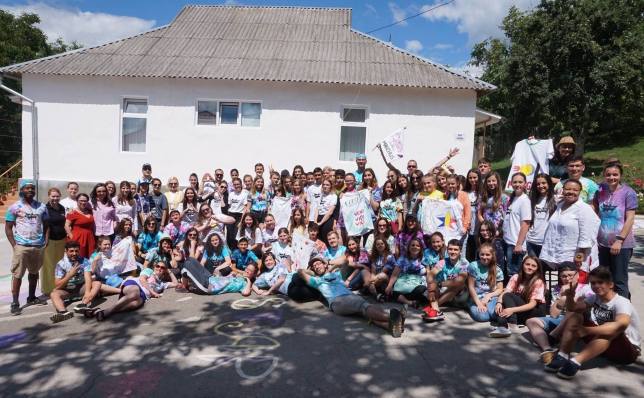
Other volunteers participated in GLOW TOBE Moldova, shown above, a week-long summer camp where young people learn community leadership skills and expand their own self-awareness and confidence.  The program, whose full name is Girls Leading Our World – Teaching Our Boys Excellence, began in Romania in 1995 and has spread around the world with Peace Corps support. Here in Moldova, volunteers work with local counterparts to provide activities ranging from leadership workshops to singing, dancing, making S’Mores and tie-dying T shirts. The program continues throughout the year with activities across Moldova.
Another summer camp was GirlsGoIT, which provides dozens of girls with ten days of intensive training to learn job skills in science, engineering and technology. This year the girls learned about coding, robotics, 3D printing and entrepreneurship, among other things, and also how to serve as advocates to empower other girls to pursue STEM careers. My volunteer friend Susan, who has a long IT background, is shown below teaching some of them.

Then there are my fellow Peace Corps Volunteers who created their own summer camps in Căușeni, Telenești, Călinești and other communities. I can’t list them all here but it’s impressive to hear what they accomplished, often with little or no external resources.
These camps change lives, and not only for the campers. My fellow volunteers who participated gave all of these young Moldovans a summer to remember.
[Thanks to everyone who took these photos!]
Did you enjoy this post? Please share it!

Where Are You, Reader?
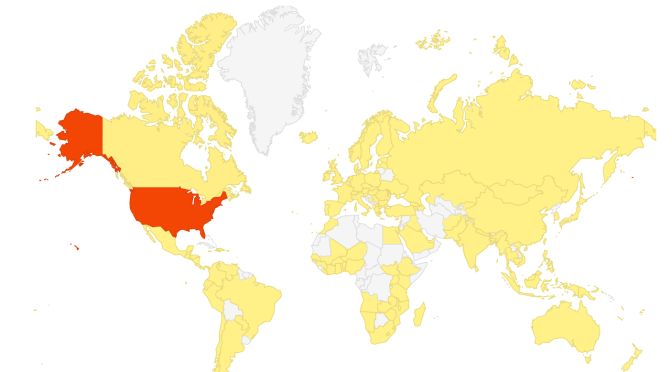
 More than 12,000 readers have visited “Not Exactly Retired” since its launch two years ago. I was curious where all of you are located, so recently ran a search on WordPress, which hosts the site.
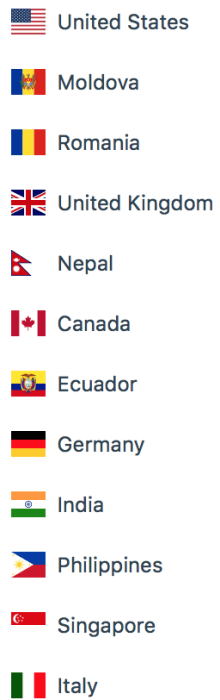
Here are the results, in order.
Not surprisingly, the largest group of readers is in the United States, followed by Moldova, where we are serving as Peace Corps Volunteers.
The Top Five also includes Nepal, where Champa was born and we maintain close ties, so that’s not a surprise either. Nor is Romania, which is next to Moldova, especially since I wrote a series of stories in April about our trip to Transylvania, some of which were featured on sites within the country.
 Some of the other “Top Dozen,” though, surprised me. Who are all of you reading “Not Exactly” in Ecuador or the Philippines? Are you fellow Peace Corps Volunteers in those countries? How about in India, Germany and Italy? I know at least one loyal reader in Singapore (hi Corinna!), but who are the rest of you? The data provided by WordPress provide only a glimpse.
I’d love to hear from you, even if your country is not on this list. You may be in one of the other countries shown in yellow on the map. I’m so happy to be sharing our journey with you. Please comment here or send me a message at djarmul@gmail.com. Tell me who you are!
Did you enjoy this post? Please share it!


Meeting at the Primăria
“This is what democracy looks like!”
For protesters around the world, that’s become a popular chant at rallies. Here in Ialoveni, it’s what I saw Thursday evening at a community meeting, one of whose livelier moments is captured in this brief video clip:
Nearly 50 citizens gathered to discuss a proposed high-rise building project in the center of town that would add residential and commercial space but affect traffic, municipal services and the environment. It also would disrupt a neighboring park and church. Some residents are concerned about the project’s impact on their own homes and property.


I didn’t understand everything people were saying, and sometimes shouting, in Romanian. I may have missed something essential, not to mention whatever people were saying privately. But the meeting was both impressive and fascinating nonetheless.
Both men and women participated. Everyone was dressed comfortably for the late-summer heat, including the mayor, Sergiu Armașu, who presided at the end of the table in a short-sleeved red shirt.

People took turns standing to speak around a long table in the meeting room on the second floor of Ialoveni’s Primăria, or town hall. Some held up documents. Some tended to children. Some listened quietly, sipped water or tapped on smart phones. A city expert pointed to one of several maps on the wall, explaining the project in detail. A local journalist recorded everything. A woman from the Primăria’s newspaper snapped photos and took notes.


The meeting began at 5 p.m. and broke up shortly before 7 p.m. The mayor shook hands with citizens as they exited. Several people remained behind to argue about the project. As best I could tell, the situation remained unresolved, with a decision about the project still pending. On this one night in Ialoveni, Moldova, it’s what democracy looked like.
Did you enjoy this post? Please share it!


Painting the Playground
These “Before” and “After” photos tell the story of what Peace Corps can accomplish with a local community, sometimes within a couple of hours.


All three photos above show a playground in central Ialoveni. The left photo, which I shot on Tuesday morning, shows how faded and dingy the equipment looked. The middle and right photos show some of the same equipment on Tuesday evening after a Peace Corps group joined with local residents to give the playground a paint job and makeover. (“Vopsit” means “painted.” The sign on the left says: Help us put the “love” in Ialoveni.)
Nine Peace Corps trainees who’ve been living in Ialoveni for the past two months organized the event, which included ice cream and games for children. They’ve been staying with host families and studying every day at Liceul Teoretic “Petre Ştefănucă,” a school near the library where I work. 
Next week they will swear in as volunteers and begin serving in the community and organizational development (COD) program for Peace Corps Moldova. They’ll serve with a companion COD group of trainees who’ve been living and taking language classes in the nearby village of Sociteni.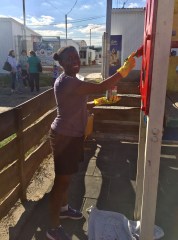 Those trainees held their community service event last week, a clean-up of Sociteni’s main street.
Both groups of COD trainees are looking forward to finally finishing their preparation and moving to their permanent posts to begin assisting local governments, libraries, nongovernmental organizations and others across Moldova. 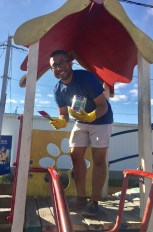 Two other groups of trainees— in English education and health education — will also swear in next week.
  Altogether, more than 50 trainees are expected to join Peace Corps Moldova’s current volunteers, most of whom swore in a year ago and will continue serving until next summer, Champa and me among them.
You can see the Ialoveni trainees posing here at the end of Tuesday’s event with Mayor Sergiu Armașu and a couple of local girls, Champa and me. We participated along with two other current volunteers (Reggie and Beth) and an impressive number of community members.
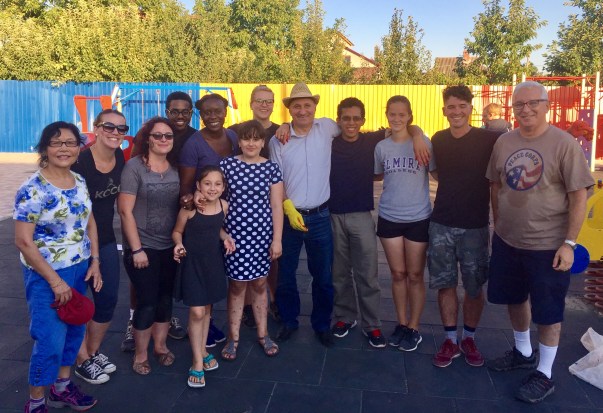
For both of us, it was gratifying to watch our two communities — Peace Corps and Ialoveni — come together for such a worthwhile cause. Ialovei is our home for another year and this playground next to the main piața, or shopping area, looks so much better now. If the kids loved it before, they’re going to love it even more after the makeover.

 "Not Exactly Retired"