

Did you struggle in high school or college to learn Spanish, French or some other foreign language? Great! This question is for you:
I learned Nepali when I was a Peace Corps volunteer four decades ago and am now learning Romanian as a volunteer in Moldova. Which language do you think is harder?
Keep in mind: Romanian is related to many other European languages and to our own. It shares many words with English. Its syntax is similar. Nepali, on the other hand, is a Sanskrit language. Its alphabet, Devanagari, is completely different, as is its syntax. In Nepali, the sentence “What is your name?” literally translates as, “Your name what is?”
Maybe you’re thinking this is a trick. Maybe I’m encouraging you to say Nepali is harder but I actually think Romanian is harder.
Well, I do think Romanian is harder. But the problem is that I’m not sure it really is harder. Perhaps I’m just not as good at learning languages as I used to be.
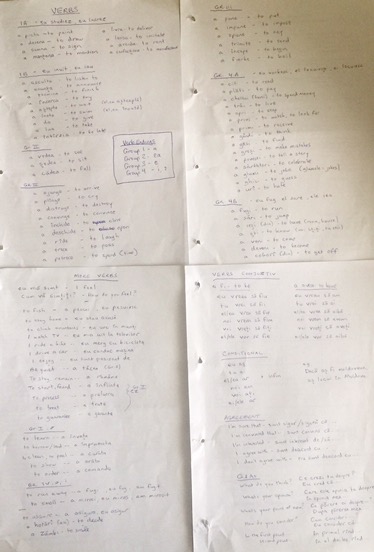 To be sure, Nepali was harder for me at the outset. Its sentence structures seemed so bizarre that I walked out of my first language class, ready to quit in despair. Within a few days, though, I got the hang of it. By the end of our training, I was able to have a simple conversation. Today I still speak it easily, if imperfectly.
When I first encountered Romanian, it reminded me of French, which I studied in high school. I was relieved so many words looked familiar. For instance, here are some Romanian verbs whose meaning you can probably guess: discuta, studia, dansa, telefona and permite. I am a voluntar who is activ, sociabil, inteligent and optimist. Right now it’s August. Next month is Septembrie.
See what I mean? How hard could it be to learn Romanian, right?
Well, it’s been plenty hard. Accent marks change the pronunciation and meaning of s, t, a and i. Adjectives and verbs must be conjugated as masculine or feminine. Verbs fall into multiple categories, each with their own conjugation. There are endless exceptions.
During our language training, which wrapped up last week, we blasted through lessons on how to describe our families, order food, ask for directions or describe our work as Peace Corps volunteers. We learned how to use present tense, past tense, future tense, reflexive verbs and things like “genitive case” whose meaning I’d long forgotten in English, much less Romanian. We memorized lists of foods, clothing, furniture and more.
I’ve found it much harder to cram all of this into my brain than when I learned French or Nepali. I mutter “Damn you, neural plasticity!” to myself while I study before and after our four-hour classes, make word lists, then make new lists of words I still can’t remember.
 Fortunately, I had an incredible teacher, Diana, who was skillful and tireless in helping my classmates and me learn everything. That’s her in the flower dress with us. With Diana’s help, I ended up with a good score on the exam they administered before we swore in as volunteers last week. She kept telling me I was doing fine, and I guess she was right.
In any case, this is just the first lap. I recently moved in with Champa while her group finishes its training, and I’ve been using the time to keep studying. Whenever I need more motivation, I remind myself I’m moving soon to a post where my partner doesn’t speak much English.
There’s a Romanian word for what this has been like for someone 63 years old. You can probably guess its meaning: dificil. However, I am doing my best to stay focused on another Romanian word: succes. Regardless of how your own language class turned out, please wish me luck.


 It’s time for another edition of Maria’s Kitchen!
 This recipe is simple and delicious, with a taste more sweetly tart than sour. Here are the steps:
 Roll up each triangle from the long side towards the opposite point. Place them on a metal tray and bake for 30-40 minutes at medium heat.
 Remove the pastries from the oven and let them cool. Then roll them in powdered sugar.
 You can search on this blog to find some of Maria’s other specialties. If you’re interested in learning more about Moldovan cuisine, check out this

 Worldwide, Americans over age 50 comprise about 7 percent of the nearly 7,000 Peace Corps volunteers now serving in 63 countries around the world. With its better medical facilities and programs in fields such as business development that attract people with lots of real-world experience, Moldova attracts higher numbers.
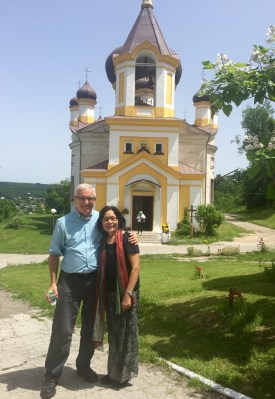 We differ from our younger counterparts in some ways. Learning a new language may be tougher for us, although many of us are doing fine in our Romanian classes. We may run slower in a group soccer game, if we participate at all. When several younger friends went to get tattoos recently, they knew better than to invite me along. They also may party harder and make surprising cultural references. When I was in the Peace Corps office the other day, a Carole King song started playing and the young woman next to me said, “Hey, it’s that song from the Gilmore Girls!”

 When most Americans think of World War II, they think of Normandy, Iwo Jima and other battles where our soldiers died. My own father fought at D-Day, navigating a plane that was shot and almost didn’t return to England. He was part of the “greatest generation” whose enormous sacrifices kept our country free.
 morial. They are everywhere in Moldova. The second photo shows one in Dereneu, a small village we visited a few weeks ago. In Chisnau, Moldova’s capital, one of the main tourist sites is the Victory Memorial and eternal flame, five giant marble pillars representing the five years of Moldovan involvement in the conflict.


 Peace Corps brought all of us all together in Chisinau, Moldova’s capital, to align our plans and expectations over the next two years. After reviewing the history of the Peace Corps and its activities in Moldova, the conference leaders reminded our partners that we are volunteers with a special role: We’ve come to share our skills and perspective, empowering our colleagues and others to blaze their own paths after we leave.
 These ideals were fundamental to the Peace Corps when I served four decades ago, and they remain so today. My service in Moldova differs in so many ways from what I experienced in Nepal, from the local food to the speed of communications, but the mission is unchanged, still reflecting the original vision of President Kennedy.
 The other trainees in my “community and organizational development” group came to the conference with their partners from across Moldova — mayors, village librarians, NGO leaders and others. Each pair worked together to clarify how the volunteer will learn about his or her post, develop a work schedule and deal with inevitable disappointments.
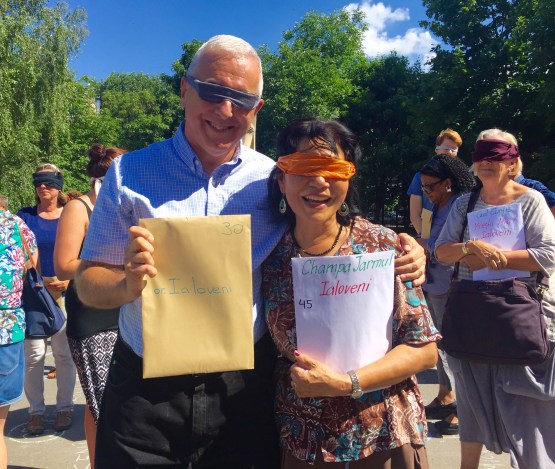
 The name on the envelopes for Champa and me was Ialoveni (pronounced Yah-lo-ven). It’s a big town close to Chisinau, not far from our training sites. After Champa and I finish our training and swear in on July 29, it’s where we’ll be living.
 At my group’s tech class on Tuesday, we discussed how Moldovans and Americans differ. One of the charts we filled out, shown in the photo, compared each culture’s tolerance for risk. The green tags represent Moldovans; the red tags represent Americans. As you can see, our group saw Americans as being more willing to take chances in life.

 Why has the Peace Corps sent me and others to Moldova, a small country in eastern Europe that many Americans have never heard of?

 I’m looking forward to the challenge. I was impressed by Ekaterina, Petru and Elena, and by the young people I met at the library. I’m hoping to find similar people wherever we’re sent, and am eager to work with them to tackle local problems.
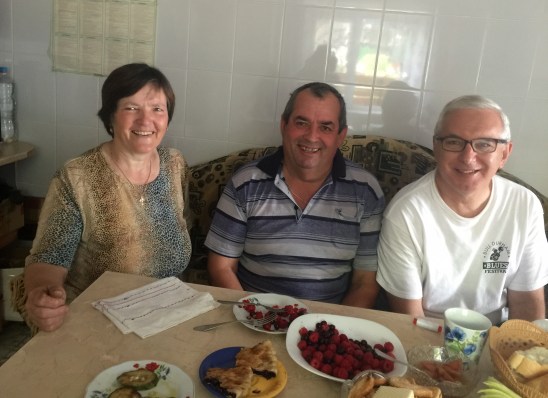
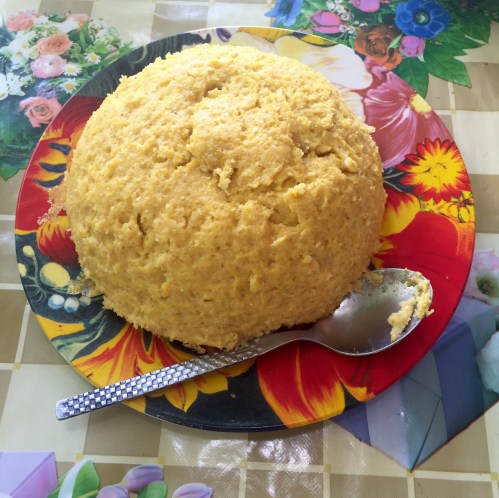 Not here in Moldova. My host mother, Maria, shown here with her husband Vladimir, is an amazing cook, so I’m going to feature her in occasional posts about Moldovan cuisine. On Sunday, while Champa was visiting, she served us mamaliga, which is a denser version of American cornbread.
 In this brief video, she demonstrates the traditional method of slicing mamaliga with a string. You can hear Champa in the background admiring her technique. (You’ll find a recipe for mamaliga and other Moldovan foods at this
 My current day-to-day reality is this: I go to language class all morning. I have tech training in the afternoon. I talk with Champa on the phone. I eat and try to communicate with my host family. I cram vocabulary lists and verb conjugations whenever I can. Then I go to sleep. The photos show what we did on Wednesday.
 So I should have known what to expect emotionally when I heard the terrible news about Orlando, followed by the controversy over Donald Trump’s response and everything else that has happened in the past few days. But familiarity is not a vaccination. It’s still been strange to watch all of this from a distance, discussing it with the other trainees when we get a moment between language classes. Soon enough, we’re back to memorizing the Romanian words for fruits and vegetables, or how to conjugate the feminine plural form of an adjective.
 "Not Exactly Retired"