Dazzling Autocracy

Dubai and Abu Dhabi were impressive when we visited last week. Our overlap with President Trump’s trip to the region was coincidental but instructive.

Millions of people have flocked to the United Arab Emirates from around the world. They seek higher-paying jobs and better lives amid growing skylines, bustling airports, a modern metro system and luxurious shopping centers.

What they don’t find are democratic institutions. UAE’s citizens, who comprise a small percentage of the population, cannot change their government and have limited human rights.

The same is true of Qatar and Saudi Arabia, which President Trump also visited last week. Thanks to their oil riches, all three nations have transformed over the past half-century from poor agrarian societies into modern global powers. Champa and I visited Qatar’s capital, Doha, two years ago, and were amazed, just as we were in the UAE.

Yet I wouldn’t want to live in any of these countries. As an American, I am unwilling to compromise my freedom to speak out, criticize the government and write an article like this one. 

I recognize my good fortune in asserting this. If I were poorer and felt no stake in the political system, my overwhelming concern might be to improve my economic situation.

The UAE exemplifies the beguiling appeal of autocracy. Its royal families can act with few constraints from courts, legislatures, reporters or protestors. They have used their extraordinary power and wealth to build schools, hospitals, roads and shopping malls, creating jobs for millions of people while enhancing their own fortunes.

You can make a similar case for China and some other nations that have prospered over the past several decades. Their leaders have immense power and can be ruthless and corrupt, but they often get things done.

In our own country, by comparison, our political system struggles to solve anything, from the price of eggs to protecting our borders. Recent successes have been limited.

It’s not just that these Mideast monarchies have so much money. Consider Bhutan, where we spent several days before flying to Dubai. It’s vastly different from the UAE — poorer, Himalayan and Buddhist. It is remote and idyllic, with a “democratic constitutional monarchy.” Yet its unelected king retains enormous influence.

Here, too, the people we met — a tiny sample — enjoy living there. Bhutan has made great strides in reducing extreme poverty. It’s currently building a “mindfulness city” that was glowingly profiled on 60 Minutes. Many of its young people have left to pursue opportunities abroad, including in the Gulf, but Bhutan has been a success story compared to many of its neighbors. We traveled there from Sri Lanka and Nepal, two fragile democracies beset by poverty and political strife.

Of course, during the past year we’ve also traveled to Portugal, Canada, Australia and New Zealand — countries with both strong democracies and healthy economies. At the other end of the spectrum, I’ve visited autocracies that provide neither freedom nor prosperity. And to be clear, I am appalled by the corruption and cruelty taking hold in my own country, and by the recent attacks on science, education, diversity and other ideals central to my career.

Furthermore, I know the people I met in the UAE may have hidden what they really believe, and people everywhere are motivated by more than economics. Autocracy’s rise in our own country has many roots.

So all of this is complicated, to be sure. And, no, this trip didn’t change my mind about what I value. Yet traveling to the UAE, especially while Trump was there, made me think anew about why so many people, including fellow Americans, are willing to accept autocracy. I don’t agree with them. I think we must solve our problems ourselves, without autocrats who often make things worse. But after seeing these gleaming cities up close, I find it easier to understand why some people might make choices different from mine.

When autocracy dazzles, it’s hard to see anything else.

Rethinking Bhutan

Bhutan has been widely hailed as the champion of “gross national happiness,” but I had my doubts.

I’ve never forgotten its mass deportation of ethnic Nepalis in the 1990s. More than 100,000 people languished for years in refugee camps. Ever since, I’ve avoided going there. Until now.

I kept hearing glowing reports from friends who visited Bhutan. There was also no denying Bhutan’s leadership in showing how a country can advance while protecting its own culture and environment.

So, this past week, I finally traveled there with Champa from Kathmandu. We arranged a quick tour with an excellent local company, visiting Thimphu, Punakha and Paro. 

And now, I have to admit it: Bhutan is pretty wonderful.

It’s like Nepal in many ways, with terraced fields and snow-capped mountains, but it’s cleaner, calmer and easier. As we drove from the airport in Paro to the capital, Thimphu, there was no trash on the road. No blaring horns. The rivers were clear. The air was pure. Everything was well-maintained. 

Many people wear Bhutan’s distinctive national dress — the kira for women and the gho for men. Every building has traditional architectural motifs. Prayer flags are everywhere. So are photos of the royal family. Bhutan’s beauty surrounds you. 

We visited many of the main tourist spots, including several dzongs, or fortified monasteries, and the breathtaking Dochula Pass, whose 108 memorial stupas frame white peaks of the Himalayas. We climbed partway up a mountain to view the Tiger’s Nest monastery, which clings to the side of a cliff (top photo).

We visited a “fertility temple” along a path whose shops feature ornamental penises. We bathed in tubs heated by hot stones, tasted the local momos and drank homemade alcohol with a Bhutanese family. 

Like I said: pretty wonderful. 

So now I’ve joined the ranks of Bhutan’s many admirers. Bhutan requires visitors to travel with a guide and imposes a hefty daily fee, so it’s more expensive than a typical trip to Nepal, which is why our own trip was short. But Bhutan is also gentler for Western visitors, especially those who haven’t experienced South Asia previously. 

Personally, I’m much more likely to return to Nepal instead of Bhutan in the future. That’s where our family is and where my heart lies. I speak Nepali and feel at home in the chaos of Kathmandu traffic and the paths of Champa’s hometown. Nepal is also a much bigger country, with a population of nearly 30 million people versus 800,000 for Bhutan. 

Yet I’m glad we finally gave Bhutan a chance and I’d recommend it to anyone wanting to explore the Himalayas. The scenery is stunning, the people are friendly and it’s fascinating to learn how this small country is charting its own development path based on gross national happiness — something we could use a lot more of ourselves back home these days. 

New School Video

The school we helped build in Nepal is now open. (See post.) This video tells the story. Also on YouTube.

Samalbung’s New School

The new school we’ve been helping to build in a Nepalese village has finally opened!

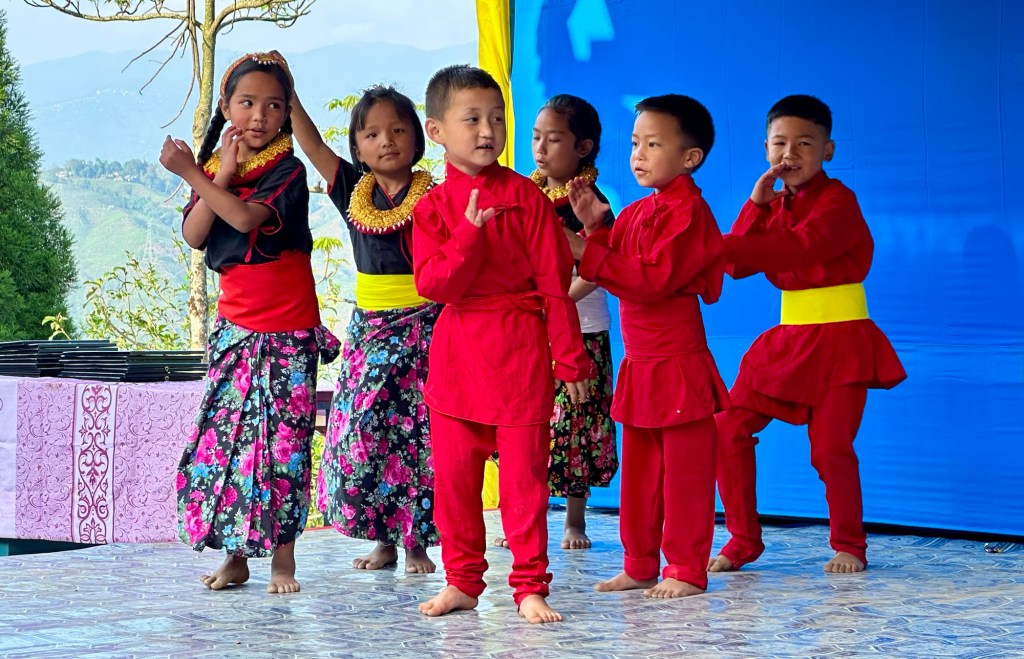
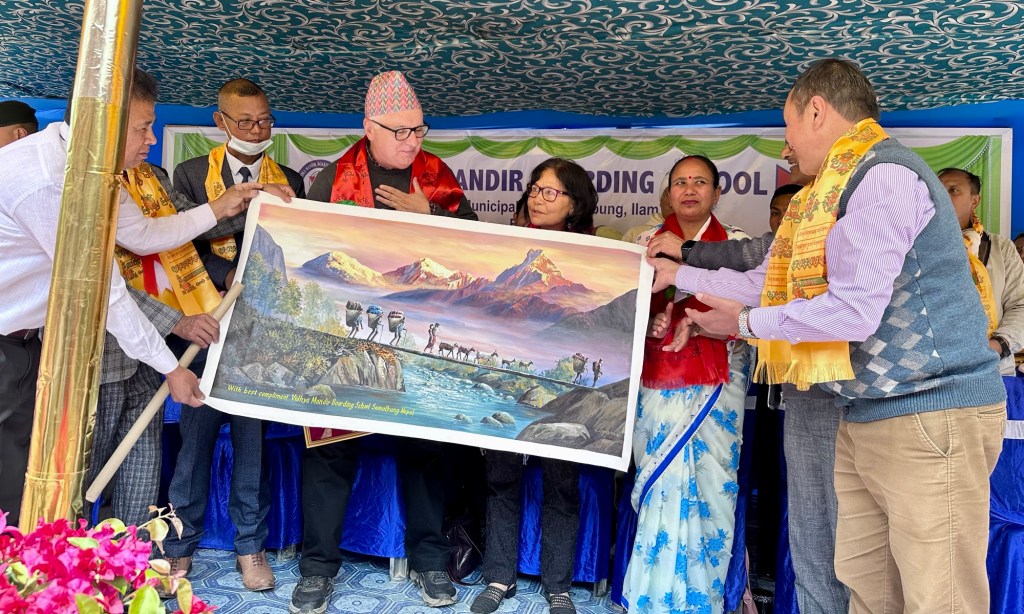
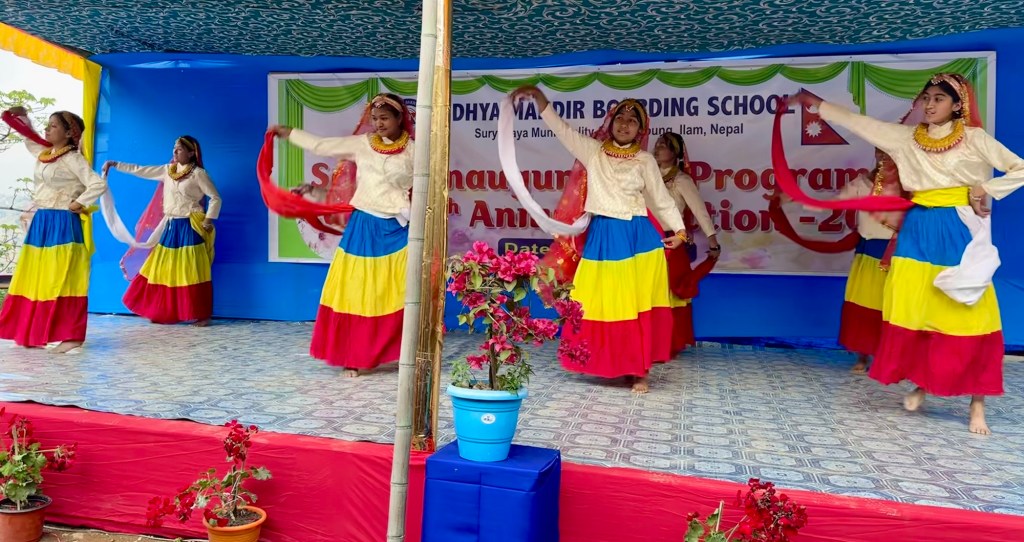
The local community dedicated it on April 30 in a colorful ceremony filled with dances, songs, speeches and food. We traveled there to join the celebration.

The school is more beautiful than we’d dared to dream and the community couldn’t be happier. 

The Vidhya Mandir Boarding School in the eastern village of Samalbung has 126 students, many from indigenous and marginalized groups. School fees are low and some students receive full or partial scholarships. 

The attractive two-story structure, with a lovely view of the Himalayas, is a huge improvement over the previous school, which was in terrible condition. The students now have a much brighter future. 

The two of us have spent the past year working with a team at the school to design and construct the new building. We also raised funds for the project through a GoFundMe site and direct contributions. 

We were overwhelmed by the response from family, friends, Not Exactly Retired readers, Returned Peace Corps Volunteers, Friends of Nepal and others. 

Their generous contributions totaled more than $24,000, which covered a significant share of the costs. The two of us funded most of the budget. The school community prepared the site, donated money, contributed labor and supported the school in other ways, from providing wood from their trees to feeding the workers.

I’ve posted some photos here and produced a short video so you can see the new school and celebration for yourself. You can watch the video above or on YouTube.

We are grateful to everyone who opened their hearts (and wallets) to assist these young people. We extend special thanks to Santosh Khapung, Bindu Suwal, Shankar Limbu, and Pooja and Sabin Shrestha for all of their help to us during this project. 

Thank you — and enjoy the video