Tag Archives: research

Amazing but False

Whether it’s voting results, vaccines or space lasers, many Americans cling to dramatic stories long after they’re shown to be nonsense.

As I saw during our recent trip to Portugal, Americans are not alone. People everywhere prefer a good story to a factual one.

Two of our guides there told us the same amazing, but false, story. When I questioned them about it, one guide avoided the conversation and the other told me I was ruining his narration. They undoubtedly found me annoying even though I was right.

The story involved Portugal’s high rate of divorce. Daniel, our guide in the university town of Coimbra, shown above, said 94 percent of married couples got divorced during the Covid pandemic. Wait a minute, I thought to myself, 23 or 24 of every 25 married couples got divorced? That couldn’t possibly be true, no matter how stressed out people were from Covid.

“Are you sure that’s right?” I asked Daniel quietly.

“Oh, yes,” he responded confidently. “I saw it on television. Portugal has a really high divorce rate. It’s a big problem for us.”

I’m sure it is, but 94 percent? My BS Detector, which I cultivated during my career as a science writer, began blaring in my head.

I lagged behind the group, pulled out my phone and checked the facts. Portugal’s 94% “divorce rate” was an actual statistic but not what Daniel and our subsequent guide in the Douro Valley wine region said it meant, namely that 94 percent of couples got divorced.

Instead, it was a comparison of the total number of divorces to the total number of marriages in a given year. During the pandemic, divorces rose while marriages declined, so the ratio climbed to 94 percent. The odds that a specific couple would divorce, however, remained much lower.

Sure enough, after the pandemic ended, Portugal’s divorce-marriage ratio decreased dramatically to normal levels.

As we continued walking, I whispered to Daniel that I had uncovered the discrepancy and could explain it to him after the tour ended. He gave me a tight smile and, as soon as everyone dispersed, he left.

Our Douro Valley guide, Carlos, couldn’t escape since we were in a car together. After he told the same story, he had no choice but to listen to my brief explanation of what “94 percent” actually measured. Carlos laughed that he still preferred his version even though it wasn’t true.

I knew I was coming across as a know-it-all American retiree.  But having spent much of my career assessing scientific claims before agreeing to write about them, I’ve developed a sixth sense about statistics being misused. I’ve written or edited countless articles about research findings and consider accuracy more essential than popularity, even when my wife reminds me we’re on vacation.

This all happened two weeks ago but I’ve kept wondering about it, even though it’s hard to imagine anything that affects my own life less than Portugal’s divorce rate.

Am I just being a mansplaining jerk? Or did this episode highlight something deeper about human behavior that informs the situation we face here in America? As I’ve tuned in again to our angry political controversies and “fake news” accusations, with politicians peddling scary anecdotes that misrepresent larger realities, much of it sounds to me like the Portugal divorce story — catchy, unnerving but wrong.

I’m not sure what to think. For now I’m assessing my own uncertainty level at 94 percent. I’m also keeping my BS Detector turned on. 

Unknown Researchers

Growing numbers of professors across the United States now use social media to highlight their research, share their ideas, expand their connections and attract new funding.

Not so in this corner of Eastern Europe. Facebook is widespread in Moldova but Twitter is not. Instagram is still catching on. Many Moldovans prefer Russian-language social networks such as Odnoklassniki or Vkontakte. And, of course, faculty members who hope to catch the attention of English-speaking journalists may have difficulty communicating with them.

IMG_3403

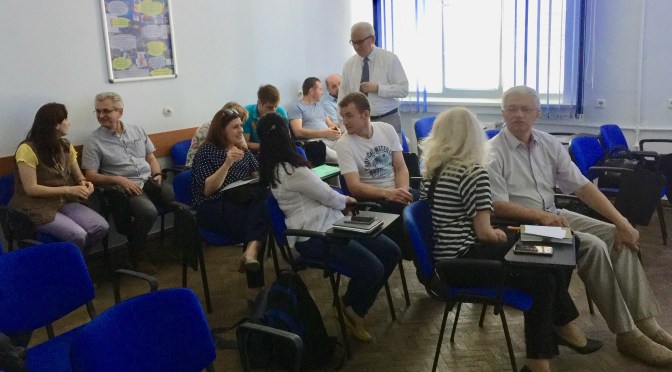
The deeper challenge, though, as I discovered when leading a workshop at Moldova State University on Friday, is that researchers in this post-Soviet state have no training or infrastructure to help them explain their work to the public, whether on social media, through journalists or otherwise. IMG_3407Moldova State University, the country’s flagship academic institution, doesn’t even have a news office, much less a system for promoting faculty research.

As someone who worked with researchers for several decades in the United States before coming to Moldova two years ago to serve as a Peace Corps Volunteer, I was humbled by the immense challenges academics face here. The ones I met are working on renewable energy options, decision-making models, biomedical systems and more, but they are essentially on their own in sharing their work with their fellow Moldovans, much less the outside world. 

Screen Shot 2018-05-26 at 1.57.25 PM

By contrast, the news office I led previously at Duke University (above) now has three research communicators as well as videographers, photographers, social media experts and others available to assist with stories. Additional research communicators focus on medicine, engineering, environment and other topics at Duke’s various schools. The same is true at other top U.S. research universities, as well as at other campuses, national labs, corporations and others involved in research. The National Association of Science Writers has nearly 2,000 members, with active regional groups, and there are U.S. groups for professional communicators in medicine, health care, environment, education and other fields.

Here in Moldova, there’s close to nothing.

Screen Shot 2018-05-26 at 1.30.01 PM

The main reason, of course, is money, or rather the lack of it. Prior to the workshop, I reached out to Florentin Paladi, a physicist and impressive guy (in the blue shirt in the photo above) who oversees research at the university and, earlier in his career, spent time at the University of Michigan and institutions in London, Italy and Japan. He described a budget so tight that most professors earn less than a U.S. teenager working at McDonald’s, with no resources left for news offices and other functions we take for granted back home.

Screen Shot 2018-05-27 at 9.19.53 AM

Screen Shot 2018-05-27 at 9.21.02 AM

That’s why I encouraged the professors to use social media, since they can do it themselves for free. I showed them how researchers do this in the West, drawing on some excellent slides shared by my former Duke colleague, Karl Bates. I also showed a few budding social media examples from this part of the world, a few of which I’ve included here. I needed to move quickly, though, since I had to leave time for everyone to practice explaining their work simply to each other and, later, to the group. Just like back home, this led to laughter and applause as these highly trained experts struggled to speak without jargon, whether in Romanian or English. (The workshop was supposed to be in English but I ended up teaching much of it in Romanian.)

DSC_0030

A few weeks earlier, at the invitation of Vladimir Snurenco, I taught workshops at the American Language Center (above), on news writing and opinion writing. The students at these sessions were not academics but I encountered similar cultural differences. For instance, many media outlets here are controlled by oligarchs or foreign governments and even routine local news stories may be colored with political commentary. “Pay to play” is common. There are few op-ed pages.

I’ll be returning home in a few weeks and am already bracing myself for the first time I hear someone complain we don’t do enough in the United States and other developed countries to highlight research, which is often supported with public funds and is essential to our collective health, security and prosperity. I agree with them but, even so, I now know some experts who could give them a second opinion.

Subscribe to Not Exactly Retired.