

This memorial honoring local heroes who died fighting for the Soviet Union in World War II is the first thing I see when I open my host family’s gate every morning.
The memorial’s base shows the names of the fallen. There are several men named Sava and several others named Tonu. I now live with a family named Sava and previously lived with the Tonus. For their extended families, as for people across Moldova and the rest of the former Soviet Union, the war brought unimaginable suffering.
 When most Americans think of World War II, they think of Normandy, Iwo Jima and other battles where our soldiers died. My own father fought at D-Day, navigating a plane that was shot and almost didn’t return to England. He was part of the “greatest generation” whose enormous sacrifices kept our country free.
The war’s impact on our own history was huge. Yet many Americans don’t know that the Soviet Union suffered more than 50 times as many deaths as we did, according to some estimates. It’s hardly a surprise, therefore, that the war’s legacy here is profound, even after Moldova broke away from the Soviet Union in 1991 to become an independent country.
My current village, Bardar, is hardly alone in having a prominent me morial. They are everywhere in Moldova. The second photo shows one in Dereneu, a small village we visited a few weeks ago. In Chisnau, Moldova’s capital, one of the main tourist sites is the Victory Memorial and eternal flame, five giant marble pillars representing the five years of Moldovan involvement in the conflict.
In Ialoveni, where Champa and I will soon be living, there is a memorial outside her school honoring a local soldier who died in Afghanistan. Across the street is the town’s World War II memorial, imposing with its dark stone, shown in the photo below.
Adjacent to that memorial, though, are two smaller memorials in white stone. They are topped with crosses, which tells you they were built after the Soviet era. These newer memorials honor the Moldovan victims of Soviet repression under Joseph Stalin. Large numbers of intellectuals, political opponents and ordinary people were exiled to Siberia and elsewhere.
I knew almost nothing about this history before coming here, but Moldovans have been eager to share their stories with me. I avoid local politics since I am a Peace Corps volunteer. Still, the history of this country, so unknown to Americans, is proving fascinating.


When I open my gate every morning I know I am just beginning to learn what it all means. So far, the impression is monumental.


 Peace Corps brought all of us all together in Chisinau, Moldova’s capital, to align our plans and expectations over the next two years. After reviewing the history of the Peace Corps and its activities in Moldova, the conference leaders reminded our partners that we are volunteers with a special role: We’ve come to share our skills and perspective, empowering our colleagues and others to blaze their own paths after we leave.
 These ideals were fundamental to the Peace Corps when I served four decades ago, and they remain so today. My service in Moldova differs in so many ways from what I experienced in Nepal, from the local food to the speed of communications, but the mission is unchanged, still reflecting the original vision of President Kennedy.
 The other trainees in my “community and organizational development” group came to the conference with their partners from across Moldova — mayors, village librarians, NGO leaders and others. Each pair worked together to clarify how the volunteer will learn about his or her post, develop a work schedule and deal with inevitable disappointments.
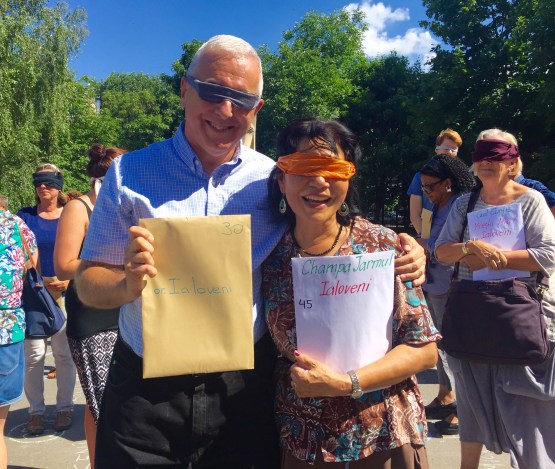
 The name on the envelopes for Champa and me was Ialoveni (pronounced Yah-lo-ven). It’s a big town close to Chisinau, not far from our training sites. After Champa and I finish our training and swear in on July 29, it’s where we’ll be living.
 At my group’s tech class on Tuesday, we discussed how Moldovans and Americans differ. One of the charts we filled out, shown in the photo, compared each culture’s tolerance for risk. The green tags represent Moldovans; the red tags represent Americans. As you can see, our group saw Americans as being more willing to take chances in life.

 Why has the Peace Corps sent me and others to Moldova, a small country in eastern Europe that many Americans have never heard of?

 I’m looking forward to the challenge. I was impressed by Ekaterina, Petru and Elena, and by the young people I met at the library. I’m hoping to find similar people wherever we’re sent, and am eager to work with them to tackle local problems.
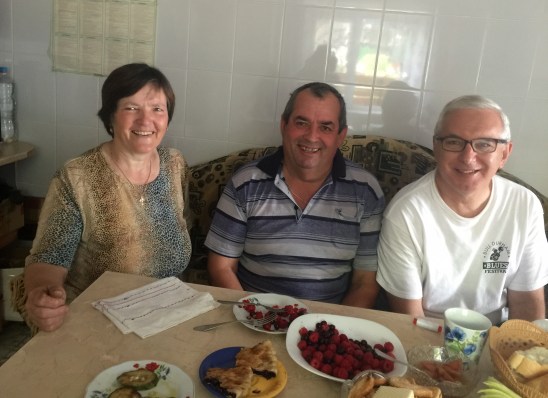
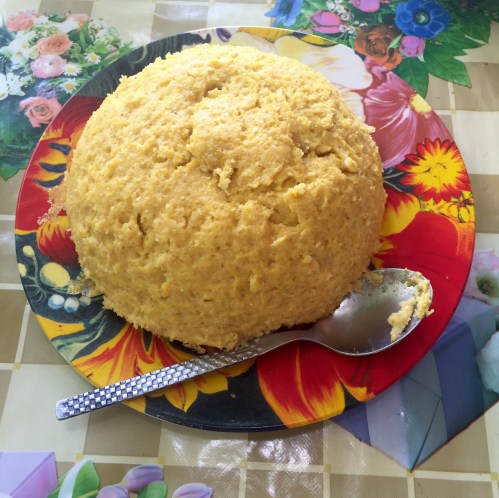 Not here in Moldova. My host mother, Maria, shown here with her husband Vladimir, is an amazing cook, so I’m going to feature her in occasional posts about Moldovan cuisine. On Sunday, while Champa was visiting, she served us mamaliga, which is a denser version of American cornbread.
 In this brief video, she demonstrates the traditional method of slicing mamaliga with a string. You can hear Champa in the background admiring her technique. (You’ll find a recipe for mamaliga and other Moldovan foods at this
 My current day-to-day reality is this: I go to language class all morning. I have tech training in the afternoon. I talk with Champa on the phone. I eat and try to communicate with my host family. I cram vocabulary lists and verb conjugations whenever I can. Then I go to sleep. The photos show what we did on Wednesday.
 So I should have known what to expect emotionally when I heard the terrible news about Orlando, followed by the controversy over Donald Trump’s response and everything else that has happened in the past few days. But familiarity is not a vaccination. It’s still been strange to watch all of this from a distance, discussing it with the other trainees when we get a moment between language classes. Soon enough, we’re back to memorizing the Romanian words for fruits and vegetables, or how to conjugate the feminine plural form of an adjective.

 Like me, Champa has a nice living situation. Her house has a modern kitchen and bathroom, wifi and a dining room, as well as her own bedroom. Maria is very friendly and even speaks some English. Champa does have a long uphill walk to the school where she has her language classes and technical training, but she says it reminds her of walking in Nepal.


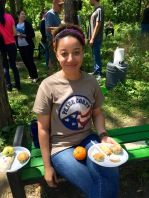 Here are Chelsea, left, and Rose, right, making their own fashion statements in support of peace and the Peace Corps.
 Champa and I have been training in different villages, so we enjoyed being together. We both have made lots of new friends, though, so we also spent time catching up with them. Here’s Champa with Reggie, a member of my language group and a fellow North Carolinian.


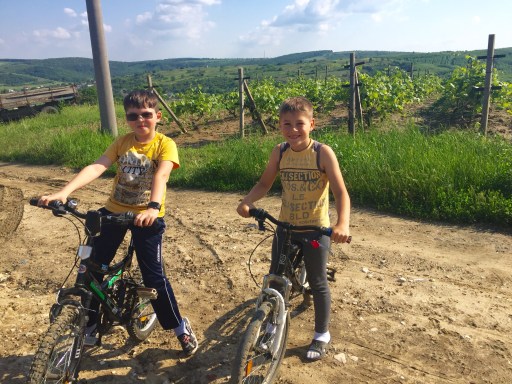
 Along the way they taught me the Romanian words for tree, dog and other things, like this village well adorned with religious figures.
 Here’s one of our teachers offering advice about how to interact with our host families. Moldova is still very new to us but, so far, we love it.
 My new home is just beyond the outskirts of Chisinau. Since Moldova is only the size of Maryland, Champa’s village isn’t far away. With local Sim cards in our iPhones, we can call each other easily. Here’s the home I’m sharing with the two boys and the rest of their family. I have my own bedroom, a good Internet connection and a house full of friendly teachers, some of whom don’t even ride bicycles.
 "Not Exactly Retired"