
Before I joined the Peace Corps I wouldn’t have thought twice about eating a bowl of cereal, waving goodbye to my wife and walking to work. On Friday morning, all three things made me happy.

I had corn flakes for breakfast with a cup of coffee and a banana, as I sometimes ate back home. Here in Moldova, though, for the past two months my wonderful host families served me breakfasts of kasha, sausages, eggs, chicken cutlets, spaghetti or hot cereal. I enjoyed the food but yearned for cold cereal and a cup of coffee. On Friday, that’s what I had.
A day earlier, Champa and I moved to Ialoveni, the town near Moldova’s capital where we expect to serve as volunteers for the next two years. We’re staying with a local family but are cooking for ourselves. The corn flakes were included in the first three bags of groceries we bought for $16 at a nearby market.

After breakfast, I waved goodbye to Champa, who stayed home to finish our unpacking. Once again, that was unremarkable, except that she and I are now together again after being separated through most of our training. We knew in advance we would live in different villages during training, since we work in different programs. We made the best of the situation but, after 36 years of marriage, we really missed each other.
Similarly, it doesn’t sound like a big deal for someone who has worked for four decades to get up and go to work. Yet it’s been more than a year since I left my job in North Carolina to pursue a new life of adventure and service with Champa. Friday morning was my first “go to work” day since then. Peace Corps has assigned me to assist Ialoveni’s county government with development projects and to help the local community in other ways. This time around, I’m not wearing a suit. I don’t have a staff. But it’s important work and I’m excited to get started.
In these and so many other ways, being “not exactly retired” has helped me to see my previous life with new eyes. On Friday morning alone, I savored things as unremarkable as a bowl of cereal, the shower I took before breakfast and the cool morning that followed a long hot spell without air conditioning.
Such simple pleasures were there in front of me when I lived in America. It’s only after I came halfway around the world that I noticed them again. I’d feel foolish if I weren’t so grateful for the nudge.


 To be sure, Nepali was harder for me at the outset. Its sentence structures seemed so bizarre that I walked out of my first language class, ready to quit in despair. Within a few days, though, I got the hang of it. By the end of our training, I was able to have a simple conversation. Today I still speak it easily, if imperfectly.
 Fortunately, I had an incredible teacher, Diana, who was skillful and tireless in helping my classmates and me learn everything. That’s her in the flower dress with us. With Diana’s help, I ended up with a good score on the exam they administered before we swore in as volunteers last week. She kept telling me I was doing fine, and I guess she was right.

 It’s time for another edition of Maria’s Kitchen!
 This recipe is simple and delicious, with a taste more sweetly tart than sour. Here are the steps:
 Roll up each triangle from the long side towards the opposite point. Place them on a metal tray and bake for 30-40 minutes at medium heat.
 Remove the pastries from the oven and let them cool. Then roll them in powdered sugar.
 You can search on this blog to find some of Maria’s other specialties. If you’re interested in learning more about Moldovan cuisine, check out this

 Worldwide, Americans over age 50 comprise about 7 percent of the nearly 7,000 Peace Corps volunteers now serving in 63 countries around the world. With its better medical facilities and programs in fields such as business development that attract people with lots of real-world experience, Moldova attracts higher numbers.
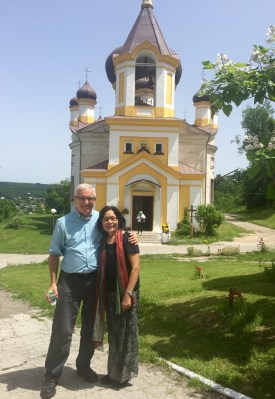 We differ from our younger counterparts in some ways. Learning a new language may be tougher for us, although many of us are doing fine in our Romanian classes. We may run slower in a group soccer game, if we participate at all. When several younger friends went to get tattoos recently, they knew better than to invite me along. They also may party harder and make surprising cultural references. When I was in the Peace Corps office the other day, a Carole King song started playing and the young woman next to me said, “Hey, it’s that song from the Gilmore Girls!”

 When most Americans think of World War II, they think of Normandy, Iwo Jima and other battles where our soldiers died. My own father fought at D-Day, navigating a plane that was shot and almost didn’t return to England. He was part of the “greatest generation” whose enormous sacrifices kept our country free.
 morial. They are everywhere in Moldova. The second photo shows one in Dereneu, a small village we visited a few weeks ago. In Chisnau, Moldova’s capital, one of the main tourist sites is the Victory Memorial and eternal flame, five giant marble pillars representing the five years of Moldovan involvement in the conflict.


 Peace Corps brought all of us all together in Chisinau, Moldova’s capital, to align our plans and expectations over the next two years. After reviewing the history of the Peace Corps and its activities in Moldova, the conference leaders reminded our partners that we are volunteers with a special role: We’ve come to share our skills and perspective, empowering our colleagues and others to blaze their own paths after we leave.
 These ideals were fundamental to the Peace Corps when I served four decades ago, and they remain so today. My service in Moldova differs in so many ways from what I experienced in Nepal, from the local food to the speed of communications, but the mission is unchanged, still reflecting the original vision of President Kennedy.
 The other trainees in my “community and organizational development” group came to the conference with their partners from across Moldova — mayors, village librarians, NGO leaders and others. Each pair worked together to clarify how the volunteer will learn about his or her post, develop a work schedule and deal with inevitable disappointments.
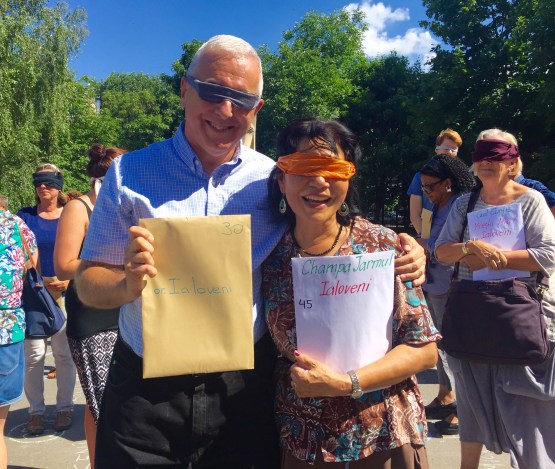
 The name on the envelopes for Champa and me was Ialoveni (pronounced Yah-lo-ven). It’s a big town close to Chisinau, not far from our training sites. After Champa and I finish our training and swear in on July 29, it’s where we’ll be living.
 At my group’s tech class on Tuesday, we discussed how Moldovans and Americans differ. One of the charts we filled out, shown in the photo, compared each culture’s tolerance for risk. The green tags represent Moldovans; the red tags represent Americans. As you can see, our group saw Americans as being more willing to take chances in life.

 Why has the Peace Corps sent me and others to Moldova, a small country in eastern Europe that many Americans have never heard of?

 I’m looking forward to the challenge. I was impressed by Ekaterina, Petru and Elena, and by the young people I met at the library. I’m hoping to find similar people wherever we’re sent, and am eager to work with them to tackle local problems.
 "Not Exactly Retired"